
Hello,
I would like to install a robotic lawn mower in my garden but am quite uncertain about how to proceed!
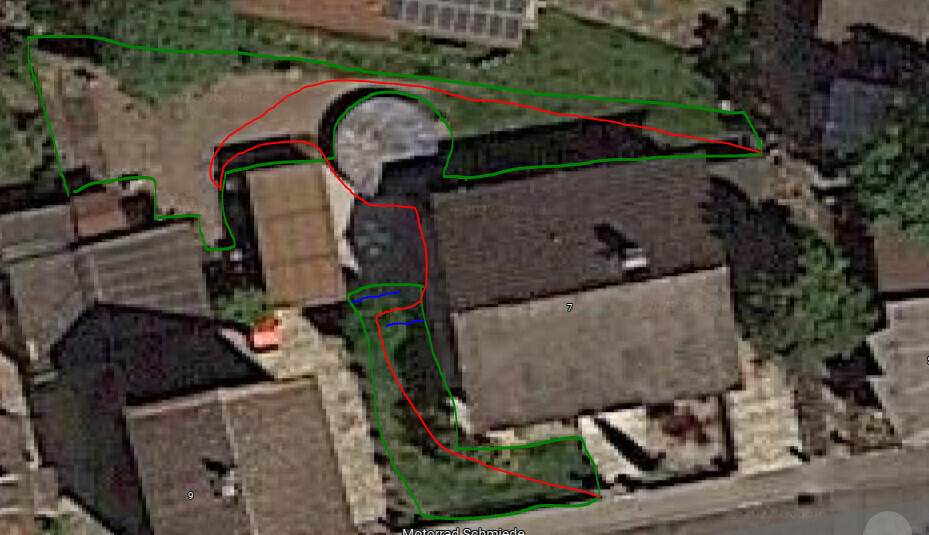
The green outline represents the future lawn area, the red line indicates a possible location for a boundary wire, and the blue area marks a privacy screen that will still be installed.
There is a terrace with chairs and a table between the two areas, so the mower cannot simply pass through there.
Questions:
What is the best way to mow the two separate areas?
Is the position of the charging station (at the end of the red lines) suitable?
Would the robotic mower be able to mow around the privacy screen as well?
My only idea so far is to create two separate mowing zones, manually place the mower on the second area at fixed intervals, and have it return to the charging station using the boundary wire. I would try to lay the wire as far as possible from the terrace chairs, probably in the gaps between the tiles.
The plot has a slight incline to the right, but there are no height differences between the garage, pool, and the lower area.
Thank you in advance.
I would like to install a robotic lawn mower in my garden but am quite uncertain about how to proceed!
The green outline represents the future lawn area, the red line indicates a possible location for a boundary wire, and the blue area marks a privacy screen that will still be installed.
There is a terrace with chairs and a table between the two areas, so the mower cannot simply pass through there.
Questions:
What is the best way to mow the two separate areas?
Is the position of the charging station (at the end of the red lines) suitable?
Would the robotic mower be able to mow around the privacy screen as well?
My only idea so far is to create two separate mowing zones, manually place the mower on the second area at fixed intervals, and have it return to the charging station using the boundary wire. I would try to lay the wire as far as possible from the terrace chairs, probably in the gaps between the tiles.
The plot has a slight incline to the right, but there are no height differences between the garage, pool, and the lower area.
Thank you in advance.

ChrLenz schrieb:
How exactly does the robot cross the boundary wire? Every robot crosses over the wire, turns above it, and then drives back.
With the Gardena model, the body extends about 25cm (10 inches) beyond the wire, so it mows approximately 15cm (6 inches) over the wire.
This value can be adjusted on the mower and varies between manufacturers. That’s why the wire, once installed, can only be used with the same mower. The distance to obstacles, flower beds, and edges is specified by the manufacturer.
Before laying the wire and purchasing the mower, read the user manual online.
Similar topics