
ᐅ New Single-Family Home Construction on a Slope in Baden-Württemberg: Floor Plan, Building Method & Architect – Looking for Opinions
Created on: 22 Dec 2025 01:39
B
beicampi
We are just at the very beginning of the process, but precisely for that reason, I would like to make use of the forum’s expertise right away instead of only asking questions once we possibly already have fixed ideas. I will orient myself along the list of questions from the floor plan section to “introduce” our project. I am interested in your opinions and ideas regarding the general layout and also the basic construction method.
We do not have an architect yet, and I’m not quite sure where to start finding the right one. Also, I’m uncertain whether it’s better to plan independently or to work with an architect employed by a construction company.
The location of the project is in BW. The plot is already owned, and an existing building will be demolished.
Development plan / restrictions
Plot size:
1,250 m² (13,455 sq ft), only 20 meters (66 feet) wide and approximately 60 meters (197 feet) long
The short side is the street frontage on the north side of the plot
Slope: the plot rises about 4 meters (13 feet) from street level in the north towards the south over more than 60 meters (197 feet) in length (I still need to measure this precisely and create an elevation profile)
Floor area ratio 0.4
Site occupancy index 0.4
Building envelope, building line, and boundary
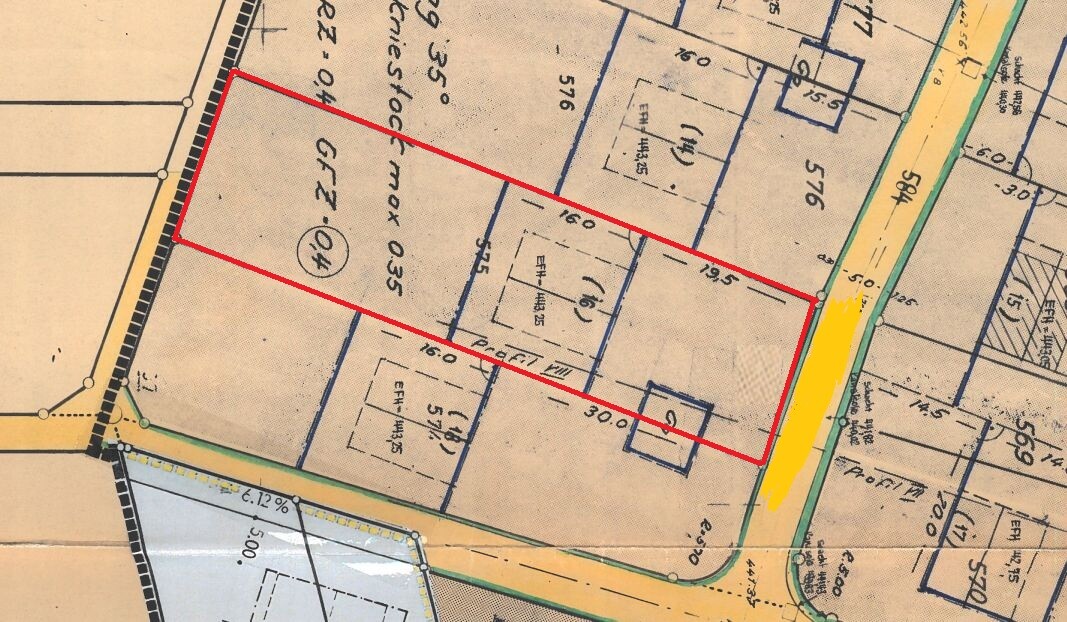
The building envelope starts 20 meters (66 feet) back from the street and extends 16 meters (52 feet) “long/deep.” Officially, it spans the entire width of the plot, although I do not want construction up to the boundary, and this would not seem practical either.
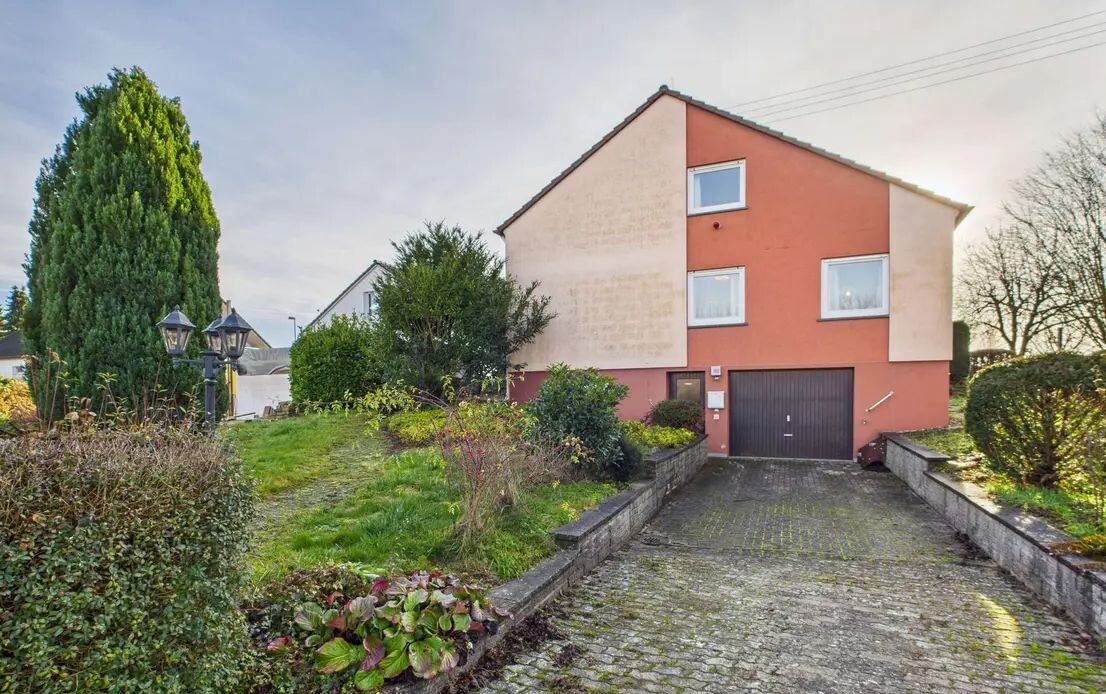
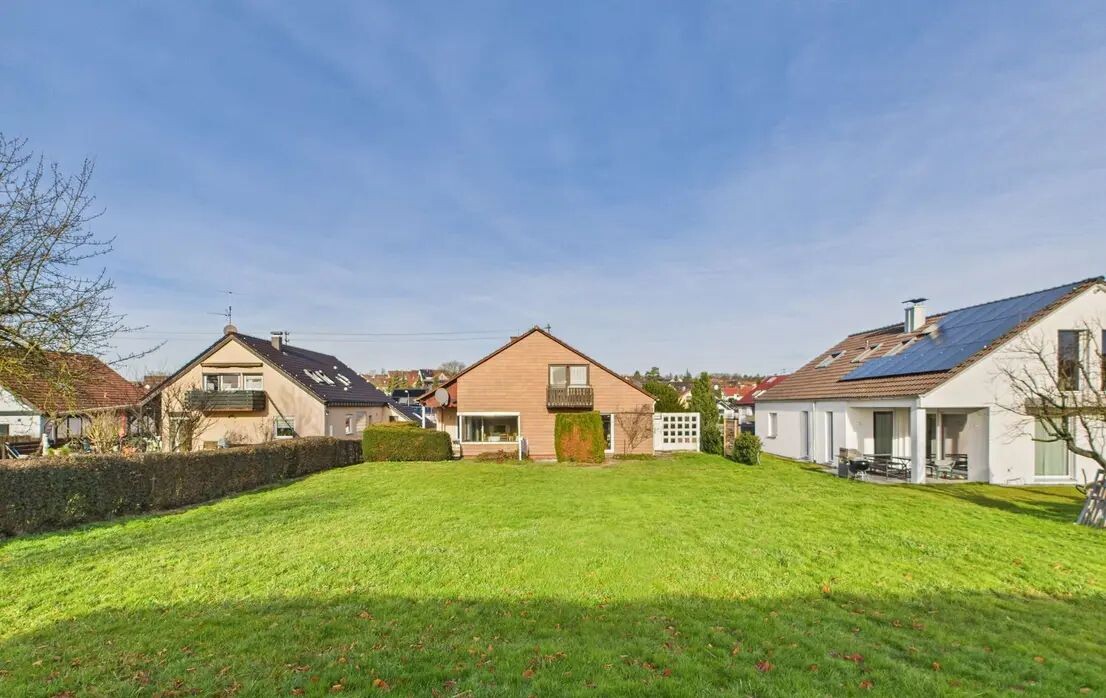
There is an existing building that we plan to demolish to build a new one, including a basement. Due to the slope of the land, the basement is visible from the street side (although currently, even the existing building’s basement is somewhat below street level to allow garage access). Some neighboring buildings have only the “upper half” of their basements visible, see attached picture. On the south side, the ground floor opens directly onto the slightly sloping garden.
Number of parking spaces
We would like 3 parking spaces for cars in garages, plus space for bicycles etc. One or two garage spaces integrated into the building itself would be preferred.
Number of floors
One full story plus basement and attic (somewhat limited by the low knee wall height)
Roof shape
A gable roof with a 35° pitch is required. Ridge direction north-south, knee wall only 35 cm (14 inches) high. Dormers are officially not allowed according to the development plan but have become possible through an amendment (maximum width 4 meters (13 feet)).
Architectural style
A classic single-family home built to today’s standards, with a traditional plaster façade. I do not like very modern houses without roof overhangs. An attractive design is important to me, though I do not have very clear ideas yet.
Orientation: ridge direction north-south
Maximum heights / limits
Only the single-family house type is specified in the development plan, which means most surrounding houses have a small staircase up to the ground floor to make up for the last meter of height. Due to the slight slope, a basement will be practically necessary, which suits me well.
Further specifications
Style, roof shape, building type
I am a big fan of timber construction. Although I am open to solid construction and would consider it as well, I prefer wooden ceilings, the indoor climate, and the general idea of a wooden house. However, this is not set in stone, more of a strong preference. I find solid timber construction especially interesting but without an overuse of wood. Interior walls should be classic white (drywall), but ceilings and floors preferably made of solid wood with some additional wooden accents, such as a window seat. For example, houses made of dowel-laminated timber (e.g., from Kaufmannbau) are interesting to me in this context.
Number of occupants, ages
4 people: parents around 40 years old, children aged 9 and 6.
Space requirements on ground and upper floors
We like spacious rooms and higher ceilings, even in the basement. I would aim for 220+ m² (2,368+ sq ft) and rather one room too many than too few.
The upper floor would be completely for the children’s bedrooms, possibly with an additional guest room. Either one children’s bathroom or each bedroom with a small en-suite.
The ground floor should have the parents’ bedroom, dressing room, parents’ bathroom, kitchen, dining area, living room, and guest toilet.
In the basement, I would like a fitness room. Possibly also a mancave/home cinema (?) or basement bar. A guest room in the basement could be an alternative to the upper floor. An office could be located either in the basement or ground floor.
Office: family use or home office?
Currently no home office use, but possibly in the future. The office should be large enough for a double desk and some filing cabinets.
Guest stays per year: rare but possible.
Open or closed architecture: not extremely open, at least no open atriums or similar.
Conservative or modern construction: I’m not sure how to clearly define this, probably more modern.
Open kitchen, preferably with cooking island.
Number of dining seats: when we have guests, usually many; a large dining table is a must.
Fireplace: nice to have but not essential.
Music / home theater wall: typical setup with TV mounted on the living room wall.
Balcony, roof terrace: not necessary, although a balcony facing the garden (south side) could be nice.
Garage, carport: no carport, only garage(s).
Utility garden, greenhouse: not needed, maybe a raised bed.
Other wishes / special features / daily routine, also reasons why you want or don’t want something
I would like to build so that living on one level, suitable for aging in place, is possible in the future. In an extreme case, a shaft for a lift might be prepared?
House design
Who made the plan: none yet / existing building as reference.
What do you like most? Why? Based on the current building: the basement garage with house access is something I find very good.
What do you dislike? Why? The current ground floor entrance is outside via stairs, which I don’t like long-term (not suitable for aging in place, in my view). Perhaps ground reshaping would be possible to allow entrance level with the house despite the slope.
Estimated price according to architect/planner: N/A
Personal price expectation for the house: without land, €1.2 million (approx. 1.2 M€) would be my target, but not a strict limit.
Preferred heating technology: ground-source heat pump with active cooling and dew point monitoring; alternatively ground-source heat pump plus split air conditioning units (which are less attractive visually).
All without significant self-build, I am not capable and do not have time for that. I would like to have as turnkey a construction as possible.
If you had to give up something, which details/extra features could you omit?
- Could do without a dedicated guest room; it could also be used as a mancave or something similar.
- Garage integrated into the building would be nice but might be omitted. This would reduce the visible basement from the street side, possibly making the house more attractive overall.
What is non-negotiable:
- Active climate control
Specific questions:
We do not have an architect yet, and I’m not quite sure where to start finding the right one. Also, I’m uncertain whether it’s better to plan independently or to work with an architect employed by a construction company.
The location of the project is in BW. The plot is already owned, and an existing building will be demolished.
Development plan / restrictions
Plot size:
1,250 m² (13,455 sq ft), only 20 meters (66 feet) wide and approximately 60 meters (197 feet) long
The short side is the street frontage on the north side of the plot
Slope: the plot rises about 4 meters (13 feet) from street level in the north towards the south over more than 60 meters (197 feet) in length (I still need to measure this precisely and create an elevation profile)
Floor area ratio 0.4
Site occupancy index 0.4
Building envelope, building line, and boundary
The building envelope starts 20 meters (66 feet) back from the street and extends 16 meters (52 feet) “long/deep.” Officially, it spans the entire width of the plot, although I do not want construction up to the boundary, and this would not seem practical either.
There is an existing building that we plan to demolish to build a new one, including a basement. Due to the slope of the land, the basement is visible from the street side (although currently, even the existing building’s basement is somewhat below street level to allow garage access). Some neighboring buildings have only the “upper half” of their basements visible, see attached picture. On the south side, the ground floor opens directly onto the slightly sloping garden.
Number of parking spaces
We would like 3 parking spaces for cars in garages, plus space for bicycles etc. One or two garage spaces integrated into the building itself would be preferred.
Number of floors
One full story plus basement and attic (somewhat limited by the low knee wall height)
Roof shape
A gable roof with a 35° pitch is required. Ridge direction north-south, knee wall only 35 cm (14 inches) high. Dormers are officially not allowed according to the development plan but have become possible through an amendment (maximum width 4 meters (13 feet)).
Architectural style
A classic single-family home built to today’s standards, with a traditional plaster façade. I do not like very modern houses without roof overhangs. An attractive design is important to me, though I do not have very clear ideas yet.
Orientation: ridge direction north-south
Maximum heights / limits
Only the single-family house type is specified in the development plan, which means most surrounding houses have a small staircase up to the ground floor to make up for the last meter of height. Due to the slight slope, a basement will be practically necessary, which suits me well.
Further specifications
Style, roof shape, building type
I am a big fan of timber construction. Although I am open to solid construction and would consider it as well, I prefer wooden ceilings, the indoor climate, and the general idea of a wooden house. However, this is not set in stone, more of a strong preference. I find solid timber construction especially interesting but without an overuse of wood. Interior walls should be classic white (drywall), but ceilings and floors preferably made of solid wood with some additional wooden accents, such as a window seat. For example, houses made of dowel-laminated timber (e.g., from Kaufmannbau) are interesting to me in this context.
Number of occupants, ages
4 people: parents around 40 years old, children aged 9 and 6.
Space requirements on ground and upper floors
We like spacious rooms and higher ceilings, even in the basement. I would aim for 220+ m² (2,368+ sq ft) and rather one room too many than too few.
The upper floor would be completely for the children’s bedrooms, possibly with an additional guest room. Either one children’s bathroom or each bedroom with a small en-suite.
The ground floor should have the parents’ bedroom, dressing room, parents’ bathroom, kitchen, dining area, living room, and guest toilet.
In the basement, I would like a fitness room. Possibly also a mancave/home cinema (?) or basement bar. A guest room in the basement could be an alternative to the upper floor. An office could be located either in the basement or ground floor.
Office: family use or home office?
Currently no home office use, but possibly in the future. The office should be large enough for a double desk and some filing cabinets.
Guest stays per year: rare but possible.
Open or closed architecture: not extremely open, at least no open atriums or similar.
Conservative or modern construction: I’m not sure how to clearly define this, probably more modern.
Open kitchen, preferably with cooking island.
Number of dining seats: when we have guests, usually many; a large dining table is a must.
Fireplace: nice to have but not essential.
Music / home theater wall: typical setup with TV mounted on the living room wall.
Balcony, roof terrace: not necessary, although a balcony facing the garden (south side) could be nice.
Garage, carport: no carport, only garage(s).
Utility garden, greenhouse: not needed, maybe a raised bed.
Other wishes / special features / daily routine, also reasons why you want or don’t want something
I would like to build so that living on one level, suitable for aging in place, is possible in the future. In an extreme case, a shaft for a lift might be prepared?
House design
Who made the plan: none yet / existing building as reference.
What do you like most? Why? Based on the current building: the basement garage with house access is something I find very good.
What do you dislike? Why? The current ground floor entrance is outside via stairs, which I don’t like long-term (not suitable for aging in place, in my view). Perhaps ground reshaping would be possible to allow entrance level with the house despite the slope.
Estimated price according to architect/planner: N/A
Personal price expectation for the house: without land, €1.2 million (approx. 1.2 M€) would be my target, but not a strict limit.
Preferred heating technology: ground-source heat pump with active cooling and dew point monitoring; alternatively ground-source heat pump plus split air conditioning units (which are less attractive visually).
All without significant self-build, I am not capable and do not have time for that. I would like to have as turnkey a construction as possible.
If you had to give up something, which details/extra features could you omit?
- Could do without a dedicated guest room; it could also be used as a mancave or something similar.
- Garage integrated into the building would be nice but might be omitted. This would reduce the visible basement from the street side, possibly making the house more attractive overall.
What is non-negotiable:
- Active climate control
Specific questions:
- Should the demolition of the existing building be delayed and coordinated with construction, or should it be done beforehand? In the latter case, the site would need securing.
- Ideas for floor plans, possibly based on existing prefabricated house plans.
- Free planning vs. planning by a construction company offering turnkey building.
- Solid timber house: alternatives to dowel-laminated timber, supplier selection, possibly recommendations? Turnkey delivery is key for me.
- Solid construction vs. timber construction: what ultimately should reasonably determine the choice?
beicampi schrieb:
There is already a garage on the property that lies outside the building zone.I see a simple building zone, specifically designated for garages in the front area.ypg schrieb:
I see a simple building plot, designated specifically for garages in the front area.Correct, but the existing single garage is located exactly on the other side (west), so not within the designated building plot. The same applies to the neighboring property, mirrored. And the eastern neighbor is currently building a new garage outside the building plot, directly attached to their house.
I have now seriously started looking for architects, and admittedly, I'm finding it somewhat challenging. Surprisingly many independent architects in our rural area don’t even have a basic website or any online presence showing at least a few examples of their work. I would like to stay within a radius of 25 meters (15.5 miles) around the construction site. Most likely, the only option in the end will be to call up addresses, have initial meetings, and ask to see examples of their projects.
Can you give me tips on how to efficiently find out whether an architect is a good fit beyond just relying on recommendations from 11ants and general likeability? Is it common to agree on a fixed price for commissioning phases 1 and 2? The basis for calculating fees according to HOAI is probably still very unclear at that point.
Can you give me tips on how to efficiently find out whether an architect is a good fit beyond just relying on recommendations from 11ants and general likeability? Is it common to agree on a fixed price for commissioning phases 1 and 2? The basis for calculating fees according to HOAI is probably still very unclear at that point.

The additional cost of a "clean plate"—that is, clearing the foundation or even the ground beneath it solely due to the limited ceiling height of the existing building—starts at a six-figure amount beginning with at least a "2," not to mention the ecological impact. An architect’s role here is to appropriately and objectively assess the alternative of renovation instead of demolition. As I mentioned in posts #7/8, the absence of a website can even be an indication of an architect suitable for this project. I consider this assessment part of the scope of services I call "Module A," a demanding version of design phase 1. The fee can be adjusted via a performance improvement agreement, so as a preliminary “basis for calculation” (I would not strictly apply HOAI here but only use it as a guideline), a sum derived from the existing building’s living area multiplied by a factor of 3,000 is reasonable. No, the approach I suggest is not exactly “standard”: architects more commonly offer termination options after each completed design phase through a standard contract. This is an effective way to filter out unsuitable candidates: typical standard contracts cover either phases 1 to 9 (overcharging—phase 9’s fee on a single-family home mainly fills the Porsche fund) or phases 1 to 4 (design artists or unique architects without construction experience whose cost estimates frequently miss the mark). A reasonable standard contract scope is therefore phases 1 to 8 (which doesn’t stop me from proposing the modular concept—for which a cold call is not recommended due to the need for detailed explanation). If you jump in too directly, unanswered messages are likely. If renovation is chosen, the entire “Module B” must be handled very differently than in a new build. In an existing building, you can only determine earlier on whether the selected architect is the right fit. The choice of construction method is not required here—except for two exceptions: partial demolition down to the top of the basement ceiling or adding an additional story.
https://www.instagram.com/11antgmxde/
https://www.linkedin.com/company/bauen-jetzt/
https://www.instagram.com/11antgmxde/
https://www.linkedin.com/company/bauen-jetzt/
beicampi schrieb:
or any other presence with at least a few pictures of their work.P.S.: Architect references should generally only be discussed during the initial consultation, and even then, they should not be limited to simple before-and-after pictures like those in makeover magazines for women or home decor. One should also consider the comparison between estimated and invoiced costs, which for data protection reasons cannot be publicly displayed. (Image) references on the website (whether on the web, Facebook/Instagram, or similar) are a sign of architects who receive their honeymoon vacation paid for by facade cladding manufacturers, as @Gerddieter warns.https://www.instagram.com/11antgmxde/
https://www.linkedin.com/company/bauen-jetzt/
11ant schrieb:
The additional cost of a "clean plate"—meaning clearing the foundation or even the underlying soil solely due to the limited ceiling height of the existing building—is in the six-figure range, starting with at least a "2," not to mention the environmental impact. So the estimate is that demolishing the existing building costs over 200,000 euros? How does that fit with the fact that demolishing and rebuilding existing buildings is quite common? I would have calculated about 60,000 euros for demolition plus 20-30% contingency.
Or is the additional cost referring to the sum of demolition and rebuilding the new basement? Then I could understand the figure exceeding 200,000 euros.
Similar topics