
Hi,
We were almost finished with our planning, but now, thanks to a fortunate development, we can build higher than previously expected.
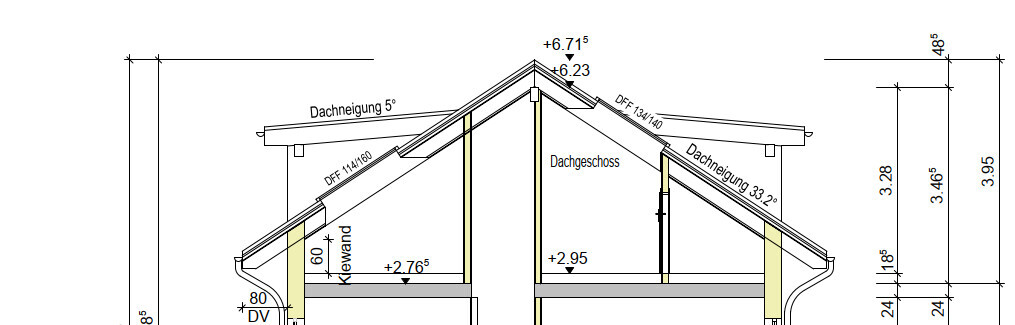
For our attic space, the question is whether to choose a knee wall with an interior clear height of 60 cm (24 inches) featuring large dormers (covering half the facade) and a roof pitch of about 35°, as originally planned, or to raise the knee wall to 160 cm (63 inches) with a roof angle of 24° without dormers.
Since the eaves line must remain continuous, dormers cannot be implemented with the higher knee wall.
Due to area limitations for living and ancillary space, we have to construct the attic rooms accordingly.
Our builder cannot install strip windows in the 160 cm knee wall option.
Because of the continuous eaves, in the dormer version the knee wall must be lowered to 60 cm (24 inches) to fit large windows with a sill height of 1 m (39 inches).
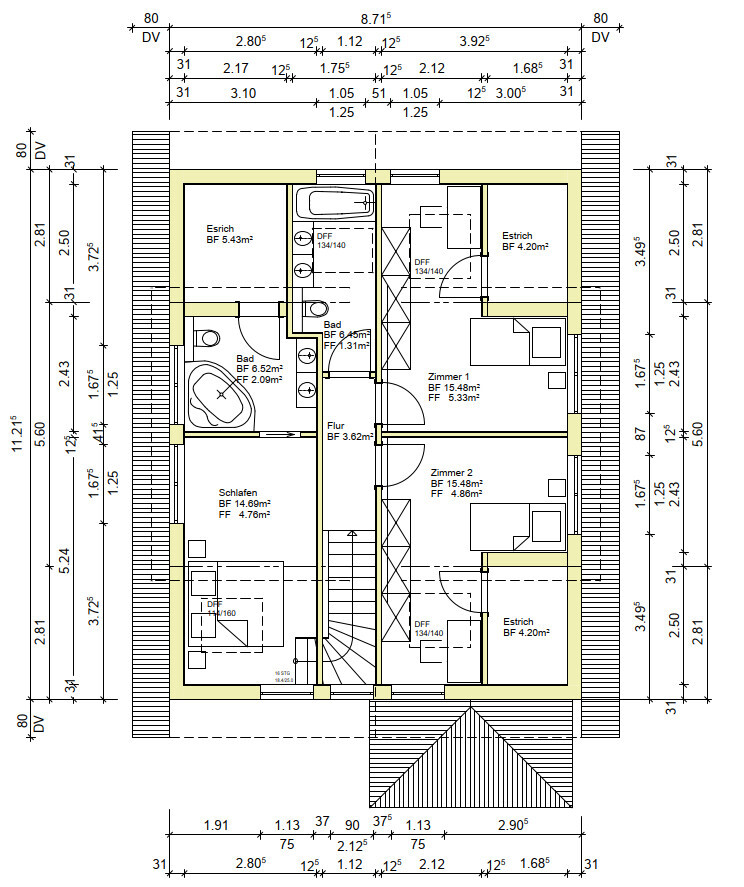
On the children's room side, there is a nice view to the southeast, which speaks in favor of the dormer option.
In the master bedroom, the higher knee wall would provide more headroom above the bed. We would not position the bed as shown in the attached floor plan, but against the walls by the hallway and the end wall.
Additionally, the attic storage spaces would be more accessible with standing height on the ridge side. If it becomes legally possible to convert these storage areas into rooms in the future, the higher knee wall would make them much more usable.
What do you think?
Note: In the attached section, the dormer version has a slightly lower ridge height (the latest status before the new information). We can raise up to a clear height of 3.40 m (11 ft 2 in) under the ridge. So, either knee wall 60 cm (24 inches) with roof pitch 35°, or knee wall 160 cm (63 inches) with roof pitch 24°.
We were almost finished with our planning, but now, thanks to a fortunate development, we can build higher than previously expected.
For our attic space, the question is whether to choose a knee wall with an interior clear height of 60 cm (24 inches) featuring large dormers (covering half the facade) and a roof pitch of about 35°, as originally planned, or to raise the knee wall to 160 cm (63 inches) with a roof angle of 24° without dormers.
Since the eaves line must remain continuous, dormers cannot be implemented with the higher knee wall.
Due to area limitations for living and ancillary space, we have to construct the attic rooms accordingly.
Our builder cannot install strip windows in the 160 cm knee wall option.
Because of the continuous eaves, in the dormer version the knee wall must be lowered to 60 cm (24 inches) to fit large windows with a sill height of 1 m (39 inches).
On the children's room side, there is a nice view to the southeast, which speaks in favor of the dormer option.
In the master bedroom, the higher knee wall would provide more headroom above the bed. We would not position the bed as shown in the attached floor plan, but against the walls by the hallway and the end wall.
Additionally, the attic storage spaces would be more accessible with standing height on the ridge side. If it becomes legally possible to convert these storage areas into rooms in the future, the higher knee wall would make them much more usable.
What do you think?
Note: In the attached section, the dormer version has a slightly lower ridge height (the latest status before the new information). We can raise up to a clear height of 3.40 m (11 ft 2 in) under the ridge. So, either knee wall 60 cm (24 inches) with roof pitch 35°, or knee wall 160 cm (63 inches) with roof pitch 24°.
H
hanghaus202317 May 2023 14:43I quickly put this together.
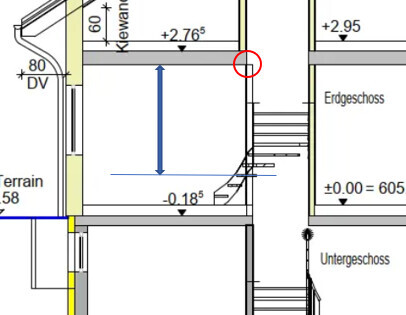
The drawn height is 1.97 meters (6 ft 6 in). According to DIN standards, it must be 2 meters (6 ft 7 in). The red circle shows the spot where it becomes tight when going downstairs.
The drawn height is 1.97 meters (6 ft 6 in). According to DIN standards, it must be 2 meters (6 ft 7 in). The red circle shows the spot where it becomes tight when going downstairs.
8
8aElProfe17 May 2023 15:12That’s fine. I’m almost 1.90 m (6 ft 3 in) tall and grew up in a house with a noticeably lower doorway. I’ll discuss it again and we might extend the top flight of stairs by one step. With the floor height increase, the stair starting point and that area would have at least 10 cm (4 inches) more. Thanks for your feedback on this.
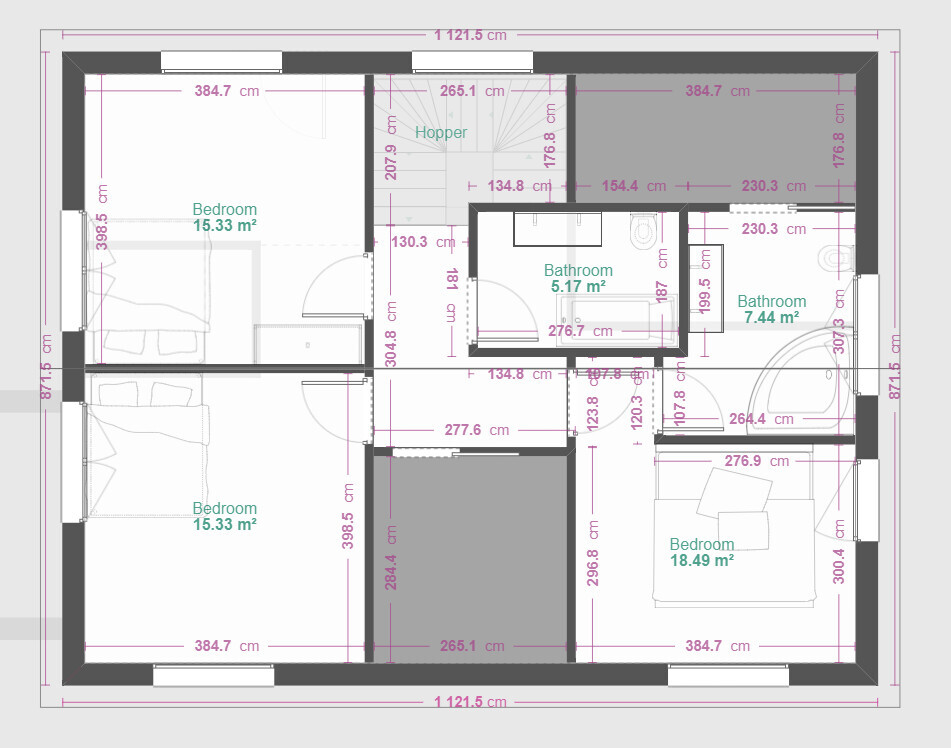
I absolutely can’t imagine it without skylights if the knee wall is that high. There isn’t enough light coming in through the ridge-side windows for the intended layout (3 bedrooms, 2 bathrooms) and the restriction that we need to have about 14 m² (150 sq ft) as utility space (storage rooms).
If we go with a knee wall of 180 cm (6 ft) and a roof pitch of 21°, which would allow skylights, it might work if the staircase is moved to the middle of the eaves side.
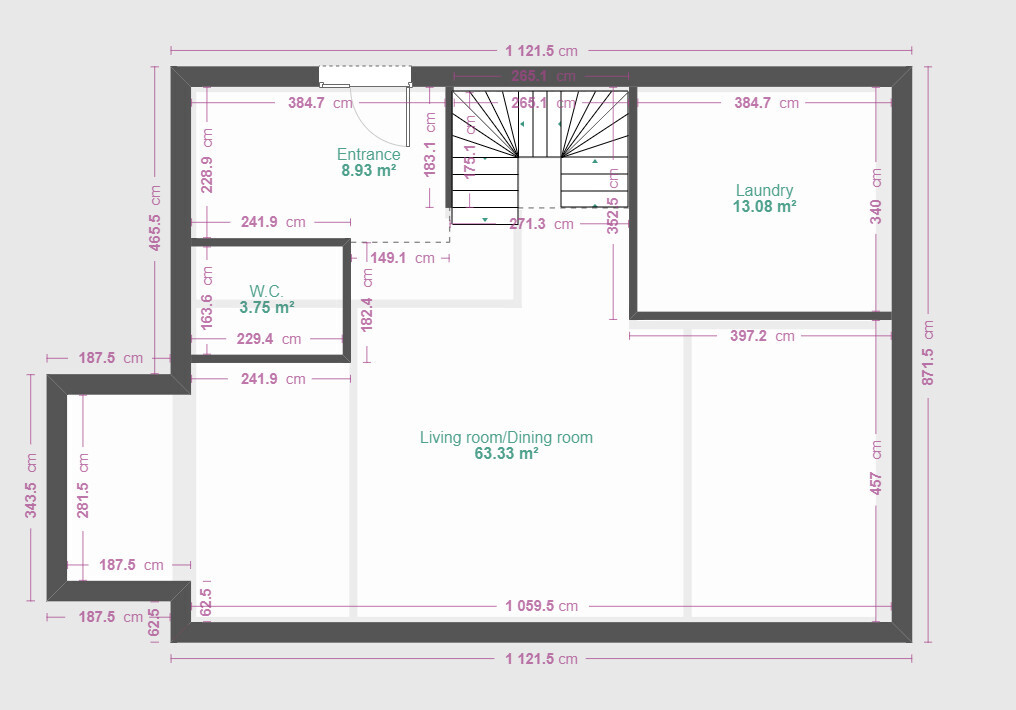
With minor changes on the ground floor, that’s even possible. But I’m not sure if we really want to take on that redesign, especially since there are also disadvantages and it wouldn’t solve everything nicely.
Sorry for the 90° rotation.
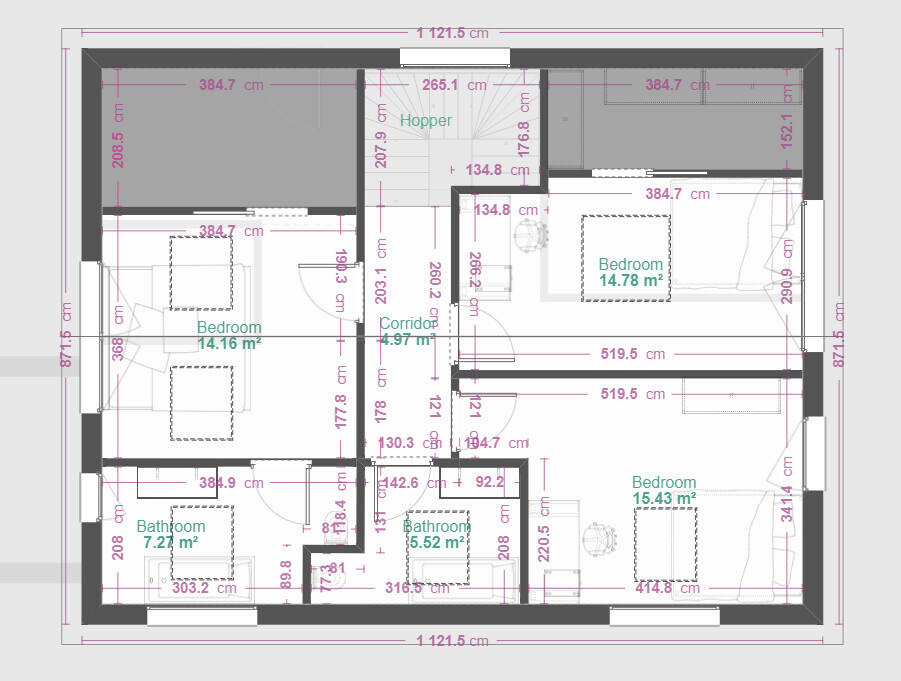
I absolutely can’t imagine it without skylights if the knee wall is that high. There isn’t enough light coming in through the ridge-side windows for the intended layout (3 bedrooms, 2 bathrooms) and the restriction that we need to have about 14 m² (150 sq ft) as utility space (storage rooms).
If we go with a knee wall of 180 cm (6 ft) and a roof pitch of 21°, which would allow skylights, it might work if the staircase is moved to the middle of the eaves side.
With minor changes on the ground floor, that’s even possible. But I’m not sure if we really want to take on that redesign, especially since there are also disadvantages and it wouldn’t solve everything nicely.
Sorry for the 90° rotation.
H
hanghaus202317 May 2023 15:32May I ask what led you to design the house completely without a shower?
Would it be possible to reduce the floor area by using a knee wall? This would be feasible in all rooms except for the stairwell.
Would it be possible to reduce the floor area by using a knee wall? This would be feasible in all rooms except for the stairwell.
8aElProfe schrieb:
I absolutely can’t imagine it with a high knee wall without skylight strips. That was my follow-up question;
ypg schrieb:
Wait, so the windows currently shown on the eaves side would be removed? I’m expanding my question: are no openable windows possible for safety reasons, or is that a general restriction?
Because even fixed skylight strips would add some appeal alongside a main window, although they would need to be cleaned from the outside.
8aElProfe schrieb:
That’s fine. I’m nearly 1.90 meters (6 ft 3 in) tall and grew up in a house where the passage was clearly lower. It’s also about being able to carry something slightly long up the stairs.
Is the basement only usable space?
The offer for the floor plan discussion still stands.
8
8aElProfe17 May 2023 16:13hanghaus2023 schrieb:
May I ask what led you to plan a house completely without a shower?
Would it be possible to reduce the area by using a knee wall? In all rooms except the stairwell, that should be feasible.You can shower in the bathtubs. We don’t have space for separate showers. We like to take baths sometimes. We weren’t entirely sure about the kids’ bathroom, but we have a teenager who enjoys bathing—I did too when I was young—and as small children we also liked splashing around in the tub.
ypg schrieb:
That was my question;
I’ll expand it: are no openable windows possible for safety reasons or is it a general limitation? Because fixed window bands alongside a main window would have their appeal, although you would have to clean them from the outside.
It’s also about being able to carry something a bit longer through the stairwell. Is the basement only utility space?
The offer for the floor plan discussion is still open.Only permanently sealed window bands are possible anyway, and these can only be installed structurally starting from an internal knee wall height of about 180cm (70.9 inches).
Knee walls might work, but then there would be no room for window bands—or where would you place them? It will also be difficult to achieve 14m² (150 sq ft) this way, and the space wouldn’t be usable anymore, not even for storage.
8
8aElProfe17 May 2023 16:21PS
Fixed windows due to SIA standard (risk of falling).
Basement is only a secondary area, exactly.
Fixed windows due to SIA standard (risk of falling).
Basement is only a secondary area, exactly.
Similar topics