
Hi,
We were almost finished with our planning, but now, thanks to a fortunate development, we can build higher than previously expected.
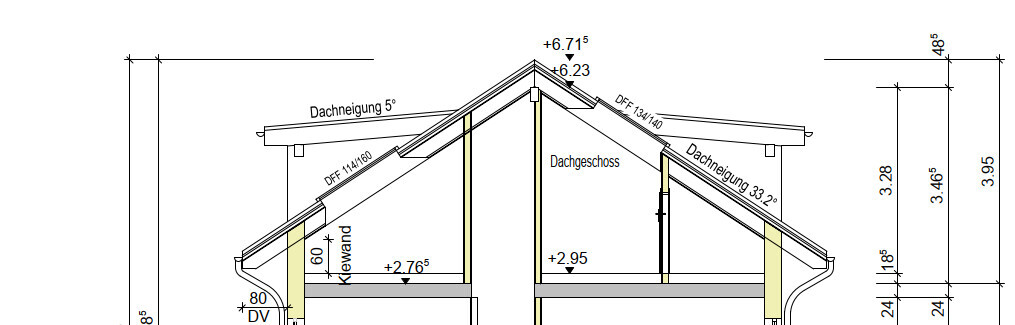
For our attic space, the question is whether to choose a knee wall with an interior clear height of 60 cm (24 inches) featuring large dormers (covering half the facade) and a roof pitch of about 35°, as originally planned, or to raise the knee wall to 160 cm (63 inches) with a roof angle of 24° without dormers.
Since the eaves line must remain continuous, dormers cannot be implemented with the higher knee wall.
Due to area limitations for living and ancillary space, we have to construct the attic rooms accordingly.
Our builder cannot install strip windows in the 160 cm knee wall option.
Because of the continuous eaves, in the dormer version the knee wall must be lowered to 60 cm (24 inches) to fit large windows with a sill height of 1 m (39 inches).
On the children's room side, there is a nice view to the southeast, which speaks in favor of the dormer option.
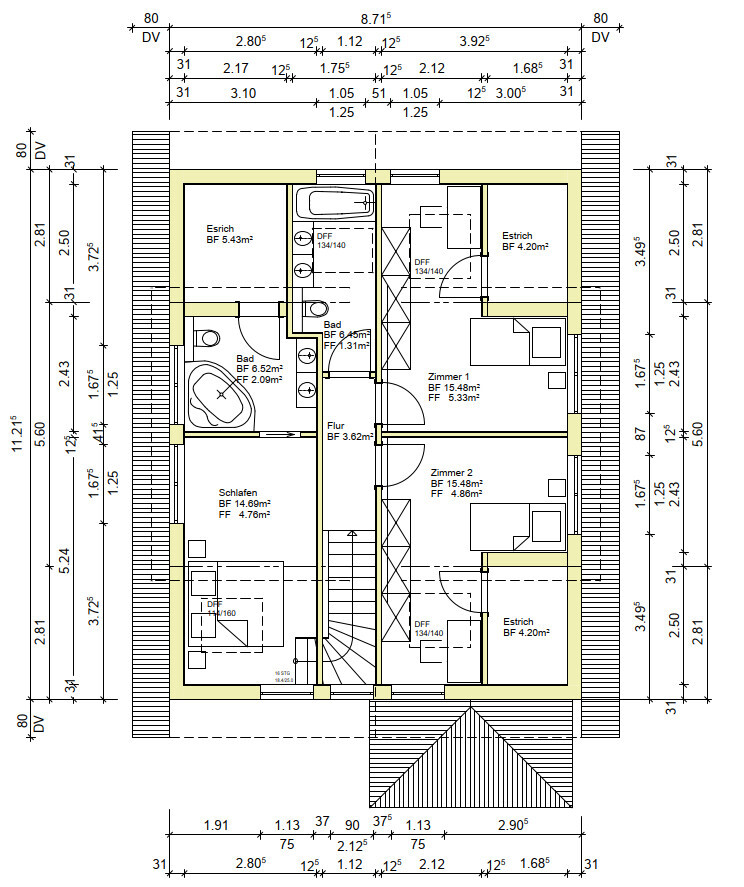
In the master bedroom, the higher knee wall would provide more headroom above the bed. We would not position the bed as shown in the attached floor plan, but against the walls by the hallway and the end wall.
Additionally, the attic storage spaces would be more accessible with standing height on the ridge side. If it becomes legally possible to convert these storage areas into rooms in the future, the higher knee wall would make them much more usable.
What do you think?
Note: In the attached section, the dormer version has a slightly lower ridge height (the latest status before the new information). We can raise up to a clear height of 3.40 m (11 ft 2 in) under the ridge. So, either knee wall 60 cm (24 inches) with roof pitch 35°, or knee wall 160 cm (63 inches) with roof pitch 24°.
We were almost finished with our planning, but now, thanks to a fortunate development, we can build higher than previously expected.
For our attic space, the question is whether to choose a knee wall with an interior clear height of 60 cm (24 inches) featuring large dormers (covering half the facade) and a roof pitch of about 35°, as originally planned, or to raise the knee wall to 160 cm (63 inches) with a roof angle of 24° without dormers.
Since the eaves line must remain continuous, dormers cannot be implemented with the higher knee wall.
Due to area limitations for living and ancillary space, we have to construct the attic rooms accordingly.
Our builder cannot install strip windows in the 160 cm knee wall option.
Because of the continuous eaves, in the dormer version the knee wall must be lowered to 60 cm (24 inches) to fit large windows with a sill height of 1 m (39 inches).
On the children's room side, there is a nice view to the southeast, which speaks in favor of the dormer option.
In the master bedroom, the higher knee wall would provide more headroom above the bed. We would not position the bed as shown in the attached floor plan, but against the walls by the hallway and the end wall.
Additionally, the attic storage spaces would be more accessible with standing height on the ridge side. If it becomes legally possible to convert these storage areas into rooms in the future, the higher knee wall would make them much more usable.
What do you think?
Note: In the attached section, the dormer version has a slightly lower ridge height (the latest status before the new information). We can raise up to a clear height of 3.40 m (11 ft 2 in) under the ridge. So, either knee wall 60 cm (24 inches) with roof pitch 35°, or knee wall 160 cm (63 inches) with roof pitch 24°.

ypg schrieb:
I actually don’t understand why the areas labeled as “Estrich” are built in separately.What the Swiss refer to as “Estrich” is, according to German usage, an attic or loft; in this particular case, it likely corresponds to the space behind a knee wall.https://www.instagram.com/11antgmxde/
https://www.linkedin.com/company/bauen-jetzt/
H
hanghaus202313 May 2023 13:48@ypg I have quoted the passage from the 2018 datasheet on storeys.
"The cantonal (or municipal) law can therefore, if necessary, limit the dimensions of roofs with design regulations, for example by restricting the roof pitch or indirectly by limiting the usable floor area in the attic."
"The cantonal (or municipal) law can therefore, if necessary, limit the dimensions of roofs with design regulations, for example by restricting the roof pitch or indirectly by limiting the usable floor area in the attic."
If another opinion is still relevant:
I am familiar with both options and would choose the higher knee wall if the floor plan is suitable. Of course, this depends on whether window placement still works well in all rooms. We currently have a knee wall height of 1.80 meters (5 ft 11 in). I find it great, especially for arranging furniture in the rooms. Our small house feels much larger upstairs because of it.
However, the roof pitch is quite steep for skylights and still relatively low for strip windows. You could probably manage it somehow, but a window at knee height takes some getting used to. On the other hand, we have large windows on the gable side, so it is still very bright, and the roof can be fully used for photovoltaic panels.
I am familiar with both options and would choose the higher knee wall if the floor plan is suitable. Of course, this depends on whether window placement still works well in all rooms. We currently have a knee wall height of 1.80 meters (5 ft 11 in). I find it great, especially for arranging furniture in the rooms. Our small house feels much larger upstairs because of it.
However, the roof pitch is quite steep for skylights and still relatively low for strip windows. You could probably manage it somehow, but a window at knee height takes some getting used to. On the other hand, we have large windows on the gable side, so it is still very bright, and the roof can be fully used for photovoltaic panels.
8
8aElProfe17 May 2023 08:29ypg schrieb:
I actually don’t understand why the areas labeled as “screed” are separately built in. If they are located under the roof and don’t have full standing height, they aren’t counted as part of the floor level. So even if the walls aren’t there, we are in the non-full story area. Including this area, the rooms would be more attractive. And what’s the point of the expensive roof windows? They are placed exactly where there are already windows in the gable ends. hanghaus2023 schrieb:
@ypg maybe the regulations in Switzerland are different. 😉 Exactly, once the clear height is over 1 meter (3 feet 3 inches), it counts as usable floor area. We don’t have any living space left, but we still have ancillary space.
Kalibri schrieb:
If another opinion is still relevant:
I’m familiar with both options and, given a suitable floor plan, would go for the higher knee wall. The prerequisite is, of course, that the window arrangements in all rooms still work. We have a knee wall height of 1.80 meters (5 feet 11 inches). I really like it, especially for arranging furniture. Our small house feels much larger on the upper floor because of it.
However, the roof pitch is quite steep for roof windows and still relatively low for continuous strip windows. You might be able to make it work, but a window at knee height takes some getting used to.
We have large windows on the gable side, which makes the space very bright, and the roof can be fully used for photovoltaic panels. That makes me think again. Most people here seem to favor the higher knee wall. We probably can’t go as high as 180 cm (5 feet 11 inches) because the roof pitch would be too shallow, but maybe we’ll investigate further. The clear height under the ridge must not exceed 340 cm (11 feet 2 inches); otherwise, a virtual intermediate floor is added, and that area is counted again...
8
8aElProfe17 May 2023 08:36Unfortunately, we have realized that increasing the knee wall height also means we would have to reduce the bay window by one grid unit (62.5 cm (25 inches)), since the entire upper floor now has a clear height of over 1 m (3.3 ft). Another argument against it.
We could slightly reduce the basement size (service areas budget) and correspondingly enlarge the walk-in kitchen (service area -> living area) in order to keep the bay window.
We also have the nice distant view including a view of the Alps from the eaves side.
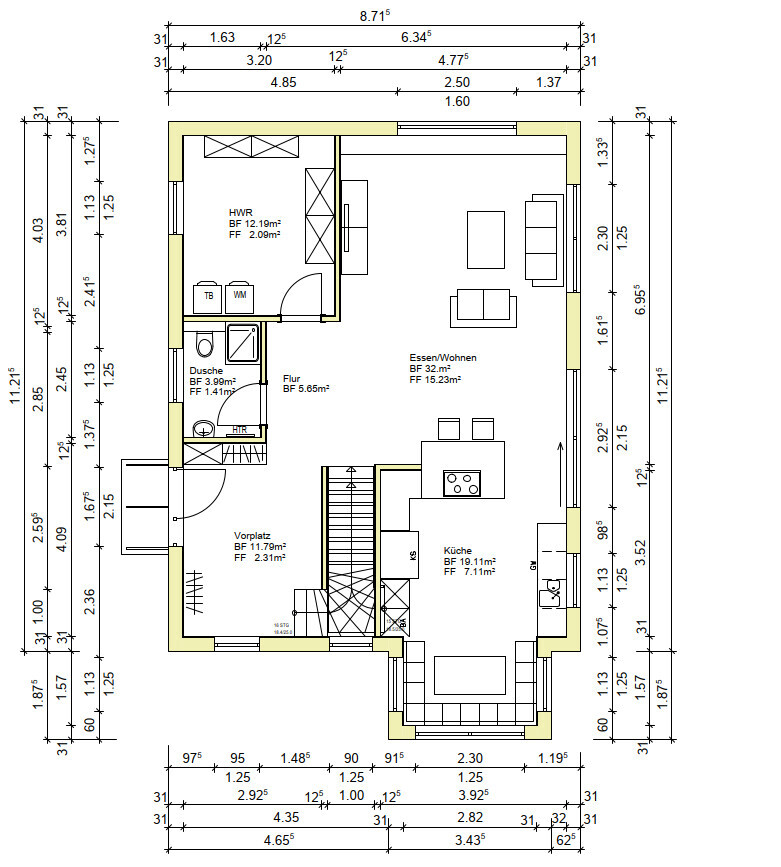
We could slightly reduce the basement size (service areas budget) and correspondingly enlarge the walk-in kitchen (service area -> living area) in order to keep the bay window.
We also have the nice distant view including a view of the Alps from the eaves side.
Similar topics