
ᐅ Site Planning for a Single-Family Home on a North-Facing Slope with a Basement
Created on: 25 Feb 2019 12:44
A
Artemis90
Hello everyone,
Here are my initial thoughts on the single-family house on a north-facing slope with a basement intended for commercial use.
I would like to know if my first draft is completely off or not.
Development plan/restrictions (none)
710m² (21x34)
North-facing slope (view top left "green line": the plot is currently lowered by about 2.5 meters (8 feet) both above and below)
No surveying or soil testing done yet
Number of parking spaces (double garage; 2-3 parking spaces on the north side)
Number of floors (basement, ground floor, upper floor)
Roof type (gable roof)
Client requirements
Basement to be used for a secondary business
Number of people, ages (2 adults: 30, 25 + possibly children (2))
Office: in the basement (secondary business)
Number of overnight guests per year: 0
Open or closed architecture (kitchen, dining and living area separated from hallway by glass door)
Conservative or modern style (without too many frills / straight lines)
Kitchen unit with island
Number of dining seats: 6-8
Fireplace: yes
Garage (double garage) + parking spaces 2-3
House design
Who planned it:
- Do-it-Yourself
What do you particularly like? Why?
South and north access (ground floor and basement, private and secondary business)
Personal price limit for the house, including fixtures:
450,000 (land already owned)
If you have to give up anything, what details/extras would you omit?
- Can give up: space beneath the ground floor garage (reasonable or not a "price question")
- Cannot give up: very large basement room
What is the most important/basic question about the floor plan in 130 characters?
Is the orientation of the house and garage practical?
Should the house be placed as far north as possible, with the land filled in so the garden is mostly on the south side, or would the filling exceed all dimensions?
I know very few measurements have been included. This is not about the perfect room layout but about how best to position the house.
I look forward to your suggestions and feedback
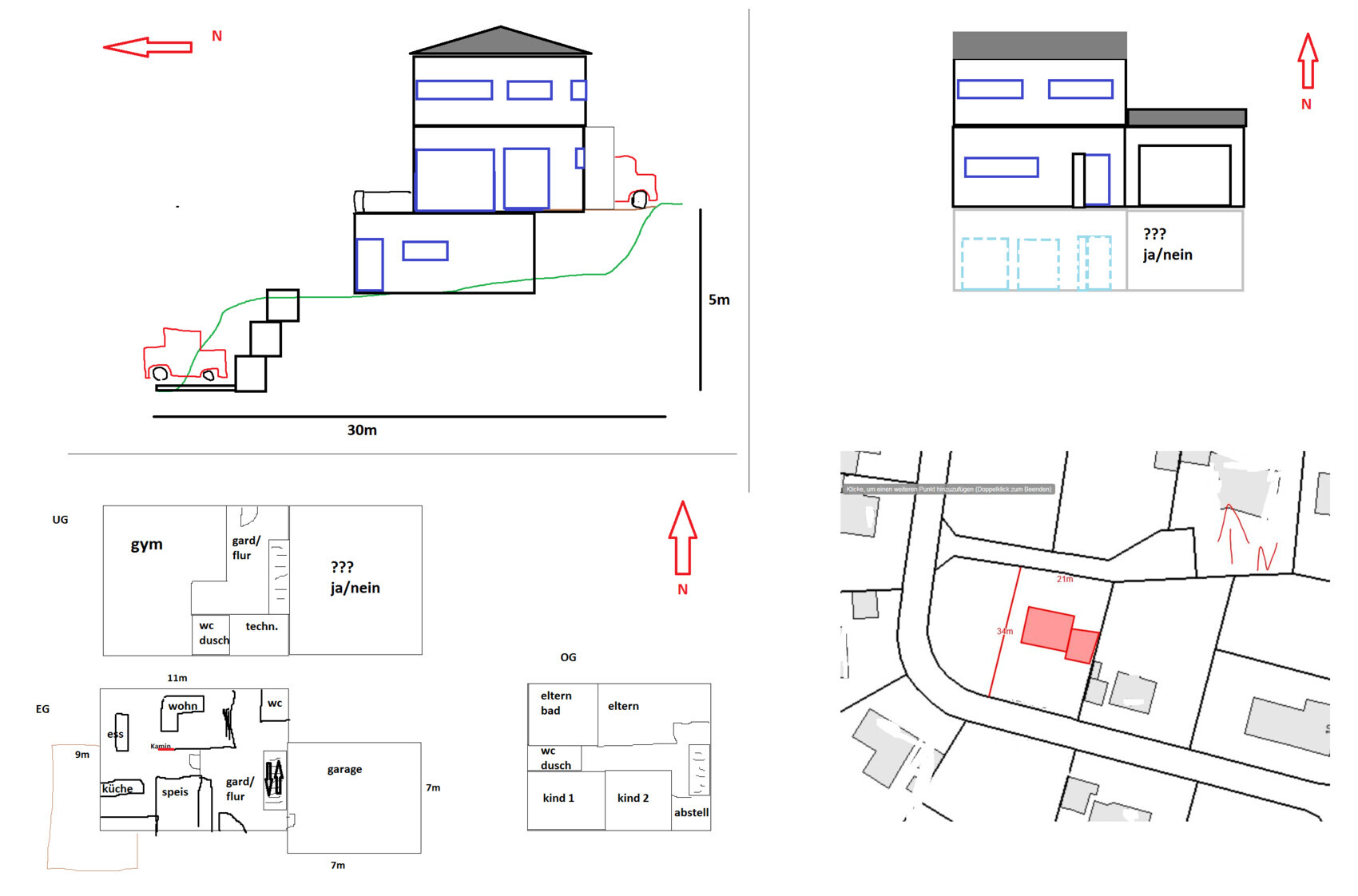
Here are my initial thoughts on the single-family house on a north-facing slope with a basement intended for commercial use.
I would like to know if my first draft is completely off or not.
Development plan/restrictions (none)
710m² (21x34)
North-facing slope (view top left "green line": the plot is currently lowered by about 2.5 meters (8 feet) both above and below)
No surveying or soil testing done yet
Number of parking spaces (double garage; 2-3 parking spaces on the north side)
Number of floors (basement, ground floor, upper floor)
Roof type (gable roof)
Client requirements
Basement to be used for a secondary business
Number of people, ages (2 adults: 30, 25 + possibly children (2))
Office: in the basement (secondary business)
Number of overnight guests per year: 0
Open or closed architecture (kitchen, dining and living area separated from hallway by glass door)
Conservative or modern style (without too many frills / straight lines)
Kitchen unit with island
Number of dining seats: 6-8
Fireplace: yes
Garage (double garage) + parking spaces 2-3
House design
Who planned it:
- Do-it-Yourself
What do you particularly like? Why?
South and north access (ground floor and basement, private and secondary business)
Personal price limit for the house, including fixtures:
450,000 (land already owned)
If you have to give up anything, what details/extras would you omit?
- Can give up: space beneath the ground floor garage (reasonable or not a "price question")
- Cannot give up: very large basement room
What is the most important/basic question about the floor plan in 130 characters?
Is the orientation of the house and garage practical?
Should the house be placed as far north as possible, with the land filled in so the garden is mostly on the south side, or would the filling exceed all dimensions?
I know very few measurements have been included. This is not about the perfect room layout but about how best to position the house.
I look forward to your suggestions and feedback
A basement on a flat site costs about the same as a basement on a sloped site.
For the sloped site, you also need to factor in retaining and leveling the remaining part of the property.
The planned floors on flat land will exceed your budget as well.
You will need to build smaller.
If I had the choice, I would take the sloped site. However, you don’t have the budget for it. If you are burdened by debt, you haven’t gained anything.
Take a look at the model house Orlando from Rensch-Haus.
Is the office space sufficient for your practice?
The storage room will become a WC, the building services will be moved into the utility room and WC.
You should omit the bay window in the dining area (a cost driver).
With a carport and doing some work yourself, and carefully selecting finishes within the budget, this should be achievable for your budget on flat land.
But can you sell the sloped site?
In the end, you have to decide.
Keep in mind that every dig with the excavator costs money,
and every square meter (QM) adds to the high amount of floor area.
Do you really need three floors?
Parking spaces and carport should be placed on the north side by the street,
with the practice and bedrooms in the basement level,
and the living spaces and terrace facing south upstairs.
For the sloped site, you also need to factor in retaining and leveling the remaining part of the property.
The planned floors on flat land will exceed your budget as well.
You will need to build smaller.
If I had the choice, I would take the sloped site. However, you don’t have the budget for it. If you are burdened by debt, you haven’t gained anything.
Take a look at the model house Orlando from Rensch-Haus.
Is the office space sufficient for your practice?
The storage room will become a WC, the building services will be moved into the utility room and WC.
You should omit the bay window in the dining area (a cost driver).
With a carport and doing some work yourself, and carefully selecting finishes within the budget, this should be achievable for your budget on flat land.
But can you sell the sloped site?
In the end, you have to decide.
Keep in mind that every dig with the excavator costs money,
and every square meter (QM) adds to the high amount of floor area.
Do you really need three floors?
Parking spaces and carport should be placed on the north side by the street,
with the practice and bedrooms in the basement level,
and the living spaces and terrace facing south upstairs.

Artemis90 schrieb:
It is a large 1250m² (13,450 sq ft) plot that would be divided. The other half would remain undeveloped and might possibly go back to me if I manage to become debt-free. I don’t quite understand: someone is keeping the other half reserved for you and leaving it undeveloped until you can buy it later, but what purpose would it serve afterward?
Artemis90 schrieb:
Can you explain to me the financial and technical differences between building a basement on a flat plot versus an underground level on a sloped site? Technically, in one case the basement is fully "underground" and used as storage—partially converting it into living space is more complex; in the other case, the basement is only underground on the downhill side, making partial living use much more obvious. Financially, I think it’s hard to generalize. The main difference, in my opinion, is the terrain itself: slopes usually have a steeper gradient than groundwater flow can follow—so you typically face a different level of hydrostatic pressure. A slope does not naturally hold itself—it requires retaining walls or root systems, something has to stabilize it, and that costs money.
As a rule of thumb, building on a slope always requires a higher budget; but the desire to partially use the basement as living or recreational space offsets this somewhat. I could imagine that renting commercial space might be more economical than trying to squeeze it under the residential area.
A slope is really only more attractive where it offers a corresponding panoramic view—but of course that comes with an equally higher price for the location. A slope that is cheaper as a plot compared to flat land is typically balanced out by the additional site development costs.
https://www.instagram.com/11antgmxde/
https://www.linkedin.com/company/bauen-jetzt/
Similar topics