
Hello dear forum community,
I have been following the discussions and browsing the forum for quite some time now. For our planned construction project, I would like to ask for your assessment and advice. It concerns a plot of land with a slight slope and the planning of the building on it. To better illustrate, I am attaching a site sketch with the measured elevation points as well as the maximum building footprint. We are currently in the floor plan design phase, so the footprint might end up being slightly smaller. The difference in elevation within the maximum building area is about 1 m (3.3 ft), depending on the arrangement, and possibly slightly more diagonally. If the building footprint is somewhat reduced, the maximum height difference would also decrease.
We have already commissioned a soil report in advance, which recommends a load-bearing slab foundation with frost protection edges or a strip footing (we had previously indicated that a basement is not strictly required). The transition to bedrock occurs at approximately 2.80 m (9.2 ft).
Our planning, based on the soil report, envisions a building without a basement. The plan is to set the building gently into the slope to somewhat reduce the height difference. However, after reading some posts here in the forum, I am no longer sure if this approach is practical or feasible as planned. How do you evaluate the situation? Is a slab foundation sensible and technically feasible? Are L-walls required on the southeast side, or could the terrain possibly be terraced due to the plot size? What is your overall cost estimate for the earthworks?
Note: The terrace is expected to run around the southeast corner of the building.
Thanks in advance for your advice!
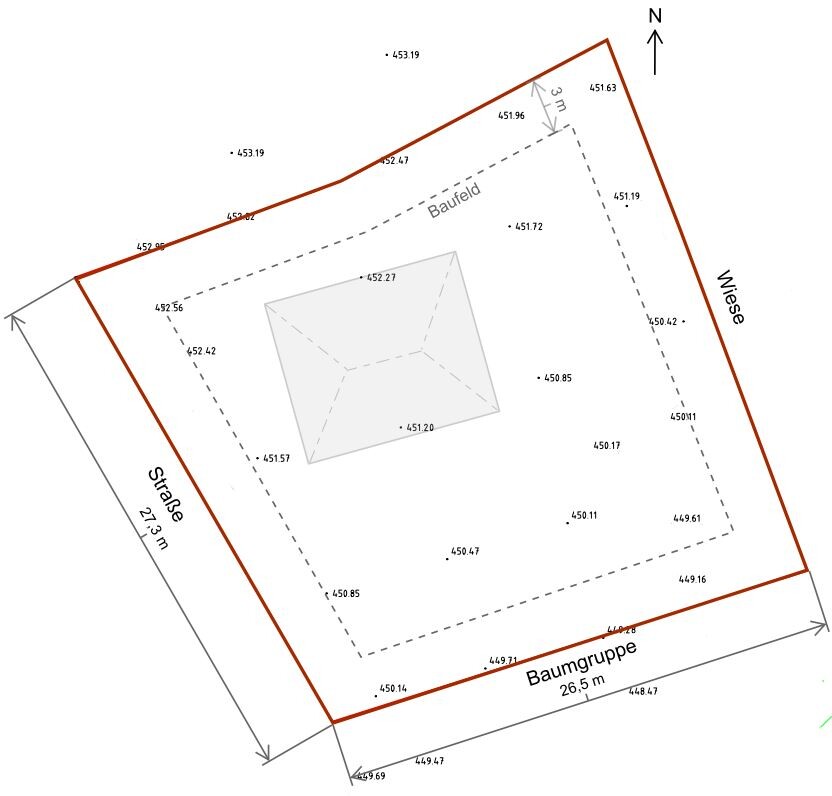
I have been following the discussions and browsing the forum for quite some time now. For our planned construction project, I would like to ask for your assessment and advice. It concerns a plot of land with a slight slope and the planning of the building on it. To better illustrate, I am attaching a site sketch with the measured elevation points as well as the maximum building footprint. We are currently in the floor plan design phase, so the footprint might end up being slightly smaller. The difference in elevation within the maximum building area is about 1 m (3.3 ft), depending on the arrangement, and possibly slightly more diagonally. If the building footprint is somewhat reduced, the maximum height difference would also decrease.
We have already commissioned a soil report in advance, which recommends a load-bearing slab foundation with frost protection edges or a strip footing (we had previously indicated that a basement is not strictly required). The transition to bedrock occurs at approximately 2.80 m (9.2 ft).
Our planning, based on the soil report, envisions a building without a basement. The plan is to set the building gently into the slope to somewhat reduce the height difference. However, after reading some posts here in the forum, I am no longer sure if this approach is practical or feasible as planned. How do you evaluate the situation? Is a slab foundation sensible and technically feasible? Are L-walls required on the southeast side, or could the terrain possibly be terraced due to the plot size? What is your overall cost estimate for the earthworks?
Note: The terrace is expected to run around the southeast corner of the building.
Thanks in advance for your advice!
Tim1985 schrieb:
Is a slab foundation practical and structurally feasible? Yes, why not?
Tim1985 schrieb:
For our planned construction project What exactly are you planning to build?
Tim1985 schrieb:
We are currently working on the floor plan Then please share it.

Tim1985 schrieb:
From about 2.80 m (9 ft 3 in), the transition to solid rock occurs.
Our plans are based on the soil report and propose a building without a basement. The goal is to place the building as lightly as possible into the slope to reduce the height difference somewhat. I have been reading through this forum and am now unsure whether this approach is practical and will work as planned. Two point eighty meters (9 ft 3 in) from where? – I don’t see any borehole locations marked, and for which one(s) would this apply?
A slope in the terrain also means a slope for surface water, which limits your options to avoid drainage issues. If you have not only read but understood the 11ant basement rule, then you know: it’s not just the basement that costs, but also the terrain modifications needed when you don’t use a basement.
I find it hard to understand how one can start floor plan design without incorporating the conclusions from the topographical survey. That way, you might as well plan “castles in the air,” as if you didn’t even know the site.
There are several people here who understand soil reports and can work with them. You should share your report first—it is more important than your own floor plan sketches at this stage.
https://www.instagram.com/11antgmxde/
https://www.linkedin.com/company/bauen-jetzt/
ypg schrieb:
Yes, why not?
What do you want to build?
Then show it. I have become uncertain about building with a slab foundation due to the height differences caused by the slight slope on the site. We are still at the early stage of the floor plan design. It will take some time before I can show anything. First, we need to clearly determine whether a basement is necessary or sensible.
11ant schrieb:
Two point eighty meters from where? – I don’t see any borehole locations marked, and which one(s) does that refer to?
A slope in the terrain also means a slope for surface water, which limits the options for avoiding issues. If you have not only read but also understood the 11ant basement rule, then you know: it’s not just the basement that costs, but also the terrain modifications not used for a basement. Two boreholes were carried out for the soil investigation – one in the southwest corner and one in the northeast corner of the marked building footprint. The depth is 2.80 m (9.2 feet) from the ground surface. More details are included below in the key points of the geotechnical report. It is clear that additional costs will arise from the excavation and terrain modifications.
11ant schrieb:
I cannot understand how someone can start floor plan design without first incorporating the conclusions from the topographical findings. That could lead to nearly the same unrealistic designs as if the site was not known at all.
There are several people here who understand geotechnical reports and can work with them. You should show that first, which is more urgent than your own floor plan sketches. The starting point was the geotechnical report, which, as described, recommends either a load-bearing slab foundation with frost protection upstands or a strip footing. We are still quite early in the floor plan design. While researching here in the forum, I came across the topic of basement / slab foundation / earthworks again. I fully understand that a basement naturally impacts the floor plan.
For further assessment, please find attached the key statements from the geotechnical report, and I would appreciate your opinions.
Tim1985 schrieb:
It will still take some time before I can show anything. First, we need to clearly determine whether a basement is necessary or practical. Exactly, and that’s why I don’t understand where ...
Tim1985 schrieb:
Two boreholes were made for the geotechnical survey – one in the southwest corner and one in the northeast corner of the marked building footprint. ... the assumed specific building footprint and its location come from, especially since two boreholes are a very limited basis.
Tim1985 schrieb:
2.80 m (9 ft 2 in) below ground surface. Two point eight meters below 452.56 would be 449.76, which is less than 450.85 by only 1.09 m (3 ft 7 in). Comparing apples and oranges.
https://www.instagram.com/11antgmxde/
https://www.linkedin.com/company/bauen-jetzt/
H
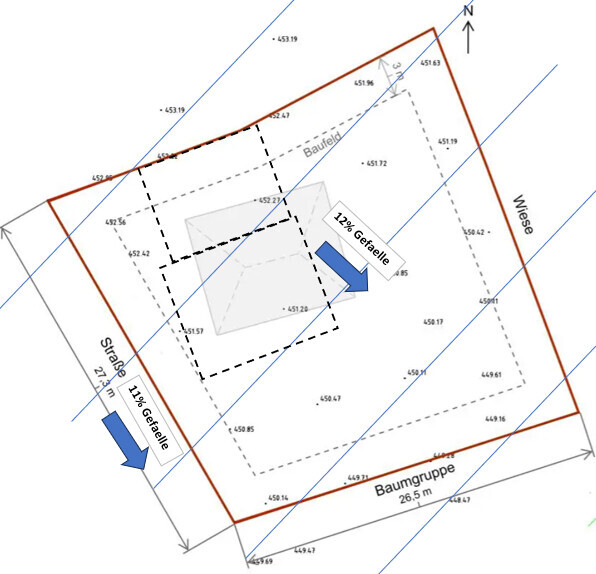
hanghaus20231 Oct 2024 13:47Here it is so that @11ant can better visualize it. There is a 1.5 m (5 feet) difference in the house level. Of course, a basement or better a lower ground floor is recommended if the budget does not allow for it.
Is there no building permit / planning permission?
Is there no building permit / planning permission?
Similar topics