
Hello everyone,
I more or less stumbled upon a plot of land after someone let their reservation expire.
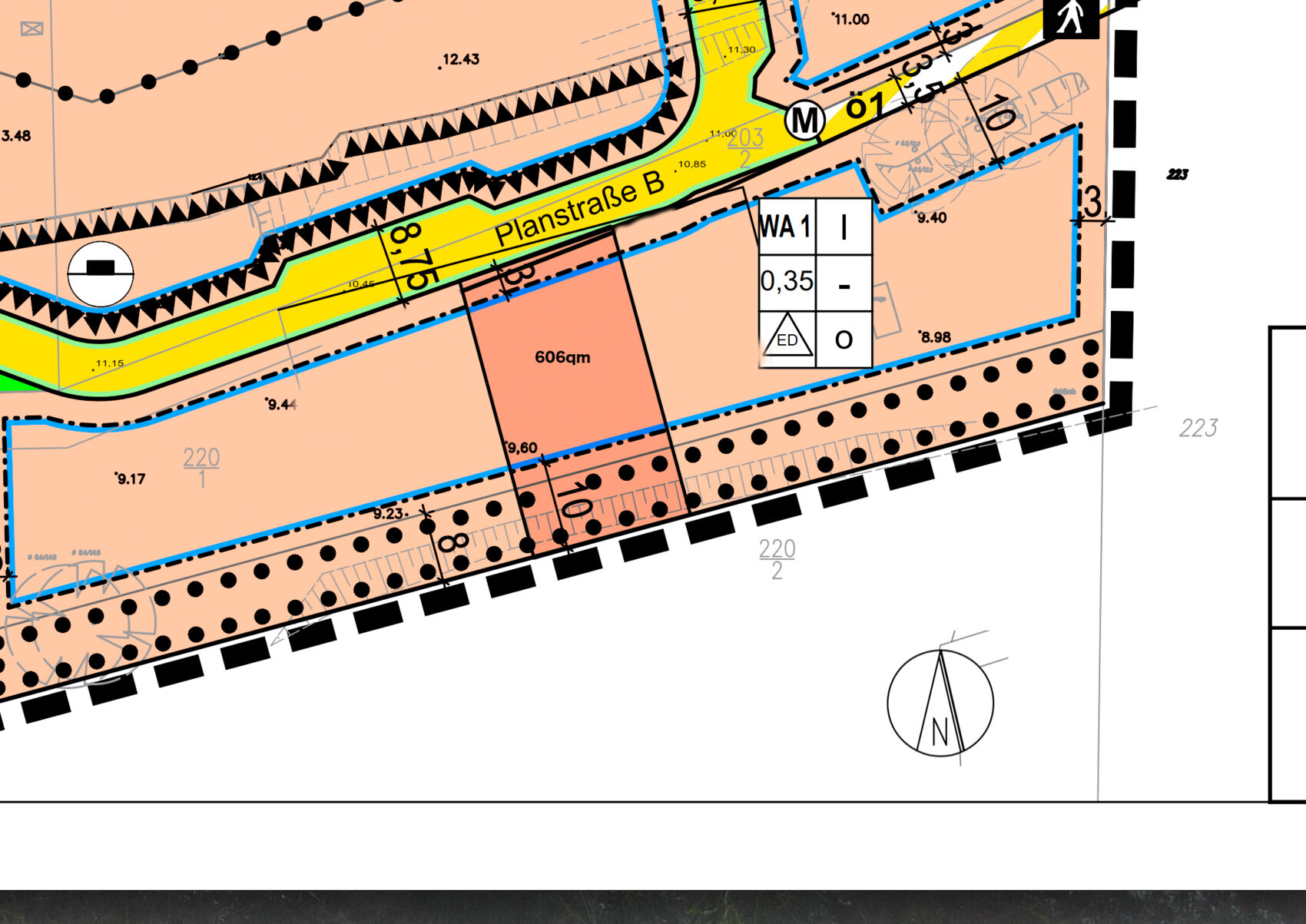
The plot is about 606 square meters (6,521 square feet), according to my "measurement" approximately 18.10 meters by 33.50 meters (60 feet by 110 feet), not officially surveyed yet, and now I’m wondering exactly what I can do with it.
The development plan sets out the following for "my plot":
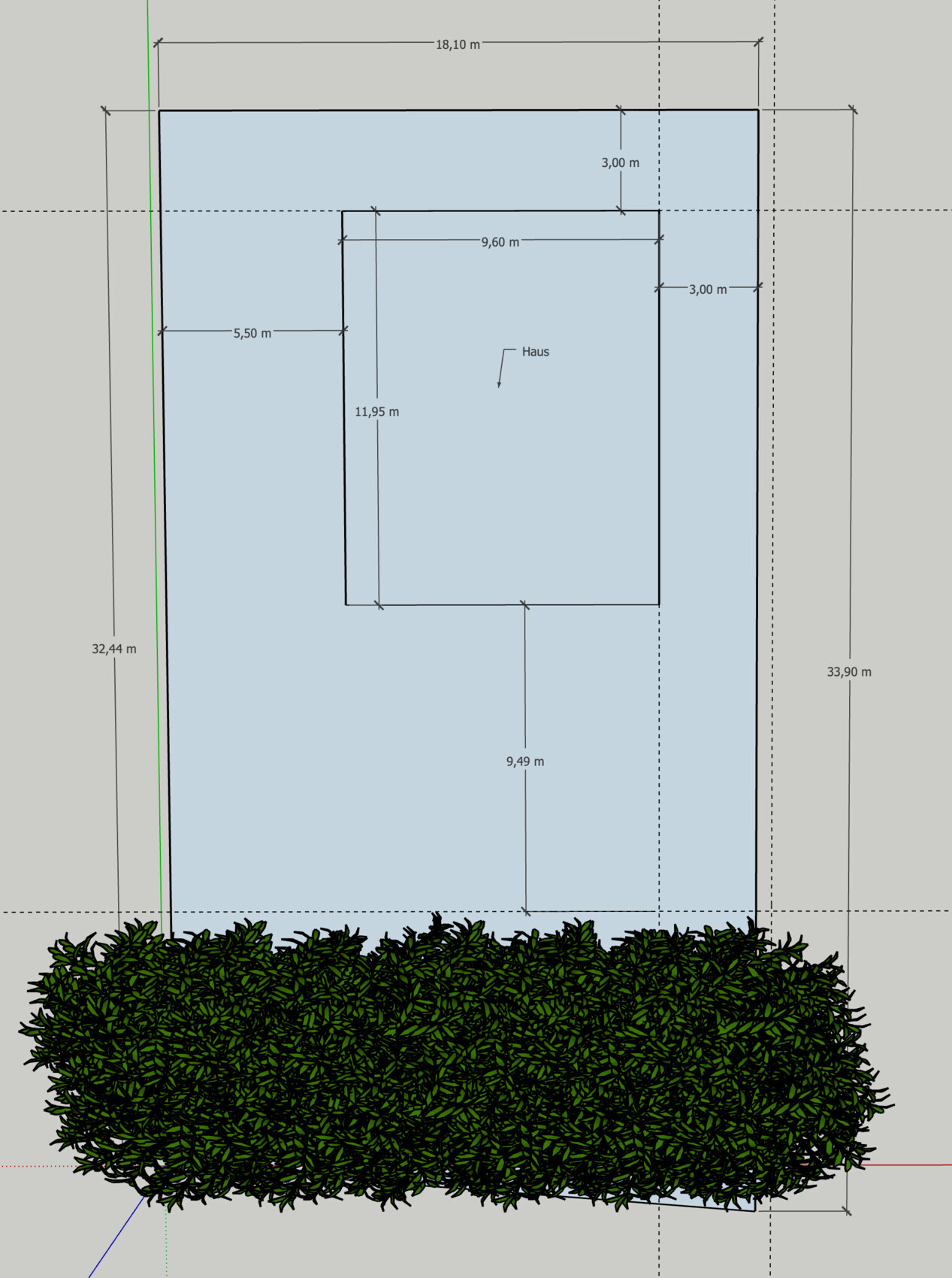
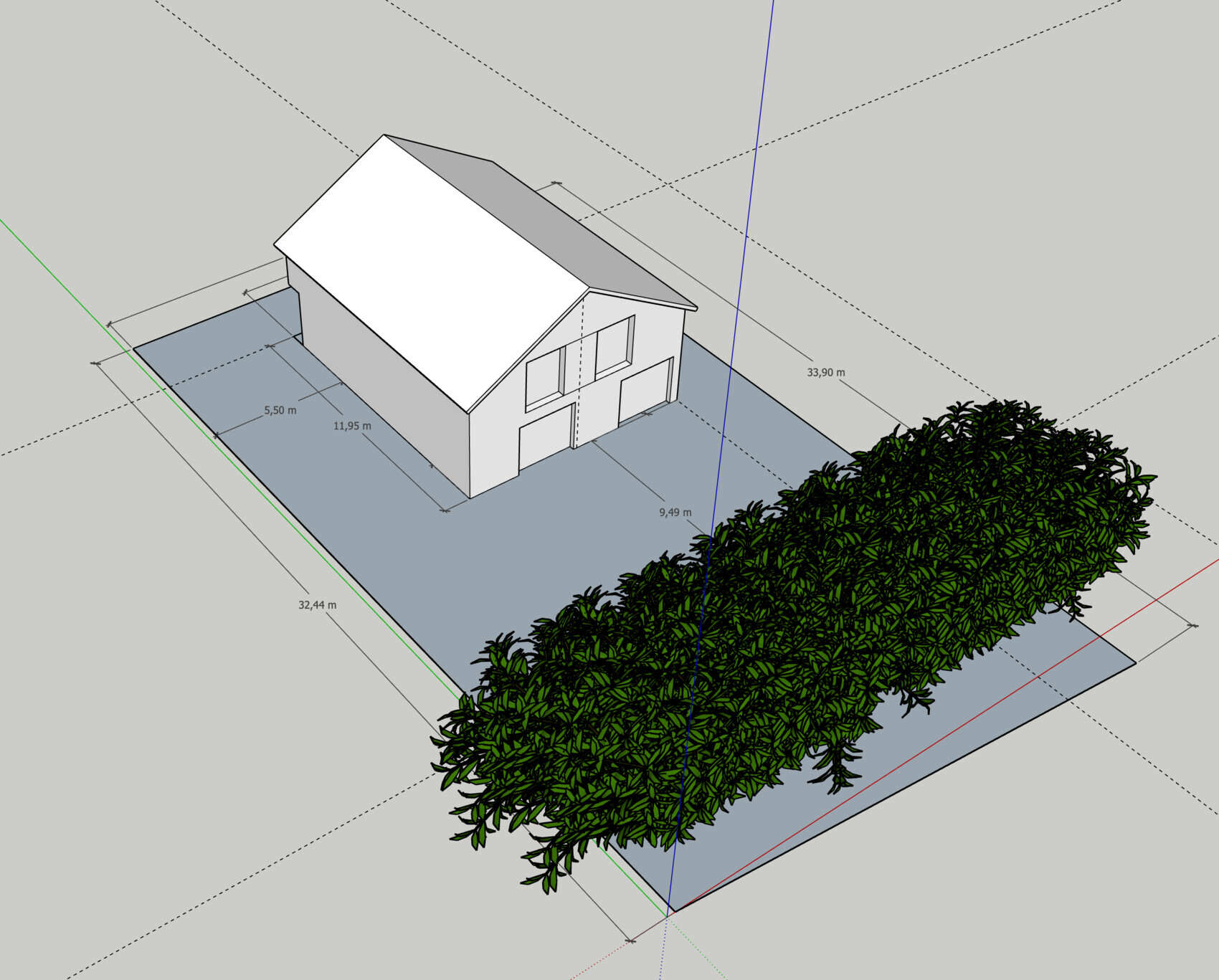
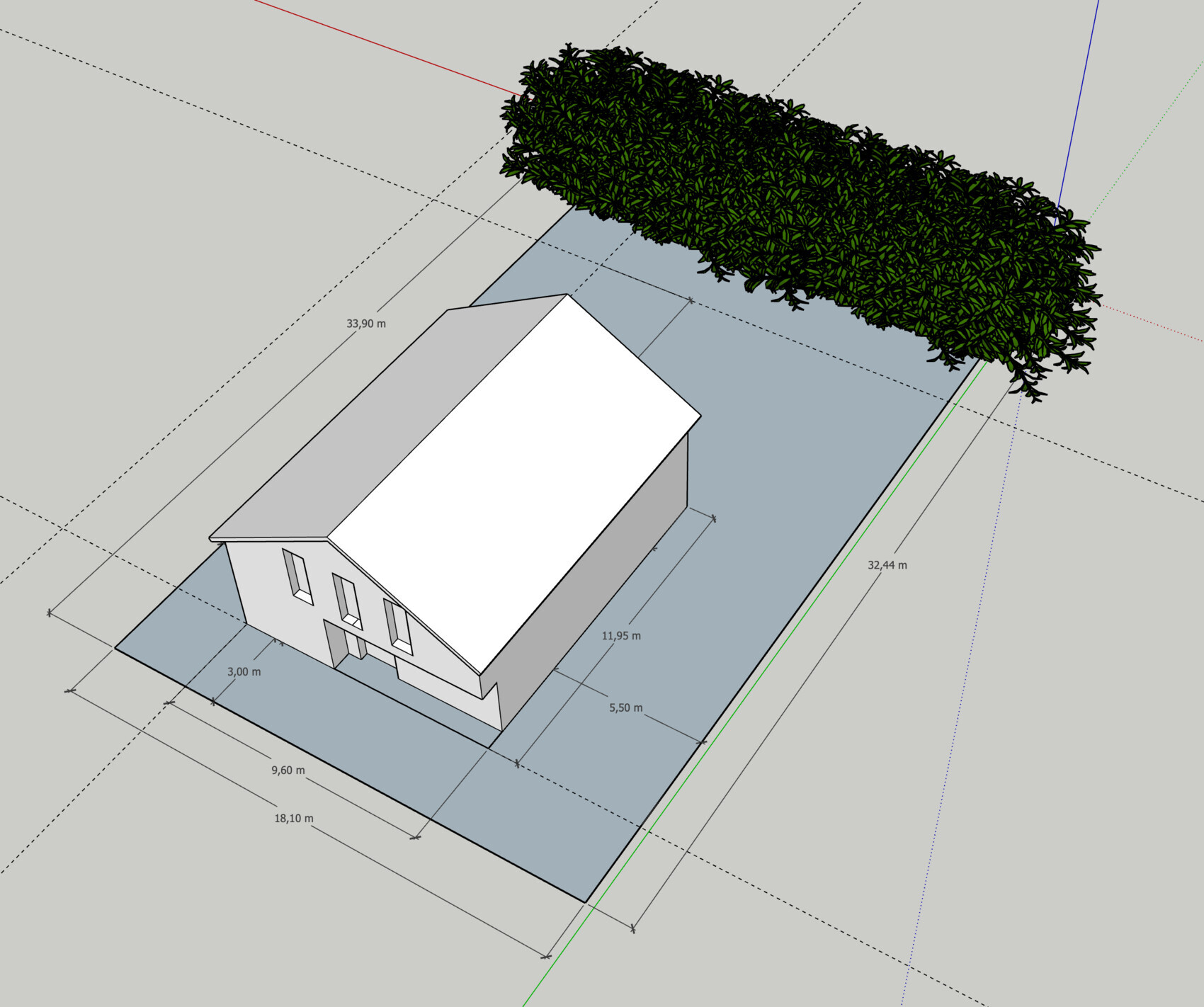
Here I have placed an example house measuring 9.60 meters by 11.95 meters (31.5 feet by 39 feet), which I like based on my initial review (Viebrockhaus Edition 600).
Next to the house, in the 5.50-meter (18 feet) wide space there would be a carport – is that enough space for two parking spots? I would prefer not to make the house narrower just to accommodate vehicles... but then there’s hardly any room left for fencing?!
The terrace and garden at the back are, of course, limited by the tall trees – but that’s a compromise I’ll have to accept.
I’ve never built a house in my life before... so this is my first time dealing with this topic in detail. What would you do in this situation? Make the house a bit smaller?
If you need more information, just ask – as I said, I’m a beginner and eager to learn 🙂
My wishes are:
- Starting from 160 square meters (1,722 square feet) upwards
- I’m currently thinking about a basement and budget around $100k extra for it
- I don’t like long corridors
Once the plot situation is reasonably clear, I’d like to hear your advice on floor plans – that will surely be a more extensive topic.
Best regards
I more or less stumbled upon a plot of land after someone let their reservation expire.
The plot is about 606 square meters (6,521 square feet), according to my "measurement" approximately 18.10 meters by 33.50 meters (60 feet by 110 feet), not officially surveyed yet, and now I’m wondering exactly what I can do with it.
The development plan sets out the following for "my plot":
- 0.35 floor area ratio
- Single-story buildings only
- Maximum building height 10 meters (33 feet)
- Eave height max 4.50 meters (15 feet)
- One driveway with max width of 4 meters (13 feet)
- Two parking spaces are mandatory
- Roof pitch between 15° and 51°
- Roofs of garages etc. may differ in shape
- Garages, carports, and ancillary buildings as defined by §14 (1) of the building use ordinance, which are buildings, must not exceed the street-side building boundaries of the access roads.
- Dormers and roof recesses: the total length of dormers or roof recesses per roof side may not exceed 50% of the total length of that roof side.
- Standard distance to property boundary is 3 meters (10 feet)
- In the southern area, there is an 8-meter (26 feet) deep strip across the full width of the plot (approx. 18 meters (60 feet)) where trees and shrubs must be preserved. This area is quite densely vegetated and reaches heights up to 10 meters (33 feet) – I’ve tried to visualize this below
- In the middle of this vegetation is a downward slope... the building boundary to this strip was reduced from the normal 3 meters to 2 meters (7 feet) so the plots aren’t too restricted.
Here I have placed an example house measuring 9.60 meters by 11.95 meters (31.5 feet by 39 feet), which I like based on my initial review (Viebrockhaus Edition 600).
Next to the house, in the 5.50-meter (18 feet) wide space there would be a carport – is that enough space for two parking spots? I would prefer not to make the house narrower just to accommodate vehicles... but then there’s hardly any room left for fencing?!
The terrace and garden at the back are, of course, limited by the tall trees – but that’s a compromise I’ll have to accept.
I’ve never built a house in my life before... so this is my first time dealing with this topic in detail. What would you do in this situation? Make the house a bit smaller?
If you need more information, just ask – as I said, I’m a beginner and eager to learn 🙂
My wishes are:
- Starting from 160 square meters (1,722 square feet) upwards
- I’m currently thinking about a basement and budget around $100k extra for it
- I don’t like long corridors
Once the plot situation is reasonably clear, I’d like to hear your advice on floor plans – that will surely be a more extensive topic.
Best regards

SaschaL schrieb:
I would definitely want KFW40+ standard – simply because I think it’s unlikely to be a wrong choice in the long run. The wall construction and building materials don’t really matter to me, probably because I’m not clear about the differences. I need to do a lot more research. Avoid the madness of feeling like you have to become an expert builder to the point of exhaustion. There are millions of happy people living in houses built entirely without relying on any government incentive programs. You will find plenty of personal preferences in your own heart that can make the building process complicated enough on their own.
https://www.instagram.com/11antgmxde/
https://www.linkedin.com/company/bauen-jetzt/

Exactly, only you can express your wishes, for example low energy consumption, as quiet as a house next to a highway, floor-to-ceiling windows in the bedroom for looking outside, morning sun to wake up to, a bright open-plan living area with a view of the garden and not the neighbor’s house or garage, and so on.
You see the bed, you simply say it has custom dimensions. Often, 180x200 cm (71x79 inches) or 200x200 cm (79x79 inches) is planned. I’ve even seen 160x200 cm (63x79 inches). Suddenly, what looked great turns out to be a disaster and doesn’t fit. Honey, we need furniture.
You don’t need to go too deep. If you want underfloor heating, then the provider with an air-to-air heat pump is out.
It’s a puzzle: preferences, references, price, gut feeling.
We wanted masonry construction, passive house, move-in ready. Except for the masonry construction, everything else worked out. In the meantime, we even moved away from the passive house idea. Eventually, you reorganize and make decisions. For us, the deciding factor wasn’t the wall build-up or energy standard, but the sales consultant who made a miscalculation and tried to pressure us into financing two additional rooms through the mortgage broker down the hall.
You don’t need to go too deep. If you want underfloor heating, then the provider with an air-to-air heat pump is out.
It’s a puzzle: preferences, references, price, gut feeling.
We wanted masonry construction, passive house, move-in ready. Except for the masonry construction, everything else worked out. In the meantime, we even moved away from the passive house idea. Eventually, you reorganize and make decisions. For us, the deciding factor wasn’t the wall build-up or energy standard, but the sales consultant who made a miscalculation and tried to pressure us into financing two additional rooms through the mortgage broker down the hall.
SaschaL schrieb:
I understand that as "focusing on the essentials that are important to you personally" Yes, otherwise you get overwhelmed by "you absolutely must also know this" stuff and end up building your energy consultant’s dream house. And it never stops: once you finally know which is the best heating system and design your house with the award-winning interior walls, it goes on with range hoods, shower heads, recessed spotlights, and so on; sliding door rollers are an unexpectedly vast topic in themselves, and of course you can wire motion detectors with Cat7 cable ... ... ...
https://www.instagram.com/11antgmxde/
https://www.linkedin.com/company/bauen-jetzt/
W
WilderSueden22 Jan 2021 20:08SaschaL schrieb:
I would definitely want KfW40+ standard – simply because I believe it’s a solid long-term choice. I don’t mind the wall construction or building materials, probably because I don’t fully understand the differences yet. I need to do a lot more research. Can you recommend good literature for a prospective homeowner? I’m willing to study the subject thoroughly, but it doesn’t have to be as detailed as an academic degree. We initially wanted 40+ as well. Then we moved away from that idea and ended up with a general contractor from the region who initially planned for KfW55. At the last meeting, just as a formality, we asked about the extra cost for a 40+ house, and apparently, with the photovoltaic system, there is enough bonus to make it work with just a bit more insulation under the slab. So we ended up where we originally wanted to be, without really pushing for it in between.
Regarding literature, I can recommend books on construction descriptions from consumer organizations like Stiftung Warentest and consumer advice centers. They cover the common pitfalls and "cost-cutting measures" used by builders. Otherwise, just dive deep into the forum and don’t get frustrated after the fifth thread debating Ytong versus brick.