
Dear Forum,
I have read several articles on this topic and gained some understanding, but it is still not entirely clear for our situation. I’m a complete beginner regarding this subject and now need to keep an eye on our interior contractor, who is handling everything for us (starting with the quote). Since I want to understand the services to be commissioned, I kindly ask for a plausible and, if possible, clearly explained answer with minimal technical jargon. Please excuse my perhaps very basic way of expressing myself!
Here is the background: we are building a single-family house with a ground floor, a finished attic, and an uninsulated loft on a concrete slab foundation. We want a satellite system with five connections (living room, 2 kids’ rooms, office, bedroom) as well as LAN wiring for the mentioned rooms.
First, about the LAN wiring: it was offered to install the LAN distribution panel and the router in the utility/technology room. From there, the individual rooms will presumably be wired. The offer includes cable installation, including connectors (which I understand as cabling), plus 5x BTR NETCOM outlet sockets, Cat. 7, 1x RJ45, Up0 TN E-DATmod-2Up0.
I have read a bit and understand that a network switch is needed to manage connections, but I don’t see it included in the offer. Will that be an additional cost? Are other components necessary?
Regarding Wi-Fi, will I be able to get coverage throughout the entire house (wood frame construction) from the technology room, or will I need a range extender? I have also read about access points; how do they work if I want Wi-Fi in both the living room and upstairs?
What about the telephone? No wall outlets were planned for it; it still needs to be installed somewhere. Will a normal cordless phone like a Gigaset TECT be enough, and do I only need a power outlet to connect it to the router? Or is more equipment required?
Concerning the satellite system, I was offered a 5-connection rooftop satellite system with a multiswitch, 85 cm dish / LNB / centrally located in the loft.
As an extra item, the preparation of satellite coax cables in the loft and grounding from the loft to the technology room is offered.
The price for the satellite system seems quite high. Therefore, I would prefer to have only the preparation done and then contract the remaining work separately. What do I need, or how should I arrange this? Should I have an empty conduit installed from the loft to the technology room? How is the cabling to the individual rooms done? Does it run from the technology room to the rooms or directly from the satellite dish in the loft?
Since LAN is already planned for the same rooms, is the satellite cable different (coaxial)?
Thank you very much in advance for your help and feedback. It’s incredible what challenges you have to deal with when building a house, which you never knew existed before.
Best regards,
Charly
I have read several articles on this topic and gained some understanding, but it is still not entirely clear for our situation. I’m a complete beginner regarding this subject and now need to keep an eye on our interior contractor, who is handling everything for us (starting with the quote). Since I want to understand the services to be commissioned, I kindly ask for a plausible and, if possible, clearly explained answer with minimal technical jargon. Please excuse my perhaps very basic way of expressing myself!
Here is the background: we are building a single-family house with a ground floor, a finished attic, and an uninsulated loft on a concrete slab foundation. We want a satellite system with five connections (living room, 2 kids’ rooms, office, bedroom) as well as LAN wiring for the mentioned rooms.
First, about the LAN wiring: it was offered to install the LAN distribution panel and the router in the utility/technology room. From there, the individual rooms will presumably be wired. The offer includes cable installation, including connectors (which I understand as cabling), plus 5x BTR NETCOM outlet sockets, Cat. 7, 1x RJ45, Up0 TN E-DATmod-2Up0.
I have read a bit and understand that a network switch is needed to manage connections, but I don’t see it included in the offer. Will that be an additional cost? Are other components necessary?
Regarding Wi-Fi, will I be able to get coverage throughout the entire house (wood frame construction) from the technology room, or will I need a range extender? I have also read about access points; how do they work if I want Wi-Fi in both the living room and upstairs?
What about the telephone? No wall outlets were planned for it; it still needs to be installed somewhere. Will a normal cordless phone like a Gigaset TECT be enough, and do I only need a power outlet to connect it to the router? Or is more equipment required?
Concerning the satellite system, I was offered a 5-connection rooftop satellite system with a multiswitch, 85 cm dish / LNB / centrally located in the loft.
As an extra item, the preparation of satellite coax cables in the loft and grounding from the loft to the technology room is offered.
The price for the satellite system seems quite high. Therefore, I would prefer to have only the preparation done and then contract the remaining work separately. What do I need, or how should I arrange this? Should I have an empty conduit installed from the loft to the technology room? How is the cabling to the individual rooms done? Does it run from the technology room to the rooms or directly from the satellite dish in the loft?
Since LAN is already planned for the same rooms, is the satellite cable different (coaxial)?
Thank you very much in advance for your help and feedback. It’s incredible what challenges you have to deal with when building a house, which you never knew existed before.
Best regards,
Charly
R
readytorumble17 Mar 2017 07:26I’m jumping in here because I’m currently wiring Cat7 cables to Cat6 outlets (+patch panel).
How did you handle the shielding? Did you completely cut off the shielding (aluminum foil) after stripping the cable, leaving just enough to terminate the conductors using an LSA connector?
I find that dealing with the aluminum foil is the most troublesome part. If I could simply cut it off completely within the last 3cm (1.2 inches), I’d be a lot faster.
Also, I see a risk at the patch panel that the aluminum foil might touch the contacts of the neighboring ports.
Attached is a picture showing how I’m doing it right now (folding the aluminum foil as far back as possible around the conductors):
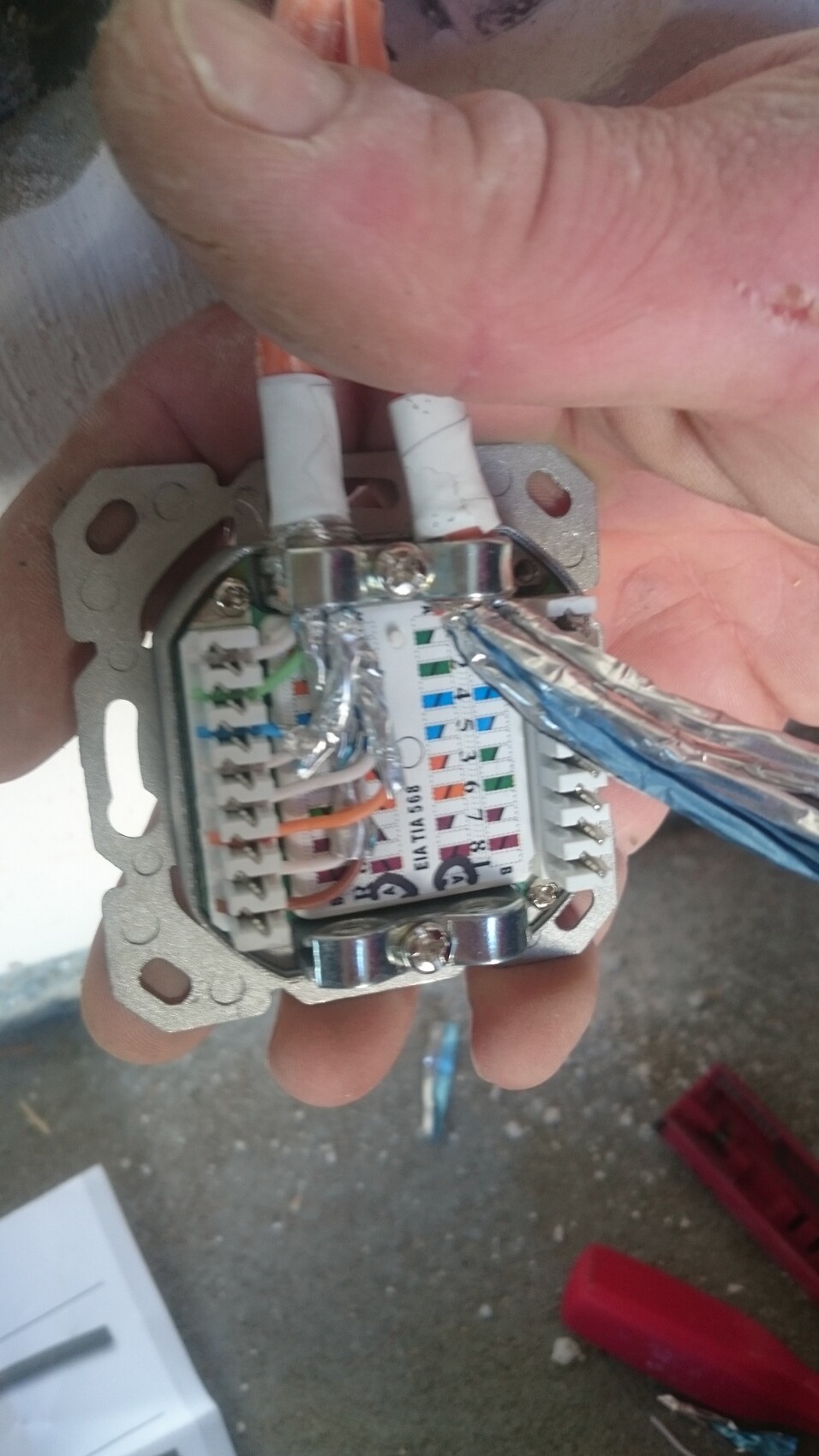
How did you handle the shielding? Did you completely cut off the shielding (aluminum foil) after stripping the cable, leaving just enough to terminate the conductors using an LSA connector?
I find that dealing with the aluminum foil is the most troublesome part. If I could simply cut it off completely within the last 3cm (1.2 inches), I’d be a lot faster.
Also, I see a risk at the patch panel that the aluminum foil might touch the contacts of the neighboring ports.
Attached is a picture showing how I’m doing it right now (folding the aluminum foil as far back as possible around the conductors):
P
Peanuts7417 Mar 2017 08:20DNL schrieb:
Cat7 cables/LAN cables are not screwed in.
They are terminated using an LSA tool. You need to be very careful because of the shielding.
You can do it yourself, but you need this kind of tool, a lot of time, must work precisely, and it’s hard to properly test the result.That’s right, it’s actually hard to test because in practice, for most people, it hardly matters whether they get 1 Gbps or just 825 Mbps.
There are many other bottlenecks.
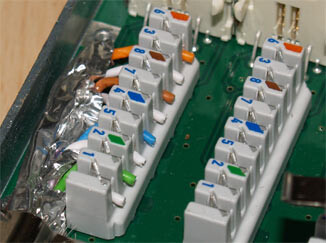
Besides, you can also push the wires between the blades of the LSA strips with a small screwdriver. You don’t really believe that the electrician (maybe even just the apprentice) carefully strips and arranges the wires in the outlet with great care and feng shui, do you?
P
Peanuts7417 Mar 2017 08:23readytorumble schrieb:
I’m jumping in here because I’m currently terminating Cat7 cables onto Cat6 outlets (+patch panel).
How did you handle the shielding? Did you completely cut off the foil shield after stripping the cables, leaving just enough to terminate the wires with the LSA tool?
I find dealing with the foil shield to be the most challenging part. If I could just cut it off entirely in the last 3cm (1.2 inches), I could work much faster.
Also, at the patch panel, I worry the foil might touch the contacts of adjacent ports.
Attached is a picture of how I’m doing it currently (wrapping the foil around the conductors as much as possible):In theory, you could separate the conductor pairs and leave the foil in place, then use some heat shrink tubing over it to secure and insulate everything.
The question is, in practice, does it even make a noticeable difference if you’re missing 3cm (1.2 inches) of shielding…

If you want to do it properly, the foil should be left up to the contacts...
And this is sloppy work times ten!
This should NEVER be recommended! Doing this spreads the LSA strips apart, and afterwards you can only hope that the outlet barely functions... Regulations and special tools are not there for no reason.
Incredible as it sounds, but yes, this is how electricians or telecommunications technicians work when following the applicable standards.
Peanuts74 schrieb:
Besides that, you can also push the wires between the blades of the LSA strips using a small screwdriver.
And this is sloppy work times ten!
This should NEVER be recommended! Doing this spreads the LSA strips apart, and afterwards you can only hope that the outlet barely functions... Regulations and special tools are not there for no reason.
Peanuts74 schrieb:
You don’t really think that the electrician (possibly just the apprentice) carefully strips and arranges the wires inside the outlet according to Feng Shui, do you?
Incredible as it sounds, but yes, this is how electricians or telecommunications technicians work when following the applicable standards.
P
Peanuts7417 Mar 2017 09:14Mycraft schrieb:
If you want to do it professionally, the foil should be left up to the contacts...

And this is botched work to the extreme!
You should NEVER recommend something like this! The LSA strips get spread apart, and afterwards, you only have a barely functioning outlet, if at all... Regulations and special tools are not there for no reason.
Incredible, but yes, this is how electricians or telecommunications technicians do it when following current standards.Exactly, IF!!!
I myself trained at Telekom and even there, it’s common to push a wire in with a screwdriver. I’m not talking about a 1.2 x 8 mm screwdriver, but one with a thickness comparable to the wire itself, which the contact can handle.
It’s clear that this is not how the manufacturer intends or what the textbooks say, but especially in Germany, many things are made into a science that makes no practical difference later on.
Similar topics