
ᐅ KNX single-family home examples for physical addresses (PAs) and group addresses (GAs)
Created on: 24 Jan 2022 13:20
R
RotorMotorR
RotorMotor24 Jan 2022 13:20Some of you have equipped your single-family homes with KNX.
I am currently setting up our house in ETS as well.
There are some examples and suggestions available, but few concrete, up-to-date, and complete best practice examples for single-family homes.
Therefore, I would appreciate it if some of you could share your versions of the structure for PAs and GAs here.
I am currently setting up our house in ETS as well.
There are some examples and suggestions available, but few concrete, up-to-date, and complete best practice examples for single-family homes.
Therefore, I would appreciate it if some of you could share your versions of the structure for PAs and GAs here.

You don’t really need any structure for the PAs. You can group or sort the devices somehow, but as soon as you add more later, that approach usually falls apart.
Regarding the GAs, take a look at the KNX Association. There are several posts there, and I believe a PDF that explains at least one system. In general, I would always recommend three-level GAs. In our case, we chose the structure room – trade – function, and so far, for our single-family house, I haven’t encountered any significant drawbacks. Ultimately, I think it doesn’t really matter too much as long as you consistently stick to “your” system. So, it’s best to think ahead about how you want to name things: whether to use abbreviations or not, the order, clear names for rooms, and so on. That way, it should work out fine.
Regarding the GAs, take a look at the KNX Association. There are several posts there, and I believe a PDF that explains at least one system. In general, I would always recommend three-level GAs. In our case, we chose the structure room – trade – function, and so far, for our single-family house, I haven’t encountered any significant drawbacks. Ultimately, I think it doesn’t really matter too much as long as you consistently stick to “your” system. So, it’s best to think ahead about how you want to name things: whether to use abbreviations or not, the order, clear names for rooms, and so on. That way, it should work out fine.
Hello, this is how I proceeded:
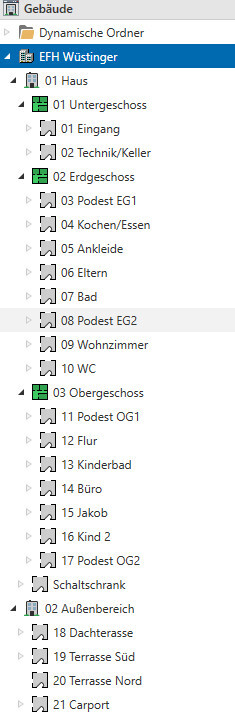
Each room/area was assigned its own number, starting from 01-Entrance up to 21-Carport.
For the physical addresses, each room was given a dedicated range of ten.
The motion detector in the entrance therefore has the physical address ending in 11, the switch in the entrance 12. The motion detector in the carport has 211. Actuators in the control cabinet start at 22, divided further into actuator groups there.
For example, a dimming actuator has 220/221/222, a switching actuator 230/231/232, and a shutter actuator 240/241/242.
With this allocation, the installation location can already be clearly identified from the physical address. This is quite useful for diagnostics.
For the group addresses, I did it like this:
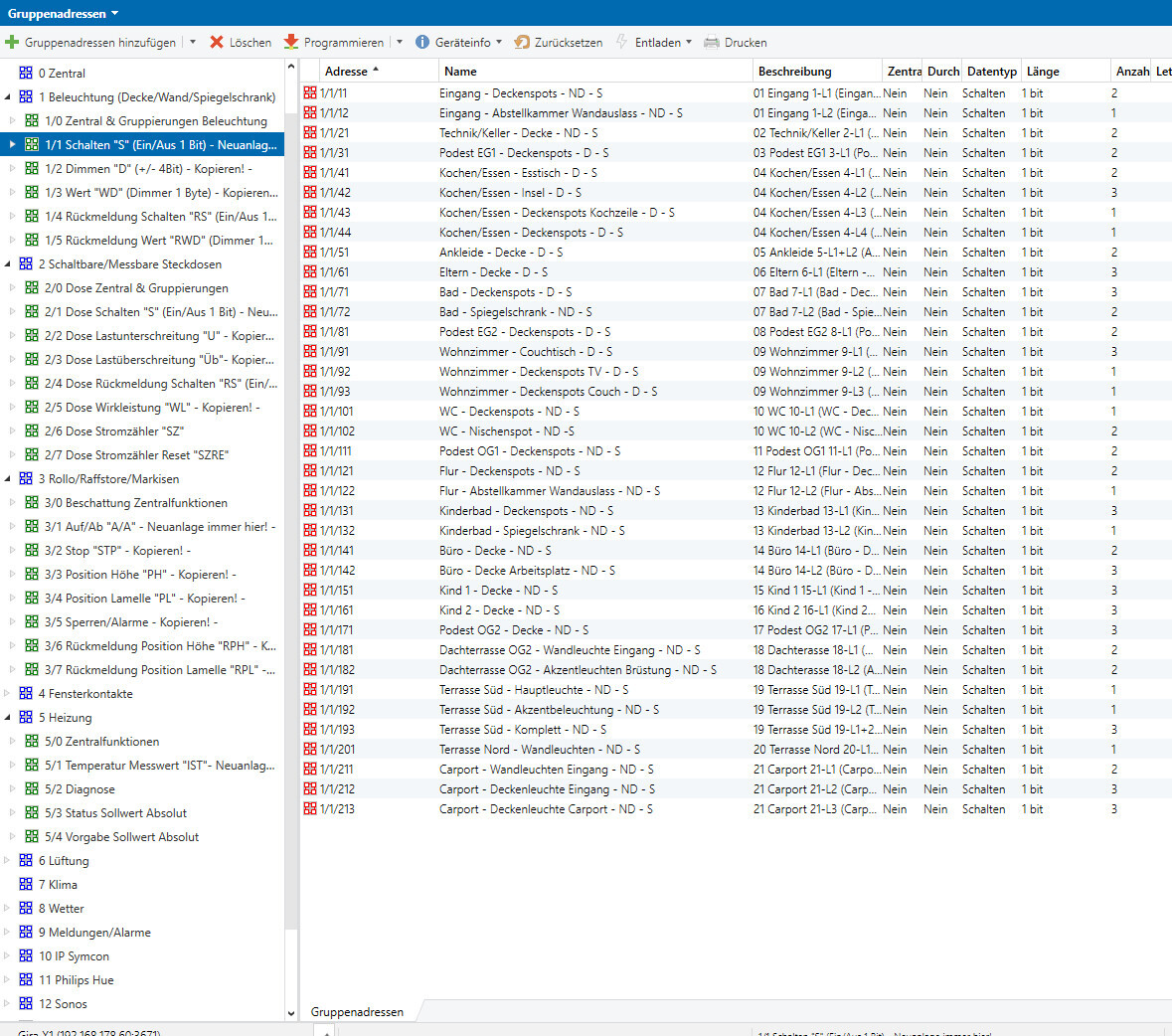
Main groups are organized by trade.
0 - Central
1 - Lighting
2 - Switchable sockets
3 - Roller shutters / Venetian blinds
4 - Window contacts
5 - Heating
and so on.
Philips Hue and Sonos each have their own main groups here as well, as do presence detectors, weather stations, etc.
Middle groups are then chosen depending on the function, in the case of lighting:
1/0 - Central
1/1 - Switching
1/2 - Dimming
1/3 - Absolute dimming
1/4 - Switching feedback
1/5 - Dimming value feedback
The respective group addresses are assigned to the room numbers mentioned above, also in groups of ten.
So, the group address for switching the light in the entrance is 1/1/11, and the corresponding status feedback is 1/4/11.
The light in the carport then has 1/1/211 and the status feedback 1/4/211.
Here too, you can immediately tell from the address which room is involved.
We have been living in the house since 2017, and nowadays I only rarely make changes. But I still find this structure very easy to navigate and have never really faced any major issues with space.
Only with locking functions for the shutters did things get a bit tight, but that was manageable.
Honestly, I can no longer say exactly where I got the structure from. I think I either adapted a version from Heinle or EIBmeier slightly.
But it doesn’t really matter—I am not claiming the idea as my own 😉
Each room/area was assigned its own number, starting from 01-Entrance up to 21-Carport.
For the physical addresses, each room was given a dedicated range of ten.
The motion detector in the entrance therefore has the physical address ending in 11, the switch in the entrance 12. The motion detector in the carport has 211. Actuators in the control cabinet start at 22, divided further into actuator groups there.
For example, a dimming actuator has 220/221/222, a switching actuator 230/231/232, and a shutter actuator 240/241/242.
With this allocation, the installation location can already be clearly identified from the physical address. This is quite useful for diagnostics.
For the group addresses, I did it like this:
Main groups are organized by trade.
0 - Central
1 - Lighting
2 - Switchable sockets
3 - Roller shutters / Venetian blinds
4 - Window contacts
5 - Heating
and so on.
Philips Hue and Sonos each have their own main groups here as well, as do presence detectors, weather stations, etc.
Middle groups are then chosen depending on the function, in the case of lighting:
1/0 - Central
1/1 - Switching
1/2 - Dimming
1/3 - Absolute dimming
1/4 - Switching feedback
1/5 - Dimming value feedback
The respective group addresses are assigned to the room numbers mentioned above, also in groups of ten.
So, the group address for switching the light in the entrance is 1/1/11, and the corresponding status feedback is 1/4/11.
The light in the carport then has 1/1/211 and the status feedback 1/4/211.
Here too, you can immediately tell from the address which room is involved.
We have been living in the house since 2017, and nowadays I only rarely make changes. But I still find this structure very easy to navigate and have never really faced any major issues with space.
Only with locking functions for the shutters did things get a bit tight, but that was manageable.
Honestly, I can no longer say exactly where I got the structure from. I think I either adapted a version from Heinle or EIBmeier slightly.
But it doesn’t really matter—I am not claiming the idea as my own 😉
C
Chris251124 Jan 2022 15:43It looks almost exactly the same for me in the ETS as well.;)
R
RotorMotor24 Jan 2022 19:41K1300S schrieb:
You don’t really need any structure for the PAs. You can group or sort the devices somehow, but as soon as you add something new, that system falls apart anyway.For now, I just assigned 5 PAs per room. Usually, there’s only one presence detector and sometimes a push button.
Most devices are centralized in the distribution panel. There, I again use 5 PAs per field/row.
K1300S schrieb:
Regarding the GAs, check out the KNX Association. There are several posts and, if I recall correctly, a PDF that explains at least one system.One of the PDFs uses the floor as the main group in the example. That didn’t seem very intuitive to me for a single-family house.matte1987 schrieb:
For the GAs, I did it like this:
Main groups are sorted by trades.
0 – Central
1/0 – Central How do you differentiate between these central variants? What goes into 0 and what into 1/0, 2/0, etc.?