
Hello, we hope to solve the following issue with your help.
We have been puzzling for a long time over the design of the house facade. The original plan was a simple white plaster facade, and now the roof is in place and the windows are already ordered. However, plain plaster has become too boring for us, so we are now considering a mixed facade.
Since we didn’t initially plan for brickwork, this is now a problem. The bricks have no support or bearing surface.
We either add a support structure for the bricks afterwards or use brick slips (thin brick veneers) instead.
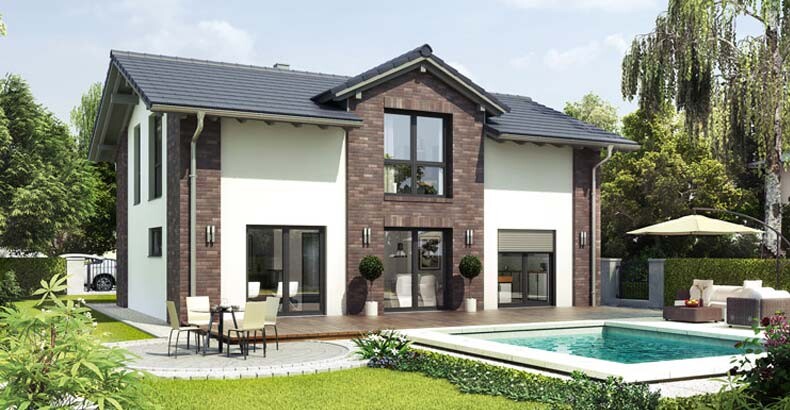
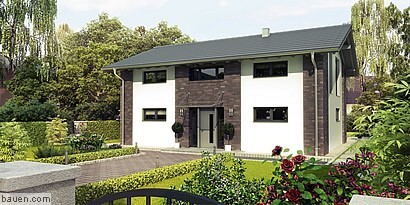
The mixed facade is intended to cover three corners and the entrance area. I have attached a similar example.
What would you do? Would you recommend brick slips, or would you go to the effort of creating a support for the brickwork?
How does the different wall structure with bricks affect the build? Should we expect a large offset, or how can this be resolved visually?
We have been puzzling for a long time over the design of the house facade. The original plan was a simple white plaster facade, and now the roof is in place and the windows are already ordered. However, plain plaster has become too boring for us, so we are now considering a mixed facade.
Since we didn’t initially plan for brickwork, this is now a problem. The bricks have no support or bearing surface.
We either add a support structure for the bricks afterwards or use brick slips (thin brick veneers) instead.
The mixed facade is intended to cover three corners and the entrance area. I have attached a similar example.
What would you do? Would you recommend brick slips, or would you go to the effort of creating a support for the brickwork?
How does the different wall structure with bricks affect the build? Should we expect a large offset, or how can this be resolved visually?
That’s exactly the question I’ve already asked! Opinions vary. Some say it’s obvious that they are just thin bricks, while others say it’s not noticeable. So, there are definitely big differences in quality. We are still undecided as well. Where are you building, if I may ask?
I didn’t know that a building permit / planning permission is required for that.
Since we have to apply for a permit for the garage anyway, we could include it at the same time.
Before regretting it for a lifetime, I would be willing to accept that.
@ KayLinus
We are building near Hannover.
We have already encountered these different opinions as well.
However, we were rather advised against the durability of the facing bricks. Moisture can get behind the facing bricks, causing them to come loose. We were assured that, in terms of appearance, they do not differ from real bricks.
We had also chosen two major manufacturers who deal extensively with facing bricks.
I’m probably not allowed to name them here.
But happy to share via private message.
Since we have to apply for a permit for the garage anyway, we could include it at the same time.
Before regretting it for a lifetime, I would be willing to accept that.
@ KayLinus
We are building near Hannover.
We have already encountered these different opinions as well.
However, we were rather advised against the durability of the facing bricks. Moisture can get behind the facing bricks, causing them to come loose. We were assured that, in terms of appearance, they do not differ from real bricks.
We had also chosen two major manufacturers who deal extensively with facing bricks.
I’m probably not allowed to name them here.
But happy to share via private message.
deTony schrieb:
I didn’t know that you have to submit a building application for that. But are you familiar with your local development plan and building permit / planning permission? Have you looked into them? They clearly specify what you are allowed to build: what has been applied for and approved. Nothing else! Who submitted the building application on your behalf?
Hmm... I partly understand this.
Before buying a plot of land, I—as the buyer—have studied the zoning plan.
I need to know what I’m allowed to build and what is not permitted. This also includes the exterior design. For some, plaster is a no-go; for others, brickwork is. Besides that, there are rules about height, roof pitch, ridge line requirements, etc.
The construction is planned according to the zoning plan, and the application is submitted based on this. There are decisions to be made by the builder regarding the design—whether the house meets their preferences. These wishes should be clarified beforehand. The house type must be coordinated: the main structure with the facade, cross-sections with windows.
That’s why I don’t understand how things work on your side.
Any changes require a new building permit / planning permission. This always remains with the builder!
Of course, it can happen that you suddenly realize not everything was fully planned—like in your case, where the facade was found to be somewhat boring. Still, as the builder, I always know the zoning plan and the options I have or had.
But the most important thing: the substructure, insulation, and the entire external wall system are coordinated, whether it’s plaster or brick.
Beyond that, my knowledge does not go further. Consult your architect and expect additional costs...
Before buying a plot of land, I—as the buyer—have studied the zoning plan.
I need to know what I’m allowed to build and what is not permitted. This also includes the exterior design. For some, plaster is a no-go; for others, brickwork is. Besides that, there are rules about height, roof pitch, ridge line requirements, etc.
The construction is planned according to the zoning plan, and the application is submitted based on this. There are decisions to be made by the builder regarding the design—whether the house meets their preferences. These wishes should be clarified beforehand. The house type must be coordinated: the main structure with the facade, cross-sections with windows.
That’s why I don’t understand how things work on your side.
Any changes require a new building permit / planning permission. This always remains with the builder!
Of course, it can happen that you suddenly realize not everything was fully planned—like in your case, where the facade was found to be somewhat boring. Still, as the builder, I always know the zoning plan and the options I have or had.
But the most important thing: the substructure, insulation, and the entire external wall system are coordinated, whether it’s plaster or brick.
Beyond that, my knowledge does not go further. Consult your architect and expect additional costs...
Similar topics