
ᐅ Kitchen unit on exterior wall: gap or internal insulation?
Created on: 21 Feb 2019 02:33
S
sonic_mucS
sonic_muc21 Feb 2019 02:33Hello,
I hope you can help me with my problem.
Our kitchen is just over three meters (about 10 feet) long on both the left and right sides and ends with a cabinet against the exterior wall on each side. The exterior wall faces north, and we previously had mold between the refrigerator and the exterior wall, as well as between the base cabinet under the sink and the exterior wall.
The issue was resolved at that time in our now 20-year-old kitchen as follows:
The refrigerator was moved from 5 cm (2 inches) to 15 cm (6 inches) away from the wall.
The wooden panel on the exterior wall side of the sink base cabinet was cut out.
Now the kitchen is being replaced. The refrigerator will stay as it is, but my wife wants the sink base cabinet to be installed with only a 5 cm (2 inches) gap to the exterior wall again (since this cabinet has an internal structure, we can’t cut it).
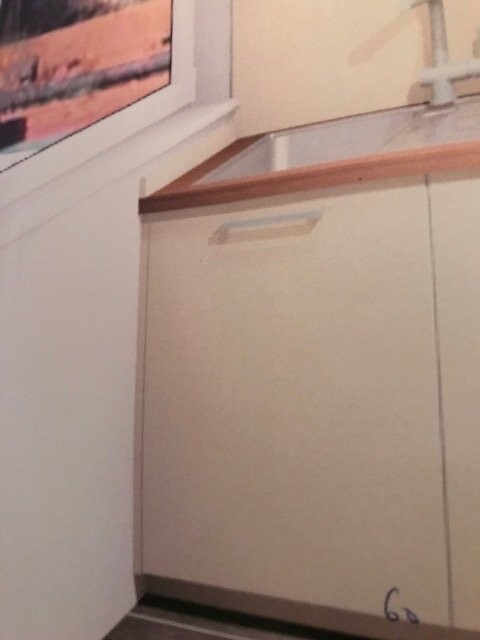
To make matters worse, this 5 cm (2 inches) gap is supposed to be covered with a front panel (see picture).
Questions:
- Can the cold exterior wall be prepared with internal insulation in this area so that the sink base cabinet can be placed safely that close to the wall?
- Should the sink base cabinet be reduced from 60 cm (24 inches) to 45 cm (18 inches) in depth, so that there is approximately 18 cm (7 inches) between the exterior wall and the cabinet, allowing better air circulation? Would a front panel then be counterproductive?
I would be very grateful for any advice!
Best regards,
Tobias
I hope you can help me with my problem.
Our kitchen is just over three meters (about 10 feet) long on both the left and right sides and ends with a cabinet against the exterior wall on each side. The exterior wall faces north, and we previously had mold between the refrigerator and the exterior wall, as well as between the base cabinet under the sink and the exterior wall.
The issue was resolved at that time in our now 20-year-old kitchen as follows:
The refrigerator was moved from 5 cm (2 inches) to 15 cm (6 inches) away from the wall.
The wooden panel on the exterior wall side of the sink base cabinet was cut out.
Now the kitchen is being replaced. The refrigerator will stay as it is, but my wife wants the sink base cabinet to be installed with only a 5 cm (2 inches) gap to the exterior wall again (since this cabinet has an internal structure, we can’t cut it).
To make matters worse, this 5 cm (2 inches) gap is supposed to be covered with a front panel (see picture).
Questions:
- Can the cold exterior wall be prepared with internal insulation in this area so that the sink base cabinet can be placed safely that close to the wall?
- Should the sink base cabinet be reduced from 60 cm (24 inches) to 45 cm (18 inches) in depth, so that there is approximately 18 cm (7 inches) between the exterior wall and the cabinet, allowing better air circulation? Would a front panel then be counterproductive?
I would be very grateful for any advice!
Best regards,
Tobias

S
sonic_muc26 Feb 2019 13:27What type of insulation would be suitable?
Would painting with silicate paint possibly be sufficient?
Thank you
Tobias
Would painting with silicate paint possibly be sufficient?
Thank you
Tobias
There is nothing wrong with interior insulation. In our solid construction on the ground floor, we also have composite panels with 3 cm (1¼ inches) of polystyrene on the walls (this was already installed), and we have no mold anywhere, even though the house was empty for one year and the lower floor has not been heated for at least 8 years.
It is important to install the interior insulation so that it cannot be bypassed by airflow, and the surface should be vapor-tight as well. Otherwise, the humid indoor air would condense on the cold wall behind it. For uneven walls, it is better to use flexible insulation, as it fits more closely (without gaps). For perfectly flat walls, rigid boards like polystyrene can be used and fully glued over the entire surface. The anchors (screws) should naturally be longer in that case.
In the upper floor (timber construction), we also installed interior insulation on all exterior walls, but there with battens and wood fiber boards plus a climate membrane, followed by double layering (OSB, gypsum fiberboard).
These are two examples of how it can be done.
It is important to install the interior insulation so that it cannot be bypassed by airflow, and the surface should be vapor-tight as well. Otherwise, the humid indoor air would condense on the cold wall behind it. For uneven walls, it is better to use flexible insulation, as it fits more closely (without gaps). For perfectly flat walls, rigid boards like polystyrene can be used and fully glued over the entire surface. The anchors (screws) should naturally be longer in that case.
In the upper floor (timber construction), we also installed interior insulation on all exterior walls, but there with battens and wood fiber boards plus a climate membrane, followed by double layering (OSB, gypsum fiberboard).
These are two examples of how it can be done.
Similar topics