
Hello, I have a new building with
Panel type: RW roof panel, 1000 mm (39.4 inches)
Core: IPN1, 160 mm (6.3 inches)
Profiling: T-trapezoidal profile RW / Q-Monobox
Kingspan
Exterior: 0.50 mm (0.02 inches), polyester 25µm, SP,
RAL 7016, anthracite
Interior: 0.40 mm (0.016 inches), polyester 15µm, PEI,
DU, RAL 9002 grey white
installed.
The substructure consists of load-bearing beams with a 6x6 cm (2.4x2.4 inches) frame spaced at 50 cm (20 inches).
The thermal stress on the panels is so high that when the weather changes from sun to clouds, cracking noises occur.
Beforehand, I spoke with an architect from Oldenburg who built a residential house using these panels.
Unfortunately, she did not mention the issue with the cracking noises. In hindsight, she admitted that she also experiences these noises.
Cause:
Because a sandwich panel, besides length changes, behaves like a bi-metal and additionally bends convexly when heated from outside, there are extra stresses on the substructure caused by twisting of the purlins and rails and additionally lifting forces on the middle supports of the purlins or rails.
Now the question is, how can this problem be solved?
A new roof... that will be expensive.
Inquiry at Kingspan: The screws are to blame! When expanding, the metal jumps over the threads of the screws.
Screw manufacturer (Ejot): Nonsense, the screws are not to blame, this is a construction-related problem of the panel in connection with the timber substructure.
Does anyone have a solution?
Panel type: RW roof panel, 1000 mm (39.4 inches)
Core: IPN1, 160 mm (6.3 inches)
Profiling: T-trapezoidal profile RW / Q-Monobox
Kingspan
Exterior: 0.50 mm (0.02 inches), polyester 25µm, SP,
RAL 7016, anthracite
Interior: 0.40 mm (0.016 inches), polyester 15µm, PEI,
DU, RAL 9002 grey white
installed.
The substructure consists of load-bearing beams with a 6x6 cm (2.4x2.4 inches) frame spaced at 50 cm (20 inches).
The thermal stress on the panels is so high that when the weather changes from sun to clouds, cracking noises occur.
Beforehand, I spoke with an architect from Oldenburg who built a residential house using these panels.
Unfortunately, she did not mention the issue with the cracking noises. In hindsight, she admitted that she also experiences these noises.
Cause:
Because a sandwich panel, besides length changes, behaves like a bi-metal and additionally bends convexly when heated from outside, there are extra stresses on the substructure caused by twisting of the purlins and rails and additionally lifting forces on the middle supports of the purlins or rails.
Now the question is, how can this problem be solved?
A new roof... that will be expensive.
Inquiry at Kingspan: The screws are to blame! When expanding, the metal jumps over the threads of the screws.
Screw manufacturer (Ejot): Nonsense, the screws are not to blame, this is a construction-related problem of the panel in connection with the timber substructure.
Does anyone have a solution?

Rubin21 schrieb:
...
Cause:
Since a sandwich panel, besides changing length, also bends convexly like a bimetal strip when exposed to external heat, additional stresses occur in the substructure due to twisting of the purlins and girts, as well as lifting forces on the middle supports of the purlins or girts.
Now the question is, how can this problem be solved?
New roof ... will be expensive.
Inquiry to Kingspan: The screws are to blame! When expanding, the metal slips over the threads of the screws.
Screw manufacturer: Nonsense, the screws are not to blame; this is a structural issue of the panel in connection with the timber substructure.
Does anyone have a solution?In my opinion, the screws are probably not at fault but rather incorrect installation. For example, wrong drill holes or too high tightening torque on the screws (or the wrong screws, such as fully threaded ones...). The fastening must accommodate the large deformations of the panels WITHOUT transferring them to the substructure. This usually requires specially trained professionals AND proper tools during installation.I have a friend who is, among other things, a specialist (including certified expert) for sandwich panel buildings. I once discussed this issue with him.
However:
a) No pictures, no "better" answer.
b) AND: complete elimination of the "creaking sounds" is, in my opinion, difficult. But a significant reduction should be achievable.
Hi, here are detailed pictures of the screws, and if available, also of the drill holes—that would be great. Ideally, pictures of the installation showing the tool used would be perfect. As mentioned before, these are important aspects when installing such sandwich panels.
During the planning of a metal roof for my sauna, I also considered its installation. The longitudinal expansion of metal panels only 3m (10 feet) long was quite a challenge! Therefore, a special fastening system allowing more than 10mm (0.4 inches) of movement was necessary. This could involve elongated holes (to maintain watertightness) or another method that permits sliding while simultaneously securing the panels and preventing direct transfer of forces to the substructure.
Alternatively, I am wondering if the substructure might be undersized and should actually be able to withstand the shear forces without twisting?
Alternatively, I am wondering if the substructure might be undersized and should actually be able to withstand the shear forces without twisting?
Ha
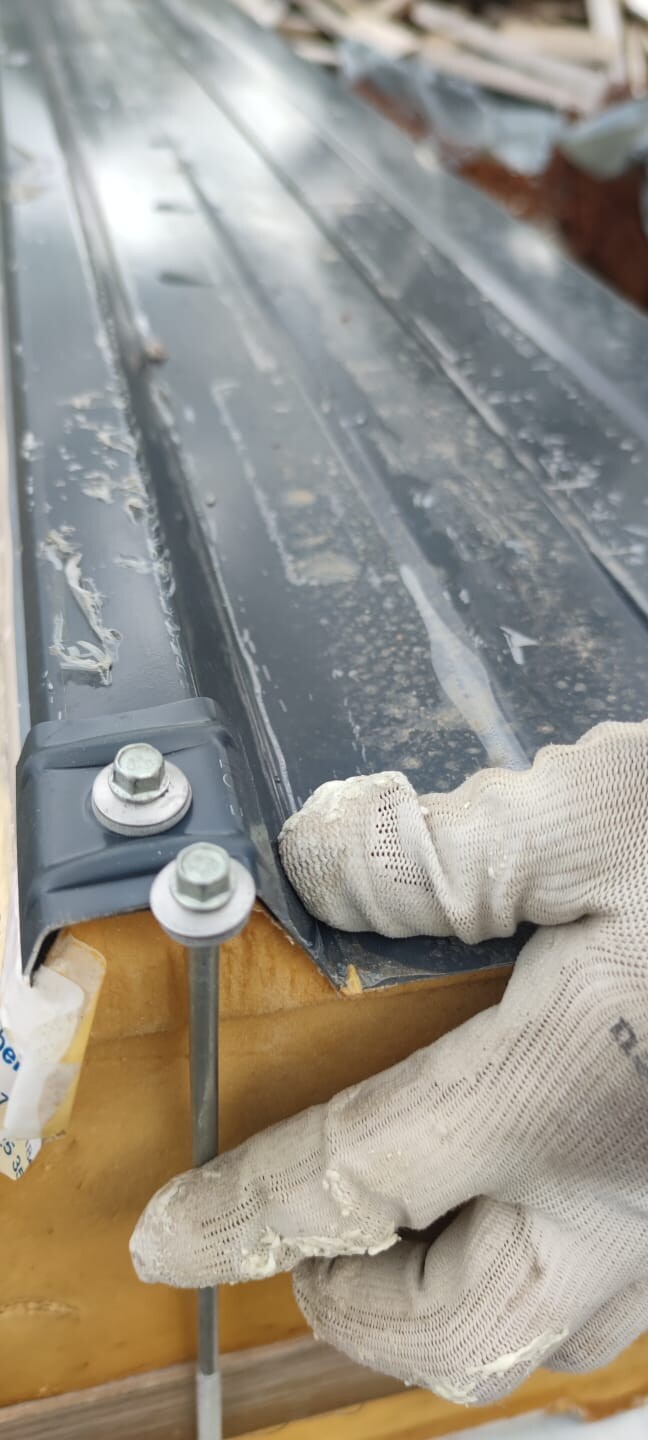
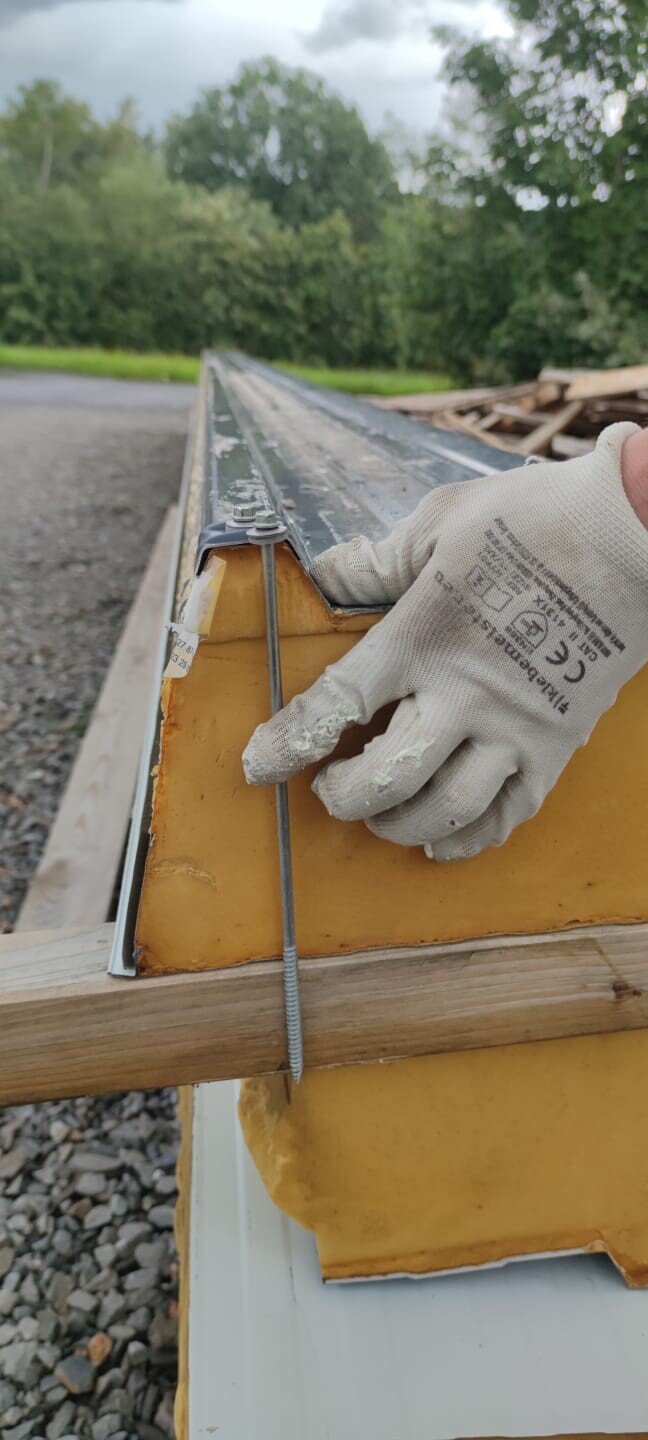
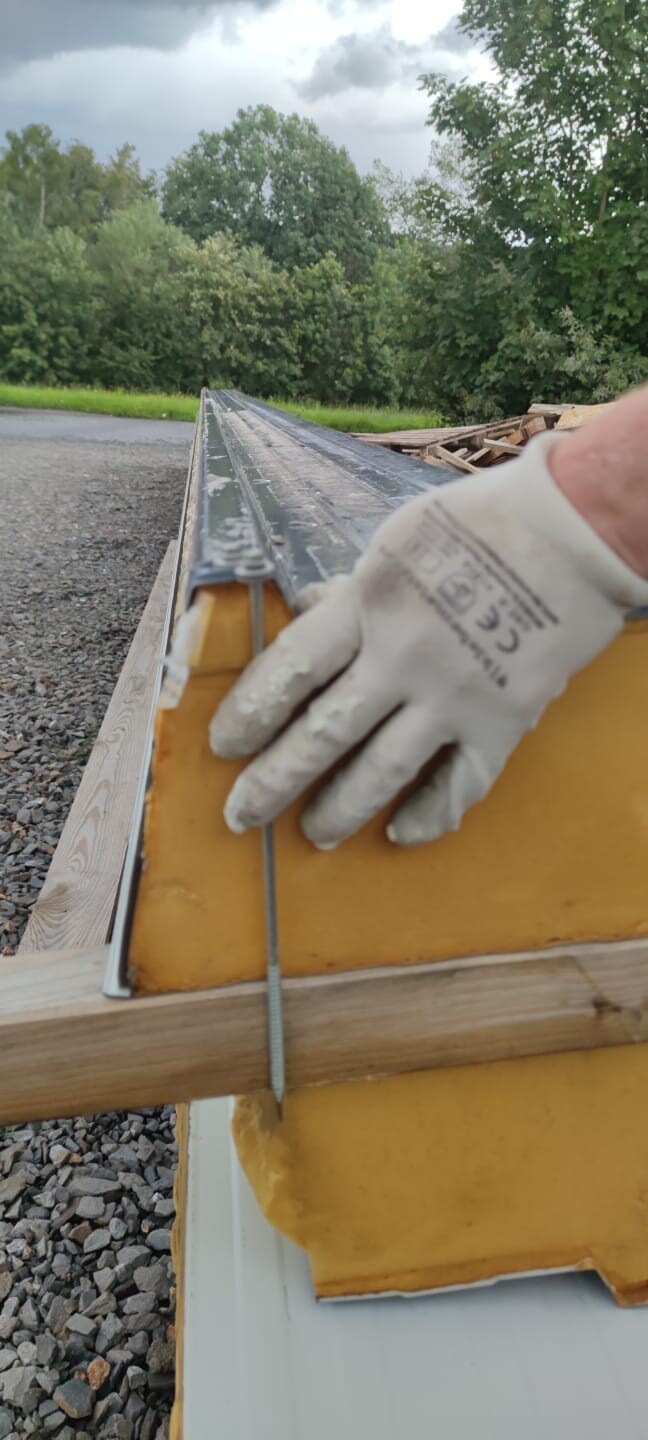
Hello, attached are photos of the screw connections.
There are no photos from the time of installation. The panels were lifted onto the roof using a telehandler.
Sealing tape was applied in the exterior areas.
The photos show the assembly on a scrap piece.
i_b_n_a_n schrieb:
Hi, detailed photos of the screw connections would be helpful, including drill holes if available. Ideally, pictures of the assembly process showing the tools used. As mentioned before, these are important details when installing sandwich panels.
Hello, attached are photos of the screw connections.
There are no photos from the time of installation. The panels were lifted onto the roof using a telehandler.
Sealing tape was applied in the exterior areas.
The photos show the assembly on a scrap piece.
Similar topics