
ᐅ KfW70 standard with a gas condensing boiler and solar panels is definitely not feasible.
Created on: 6 Aug 2014 15:56
T
TeuPhil
Hello everyone!
Yes, this is the statement from my architect that has been on my mind for quite some time now, and given that houses exactly like these exist—with the certificate I want—I am not quite satisfied with it.
But first, a brief overview of the key data for our planned single-family house, hopefully including the values relevant here:
- 2 full stories with a converted and habitable attic (35-degree pitched roof) with a total heated area of 220 sqm (2370 sq ft) without a basement
- heated building volume: 828 cubic meters (29,240 cubic feet)
- usable area according to energy saving regulations: 265 sqm (2852 sq ft)
- primary energy demand QP: 61.02
- transmission heat loss HT: 0.337
- ventilation heat loss HV: 128.35 W/K
The whole thing will be realized with the following technology and insulation:
- gas condensing boiler with solar thermal for domestic hot water (and heating support option)
- controlled ventilation system with heat recovery
- house orientation: SSW/NNE
- exterior masonry: 365 mm (14 inches) aerated concrete, thermal conductivity 0.035, U-value = 0.229
- pitched roof U-value = 0.19 (currently 20 cm (8 inches) insulation between rafters)
- ground floor slab U-value = 0.298
- aluminum front door U-value = 1.3
- triple-glazed windows U-value = 0.84
As a result, the KfW70 standard is met in terms of transmission heat loss. However, the annual primary energy demand is still problematic.
When I asked how the remaining approximately 11 kWh could be saved in a (also economically) reasonable way, I received the rather general answer: “with a heat pump or a pellet boiler.” But I deliberately chose conventional gas and do not want to deviate from that decision. Also, I suspect that these are hardly the only possible solutions but rather the simplest ones.
Before I take the (already planned) step to consult an energy advisor, I would like to ask the experts here in the forum whether my prospects are really that bleak if I stick with gas as my primary energy source.
Oh, one more thing... the house is not being built by a developer or general contractor. So I’m relatively flexible with purchasing. The cost-benefit factor should just be kept reasonable.
As a final note, here’s the answer in advance to the question: “Why KfW70 in particular?”
I am aware that a KfW85 house can have a lower energy demand than a KfW70 house. Much can be calculated advantageously here (keyword: heat pumps). But ultimately, it’s the “good feeling” of having proof at any time with a certificate that I own a particularly energy-efficient house. How paradoxical that sounds... In the end, I simply want to achieve the best possible energy standard for my budget.
Best regards
TeuPhil
Yes, this is the statement from my architect that has been on my mind for quite some time now, and given that houses exactly like these exist—with the certificate I want—I am not quite satisfied with it.
But first, a brief overview of the key data for our planned single-family house, hopefully including the values relevant here:
- 2 full stories with a converted and habitable attic (35-degree pitched roof) with a total heated area of 220 sqm (2370 sq ft) without a basement
- heated building volume: 828 cubic meters (29,240 cubic feet)
- usable area according to energy saving regulations: 265 sqm (2852 sq ft)
- primary energy demand QP: 61.02
- transmission heat loss HT: 0.337
- ventilation heat loss HV: 128.35 W/K
The whole thing will be realized with the following technology and insulation:
- gas condensing boiler with solar thermal for domestic hot water (and heating support option)
- controlled ventilation system with heat recovery
- house orientation: SSW/NNE
- exterior masonry: 365 mm (14 inches) aerated concrete, thermal conductivity 0.035, U-value = 0.229
- pitched roof U-value = 0.19 (currently 20 cm (8 inches) insulation between rafters)
- ground floor slab U-value = 0.298
- aluminum front door U-value = 1.3
- triple-glazed windows U-value = 0.84
As a result, the KfW70 standard is met in terms of transmission heat loss. However, the annual primary energy demand is still problematic.
When I asked how the remaining approximately 11 kWh could be saved in a (also economically) reasonable way, I received the rather general answer: “with a heat pump or a pellet boiler.” But I deliberately chose conventional gas and do not want to deviate from that decision. Also, I suspect that these are hardly the only possible solutions but rather the simplest ones.
Before I take the (already planned) step to consult an energy advisor, I would like to ask the experts here in the forum whether my prospects are really that bleak if I stick with gas as my primary energy source.
Oh, one more thing... the house is not being built by a developer or general contractor. So I’m relatively flexible with purchasing. The cost-benefit factor should just be kept reasonable.
As a final note, here’s the answer in advance to the question: “Why KfW70 in particular?”
I am aware that a KfW85 house can have a lower energy demand than a KfW70 house. Much can be calculated advantageously here (keyword: heat pumps). But ultimately, it’s the “good feeling” of having proof at any time with a certificate that I own a particularly energy-efficient house. How paradoxical that sounds... In the end, I simply want to achieve the best possible energy standard for my budget.
Best regards
TeuPhil
I completely agree with you! I’m also close to complete resignation. If I only consider the interest rate advantage from the KfW bank as a reward for the effort, the numbers still don’t add up for the necessary measures. But if a resale ever comes up, the energy performance certificate will definitely play a role...
As you already said, in the end, the energy saving regulations force you into an ugly straitjacket, and sustainability, efficiency, and economy get left behind.
But if there are still one or two undiscovered and sensible ways to tweak my primary energy demand by those last few required kWh, I’m happy to take them.
As you already said, in the end, the energy saving regulations force you into an ugly straitjacket, and sustainability, efficiency, and economy get left behind.
But if there are still one or two undiscovered and sensible ways to tweak my primary energy demand by those last few required kWh, I’m happy to take them.

As klblb already mentioned, maybe don’t overestimate the KfW70 standard, especially not solely for the purpose of obtaining an energy certificate, which doesn’t even show how much energy you actually end up using.
We bought a 2-year-old semi-detached house (without an energy certificate, 35.5 cm (14 inches) aerated concrete, gas condensing boiler, solar thermal system, no mechanical ventilation) with the seller stating that it is not a KfW70 house, but the consumption is close to KfW70. I could have had this confirmed through bills.
In hindsight, I have to say yes, that’s accurate. But in that case, you can really do without an energy certificate. And even when reselling later, regardless of the energy certificate, you might still be able to prove that your consumption is below KfW70.
We bought a 2-year-old semi-detached house (without an energy certificate, 35.5 cm (14 inches) aerated concrete, gas condensing boiler, solar thermal system, no mechanical ventilation) with the seller stating that it is not a KfW70 house, but the consumption is close to KfW70. I could have had this confirmed through bills.
In hindsight, I have to say yes, that’s accurate. But in that case, you can really do without an energy certificate. And even when reselling later, regardless of the energy certificate, you might still be able to prove that your consumption is below KfW70.
B
Bauexperte8 Aug 2014 11:15Hello Phil,
I am not an expert in these matters—especially since there are several ways to achieve the same goal—but I can respond based on my professional experience.
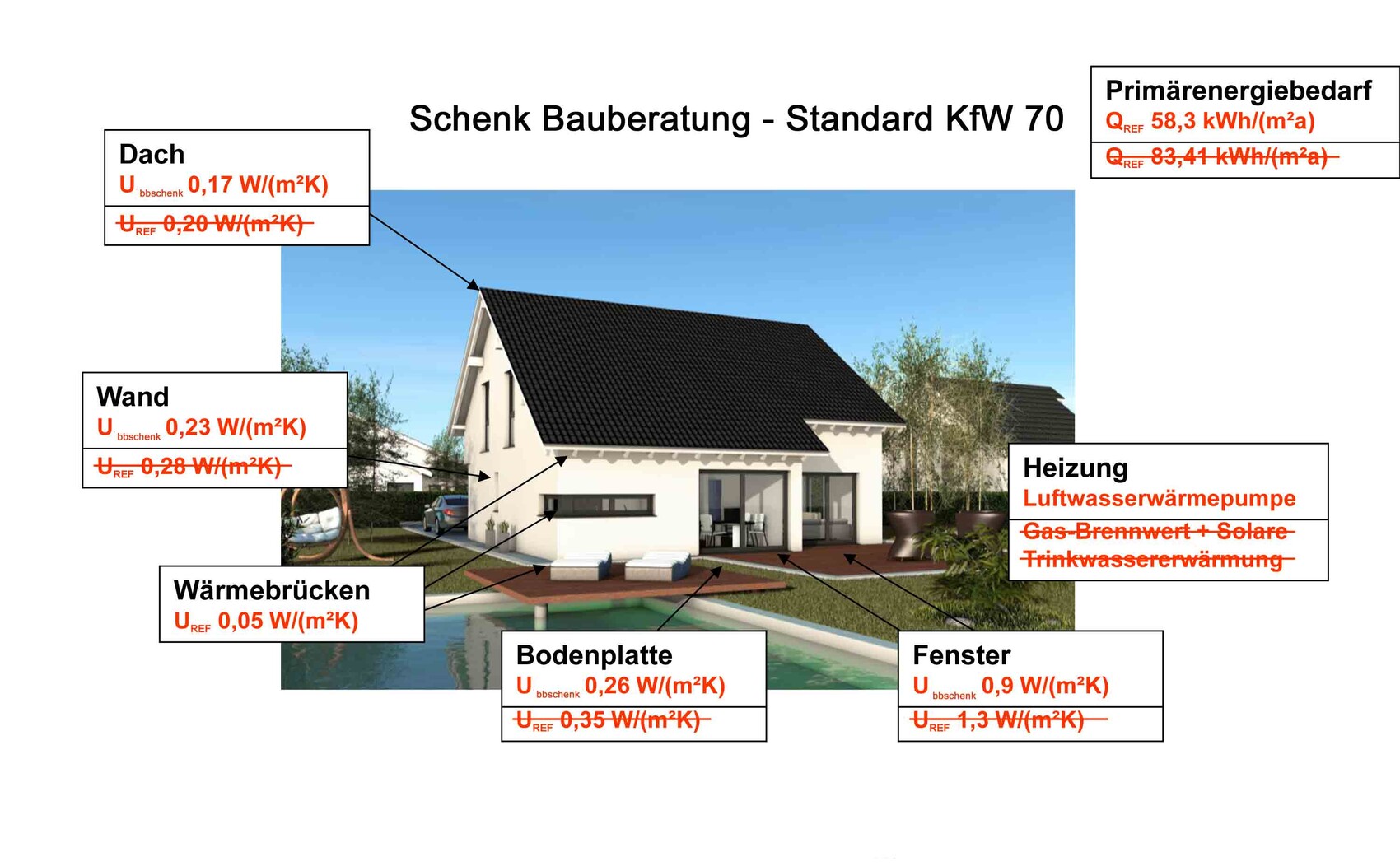
Our KfW 70 energy-efficient houses have building envelopes that meet the following standard values:
Floor slab: 0.26 W/(m²K) (0.26 W/(m²K)) → reference building 0.35 W/(m²K)
Windows (glass and frames): 0.9 W/(m²K) → reference building 1.3 W/(m²K)
Wall (36.5 monolithic): 0.23 W/(m²K) → reference building 0.28 W/(m²K)
Roof: 0.17 W/(m²K) → reference building 0.20 W/(m²K)
Considering thermal bridges (0.05 W/(m²K)), we typically achieve a calculated primary energy demand of Q 58.3 kWh/(m²a) [reference building Q 83.41 kWh/(m²a)] using an air-to-water heat pump—assuming the building is not located at an extreme altitude like Zugspitze; see attachment.
However, we already cover other factors through the building specifications; the 200 mm (8 inches) insulation you mentioned is just one of several areas where we may differ.
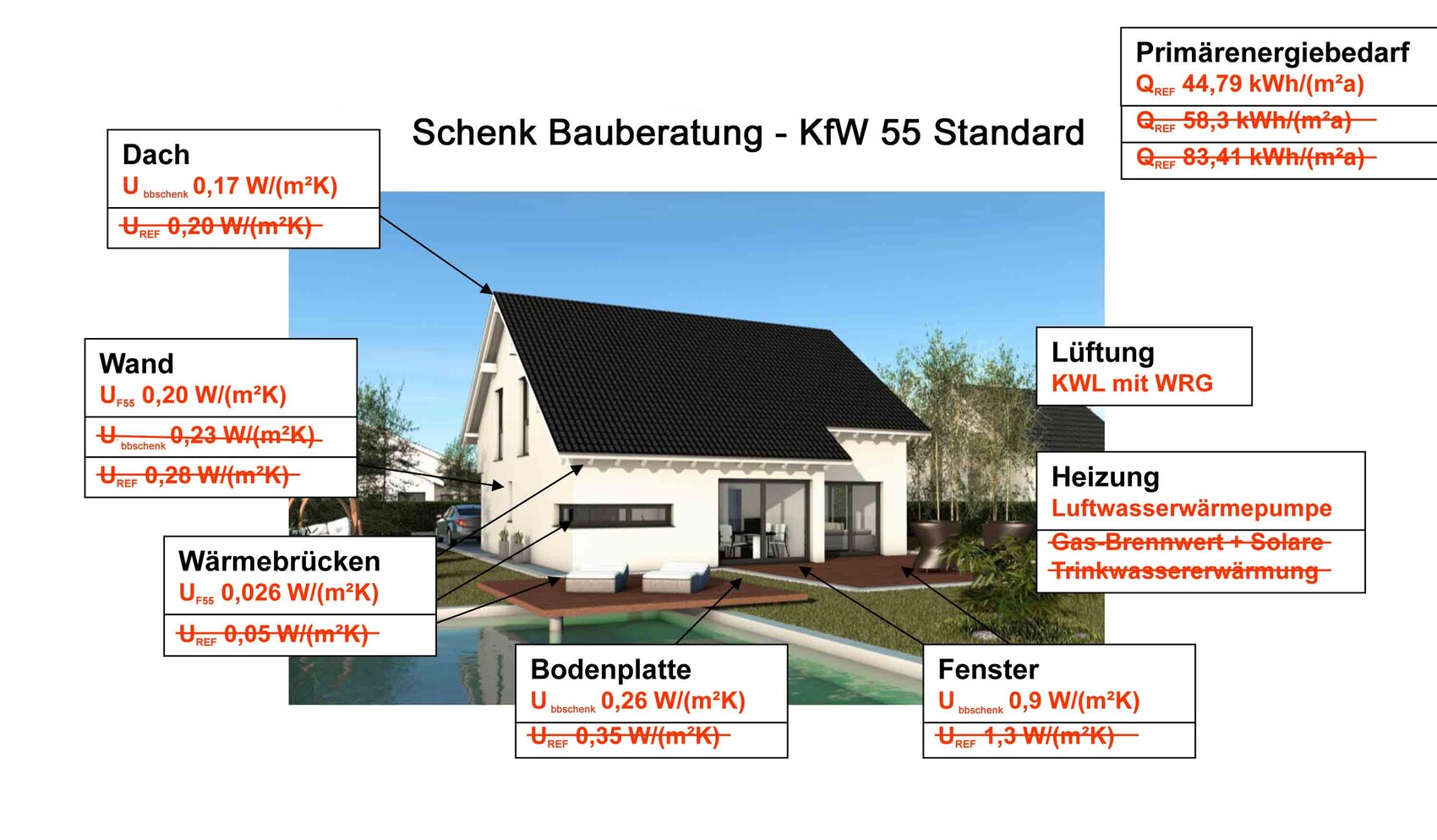
If a homeowner chooses to install a gas condensing boiler with solar heating support, they generally cannot expect to meet the KfW 70 standard with that alone; usually, the installation of a ventilation system with heat recovery is necessary. This measure is sufficient in most cases to qualify for the KfW subsidy loan; in very rare cases (depending on location), additional insulation may be required. The next level (KfW 55, see attachment) lacks only a ventilation system with heat recovery and a solid brick with a value of 0.20 W/(m²K).
As I said at the beginning, there are multiple ways to reach the goal—literally—because there are different calculation methods to prove compliance with KfW standards. Also, there are differences in the professionals performing these calculations. Some structural engineers calculate concrete as water, while others base their work on actual conditions. Since everything ultimately depends on the paperwork, your planner might belong to the first category or choose what is considered a "less favorable" calculation method.
Regarding the KfW 70 efficiency house—if subsidies are of secondary importance to you (since they are not significantly cheaper at present anyway), I would not worry too much. A single-family house built according to the Energy Saving Ordinance (EnEV) is not really a bad choice; in my personal opinion, it is often the better option considering the considerable financial effort. What matters, in my view, is not that the paperwork states “You built a single-family house subsidized under KfW 70,” but the actual energy consumption. In the event of a sale, that is what will interest a potential buyer the most.
Best regards,
Bauexperte
I am not an expert in these matters—especially since there are several ways to achieve the same goal—but I can respond based on my professional experience.
Our KfW 70 energy-efficient houses have building envelopes that meet the following standard values:
Floor slab: 0.26 W/(m²K) (0.26 W/(m²K)) → reference building 0.35 W/(m²K)
Windows (glass and frames): 0.9 W/(m²K) → reference building 1.3 W/(m²K)
Wall (36.5 monolithic): 0.23 W/(m²K) → reference building 0.28 W/(m²K)
Roof: 0.17 W/(m²K) → reference building 0.20 W/(m²K)
Considering thermal bridges (0.05 W/(m²K)), we typically achieve a calculated primary energy demand of Q 58.3 kWh/(m²a) [reference building Q 83.41 kWh/(m²a)] using an air-to-water heat pump—assuming the building is not located at an extreme altitude like Zugspitze; see attachment.
However, we already cover other factors through the building specifications; the 200 mm (8 inches) insulation you mentioned is just one of several areas where we may differ.
If a homeowner chooses to install a gas condensing boiler with solar heating support, they generally cannot expect to meet the KfW 70 standard with that alone; usually, the installation of a ventilation system with heat recovery is necessary. This measure is sufficient in most cases to qualify for the KfW subsidy loan; in very rare cases (depending on location), additional insulation may be required. The next level (KfW 55, see attachment) lacks only a ventilation system with heat recovery and a solid brick with a value of 0.20 W/(m²K).
As I said at the beginning, there are multiple ways to reach the goal—literally—because there are different calculation methods to prove compliance with KfW standards. Also, there are differences in the professionals performing these calculations. Some structural engineers calculate concrete as water, while others base their work on actual conditions. Since everything ultimately depends on the paperwork, your planner might belong to the first category or choose what is considered a "less favorable" calculation method.
Regarding the KfW 70 efficiency house—if subsidies are of secondary importance to you (since they are not significantly cheaper at present anyway), I would not worry too much. A single-family house built according to the Energy Saving Ordinance (EnEV) is not really a bad choice; in my personal opinion, it is often the better option considering the considerable financial effort. What matters, in my view, is not that the paperwork states “You built a single-family house subsidized under KfW 70,” but the actual energy consumption. In the event of a sale, that is what will interest a potential buyer the most.
Best regards,
Bauexperte
Today, I contacted an energy consultant licensed by the KfW and explained the circumstances and conditions once again. He was also quite surprised that the primary energy demand for KfW70 had supposedly not been met despite having controlled residential ventilation with heat recovery and solar thermal systems. He suspected calculation errors when cross-checking some of the data, regardless of their nature.
So now I have two options.
1) I can have the energy saving regulation certificate (and the proof for the KfW efficiency house) reviewed thoroughly again and corrected if necessary. The likelihood that the house would then qualify for funding seems quite high. This would mainly be about ending up with an energy certificate that, for example, awards an A rating instead of a B. Estimated cost: 500€.
2) To be able to use the KfW loan, the KfW assessor must, of course, be commissioned for the complete planning and construction supervision in order to issue the required certificate at the end. Even if he reduced the work and review effort required by the Federal Court of Auditors in my favor, the cost—which depends on regional fee schedules—would be several thousand euros. Cough...
So I will probably just drop all the KfW hassle, get another consultation to make sure my concept is not completely off from the requirements, and if needed, correct the energy certificate later—should a resale ever be considered.
The question remains: what do I do about my current planner if they really took it too easy with the calculations and thus based the project at least partly on incorrect values, resulting in an actual energy balance for the house that is worse than stated...
So now I have two options.
1) I can have the energy saving regulation certificate (and the proof for the KfW efficiency house) reviewed thoroughly again and corrected if necessary. The likelihood that the house would then qualify for funding seems quite high. This would mainly be about ending up with an energy certificate that, for example, awards an A rating instead of a B. Estimated cost: 500€.
2) To be able to use the KfW loan, the KfW assessor must, of course, be commissioned for the complete planning and construction supervision in order to issue the required certificate at the end. Even if he reduced the work and review effort required by the Federal Court of Auditors in my favor, the cost—which depends on regional fee schedules—would be several thousand euros. Cough...
So I will probably just drop all the KfW hassle, get another consultation to make sure my concept is not completely off from the requirements, and if needed, correct the energy certificate later—should a resale ever be considered.
The question remains: what do I do about my current planner if they really took it too easy with the calculations and thus based the project at least partly on incorrect values, resulting in an actual energy balance for the house that is worse than stated...
B
Bauexperte8 Aug 2014 16:49Hello,
The energy consultant – what exactly is a licensed energy consultant anyway? – needs to fill out form 153 “up front” for you (the structural engineer must also perform calculations for this) and then confirm at the end that a KfW 70 efficiency house was actually built. This does not cost several thousand euros at all!
Regards, Bauexperte
TeuPhil schrieb:With all due respect – that’s nonsense....
2) To be eligible for the KfW loan, the KfW assessor must of course be hired for the complete planning and construction supervision in order to issue the required certificate at the end. Even if they were to reduce the work and inspection effort mandated by the Federal Audit Office in my favor, the cost, which is regulated according to state fee schedules, would still amount to several thousand euros. Ahem.....
The energy consultant – what exactly is a licensed energy consultant anyway? – needs to fill out form 153 “up front” for you (the structural engineer must also perform calculations for this) and then confirm at the end that a KfW 70 efficiency house was actually built. This does not cost several thousand euros at all!
TeuPhil schrieb:Inform the energy consultant mentioned above about the outcome of that conversation, and then see what happens.
The question is what to do with my current planner, if they really took the calculations too lightly and therefore based them at least partly on incorrect values, resulting in the current energy balance of the house being worse than it actually is...
Regards, Bauexperte
Hello building expert,
"Licensed" might not be the correct term. However, the expert must be approved by the KfW and therefore authorized to issue the corresponding certificates. This, for example, is not the case with my structural engineer. If I had known that beforehand, I would have certainly approached the matter differently.
The fact that the certification process is associated with such costs is, on the one hand, equally surprising to me; on the other hand, I was referred here to the information sheets for KfW’s Program 153 (energy-efficient construction), which describe the requirements for the expert. This, combined with the fact that almost every appraiser charges a high fee, makes it somewhat understandable.
But I will definitely inquire further regarding the costs. After all, they are calculated based on the effort involved—and the contacted "energy efficiency expert" lives only 1 meter (3 feet) away from me.
"Licensed" might not be the correct term. However, the expert must be approved by the KfW and therefore authorized to issue the corresponding certificates. This, for example, is not the case with my structural engineer. If I had known that beforehand, I would have certainly approached the matter differently.
The fact that the certification process is associated with such costs is, on the one hand, equally surprising to me; on the other hand, I was referred here to the information sheets for KfW’s Program 153 (energy-efficient construction), which describe the requirements for the expert. This, combined with the fact that almost every appraiser charges a high fee, makes it somewhat understandable.
But I will definitely inquire further regarding the costs. After all, they are calculated based on the effort involved—and the contacted "energy efficiency expert" lives only 1 meter (3 feet) away from me.
Similar topics