
Hello everyone,
we are currently planning our single-family house in Würzburg, and the building permit / planning permission application has been in process for about three weeks. Hopefully, we can start construction in October 2020:
- Plot size: 774 m² (8329 ft²), of which approximately 500 m² (5382 ft²) is buildable, due to about 27% sloping terrain facing south and the plot being somewhat irregular with a path on it.
- Solid construction house, 2 floors, footprint 11 x 15 m (36 x 49 ft). The basement is about two-thirds underground because of the slope.
- Roof pitch 23-30°, gable roof. Roof orientation southwest (or northeast, depending on perspective), so I calculate the southwest roof area as 6.24 m x 15 m = about 93.6 m² (assuming the 30° pitch).
- Household of 5 (2 adults, one ten-year-old child, and 2 babies), living area 214 m² (2303 ft²).
- Planned photovoltaic system with full coverage, air-to-water heat pump, underfloor heating, and central ventilation system with heat recovery. A ground source heat pump with trench collector is unfortunately not possible, as rock is expected everywhere at about 1-1.20 m (3-4 ft) depth.
Two days ago, I had a very interesting meeting with my architect and a solar technician on site.
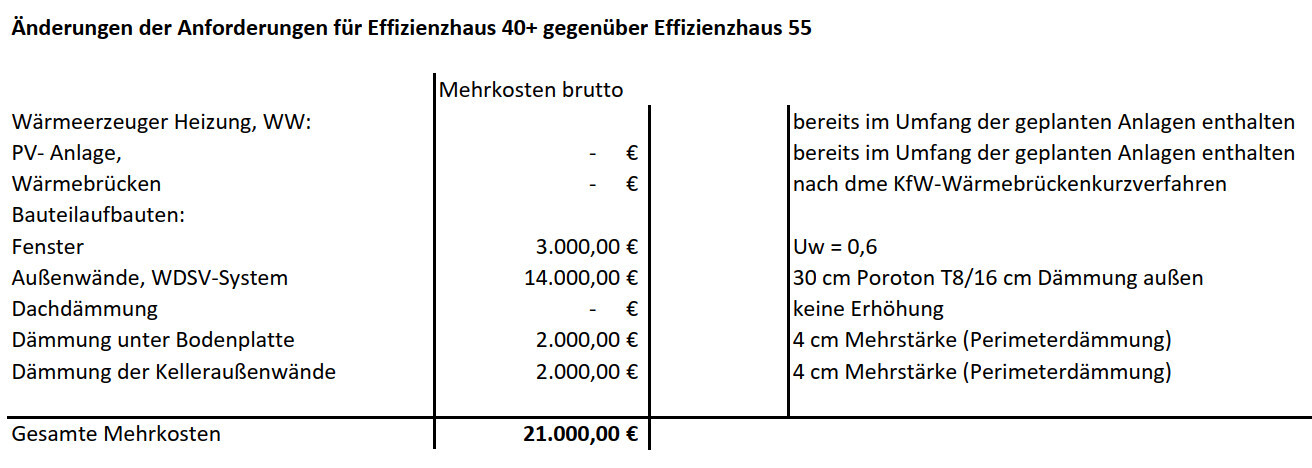
My architect calculated the additional costs for KfW 40 instead of KfW 55. For about €21,000, we can achieve KfW 40, which is less than he initially expected (he had estimated €50,000 and was originally reluctant to perform this calculation; I pushed for it). He has since changed his opinion and now recommends it. The solar technician said during the discussion that for our 5-person family and an estimated annual electricity consumption of 10 kilowatt (his estimate), a battery storage system would probably make sense anyway (as a layperson, I had previously thought a battery storage system would not be worthwhile). Since we already meet all requirements for 40+ except for the battery storage, reaching KfW 40+ would be possible directly.
This brings me to the following considerations:
Pros of 40+:
- €12,000 repayment bonus from the government in addition
- Lower heating costs, higher resale value
- Higher energy self-sufficiency through the battery storage
Cons of 40+:
- 30 cm (12 inches) thick (and somewhat harder) brick wall with external thermal insulation instead of the previously planned 40.5 cm (16 inches) thick (softer) brick wall with internal insulation
- €21,000 additional costs
- About €5,000 extra costs for the battery storage
But what do you think? 55 or 40+?
For completeness, here is the architect’s calculation:
we are currently planning our single-family house in Würzburg, and the building permit / planning permission application has been in process for about three weeks. Hopefully, we can start construction in October 2020:
- Plot size: 774 m² (8329 ft²), of which approximately 500 m² (5382 ft²) is buildable, due to about 27% sloping terrain facing south and the plot being somewhat irregular with a path on it.
- Solid construction house, 2 floors, footprint 11 x 15 m (36 x 49 ft). The basement is about two-thirds underground because of the slope.
- Roof pitch 23-30°, gable roof. Roof orientation southwest (or northeast, depending on perspective), so I calculate the southwest roof area as 6.24 m x 15 m = about 93.6 m² (assuming the 30° pitch).
- Household of 5 (2 adults, one ten-year-old child, and 2 babies), living area 214 m² (2303 ft²).
- Planned photovoltaic system with full coverage, air-to-water heat pump, underfloor heating, and central ventilation system with heat recovery. A ground source heat pump with trench collector is unfortunately not possible, as rock is expected everywhere at about 1-1.20 m (3-4 ft) depth.
Two days ago, I had a very interesting meeting with my architect and a solar technician on site.
My architect calculated the additional costs for KfW 40 instead of KfW 55. For about €21,000, we can achieve KfW 40, which is less than he initially expected (he had estimated €50,000 and was originally reluctant to perform this calculation; I pushed for it). He has since changed his opinion and now recommends it. The solar technician said during the discussion that for our 5-person family and an estimated annual electricity consumption of 10 kilowatt (his estimate), a battery storage system would probably make sense anyway (as a layperson, I had previously thought a battery storage system would not be worthwhile). Since we already meet all requirements for 40+ except for the battery storage, reaching KfW 40+ would be possible directly.
This brings me to the following considerations:
Pros of 40+:
- €12,000 repayment bonus from the government in addition
- Lower heating costs, higher resale value
- Higher energy self-sufficiency through the battery storage
Cons of 40+:
- 30 cm (12 inches) thick (and somewhat harder) brick wall with external thermal insulation instead of the previously planned 40.5 cm (16 inches) thick (softer) brick wall with internal insulation
- €21,000 additional costs
- About €5,000 extra costs for the battery storage
But what do you think? 55 or 40+?
For completeness, here is the architect’s calculation:
M
MichaelH8224 Oct 2020 19:57I like underfloor heating and the climate it creates, which I have experienced over a long time at friends’ homes. So the choice was easy for me.
M
Martial.white24 Oct 2020 20:00The minimum storage size is also specified:
The electric storage system must have a usable capacity of at least 500 watt-hours (Wh) per residential unit plus 10 Wh per square meter (m²) of usable floor area.
The electric storage system must have a usable capacity of at least 500 watt-hours (Wh) per residential unit plus 10 Wh per square meter (m²) of usable floor area.
M
MichaelH8225 Oct 2020 00:53Yes, I am aware of that. I am currently assuming a 2 kW storage system; I will receive more precise information once the building permit / planning permission is approved.