
Just no Hoval ventilation unit!!!
For anyone planning to install a heat recovery ventilation system, I can only advise against the Hoval unit! Unfortunately, we have one installed in our basement and have had nothing but problems. The first unit was replaced by customer service after the first winter because condensate water in the rotary heat exchanger froze at low temperatures. So, a new unit was installed, which runs noticeably quieter than the old one (though it’s still audible). However, almost all problems persist. The system was planned and installed by Hoval, but unfortunately, the location in the unheated storage area turned out to be very unsuitable—there were significant energy losses due to uninsulated piping. We had to cover the entire insulation cost ourselves.
I haven’t even mentioned the most serious issues yet. At lower temperatures, which can drop to minus 24 degrees Celsius (minus 11°F) where we live, the supply air temperature only reaches about 8-9 degrees Celsius (46-48°F), despite the promised 17 degrees Celsius (63°F). Because we don’t live in a mild climate like Italy, the supply air needs preheating regardless of the system used. Hoval still insists their system works without preheating. Furthermore, there is excessive moisture in the living space due to moisture recovery. At lower temperatures, the rotor speed is increased counterproductively, leading to window condensation at a relative humidity of 40-50%.
The worst part is the spread of odors and noise throughout the house. Since all exhaust air from the entire house comes into contact with the supply air in the rotary heat exchanger, the entire home ends up smelling like cooking odors or, even worse, toilet odors. Exhaust and supply air systems must be kept separate!!!
All attempts to get a response from Hoval have so far been unsuccessful.
For anyone planning to install a heat recovery ventilation system, I can only advise against the Hoval unit! Unfortunately, we have one installed in our basement and have had nothing but problems. The first unit was replaced by customer service after the first winter because condensate water in the rotary heat exchanger froze at low temperatures. So, a new unit was installed, which runs noticeably quieter than the old one (though it’s still audible). However, almost all problems persist. The system was planned and installed by Hoval, but unfortunately, the location in the unheated storage area turned out to be very unsuitable—there were significant energy losses due to uninsulated piping. We had to cover the entire insulation cost ourselves.
I haven’t even mentioned the most serious issues yet. At lower temperatures, which can drop to minus 24 degrees Celsius (minus 11°F) where we live, the supply air temperature only reaches about 8-9 degrees Celsius (46-48°F), despite the promised 17 degrees Celsius (63°F). Because we don’t live in a mild climate like Italy, the supply air needs preheating regardless of the system used. Hoval still insists their system works without preheating. Furthermore, there is excessive moisture in the living space due to moisture recovery. At lower temperatures, the rotor speed is increased counterproductively, leading to window condensation at a relative humidity of 40-50%.
The worst part is the spread of odors and noise throughout the house. Since all exhaust air from the entire house comes into contact with the supply air in the rotary heat exchanger, the entire home ends up smelling like cooking odors or, even worse, toilet odors. Exhaust and supply air systems must be kept separate!!!
All attempts to get a response from Hoval have so far been unsuccessful.
M
Martin2064 Apr 2015 12:11Hello Falkenjaeger,
Recommendations:
1. Replace device filters every 6 months.
Affordable and excellent retrofit filters can be found, for example, on eBay and other websites.
2. Fresh air intake pre-filter:
In addition to a fly screen, you should definitely install at least a G4 filter before the Hoval unit to prevent excessive contamination on the rotor.
I recommend a filter bag directly inside the duct, ideally right after the intake grille on the outside. We can gladly discuss other solutions (feel free to contact me).
3. Pre-filters in exhaust air vents:
Every exhaust vent (kitchen, bathroom, etc.) should have a G4 pre-filter; otherwise, you will be drawing dust and grease vapors into the exhaust ducts.
PS: Points 2 and 3 also help prevent device contamination and extend the lifespan of the device filters (so that with low outdoor air pollution the device filters can be used for longer periods — but definitely not longer than 1 year).
Air purifier despite F7 device filter?
Is there a particular reason for that?
I know of a case where the F7 filter already significantly reduced fine dust inside the house. An F9 filter is also possible — it captures almost everything (but requires more frequent replacement and causes higher pressure loss/energy consumption).
Regards
-Martin-
Recommendations:
1. Replace device filters every 6 months.
Affordable and excellent retrofit filters can be found, for example, on eBay and other websites.
2. Fresh air intake pre-filter:
In addition to a fly screen, you should definitely install at least a G4 filter before the Hoval unit to prevent excessive contamination on the rotor.
I recommend a filter bag directly inside the duct, ideally right after the intake grille on the outside. We can gladly discuss other solutions (feel free to contact me).
3. Pre-filters in exhaust air vents:
Every exhaust vent (kitchen, bathroom, etc.) should have a G4 pre-filter; otherwise, you will be drawing dust and grease vapors into the exhaust ducts.
PS: Points 2 and 3 also help prevent device contamination and extend the lifespan of the device filters (so that with low outdoor air pollution the device filters can be used for longer periods — but definitely not longer than 1 year).
Air purifier despite F7 device filter?
Is there a particular reason for that?
I know of a case where the F7 filter already significantly reduced fine dust inside the house. An F9 filter is also possible — it captures almost everything (but requires more frequent replacement and causes higher pressure loss/energy consumption).
Regards
-Martin-
F
Falkenjaeger4 Apr 2015 18:04Hello Martin
Thank you for your reply.
What you wrote makes sense.
I was quite surprised by how much dust and dirt had accumulated after 13 months.
I had planned to check the filters in autumn anyway and will probably replace them then.
Is it possible to retrofit exhaust vents with filters?
Unfortunately, our house is already built and the intake pipe is on the roof.
The air purifiers are actually humidifiers (with the added benefit that they clean the air a little). We have good to very good humidity levels thanks to the humidifiers. I will turn off the humidifier in the living room this weekend...
We had some small cracks in the wood, so we added extra humidifiers...
Best regards and happy Easter!
-Falkenjaeger-
Thank you for your reply.
What you wrote makes sense.
I was quite surprised by how much dust and dirt had accumulated after 13 months.
I had planned to check the filters in autumn anyway and will probably replace them then.
Is it possible to retrofit exhaust vents with filters?
Unfortunately, our house is already built and the intake pipe is on the roof.
The air purifiers are actually humidifiers (with the added benefit that they clean the air a little). We have good to very good humidity levels thanks to the humidifiers. I will turn off the humidifier in the living room this weekend...
We had some small cracks in the wood, so we added extra humidifiers...
Best regards and happy Easter!
-Falkenjaeger-

F
Falkenjaeger4 Apr 2015 18:24Hey Cool Mycraft and Martin!
I will try it out, I’m sure it works! It definitely makes sense.
I will also pass it on to the other 5 homeowners in my new development, my neighbors...
Regards and happy Easter
-Falkenjaeger-
I will try it out, I’m sure it works! It definitely makes sense.
I will also pass it on to the other 5 homeowners in my new development, my neighbors...
Regards and happy Easter
-Falkenjaeger-
M
Martin20626 Jul 2015 23:06Yes, cone filters or rectangular filter bags.
You can sew them yourself from fabric by the meter... then the cost is practically zero.
Is it at least possible to access the intake so that you can hang a filter bag there every six months?
For example, removing the hood/fly screen, hanging the filter bag, and then putting the hood back on or securing it?
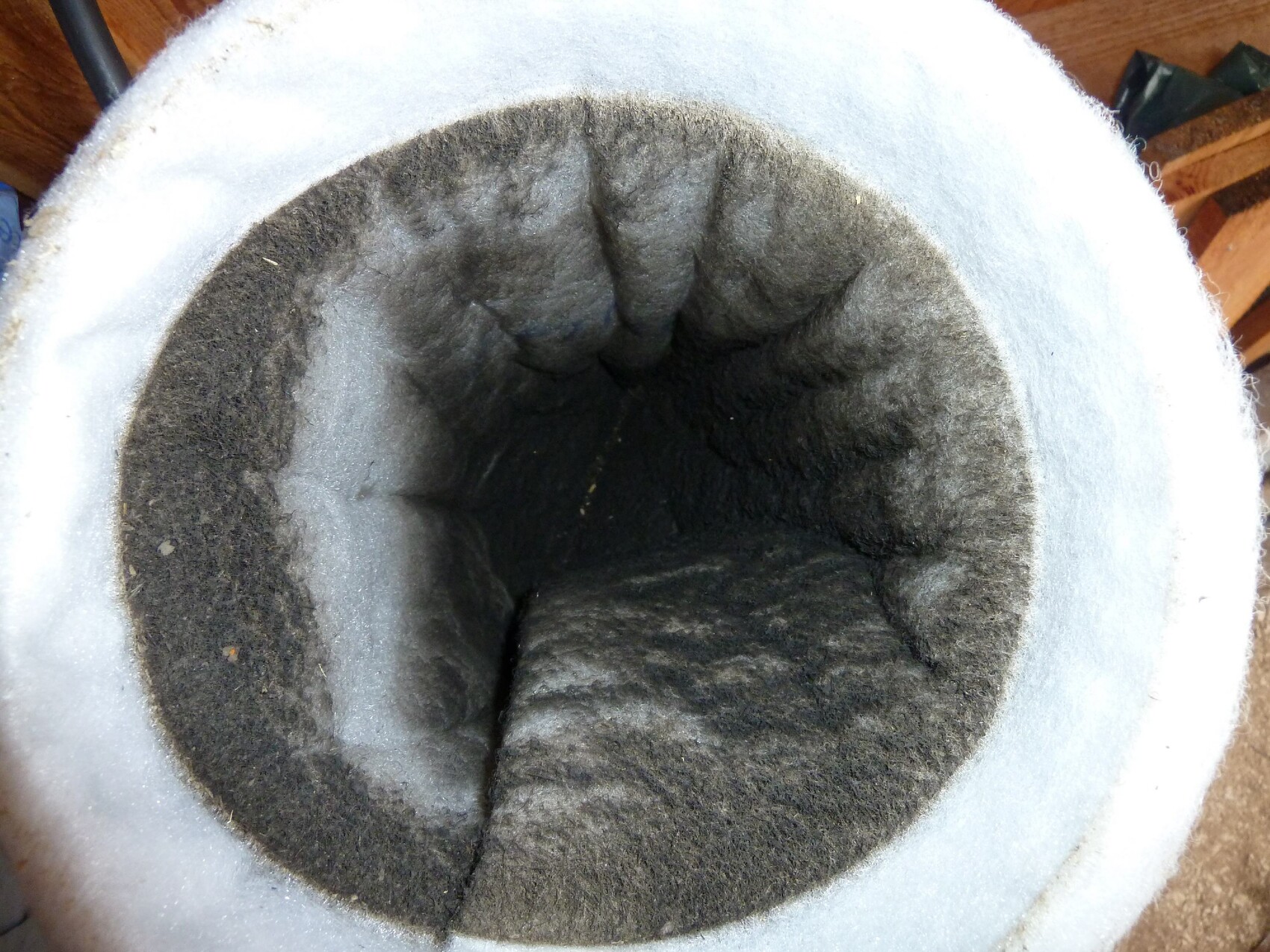
This is roughly how we do it... just slip a self-sewn G4 filter bag with an edge over the pipe so that the filter bag hangs down inside the pipe.
I have a 1m (3.3 ft) long G4 filter bag with a 20cm (8 inch) diameter... we replace it at the earliest after six months – and that works well.
As you can see in the photo, it’s worth filtering out the dirt (soot in winter, pollen in spring)... otherwise, it ends up in the controlled residential ventilation system... in the RS-250 directly on the rotor (the supply air filter comes after the rotor!).
You can sew them yourself from fabric by the meter... then the cost is practically zero.
Is it at least possible to access the intake so that you can hang a filter bag there every six months?
For example, removing the hood/fly screen, hanging the filter bag, and then putting the hood back on or securing it?
This is roughly how we do it... just slip a self-sewn G4 filter bag with an edge over the pipe so that the filter bag hangs down inside the pipe.
I have a 1m (3.3 ft) long G4 filter bag with a 20cm (8 inch) diameter... we replace it at the earliest after six months – and that works well.
As you can see in the photo, it’s worth filtering out the dirt (soot in winter, pollen in spring)... otherwise, it ends up in the controlled residential ventilation system... in the RS-250 directly on the rotor (the supply air filter comes after the rotor!).

Similar topics