
Good evening,
Our landscaper paved our driveway up to the garage with a gravel joint about 3 - 4 cm (1.2 - 1.6 inches) wide, as shown in the picture. This is not really ideal because some gravel keeps coming out of the joint. Also, the loose gravel probably won’t create enough lateral pressure in the long term, which may cause the stones to shift.
How can this be improved? The joint should remain permeable because the pavement is approximately level with the garage floor. Our idea is to remove about 2 - 3 cm (0.8 - 1.2 inches) of gravel from the joint and fill it with drainable concrete. What do you think?
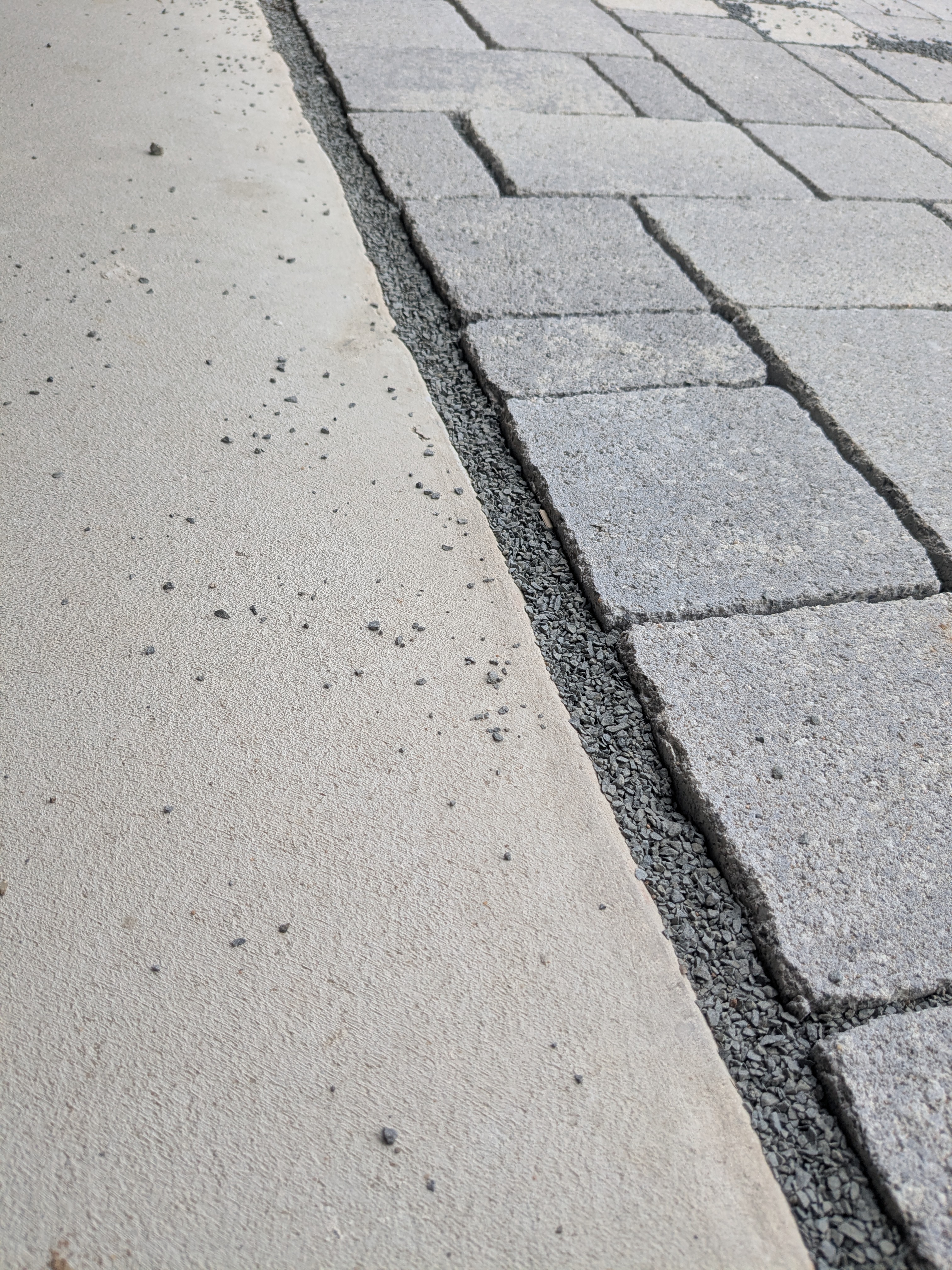
Our landscaper paved our driveway up to the garage with a gravel joint about 3 - 4 cm (1.2 - 1.6 inches) wide, as shown in the picture. This is not really ideal because some gravel keeps coming out of the joint. Also, the loose gravel probably won’t create enough lateral pressure in the long term, which may cause the stones to shift.
How can this be improved? The joint should remain permeable because the pavement is approximately level with the garage floor. Our idea is to remove about 2 - 3 cm (0.8 - 1.2 inches) of gravel from the joint and fill it with drainable concrete. What do you think?
M
MachsSelbst9 Feb 2026 21:33That’s all nonsense. In jehd’s post, they talk about an epoxy resin joint to a walkway that now lasts 10 years. Fine. But a joint to a walkway isn’t subjected to daily multiple crossings by 2-ton (about 4,400 lbs) passenger cars.
That’s why... the cleanest solution would be to politely ask the landscaper why they executed it so poorly and request that they move the last row to align properly with the garage, leaving a joint width consistent with the paving joints.
If I were you... maybe pay another paver to do it properly if the first one refuses. Then it will be done right.
Because if you are not capable of breaking paving stones yourself (tools can be borrowed, it’s a kind of antique paving, you don’t need to cut them, you can break them), I don’t think you’ll be able to make a joint with mortar, epoxy, or similar materials properly. That looks easier than paving... but it’s not. And once that stuff is in, it stays there.
Don’t do it, do it right. Then it will last 30 years, and the few dollars over that time won’t matter.
PS:
And right at a spot like that, significant forces develop at the transition between slightly flexible paving and fixed concrete slab because of the tires...
That’s why... the cleanest solution would be to politely ask the landscaper why they executed it so poorly and request that they move the last row to align properly with the garage, leaving a joint width consistent with the paving joints.
If I were you... maybe pay another paver to do it properly if the first one refuses. Then it will be done right.
Because if you are not capable of breaking paving stones yourself (tools can be borrowed, it’s a kind of antique paving, you don’t need to cut them, you can break them), I don’t think you’ll be able to make a joint with mortar, epoxy, or similar materials properly. That looks easier than paving... but it’s not. And once that stuff is in, it stays there.
Don’t do it, do it right. Then it will last 30 years, and the few dollars over that time won’t matter.
PS:
And right at a spot like that, significant forces develop at the transition between slightly flexible paving and fixed concrete slab because of the tires...
Maybe you should read more carefully before making such incorrect statements. Contrary to your false claim, the epoxy resin joint in my case is exactly at the location in question here, and it is driven over daily by a car – on the way to and from the garage onto the driveway.
The joint was installed by a landscaping contractor, and there are structural reasons why this was done instead of laying the pavers differently. There are products specifically designed for this purpose that meet the relevant standards and load requirements.
The cement joint was between the driveway and the walkway and was also driven over every time on the way in and out of the garage. As described, it did not hold up due to this load.
The joint was installed by a landscaping contractor, and there are structural reasons why this was done instead of laying the pavers differently. There are products specifically designed for this purpose that meet the relevant standards and load requirements.
The cement joint was between the driveway and the walkway and was also driven over every time on the way in and out of the garage. As described, it did not hold up due to this load.
D
derdietmar10 Feb 2026 14:35Hello,
Clear out the joint and fill it with concrete, sloping it gently like a wedge towards the paving. Any water standing there will seep into the joints between the stones. There’s no need to overcomplicate it. If it cracks, it just cracks. The concrete has nowhere to go. And after 10 years, you can simply redo the joint. For the appearance, you can press the existing gravel into the wet concrete and then brush off the loose remainder later.
Best regards
Clear out the joint and fill it with concrete, sloping it gently like a wedge towards the paving. Any water standing there will seep into the joints between the stones. There’s no need to overcomplicate it. If it cracks, it just cracks. The concrete has nowhere to go. And after 10 years, you can simply redo the joint. For the appearance, you can press the existing gravel into the wet concrete and then brush off the loose remainder later.
Best regards
S
Sockeldichtung23 Feb 2026 15:58Hello,
Thank you for the responses. I was busy with other matters over the past few days, which is why I’m only getting back now.
I would prefer not to call in a landscaper again since the last time was quite a disaster. Therefore, I would like to find the simplest possible solution to close this issue.
Additional information, in case it is relevant: there is also an underground cable running partially in the gap between the strip foundation and the garage floor, which then goes into the garage below.
I have sketched a possible solution (cross-section):
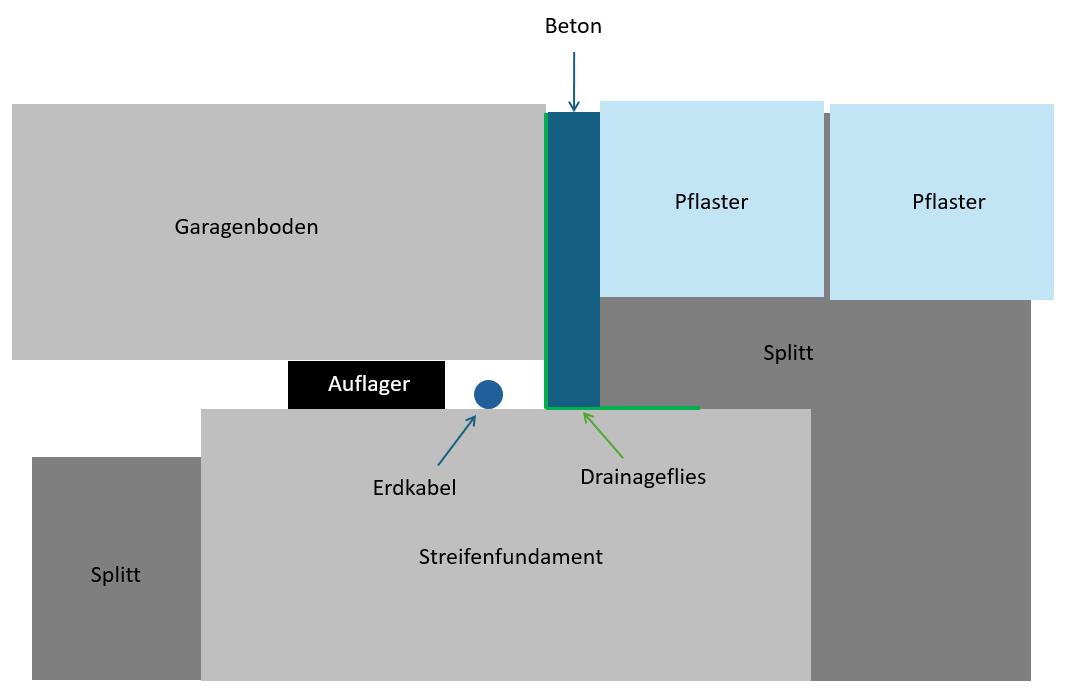
Questions:
1. I would use the drainage fleece as formwork to prevent concrete from flowing into the gap between the garage and the strip foundation, and also so that the fleece can possibly absorb any forces acting between the garage floor and the concrete wedge. Does that make sense?
2. Should I leave some gravel under the concrete wedge so that water can drain in both directions from the wedge (better frost protection)?
Thank you for the responses. I was busy with other matters over the past few days, which is why I’m only getting back now.
I would prefer not to call in a landscaper again since the last time was quite a disaster. Therefore, I would like to find the simplest possible solution to close this issue.
Additional information, in case it is relevant: there is also an underground cable running partially in the gap between the strip foundation and the garage floor, which then goes into the garage below.
I have sketched a possible solution (cross-section):
Questions:
1. I would use the drainage fleece as formwork to prevent concrete from flowing into the gap between the garage and the strip foundation, and also so that the fleece can possibly absorb any forces acting between the garage floor and the concrete wedge. Does that make sense?
2. Should I leave some gravel under the concrete wedge so that water can drain in both directions from the wedge (better frost protection)?
D
derdietmar24 Feb 2026 16:57Hello,
you will have to pour concrete over the crushed stone; otherwise, it will wash out from under the paving stones. The concrete wedge should be as high as the paving stones. You can, of course, lay the geotextile fabric on top of the crushed stone.
Along the joint, you should insert a few reinforcing bars to help prevent cracking. It won’t fully stop it, but large cracks should no longer occur.
Best regards
you will have to pour concrete over the crushed stone; otherwise, it will wash out from under the paving stones. The concrete wedge should be as high as the paving stones. You can, of course, lay the geotextile fabric on top of the crushed stone.
Along the joint, you should insert a few reinforcing bars to help prevent cracking. It won’t fully stop it, but large cracks should no longer occur.
Best regards
S
Sockeldichtung25 Feb 2026 12:57Thank you!
I would probably remove a row of paving stones and pour concrete all the way down. Then refill with gravel and put the paving back on. In my opinion, this has the advantage that gravel won't eventually be pushed into the joint toward the underground cables by the lateral or diagonal pressure from the paving. Or am I overthinking this? Would you use geotextile fabric as drainage under the concrete and as an expansion joint between the garage and the concrete, or not?
I would probably remove a row of paving stones and pour concrete all the way down. Then refill with gravel and put the paving back on. In my opinion, this has the advantage that gravel won't eventually be pushed into the joint toward the underground cables by the lateral or diagonal pressure from the paving. Or am I overthinking this? Would you use geotextile fabric as drainage under the concrete and as an expansion joint between the garage and the concrete, or not?
Similar topics