
Good evening,
Our landscaper paved our driveway up to the garage with a gravel joint about 3 - 4 cm (1.2 - 1.6 inches) wide, as shown in the picture. This is not really ideal because some gravel keeps coming out of the joint. Also, the loose gravel probably won’t create enough lateral pressure in the long term, which may cause the stones to shift.
How can this be improved? The joint should remain permeable because the pavement is approximately level with the garage floor. Our idea is to remove about 2 - 3 cm (0.8 - 1.2 inches) of gravel from the joint and fill it with drainable concrete. What do you think?
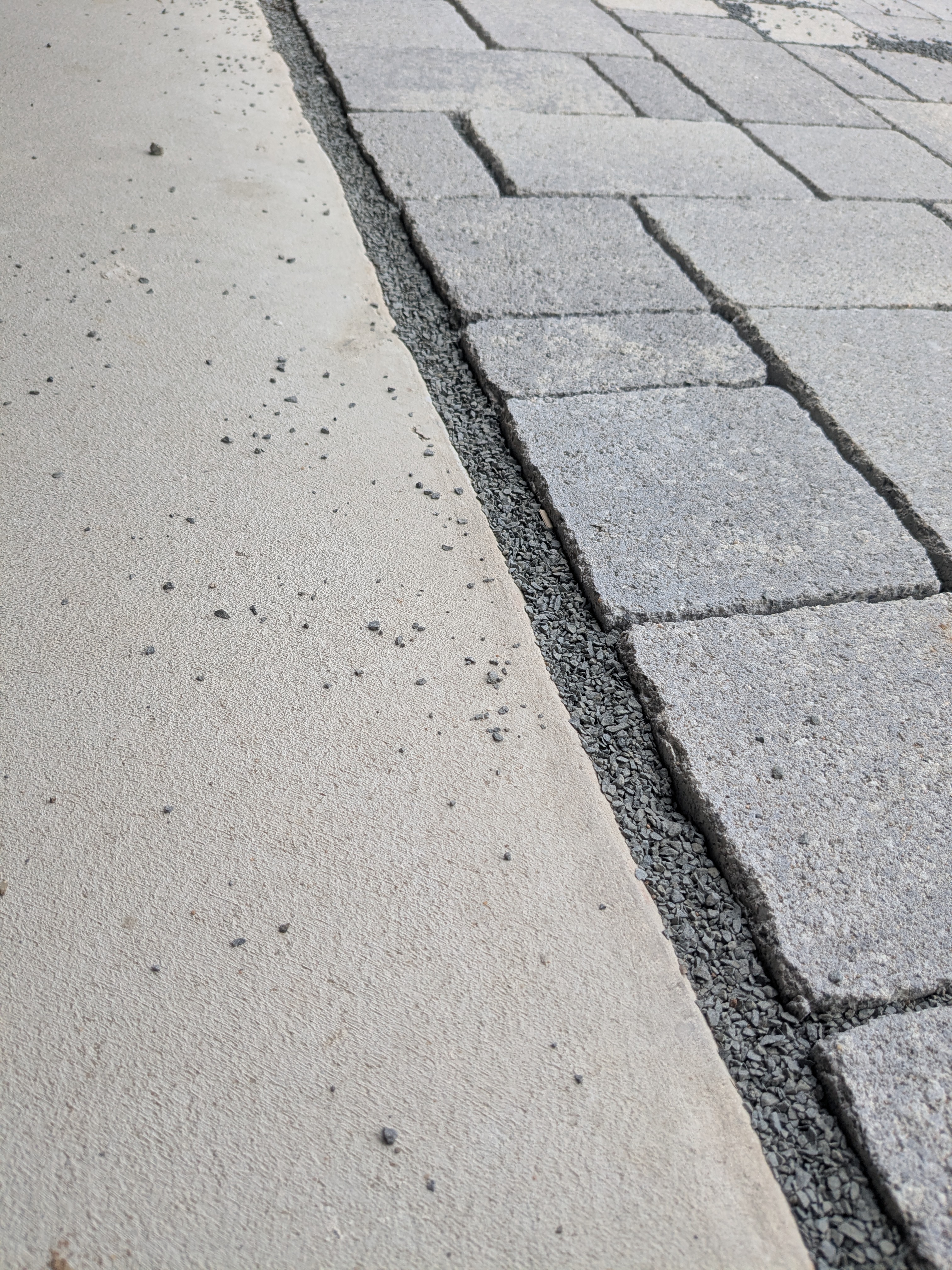
Our landscaper paved our driveway up to the garage with a gravel joint about 3 - 4 cm (1.2 - 1.6 inches) wide, as shown in the picture. This is not really ideal because some gravel keeps coming out of the joint. Also, the loose gravel probably won’t create enough lateral pressure in the long term, which may cause the stones to shift.
How can this be improved? The joint should remain permeable because the pavement is approximately level with the garage floor. Our idea is to remove about 2 - 3 cm (0.8 - 1.2 inches) of gravel from the joint and fill it with drainable concrete. What do you think?
When it rains with wind blowing towards the garage, rain will hit the door and run down it anyway. This water doesn’t pass through the joint or drainage before it could be pushed into the garage.
If you want to prevent that, there are sealing profiles that can be attached to the floor under the door like a small threshold.
I don’t have such a threshold, and in fact, sometimes small amounts of water are pushed into the garage. I’m not sure if this comes directly through the door or through the joint in front of it. But I don’t really mind, since a wet car being driven inside brings in a comparable amount of water. Not to mention snow on the car melting inside the garage…
PS Epoxy resin joints are also available with water permeability. Whether I have such a joint, I don’t know – it could also be sealed.
If you want to prevent that, there are sealing profiles that can be attached to the floor under the door like a small threshold.
I don’t have such a threshold, and in fact, sometimes small amounts of water are pushed into the garage. I’m not sure if this comes directly through the door or through the joint in front of it. But I don’t really mind, since a wet car being driven inside brings in a comparable amount of water. Not to mention snow on the car melting inside the garage…
PS Epoxy resin joints are also available with water permeability. Whether I have such a joint, I don’t know – it could also be sealed.
S
Sockeldichtung9 Feb 2026 18:50Thank you for all the responses!
The tip about the gravel stabilizer is interesting, but from what I have seen, it doesn’t create a surface suitable for driving on.
I have now also found permeable epoxy joint mortar. That might be worth considering.
Out of curiosity: Why do you think drainage mortar would not hold, for example with a compressive strength of 25 N/mm²?
The tip about the gravel stabilizer is interesting, but from what I have seen, it doesn’t create a surface suitable for driving on.
I have now also found permeable epoxy joint mortar. That might be worth considering.
Out of curiosity: Why do you think drainage mortar would not hold, for example with a compressive strength of 25 N/mm²?
Mortar/cement hardens completely. However, the paving stones move when driven over, especially if they are laid on loose aggregate. This causes the joint to essentially disintegrate.
Epoxy resin remains somewhat flexible. Therefore, it holds up better.
At the other end of my area, I tried a similarly wide cement joint next to the sidewalk to prevent weeds. It was damaged after 2-3 years. The epoxy resin is 10 years old and still looks like new.
Epoxy resin remains somewhat flexible. Therefore, it holds up better.
At the other end of my area, I tried a similarly wide cement joint next to the sidewalk to prevent weeds. It was damaged after 2-3 years. The epoxy resin is 10 years old and still looks like new.
S
Sockeldichtung9 Feb 2026 21:13Thank you again!
That sounds reasonable. I will fill the joint with epoxy grout. Does it make sense to place a thin fabric membrane between the concrete and the grout to prevent the joint from sticking firmly to both the paving and the garage, thus avoiding the transfer of movements and stresses between the components?
That sounds reasonable. I will fill the joint with epoxy grout. Does it make sense to place a thin fabric membrane between the concrete and the grout to prevent the joint from sticking firmly to both the paving and the garage, thus avoiding the transfer of movements and stresses between the components?
M
MachsSelbst9 Feb 2026 21:15Is there a genuine, practical reason why you don’t simply lay the paving directly against the garage’s concrete slab and avoid having any joint there, in whatever form? Most of the stones are cut anyway. You just lift them, cut new ones to fit with a normal joint, and that’s it... it looks much better than filling the gap with resin, mortar, or something else.
S
Sockeldichtung9 Feb 2026 21:19We don’t have the right equipment for that, and it probably exceeds our skills as well. The joint is hidden beneath the sealing lip of the garage door anyway and is only visible when the garage is open.
Similar topics