
ᐅ Is the knee wall height too low? What exactly does the measurement refer to?
Created on: 9 Jan 2018 20:59
3
305er
Hello, we are about to take possession of our house.
Recently, we measured the knee wall height.
According to the contract, it was supposed to be 150cm (59 inches) finished.
However, these are all clear structural dimensions.
Of course, we didn’t think about that, and we were never informed.
Well, it’s too late now.
Our screed buildup on the upper floor is 12cm (5 inches).
So without flooring, the knee wall should actually be 138cm (54 inches).
Our site manager, who is supposed to be in charge but hasn’t delivered, agrees with me on this point.
(We have two site managers, but the second one doesn’t really have decision-making authority.)
However, we only have a 128cm (50 inches) knee wall.
The first site manager wanted to measure and provide information but never did.
The second site manager writes:
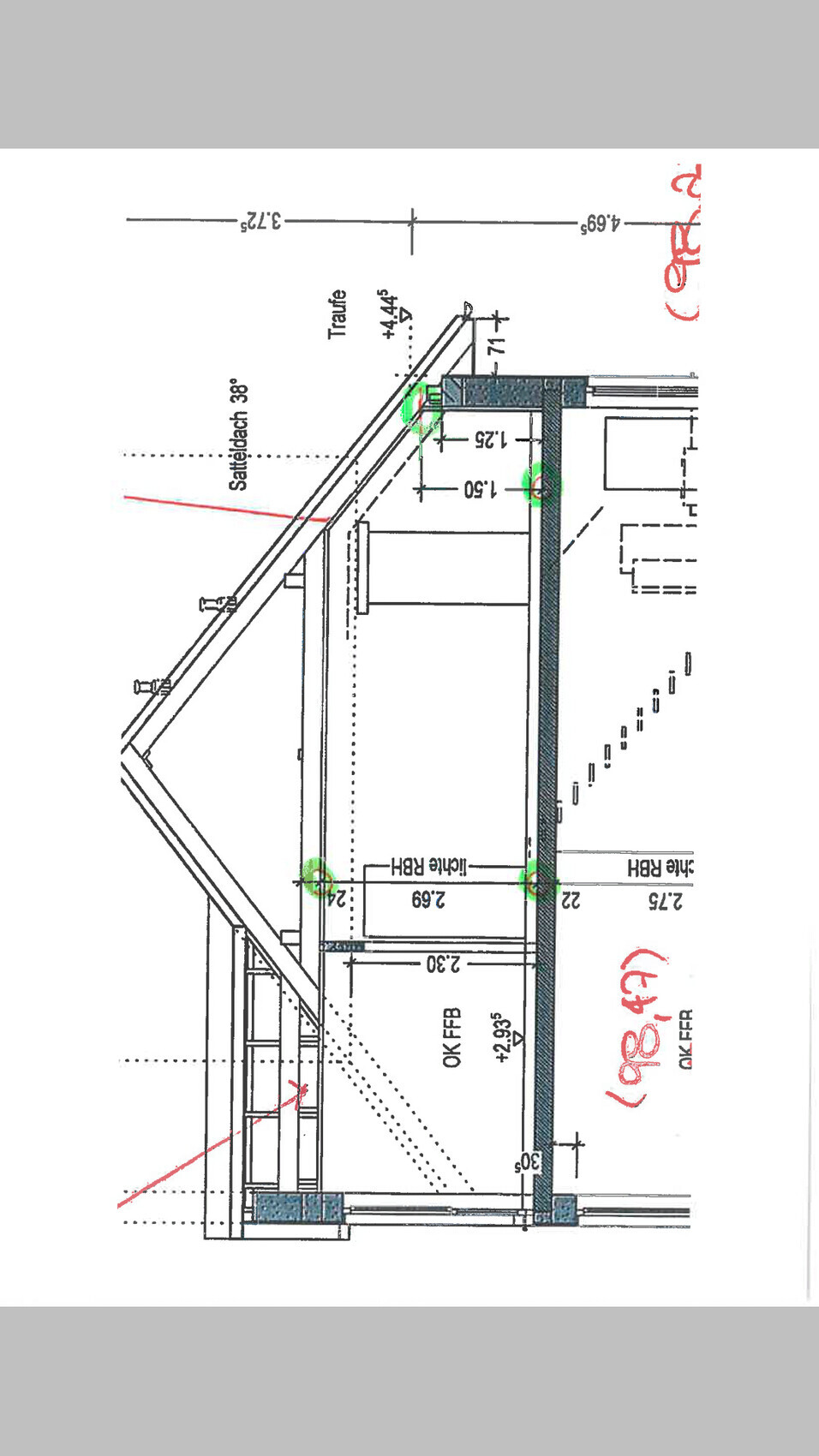
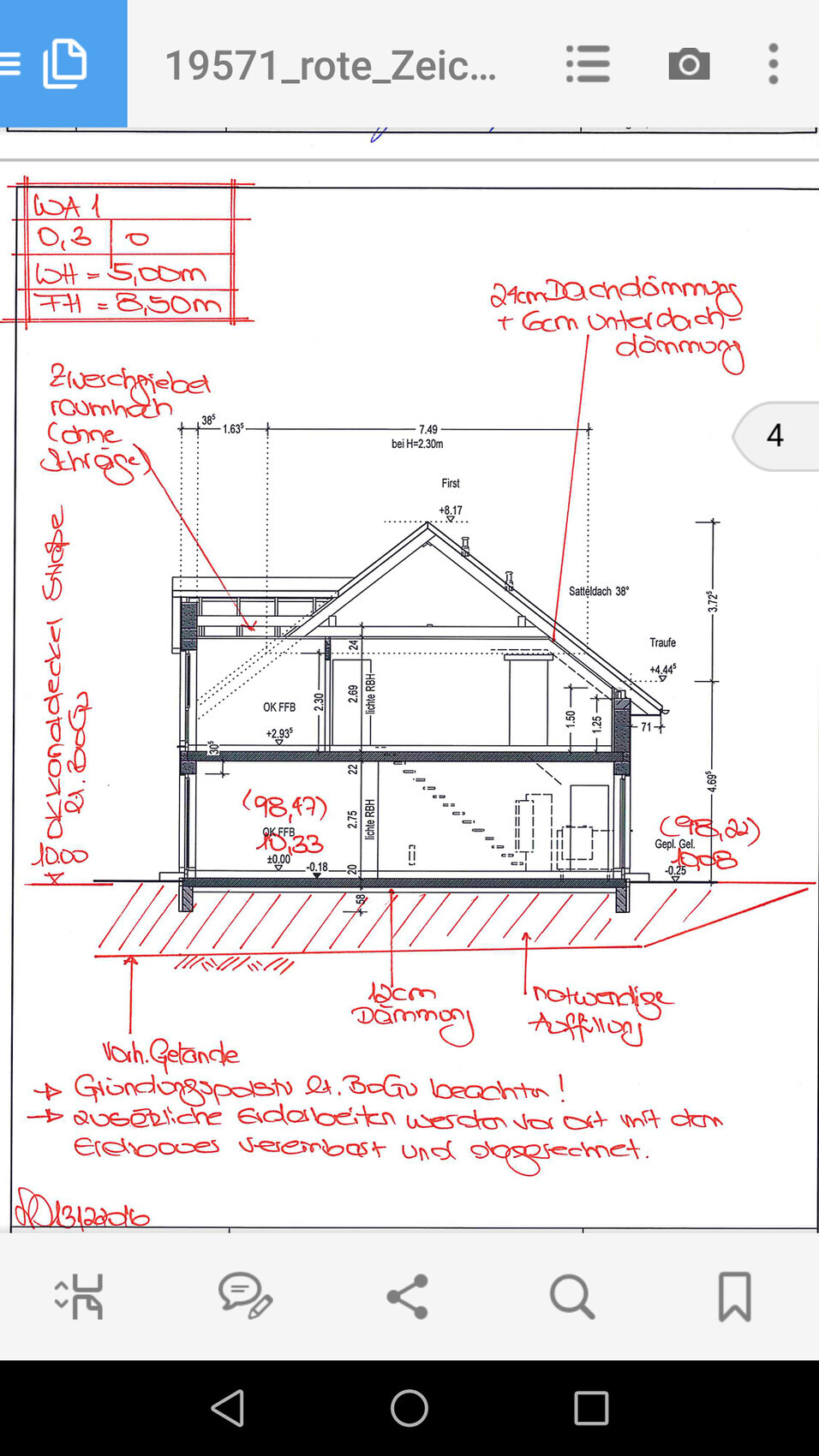
“The clear structural height is measured from the top of the raw floor slab to the bottom of the collar beam.
The knee wall height is correct as well because I checked that at the time. Here, the measurement is from the raw floor slab to the bottom of the rafter.
The drywall cladding must of course be deducted. For the sloped roof, this corresponds to about 9 to 10 cm (3.5 to 4 inches) vertically.
So 1.50 m (59 inches) - 0.09 m (4 inches) - 0.13 m (5 inches) for the screed (without covering) results in a dimension of 1.28 m (50 inches) or, with a 0.10 m (4 inches) suspension, a dimension of 1.27 m (50 inches).”
So here we differ exactly by 10cm (4 inches).
From my technical understanding (I also studied technical drawing during my training and learned assembly technology) the dimension in the plan is from the raw floor level to the "bend," meaning the start of the roof slope.
(Attachment)
After another email, the second site manager added:
“All specified dimensions always require the finished interior works to be deducted, such as plaster, screed, ceiling covering, door frames, etc.
A finished height is not indicated because, due to tolerances in structural work, deviations of up to 4 cm (1.5 inches) can occur.”
I then tried to explain again that the dimension data starts from the floor and has nothing to do with the ceiling.
Another reply from the site manager:
“Attached is an excerpt from the red-lined drawings where I marked the dimension chain for the clear structural height.
It clearly shows that the dimension chain refers to the wooden beam and not the cladding.
Why should the knee wall dimension suddenly refer to the finished ceiling when all other measurements relate back to the raw structure, except for the knee wall?
If you are still not satisfied with my explanation, you should contact the project planner, as I have nothing more to add.”
As I said, in my opinion, the plan clearly shows the drywall panels on the wall and ceiling.
And the measurement goes up to the transition (on the drywall panel).
I’m hoping for an independent expert opinion here.
Sorry for the long text.
Thank you
Recently, we measured the knee wall height.
According to the contract, it was supposed to be 150cm (59 inches) finished.
However, these are all clear structural dimensions.
Of course, we didn’t think about that, and we were never informed.
Well, it’s too late now.
Our screed buildup on the upper floor is 12cm (5 inches).
So without flooring, the knee wall should actually be 138cm (54 inches).
Our site manager, who is supposed to be in charge but hasn’t delivered, agrees with me on this point.
(We have two site managers, but the second one doesn’t really have decision-making authority.)
However, we only have a 128cm (50 inches) knee wall.
The first site manager wanted to measure and provide information but never did.
The second site manager writes:
“The clear structural height is measured from the top of the raw floor slab to the bottom of the collar beam.
The knee wall height is correct as well because I checked that at the time. Here, the measurement is from the raw floor slab to the bottom of the rafter.
The drywall cladding must of course be deducted. For the sloped roof, this corresponds to about 9 to 10 cm (3.5 to 4 inches) vertically.
So 1.50 m (59 inches) - 0.09 m (4 inches) - 0.13 m (5 inches) for the screed (without covering) results in a dimension of 1.28 m (50 inches) or, with a 0.10 m (4 inches) suspension, a dimension of 1.27 m (50 inches).”
So here we differ exactly by 10cm (4 inches).
From my technical understanding (I also studied technical drawing during my training and learned assembly technology) the dimension in the plan is from the raw floor level to the "bend," meaning the start of the roof slope.
(Attachment)
After another email, the second site manager added:
“All specified dimensions always require the finished interior works to be deducted, such as plaster, screed, ceiling covering, door frames, etc.
A finished height is not indicated because, due to tolerances in structural work, deviations of up to 4 cm (1.5 inches) can occur.”
I then tried to explain again that the dimension data starts from the floor and has nothing to do with the ceiling.
Another reply from the site manager:
“Attached is an excerpt from the red-lined drawings where I marked the dimension chain for the clear structural height.
It clearly shows that the dimension chain refers to the wooden beam and not the cladding.
Why should the knee wall dimension suddenly refer to the finished ceiling when all other measurements relate back to the raw structure, except for the knee wall?
If you are still not satisfied with my explanation, you should contact the project planner, as I have nothing more to add.”
As I said, in my opinion, the plan clearly shows the drywall panels on the wall and ceiling.
And the measurement goes up to the transition (on the drywall panel).
I’m hoping for an independent expert opinion here.
Sorry for the long text.
Thank you
kaho674 schrieb:
Exactly. But is that binding?It is binding if it is specified that way, namely as RBM in the contract.
A good general contractor will then explain the deductions involved -> screed, floor covering, and ceiling cladding, as well as the rafter layout.
Such clarification is what separates a good general contractor from a “not so good” one.
B
baumann4210 Jan 2018 13:27Binding? Actually, yes, the bricklayer should definitely be able to read the building plans!! Surely there is also a concrete beam, which should then have the correct height.
kbt09 schrieb:
But the 150cm (59 inches) knee wall height in your drawing is about 50cm (20 inches) inside the room. Right at the wall, the knee wall height is marked as 125cm (49 inches). Knallkörper schrieb:
No. The measurement, like the other one, is taken directly at the exterior wall. No .. see the red crossed lines, it’s only about the internal knee wall height.
Knallkörper schrieb:
-1.25m (4.1 ft) knee wall, measured between the top edge of the raw ceiling and the bottom edge of the finished ceiling, so 1.38m (4.5 ft) after screed, or about 1.35m (4.4 ft) in the "finished room" with flooring No .. according to the drawing, the finished dimension would be 125cm (49 inches) minus about 20cm (8 inches) floor buildup = 105cm (41 inches).
Just takes a little time .
K
Knallkörper10 Jan 2018 14:41You are right. I made a mistake and initially assumed 1.50m (5 feet), but I correctly wrote 1.25m (4 feet 1 inch). So, it is roughly 1.10m (3 feet 7 inches) with a 12cm (5 inches) screed layer and a 3cm (1 inch) flooring layer.
In my opinion, the 1.50m (5 feet) refers to the height at the corner. The line is not drawn correctly. On the other side, the dimension lines are also covered by the dashed lines.
In any case, I believe there is no doubt that the drawing is clear.
In my opinion, the 1.50m (5 feet) refers to the height at the corner. The line is not drawn correctly. On the other side, the dimension lines are also covered by the dashed lines.
In any case, I believe there is no doubt that the drawing is clear.

305er schrieb:
The question is, who is actually right.
Whether the knee wall should be 138 cm (54 inches), or 128 cm (50 inches) as it is now. Right for what purpose: a price reduction, even though there is no actual problem?
Be glad you don’t have to stretch to look out the window. About 125 cm (49 inches) is usually an ideal effective knee wall height, and now you have it.
305er schrieb:
I can’t really explain it Oh, shouldn’t that have been clarified before signing?
Lumpi_LE schrieb:
The knee wall is the raw wall height, so in your case, 1.25 m (49 inches).
The 1.50 m (59 inches) measurement is a meaningless dimension… I read the drawing as the wall and ring beam add up to 125 cm (49 inches), and with the top plate it adds up to 150 cm (59 inches), each measured from the top edge of the unfinished floor slab.
Knallkörper schrieb:
Anyway, I believe there is no doubt that the drawing is clear. According to the drawing, the distance from the top of the unfinished floor to the top of the top plate is 150 cm (59 inches). So one meter fifty is clearly indicated, but for a dimension that is not really relevant for practical use.
https://www.instagram.com/11antgmxde/
https://www.linkedin.com/company/bauen-jetzt/

Well, I still see it a bit differently.
That strange dashed line running diagonally over the door—I have no idea what that’s supposed to represent.
Definitely nothing to do with the ceiling, otherwise it would only extend just above the door, which it doesn’t.
So the 150cm (60 inches) still goes up to the bend in the drywall panels.
I find 125cm (49 inches) way too small; there was a reason we initially wanted 150cm (60 inches). Also, the purchased loft bed of 140cm (55 inches) no longer fits underneath.
And why are there measurements taken from the window? We have floor-to-ceiling windows.
Yes, rightly so if that’s the case, in order to get a price reduction; there’s no other option.
Before signing... Hmm... Yes, but if you are being lied to about everything, it doesn’t help you at all.
The 125cm (49 inches) wall measurements were correct, I believe the 150cm (60 inches) ones were too at one point.
That strange dashed line running diagonally over the door—I have no idea what that’s supposed to represent.
Definitely nothing to do with the ceiling, otherwise it would only extend just above the door, which it doesn’t.
So the 150cm (60 inches) still goes up to the bend in the drywall panels.
I find 125cm (49 inches) way too small; there was a reason we initially wanted 150cm (60 inches). Also, the purchased loft bed of 140cm (55 inches) no longer fits underneath.
And why are there measurements taken from the window? We have floor-to-ceiling windows.
Yes, rightly so if that’s the case, in order to get a price reduction; there’s no other option.
Before signing... Hmm... Yes, but if you are being lied to about everything, it doesn’t help you at all.
The 125cm (49 inches) wall measurements were correct, I believe the 150cm (60 inches) ones were too at one point.
Similar topics