
ᐅ Is this floor plan suitable for a multigenerational house?
Created on: 19 May 2025 18:47
D
Dutchi695
Hello everyone,
this is my first post, so I apologize in advance if I haven’t provided all the necessary information – I put this together to the best of my knowledge and ability :-)
We are currently planning a multi-generational house and have already received some plans from the construction company. This is the current plan. The house is planned to be built on a plot of about 475sqm (5113 sq ft).
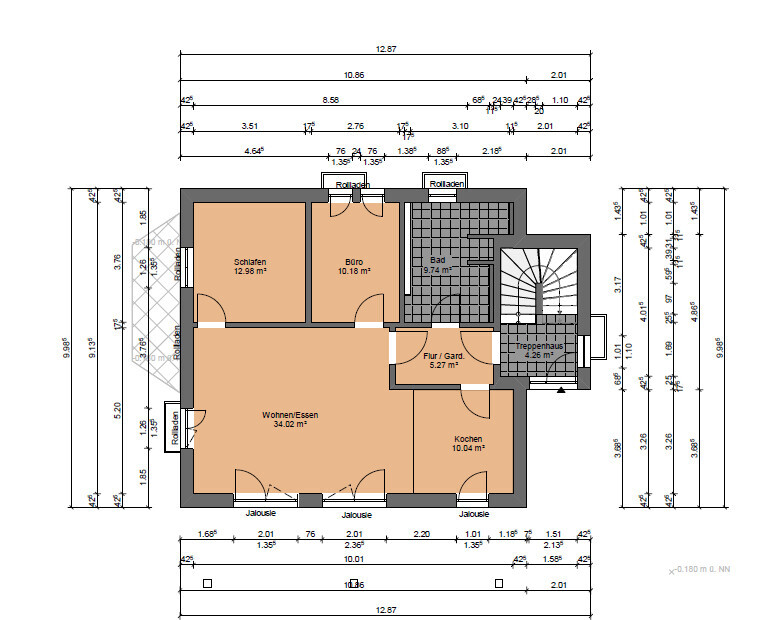
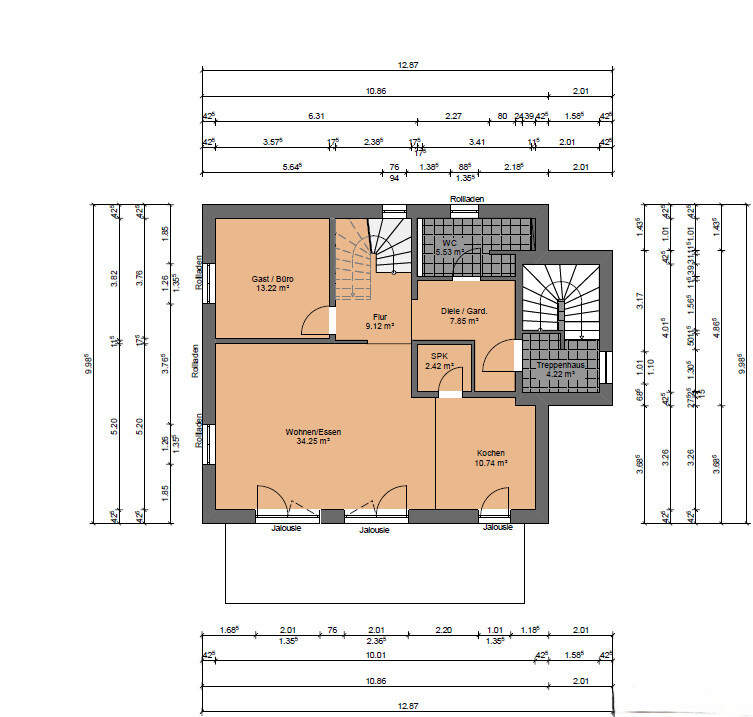
Due to the small size of the plot, the idea is for the parents-in-law to live on the ground floor, and for us (2 adults + 2 small children) to live on the upper floor and attic. We had also considered a semi-detached house with an asymmetric design, but that was too expensive and too large for the plot. Our goal is to still have enough garden space.
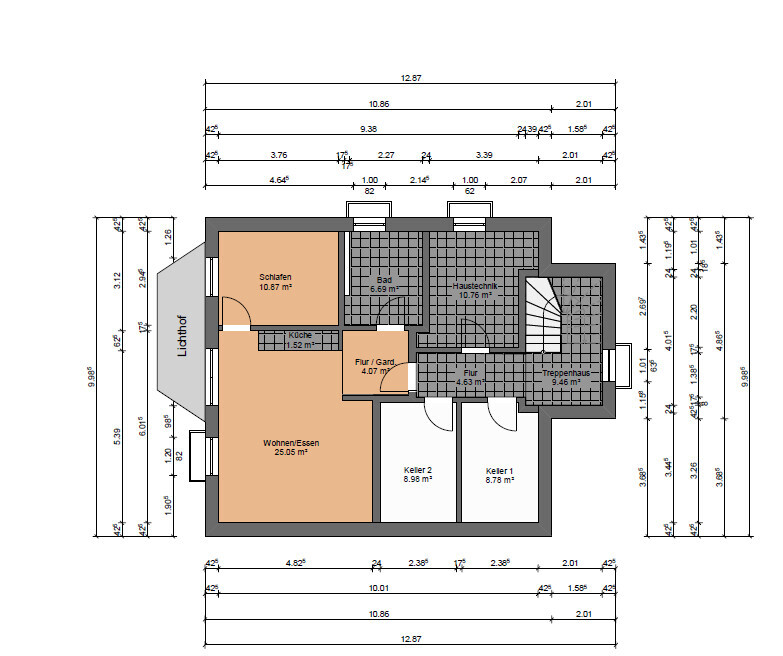
In the basement, provisions are planned for a granny flat or accessory dwelling unit that could be developed later if needed. Initially, this space will be used purely as a utility cellar.
Because of the photovoltaic requirement in Baden-Württemberg and the conditions for related subsidies, the house has been designed as a solid construction meeting KfW40 plus QNG standards. Electrically operated roller shutters or venetian blinds are standard throughout the living room and kitchen.
Development plan/restrictions
Plot size: approx. 475sqm (5113 sq ft)
Slope: no
Site occupancy index: 0.3
Floor area ratio: unknown
Building envelope, building line, boundary: open construction method
Edge development: 1 neighboring house on the left side
Number of parking spaces: 2 per dwelling unit
Number of floors: 2.5 + basement
Roof type: gable roof
Architectural style
Orientation
Maximum heights/limits: main building height 9.50m (31 ft), living area height 6.50m (21 ft)
Additional specifications
Homeowner requirements
Architectural style, roof type, building type
Basement, floors: Basement, ground floor, upper floor, and attic floor
Number of residents, ages: 2 parents-in-law + 2 adults + 2 children (1.5 years, 1 month)
Room requirements on ground floor and upper floor
Office: family use or home office?: One office for home office is planned on both the ground floor and upper floor, which will also serve as guest rooms
Number of guest stays per year: few
Open or closed architecture
Traditional or modern design
Open kitchen, kitchen island: Kitchen in L-shape plus kitchen island
Number of dining spaces: At least 6 on both ground floor and upper floor
Fireplace: no
Music/sound system wall: no
Balcony, roof terrace: Balcony planned on the upper floor
Garage, carport: double garage
Utility garden, greenhouse
Additional wishes/special features/daily routine, including reasons for design choices
House design
Planner: construction company
- Planner from a construction company
- Architect
- Do-it-yourself
What do you particularly like? Why?
What do you not like? Why?
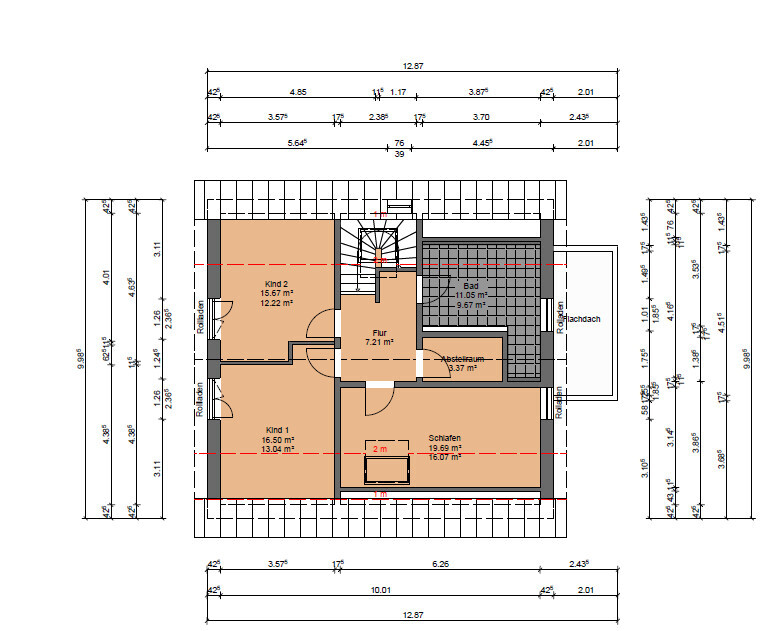
In my opinion, the children’s rooms in the attic are planned too small. This might work now when they’re toddlers, but as bedrooms for teenagers, I find them too small. We considered removing the storage room in the attic and adding it to the master bedroom so the children’s rooms could be larger. Or are we mistaken? As a replacement for the storage room, we possibly considered additional storage space under the staircase.
I have never lived under sloping ceilings, but unfortunately, there is no other way to design this (see above). However, they do significantly reduce the room size.
Price estimate according to architect/planner: The house, excluding incidental building costs and land, should cost around €800,000 (approx. $870,000) turnkey. We will have to do a significant amount of work ourselves to bring the price down.
Personal price limit for the house, including fittings: Our maximum budget for everything is €950,000 (approx. $1,035,000). Whether this is realistic remains to be seen ;-)
Preferred heating system: planned is an air-to-water heat pump plus underfloor heating
If you had to give up something, on which details/upgrades
- could you do without:
- couldn’t do without: basement
Why is the design the way it is now? For example:
The construction company already adapted the designs because previous versions were too expensive. The floor area was reduced from initially 100sqm (1076 sq ft) to 90sqm (970 sq ft). Due to the partly integrated staircase, the effective floor area is now a bit above 80sqm (860 sq ft).
Standard design from the planner?
Which/all wishes were implemented by the architect?
A mix of many examples from various magazines...
What do you think makes it particularly good or bad?
Do you see any potential improvements regarding the floor plans?
this is my first post, so I apologize in advance if I haven’t provided all the necessary information – I put this together to the best of my knowledge and ability :-)
We are currently planning a multi-generational house and have already received some plans from the construction company. This is the current plan. The house is planned to be built on a plot of about 475sqm (5113 sq ft).
Due to the small size of the plot, the idea is for the parents-in-law to live on the ground floor, and for us (2 adults + 2 small children) to live on the upper floor and attic. We had also considered a semi-detached house with an asymmetric design, but that was too expensive and too large for the plot. Our goal is to still have enough garden space.
In the basement, provisions are planned for a granny flat or accessory dwelling unit that could be developed later if needed. Initially, this space will be used purely as a utility cellar.
Because of the photovoltaic requirement in Baden-Württemberg and the conditions for related subsidies, the house has been designed as a solid construction meeting KfW40 plus QNG standards. Electrically operated roller shutters or venetian blinds are standard throughout the living room and kitchen.
Development plan/restrictions
Plot size: approx. 475sqm (5113 sq ft)
Slope: no
Site occupancy index: 0.3
Floor area ratio: unknown
Building envelope, building line, boundary: open construction method
Edge development: 1 neighboring house on the left side
Number of parking spaces: 2 per dwelling unit
Number of floors: 2.5 + basement
Roof type: gable roof
Architectural style
Orientation
Maximum heights/limits: main building height 9.50m (31 ft), living area height 6.50m (21 ft)
Additional specifications
Homeowner requirements
Architectural style, roof type, building type
Basement, floors: Basement, ground floor, upper floor, and attic floor
Number of residents, ages: 2 parents-in-law + 2 adults + 2 children (1.5 years, 1 month)
Room requirements on ground floor and upper floor
Office: family use or home office?: One office for home office is planned on both the ground floor and upper floor, which will also serve as guest rooms
Number of guest stays per year: few
Open or closed architecture
Traditional or modern design
Open kitchen, kitchen island: Kitchen in L-shape plus kitchen island
Number of dining spaces: At least 6 on both ground floor and upper floor
Fireplace: no
Music/sound system wall: no
Balcony, roof terrace: Balcony planned on the upper floor
Garage, carport: double garage
Utility garden, greenhouse
Additional wishes/special features/daily routine, including reasons for design choices
House design
Planner: construction company
- Planner from a construction company
- Architect
- Do-it-yourself
What do you particularly like? Why?
What do you not like? Why?
In my opinion, the children’s rooms in the attic are planned too small. This might work now when they’re toddlers, but as bedrooms for teenagers, I find them too small. We considered removing the storage room in the attic and adding it to the master bedroom so the children’s rooms could be larger. Or are we mistaken? As a replacement for the storage room, we possibly considered additional storage space under the staircase.
I have never lived under sloping ceilings, but unfortunately, there is no other way to design this (see above). However, they do significantly reduce the room size.
Price estimate according to architect/planner: The house, excluding incidental building costs and land, should cost around €800,000 (approx. $870,000) turnkey. We will have to do a significant amount of work ourselves to bring the price down.
Personal price limit for the house, including fittings: Our maximum budget for everything is €950,000 (approx. $1,035,000). Whether this is realistic remains to be seen ;-)
Preferred heating system: planned is an air-to-water heat pump plus underfloor heating
If you had to give up something, on which details/upgrades
- could you do without:
- couldn’t do without: basement
Why is the design the way it is now? For example:
The construction company already adapted the designs because previous versions were too expensive. The floor area was reduced from initially 100sqm (1076 sq ft) to 90sqm (970 sq ft). Due to the partly integrated staircase, the effective floor area is now a bit above 80sqm (860 sq ft).
Standard design from the planner?
Which/all wishes were implemented by the architect?
A mix of many examples from various magazines...
What do you think makes it particularly good or bad?
Do you see any potential improvements regarding the floor plans?

Dutchi695 schrieb:
Unfortunately, we do not yet have the exact measurements of the plot, as we are still waiting for official confirmation from the local authority.
I was unable to find more detailed information about the specific plot in the official application documents. According to the developer, a setback of 2.50 m (8 feet) must be maintained on all sides.
Based on all the plans we have received so far from the developer, the house’s dimensions and approximate price have been roughly outlined. In the detailed planning phase, we will have ongoing discussions with the developer’s architect until the house matches our expectations. So, it is still possible to completely redesign the house at this stage. Are you using the common incorrect term for the general contractor, or is the developer actually acting as such here, meaning the local authority awards the plots tied to a specific builder?
Otherwise, I would recommend planning with an architect of your own choice!
https://www.instagram.com/11antgmxde/
https://www.linkedin.com/company/bauen-jetzt/
Bicycles ...
... however, an access preferably from the street side or the exterior side to the basement must also be planned.
Dutchi695 schrieb:
Maybe they could be stored in the basement as suggested here
... however, an access preferably from the street side or the exterior side to the basement must also be planned.
First of all:
when you reply, you don’t need to repeat everything you already wrote in the previous message. Everyone participating here automatically reads the entire discussion and doesn’t ignore other posts.
I hope it’s not located where the parents have their terrace. However, I fear that privacy will be compromised with this topic.
when you reply, you don’t need to repeat everything you already wrote in the previous message. Everyone participating here automatically reads the entire discussion and doesn’t ignore other posts.
Dutchi695 schrieb:
The planned one is now more than 20sqm (215 sq ft), twice as large
I hope it’s not located where the parents have their terrace. However, I fear that privacy will be compromised with this topic.
H
hanghaus202322 May 2025 09:16You are buying a plot of land and do not have a site plan?
Dutchi695 schrieb:
The major decluttering is definitely still on the agenda – the rule that anything not used for more than 12 months goes, is already stored in the back of my mind.Decluttering and tidying up are always in one’s own interest when aiming for an organized and practical lifestyle. However, it seems to me that you focus more on stockpiling when reading that you store everyday items kilometers away in a storage unit, while currently living in a 100sqm (1,076 sq ft) home.
When I then read this:
Dutchi695 schrieb:
Currently, four bikes and a child trailer are used between the two households. The children are still too small for their own bikes. But this should be taken into account.Dutchi695 schrieb:
My father-in-law still has a workshop,Dutchi695 schrieb:
We have also thought about a fitness room or something similar.Dutchi695 schrieb:
We want to give up the storage unit because it is quite costly and also the trips there when you need something.…I then wonder why this is not clearly communicated, and the basement shows a completely different layout.Dutchi695 schrieb:
A storage room, wardrobe, and shoe cabinet all in one inside the house would hopefully be much more relaxed and organized.Dutchi695 schrieb:
In terms of living space, we have also expanded well through the two floors – from 100 to 150-160sqm (1,615–1,722 sq ft).You are currently making the big mistake that a) you apparently have not developed a spatial program for yourselves, b) do not know your daily routine and have not simulated your daily flow through the house multiple times, and c) do not understand the core character (building specification) of your plot.Because if I count the bikes in two years, you will have six of them and won’t know where to put them because it simply wasn’t planned.
Whether it’s a builder’s planner or an independent architect: they can only create a house that functions personally for you if you supply them with information. So not only should you sort out storage and the basement, but also yourselves.
This involves assessing your kitchen utensils inventory and determining the number of cabinets needed. The same applies to wardrobe space: a general recommendation is 50–60cm (20–24 inches) width per person for closet-quality storage. If you follow that but your wife is obsessed with shoes and collects handbags, you won’t be happy with just 60cm (24 inches) for her. She’ll take your side too, and you’ll end up with chaos in your belongings.
An additional 50sqm (538 sq ft) of living space won’t help if it’s not where it’s needed or if you don’t understand how to use a partition wall. There are also walls that can’t be used as partitions because a door is misplaced by about 60cm (24 inches) (e.g., bedroom door/wall of the parents’ room).
Perhaps you also lack the enthusiasm to deal with these details. But you will be paying off the house for 30 years; this isn’t a minor expense or a quick fix. So tackle it. Engage in the planning, sketch furniture layouts, consider kitchen ergonomics, know your current state and future goals, TV viewing distance, and other standard measurements. Draw up the potential house arrangement including bike storage, cars, etc. Make sure you can walk past the cars and that delivery drivers won’t scratch them.
If you don’t have a site plan, draw one yourselves. Nowadays, new developments usually provide information about the building specification / planning permission / building permit / Par34.
Similar topics