
ᐅ Is this floor plan suitable for a multigenerational house?
Created on: 19 May 2025 18:47
D
Dutchi695
Hello everyone,
this is my first post, so I apologize in advance if I haven’t provided all the necessary information – I put this together to the best of my knowledge and ability :-)
We are currently planning a multi-generational house and have already received some plans from the construction company. This is the current plan. The house is planned to be built on a plot of about 475sqm (5113 sq ft).
Due to the small size of the plot, the idea is for the parents-in-law to live on the ground floor, and for us (2 adults + 2 small children) to live on the upper floor and attic. We had also considered a semi-detached house with an asymmetric design, but that was too expensive and too large for the plot. Our goal is to still have enough garden space.
In the basement, provisions are planned for a granny flat or accessory dwelling unit that could be developed later if needed. Initially, this space will be used purely as a utility cellar.
Because of the photovoltaic requirement in Baden-Württemberg and the conditions for related subsidies, the house has been designed as a solid construction meeting KfW40 plus QNG standards. Electrically operated roller shutters or venetian blinds are standard throughout the living room and kitchen.
Development plan/restrictions
Plot size: approx. 475sqm (5113 sq ft)
Slope: no
Site occupancy index: 0.3
Floor area ratio: unknown
Building envelope, building line, boundary: open construction method
Edge development: 1 neighboring house on the left side
Number of parking spaces: 2 per dwelling unit
Number of floors: 2.5 + basement
Roof type: gable roof
Architectural style
Orientation
Maximum heights/limits: main building height 9.50m (31 ft), living area height 6.50m (21 ft)
Additional specifications
Homeowner requirements
Architectural style, roof type, building type
Basement, floors: Basement, ground floor, upper floor, and attic floor
Number of residents, ages: 2 parents-in-law + 2 adults + 2 children (1.5 years, 1 month)
Room requirements on ground floor and upper floor
Office: family use or home office?: One office for home office is planned on both the ground floor and upper floor, which will also serve as guest rooms
Number of guest stays per year: few
Open or closed architecture
Traditional or modern design
Open kitchen, kitchen island: Kitchen in L-shape plus kitchen island
Number of dining spaces: At least 6 on both ground floor and upper floor
Fireplace: no
Music/sound system wall: no
Balcony, roof terrace: Balcony planned on the upper floor
Garage, carport: double garage
Utility garden, greenhouse
Additional wishes/special features/daily routine, including reasons for design choices
House design
Planner: construction company
- Planner from a construction company
- Architect
- Do-it-yourself
What do you particularly like? Why?
What do you not like? Why?
In my opinion, the children’s rooms in the attic are planned too small. This might work now when they’re toddlers, but as bedrooms for teenagers, I find them too small. We considered removing the storage room in the attic and adding it to the master bedroom so the children’s rooms could be larger. Or are we mistaken? As a replacement for the storage room, we possibly considered additional storage space under the staircase.
I have never lived under sloping ceilings, but unfortunately, there is no other way to design this (see above). However, they do significantly reduce the room size.
Price estimate according to architect/planner: The house, excluding incidental building costs and land, should cost around €800,000 (approx. $870,000) turnkey. We will have to do a significant amount of work ourselves to bring the price down.
Personal price limit for the house, including fittings: Our maximum budget for everything is €950,000 (approx. $1,035,000). Whether this is realistic remains to be seen ;-)
Preferred heating system: planned is an air-to-water heat pump plus underfloor heating
If you had to give up something, on which details/upgrades
- could you do without:
- couldn’t do without: basement
Why is the design the way it is now? For example:
The construction company already adapted the designs because previous versions were too expensive. The floor area was reduced from initially 100sqm (1076 sq ft) to 90sqm (970 sq ft). Due to the partly integrated staircase, the effective floor area is now a bit above 80sqm (860 sq ft).
Standard design from the planner?
Which/all wishes were implemented by the architect?
A mix of many examples from various magazines...
What do you think makes it particularly good or bad?
Do you see any potential improvements regarding the floor plans?
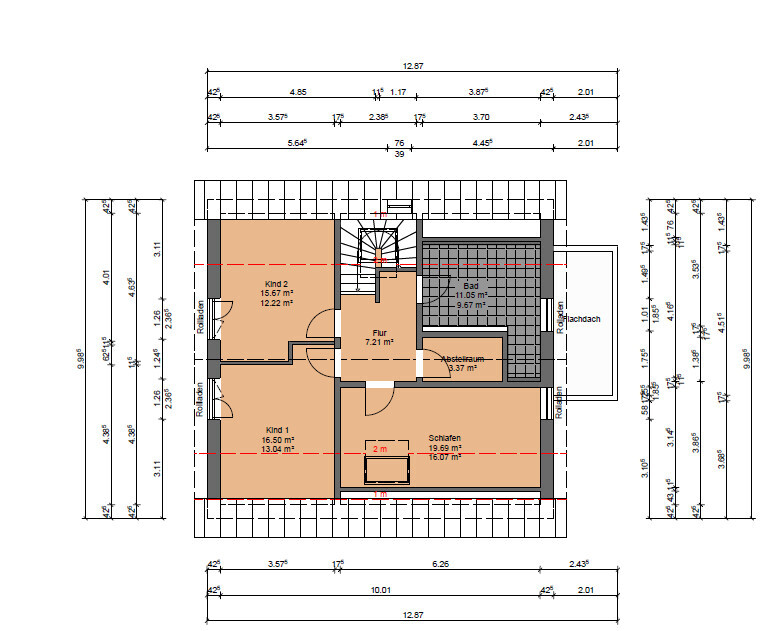
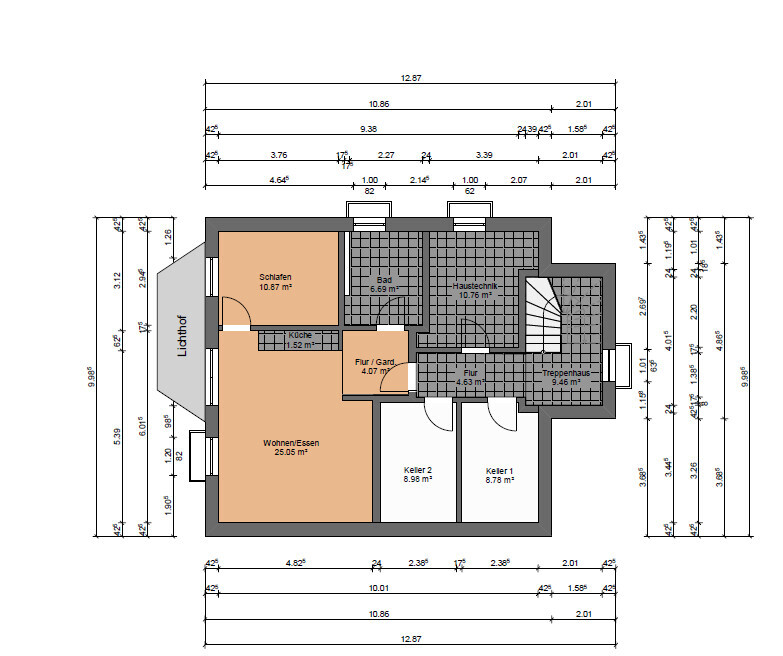
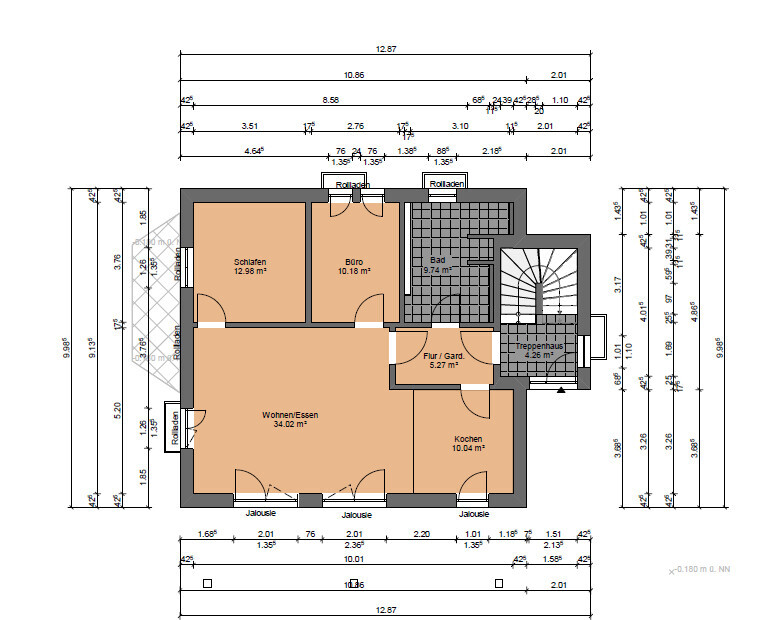
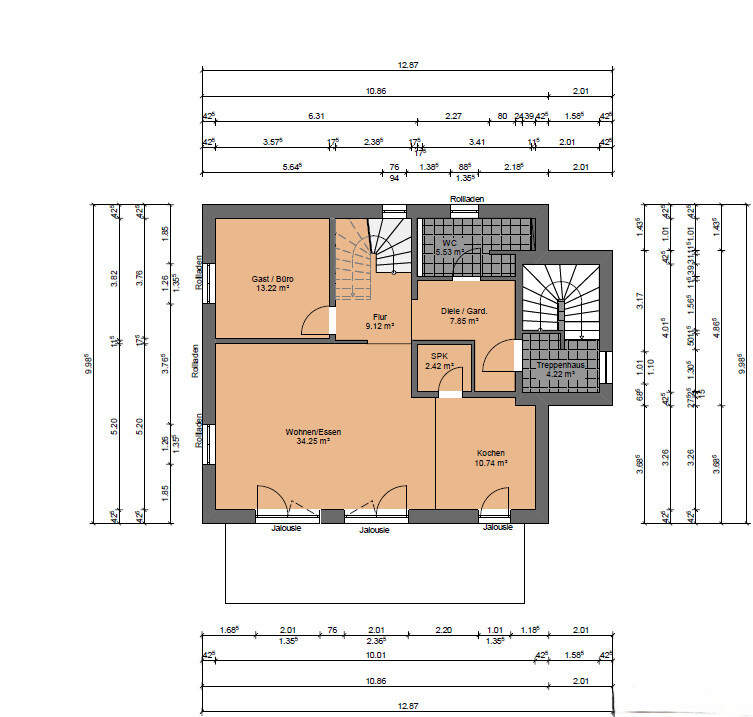
this is my first post, so I apologize in advance if I haven’t provided all the necessary information – I put this together to the best of my knowledge and ability :-)
We are currently planning a multi-generational house and have already received some plans from the construction company. This is the current plan. The house is planned to be built on a plot of about 475sqm (5113 sq ft).
Due to the small size of the plot, the idea is for the parents-in-law to live on the ground floor, and for us (2 adults + 2 small children) to live on the upper floor and attic. We had also considered a semi-detached house with an asymmetric design, but that was too expensive and too large for the plot. Our goal is to still have enough garden space.
In the basement, provisions are planned for a granny flat or accessory dwelling unit that could be developed later if needed. Initially, this space will be used purely as a utility cellar.
Because of the photovoltaic requirement in Baden-Württemberg and the conditions for related subsidies, the house has been designed as a solid construction meeting KfW40 plus QNG standards. Electrically operated roller shutters or venetian blinds are standard throughout the living room and kitchen.
Development plan/restrictions
Plot size: approx. 475sqm (5113 sq ft)
Slope: no
Site occupancy index: 0.3
Floor area ratio: unknown
Building envelope, building line, boundary: open construction method
Edge development: 1 neighboring house on the left side
Number of parking spaces: 2 per dwelling unit
Number of floors: 2.5 + basement
Roof type: gable roof
Architectural style
Orientation
Maximum heights/limits: main building height 9.50m (31 ft), living area height 6.50m (21 ft)
Additional specifications
Homeowner requirements
Architectural style, roof type, building type
Basement, floors: Basement, ground floor, upper floor, and attic floor
Number of residents, ages: 2 parents-in-law + 2 adults + 2 children (1.5 years, 1 month)
Room requirements on ground floor and upper floor
Office: family use or home office?: One office for home office is planned on both the ground floor and upper floor, which will also serve as guest rooms
Number of guest stays per year: few
Open or closed architecture
Traditional or modern design
Open kitchen, kitchen island: Kitchen in L-shape plus kitchen island
Number of dining spaces: At least 6 on both ground floor and upper floor
Fireplace: no
Music/sound system wall: no
Balcony, roof terrace: Balcony planned on the upper floor
Garage, carport: double garage
Utility garden, greenhouse
Additional wishes/special features/daily routine, including reasons for design choices
House design
Planner: construction company
- Planner from a construction company
- Architect
- Do-it-yourself
What do you particularly like? Why?
What do you not like? Why?
In my opinion, the children’s rooms in the attic are planned too small. This might work now when they’re toddlers, but as bedrooms for teenagers, I find them too small. We considered removing the storage room in the attic and adding it to the master bedroom so the children’s rooms could be larger. Or are we mistaken? As a replacement for the storage room, we possibly considered additional storage space under the staircase.
I have never lived under sloping ceilings, but unfortunately, there is no other way to design this (see above). However, they do significantly reduce the room size.
Price estimate according to architect/planner: The house, excluding incidental building costs and land, should cost around €800,000 (approx. $870,000) turnkey. We will have to do a significant amount of work ourselves to bring the price down.
Personal price limit for the house, including fittings: Our maximum budget for everything is €950,000 (approx. $1,035,000). Whether this is realistic remains to be seen ;-)
Preferred heating system: planned is an air-to-water heat pump plus underfloor heating
If you had to give up something, on which details/upgrades
- could you do without:
- couldn’t do without: basement
Why is the design the way it is now? For example:
The construction company already adapted the designs because previous versions were too expensive. The floor area was reduced from initially 100sqm (1076 sq ft) to 90sqm (970 sq ft). Due to the partly integrated staircase, the effective floor area is now a bit above 80sqm (860 sq ft).
Standard design from the planner?
Which/all wishes were implemented by the architect?
A mix of many examples from various magazines...
What do you think makes it particularly good or bad?
Do you see any potential improvements regarding the floor plans?
D
Dutchi69521 May 2025 21:09Good evening,
thank you very much for all the additional feedback. Unfortunately, I haven’t been able to respond sooner.
We don’t yet have the exact measurements of the plot; we are still waiting for official confirmation from the local authorities.
I couldn’t find any detailed information about the specific plot in the official application documents. According to the developer, a setback of 2.50 m (8 feet) must be maintained on each side.
With all the plans we have received so far from the developer, the dimensions and approximate price range of the house have been roughly outlined. During the detailed planning phase, we will have ongoing discussions with the developer’s architect until the house is designed exactly as we envision it. So basically, we can still completely redesign the entire house if needed.
thank you very much for all the additional feedback. Unfortunately, I haven’t been able to respond sooner.
We don’t yet have the exact measurements of the plot; we are still waiting for official confirmation from the local authorities.
I couldn’t find any detailed information about the specific plot in the official application documents. According to the developer, a setback of 2.50 m (8 feet) must be maintained on each side.
With all the plans we have received so far from the developer, the dimensions and approximate price range of the house have been roughly outlined. During the detailed planning phase, we will have ongoing discussions with the developer’s architect until the house is designed exactly as we envision it. So basically, we can still completely redesign the entire house if needed.
D
Dutchi69521 May 2025 21:13kbt09 schrieb:
Exactly, bicycles also came to my mind. There could well be at least 6 for all residents. It’s important to plan how to store them properly. … If necessary, an external cellar entrance with bike sliding rails. I also consider the topic of bicycles to be quite important. Perhaps they could be stored in the basement as suggested here, or in the garage if there is extra space besides the car. Currently, two households use four bicycles and one child trailer. The children are still too young to have their own bikes, but this should be taken into account.
D
Dutchi69521 May 2025 21:20hanghaus2023 schrieb:
I would like to see the architect’s initial design before the builder made cuts.
There should definitely be a site plan included as well.
I also built with an 80m2 (860 sq ft) granny flat. With a partially below-grade basement that has now become a training room. Nobody really wants to live in a basement.
And you don’t want that either.
If you have to save money, the basement is the first place to cut. That easily saves around 100k.
When moving, sell or get rid of anything you haven’t used in the last 12 months. That really saves a lot of storage space.The original footprint used was 100m2 (1,076 sq ft), which was then reduced to 90m2 (970 sq ft), and the stairwell was slightly shifted inward. As mentioned before, these were just preliminary rough plans to outline the general direction, including the budget.
We haven’t had any meetings yet with the architect from the developer’s side—but those are supposed to come during the detailed planning phase. So far, we haven’t had to pay anything.
We still have many other ideas for how to use the basement—an additional dwelling unit wasn’t really among our considerations yet. My father-in-law has a workshop that he currently keeps in his basement. That would be another possible use for the basement. We have also thought about a gym or something similar.
Primarily, the basement will be used as a utility and/or hobby room. Having an additional dwelling unit is more of a “nice to have.”
D
Dutchi69521 May 2025 21:48Arauki11 schrieb:
A basement remains a basement, and regardless of the permit situation, it’s not really easy to rent out. I also think that, just like with furniture, you should start planning more carefully now so you don’t end up building unnecessarily expensive space just because you might need it at some point or somehow.
The background information would be interesting.
Then it’s time. You can make it comfortable down there; sloped ceilings are no obstacle and can even add to the charm.
That alone doesn’t tell much. For example, I’m already a bit beyond that stage, and yet not everyone is the same age. I understand and hope the parents want to have a nice living space, too. If you want two truly attractive apartments in one house, it requires better planning than a classic single-family home since you need to avoid overlapping issues, respect privacy on both sides, and at the same time create some shared spaces.
That doesn’t necessarily require more space but imagination about how to create nice areas for everyone within limited space. The situation with children will also change eventually, and then you shouldn’t be totally unprepared.
Nobody wants to live in a basement like that, nor should they. I would reconsider everything repeatedly and see how both sides can live comfortably, whether on the ground floor or upper floor. For example, I would have preferred my parents’ apartment on the upper floor with exposed roof beams and a roof terrace, so the upper floor isn’t necessarily the losing side if you don’t make it so by poor planning.
These are already some key factors that make it more difficult. I think both points can be reconsidered. Everyone needs storage space, but it should be planned and clarified what MUST be in the house and what can be stored in a garden shed or better yet, discarded altogether.
I would like to see the calculation example. A private house should also be as private as possible, and with multigenerational living, both sides have enough challenges and joys to review; there is no need for an unrelated roommate. I would never consider that (again).
In my opinion, there is a fundamental mistake here. You will never rent something like that successfully as a holiday apartment or other rental; these are often just general ideas that don’t hold up to serious scrutiny. Maybe it just feels good to have such space mentally because of the currently “missing” storage? I could understand that, but those are very costly thoughts that limit you elsewhere and in your actual living space, often leading to less attractive solutions. I can somewhat relate since I have lived multigenerationally. My father already struggled to part with things, as did some other family members. In the end, you need your money much more urgently for your living space, controlled mechanical ventilation, air conditioning, nice flooring, external blinds, and so on, a nice separate place for the parents in the garden, and maybe a roof terrace or outdoor seating area. I would not spend the money on a basement for that.
I understand that, but this is also something that will change over time. You should be careful not to overreact to current issues. Living on the 3rd floor of an apartment building is one thing, living on the upper floor of a single-family house is another. For example, you can drive directly up to the house, and the family lives under the same roof. As I said, we had the same issue and I wouldn’t see it as so extreme, because that is exactly where the multigenerational house can show its strength—in togetherness; such things can be clarified and firmly agreed upon.
I would break that down again. I think she mainly wants to live stylishly, and there are many options she may not have thought of yet. For example, we had the living room as a staggered living level, and that alone can create a very different feel in the living area. Thank you very much for the detailed response.
As I mentioned in another post, a granny flat or holiday apartment is not our top priority. Also, our financing is secured so that we are not dependent on additional income.
My parents-in-law will be downsizing in terms of living space and will sort out their belongings beforehand. Right now, they still have a loft for storage, but won’t have that in the house anymore—so additional storage is needed. We would like to give up our externally rented storage unit because it is quite expensive and the trips there to get something are becoming tedious over time. Even with the storage unit, our basement compartment is full. We will sort out items ahead of time—which we regularly do anyway—but with three cats and now two children, space is precious and will be needed even more.
My father-in-law has a workshop that also needs to be accommodated somewhere. Everything could be stored in garden sheds or additional garages, but that would be at the expense of garden space.
The fact that the parents-in-law will be on the ground floor is also not entirely selfless—at some point, my wife and I will be in the same position ourselves. The ground floor will be enough for us, and then the multigenerational living could continue (if the children are interested). If not, the larger part would be rented out or the whole property sold.
Privacy is very important to all of us and has already led to some conversations. It is important to everyone that each person has their own retreat space (including in the garden).
Since we will move to the upper floor, having an additional balcony was a condition for us. The planned balcony is now over 20 square meters (over 215 square feet), twice the size of what we have now.
In terms of features, the standard specification is already quite good—for example, external blinds (raffstores) are included by default, and we have a good budget for tiles and flooring, as well as sanitary equipment. Special requests should hopefully remain within reasonable limits.
We have also increased our living space quite well by adding the two floors—from 100 to 150–160 square meters (1,080 to 1,720–1,730 square feet).
But I am grateful for any ideas or comments and open to suggestions. Due to the birth of our son, I may not always be able to reply quickly.
D
Dutchi69521 May 2025 21:57ypg schrieb:
He writes here:
However, I have to say that in a detached house with a larger kitchen, pantry, storage room, and well-planned built-in cabinets or partition walls (which are usually more than in an apartment) and a smaller “basement substitute” room next to the technical equipment, you can manage very well: sufficient cloakroom space so that you don’t need a separate shoe cabinet in the basement, supplies and a second refrigerator in the pantry, everything exactly where you need it, tidy children’s rooms... the rest can be disposed of as bulky waste or sold in classifieds.
An external storage space can of course be used for heirlooms or document storage, but that can really be kept in boxes in the attic.
I would reconsider that!Thank you very much for the helpful comments and tips as an alternative to the basement, for which I am very grateful.
According to the current plans, the kitchen will not be much larger than our current one. Our current storage room is used as a pantry, storage, cloakroom, and shoe cabinet all in one—hopefully, all of that will be much more relaxed and organized in the house.
A major decluttering is definitely still planned—the rule that anything not used for over 12 months will go is already stored in the back of my mind.
We would like to get rid of the external storage since it is very costly, and the trips there when you need something are inconvenient.
Similar topics