
ᐅ Is this floor plan suitable for a multigenerational house?
Created on: 19 May 2025 18:47
D
Dutchi695
Hello everyone,
this is my first post, so I apologize in advance if I haven’t provided all the necessary information – I put this together to the best of my knowledge and ability :-)
We are currently planning a multi-generational house and have already received some plans from the construction company. This is the current plan. The house is planned to be built on a plot of about 475sqm (5113 sq ft).
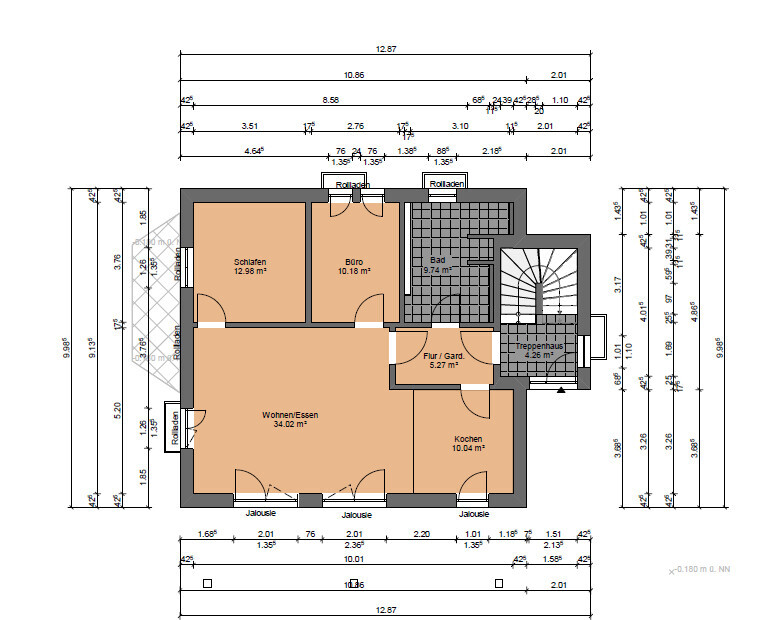
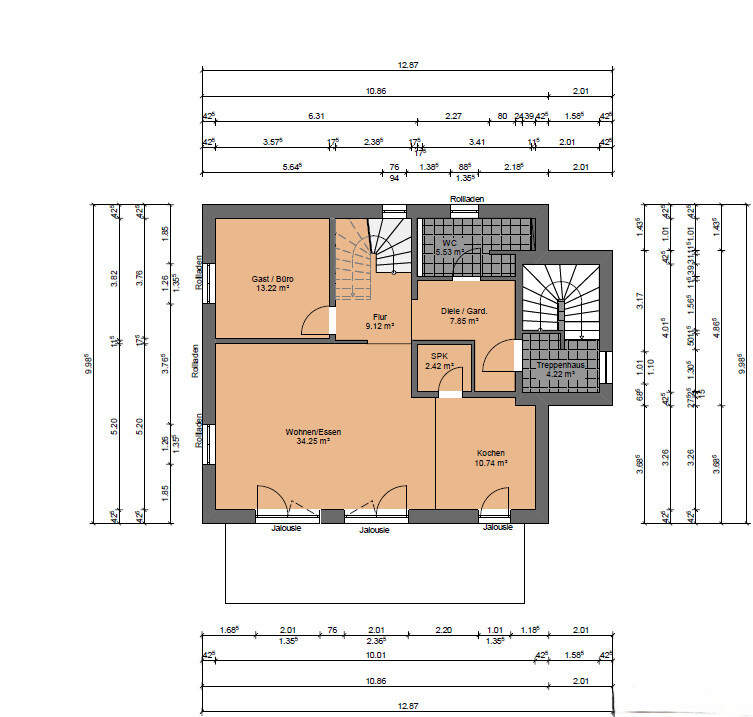
Due to the small size of the plot, the idea is for the parents-in-law to live on the ground floor, and for us (2 adults + 2 small children) to live on the upper floor and attic. We had also considered a semi-detached house with an asymmetric design, but that was too expensive and too large for the plot. Our goal is to still have enough garden space.
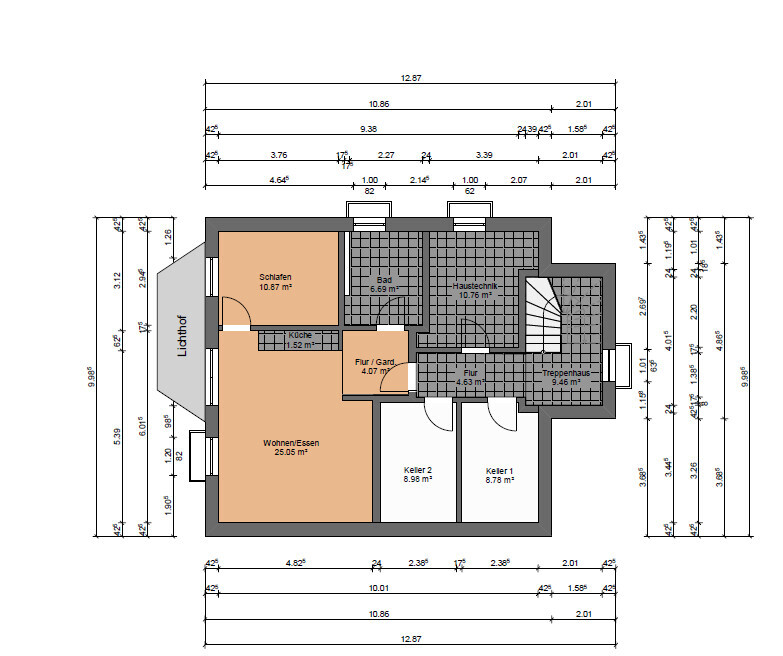
In the basement, provisions are planned for a granny flat or accessory dwelling unit that could be developed later if needed. Initially, this space will be used purely as a utility cellar.
Because of the photovoltaic requirement in Baden-Württemberg and the conditions for related subsidies, the house has been designed as a solid construction meeting KfW40 plus QNG standards. Electrically operated roller shutters or venetian blinds are standard throughout the living room and kitchen.
Development plan/restrictions
Plot size: approx. 475sqm (5113 sq ft)
Slope: no
Site occupancy index: 0.3
Floor area ratio: unknown
Building envelope, building line, boundary: open construction method
Edge development: 1 neighboring house on the left side
Number of parking spaces: 2 per dwelling unit
Number of floors: 2.5 + basement
Roof type: gable roof
Architectural style
Orientation
Maximum heights/limits: main building height 9.50m (31 ft), living area height 6.50m (21 ft)
Additional specifications
Homeowner requirements
Architectural style, roof type, building type
Basement, floors: Basement, ground floor, upper floor, and attic floor
Number of residents, ages: 2 parents-in-law + 2 adults + 2 children (1.5 years, 1 month)
Room requirements on ground floor and upper floor
Office: family use or home office?: One office for home office is planned on both the ground floor and upper floor, which will also serve as guest rooms
Number of guest stays per year: few
Open or closed architecture
Traditional or modern design
Open kitchen, kitchen island: Kitchen in L-shape plus kitchen island
Number of dining spaces: At least 6 on both ground floor and upper floor
Fireplace: no
Music/sound system wall: no
Balcony, roof terrace: Balcony planned on the upper floor
Garage, carport: double garage
Utility garden, greenhouse
Additional wishes/special features/daily routine, including reasons for design choices
House design
Planner: construction company
- Planner from a construction company
- Architect
- Do-it-yourself
What do you particularly like? Why?
What do you not like? Why?
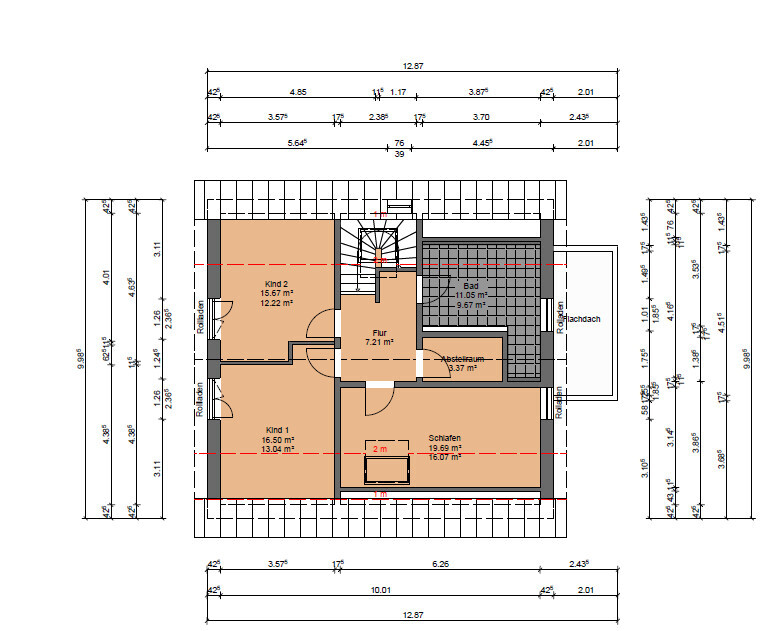
In my opinion, the children’s rooms in the attic are planned too small. This might work now when they’re toddlers, but as bedrooms for teenagers, I find them too small. We considered removing the storage room in the attic and adding it to the master bedroom so the children’s rooms could be larger. Or are we mistaken? As a replacement for the storage room, we possibly considered additional storage space under the staircase.
I have never lived under sloping ceilings, but unfortunately, there is no other way to design this (see above). However, they do significantly reduce the room size.
Price estimate according to architect/planner: The house, excluding incidental building costs and land, should cost around €800,000 (approx. $870,000) turnkey. We will have to do a significant amount of work ourselves to bring the price down.
Personal price limit for the house, including fittings: Our maximum budget for everything is €950,000 (approx. $1,035,000). Whether this is realistic remains to be seen ;-)
Preferred heating system: planned is an air-to-water heat pump plus underfloor heating
If you had to give up something, on which details/upgrades
- could you do without:
- couldn’t do without: basement
Why is the design the way it is now? For example:
The construction company already adapted the designs because previous versions were too expensive. The floor area was reduced from initially 100sqm (1076 sq ft) to 90sqm (970 sq ft). Due to the partly integrated staircase, the effective floor area is now a bit above 80sqm (860 sq ft).
Standard design from the planner?
Which/all wishes were implemented by the architect?
A mix of many examples from various magazines...
What do you think makes it particularly good or bad?
Do you see any potential improvements regarding the floor plans?
this is my first post, so I apologize in advance if I haven’t provided all the necessary information – I put this together to the best of my knowledge and ability :-)
We are currently planning a multi-generational house and have already received some plans from the construction company. This is the current plan. The house is planned to be built on a plot of about 475sqm (5113 sq ft).
Due to the small size of the plot, the idea is for the parents-in-law to live on the ground floor, and for us (2 adults + 2 small children) to live on the upper floor and attic. We had also considered a semi-detached house with an asymmetric design, but that was too expensive and too large for the plot. Our goal is to still have enough garden space.
In the basement, provisions are planned for a granny flat or accessory dwelling unit that could be developed later if needed. Initially, this space will be used purely as a utility cellar.
Because of the photovoltaic requirement in Baden-Württemberg and the conditions for related subsidies, the house has been designed as a solid construction meeting KfW40 plus QNG standards. Electrically operated roller shutters or venetian blinds are standard throughout the living room and kitchen.
Development plan/restrictions
Plot size: approx. 475sqm (5113 sq ft)
Slope: no
Site occupancy index: 0.3
Floor area ratio: unknown
Building envelope, building line, boundary: open construction method
Edge development: 1 neighboring house on the left side
Number of parking spaces: 2 per dwelling unit
Number of floors: 2.5 + basement
Roof type: gable roof
Architectural style
Orientation
Maximum heights/limits: main building height 9.50m (31 ft), living area height 6.50m (21 ft)
Additional specifications
Homeowner requirements
Architectural style, roof type, building type
Basement, floors: Basement, ground floor, upper floor, and attic floor
Number of residents, ages: 2 parents-in-law + 2 adults + 2 children (1.5 years, 1 month)
Room requirements on ground floor and upper floor
Office: family use or home office?: One office for home office is planned on both the ground floor and upper floor, which will also serve as guest rooms
Number of guest stays per year: few
Open or closed architecture
Traditional or modern design
Open kitchen, kitchen island: Kitchen in L-shape plus kitchen island
Number of dining spaces: At least 6 on both ground floor and upper floor
Fireplace: no
Music/sound system wall: no
Balcony, roof terrace: Balcony planned on the upper floor
Garage, carport: double garage
Utility garden, greenhouse
Additional wishes/special features/daily routine, including reasons for design choices
House design
Planner: construction company
- Planner from a construction company
- Architect
- Do-it-yourself
What do you particularly like? Why?
What do you not like? Why?
In my opinion, the children’s rooms in the attic are planned too small. This might work now when they’re toddlers, but as bedrooms for teenagers, I find them too small. We considered removing the storage room in the attic and adding it to the master bedroom so the children’s rooms could be larger. Or are we mistaken? As a replacement for the storage room, we possibly considered additional storage space under the staircase.
I have never lived under sloping ceilings, but unfortunately, there is no other way to design this (see above). However, they do significantly reduce the room size.
Price estimate according to architect/planner: The house, excluding incidental building costs and land, should cost around €800,000 (approx. $870,000) turnkey. We will have to do a significant amount of work ourselves to bring the price down.
Personal price limit for the house, including fittings: Our maximum budget for everything is €950,000 (approx. $1,035,000). Whether this is realistic remains to be seen ;-)
Preferred heating system: planned is an air-to-water heat pump plus underfloor heating
If you had to give up something, on which details/upgrades
- could you do without:
- couldn’t do without: basement
Why is the design the way it is now? For example:
The construction company already adapted the designs because previous versions were too expensive. The floor area was reduced from initially 100sqm (1076 sq ft) to 90sqm (970 sq ft). Due to the partly integrated staircase, the effective floor area is now a bit above 80sqm (860 sq ft).
Standard design from the planner?
Which/all wishes were implemented by the architect?
A mix of many examples from various magazines...
What do you think makes it particularly good or bad?
Do you see any potential improvements regarding the floor plans?
ypg schrieb:
You also can’t push bicycles, etc., past a house wall or a car in a tight space. Exactly, bicycles came to my mind as well. There could be at least six of them for all residents. It’s important to plan how to store them properly. ... If in doubt, an external basement access with bike sliding strips would be a good solution.
H
hanghaus202321 May 2025 10:55I would like to see the architect’s original design before the contractor reduced it.
There should definitely be a site plan for it as well.
I also built an 80m2 (860 sq ft) granny flat, partly with a basement that has now become a gym. Nobody really wants to live in a basement.
And you don’t want that either.
If you need to save money, the basement is the first place to cut. That easily saves around $100,000.
When moving, sell or dispose of anything you haven’t used in the last 12 months. That saves a lot of storage space.
There should definitely be a site plan for it as well.
I also built an 80m2 (860 sq ft) granny flat, partly with a basement that has now become a gym. Nobody really wants to live in a basement.
And you don’t want that either.
If you need to save money, the basement is the first place to cut. That easily saves around $100,000.
When moving, sell or dispose of anything you haven’t used in the last 12 months. That saves a lot of storage space.
Dutchi695 schrieb:
In the basement, preparations are planned for a granny flat that could potentially be finished later on. Initially, this space will be used purely as a utility basement.A basement is still a basement, and regardless of the approval process, it’s not really easy to rent out. I also think that, just like with furniture, you should plan more carefully now so you don’t end up building unnecessarily expensive space just because you might need it at some point in the future.Dutchi695 schrieb:
-you can’t do without: basementIt would be interesting to know the reasons behind that.Dutchi695 schrieb:
I’ve never lived under sloping ceilings before.Then it’s time to give it a try. You can make it very comfortable; sloping ceilings are not a hindrance and can even add character.Dutchi695 schrieb:
The parents-in-law are both just under 60.That alone doesn’t say much. For example, I am a bit older and people at that age are all different. I understand and hope the parents want to have a nice place, too. If you want two really nice apartments in one house, it requires more planning than a typical single-family home, because you need to avoid certain overlaps, respect privacy for both sides, but also have some common areas.Dutchi695 schrieb:
Hobbies definitely include spending a lot of time with the children, so it’s important to us to still have a bit of garden. It will probably not be more than 200sqm (2150 sq ft).For that, you don’t necessarily just need a lot of space, but creativity on how to create nice areas for everyone on limited outdoor space. Things with children change eventually, so it’s good to be prepared for that too.Dutchi695 schrieb:
In the second plan, we decided that the parents-in-law will get the ground floor (they don’t want to move into the basement).No one really wants to live in a basement like that, and they shouldn’t have to. I would reconsider everything thoroughly to find a way for both parties to live comfortably, whether on the ground floor or upper floor. For example, I personally preferred my parents’ apartment upstairs because of the exposed rafters and roof terrace. So the upper floor is not necessarily the “losing side” as long as it is planned well and not neglected.Dutchi695 schrieb:
... the parents-in-law get the ground floor (they don’t want to move into the basement) and we take the upper floor plus attic, because the parents-in-law don’t want to climb many stairs as they get older. To keep the house feeling like a single home, we didn’t want just one level for ourselves. That’s why the basement was also planned, as we need storage space.These are quite significant factors that make things more complicated. Both points can be reconsidered. Everyone needs storage, but it should be well planned and clear what must be in the house and what could go into a garden shed or, even better, thrown out.Dutchi695 schrieb:
Until now, there was no talk of a granny flat – this idea was introduced by the builder to generate additional rental income.I’d be curious to see the calculations. A private home should ideally remain private. With multigenerational living, both sides already have enough challenges and joy without needing an unrelated tenant. I would never consider that again.Dutchi695 schrieb:
Currently, we have only decided to prepare the basement for a granny flat. It will likely be used mainly for storage and possibly as a hobby room/party basement. If we ever need to generate additional rental income, it could be converted into a granny flat or vacation apartment.In my opinion, that’s a misconception. You cannot reasonably rent out such a space as a vacation rental or any other apartment. These ideas often sound good in theory but don’t hold up under serious scrutiny. Maybe it feels good to have that space in mind because you currently lack storage? I can understand that, but it’s an expensive mindset that limits your actual living space and can lead to less attractive solutions. I can relate a bit, having lived in a multigenerational household where my father had difficulty parting with things and so did other family members. In the end, you will need your money much more urgently for your main living areas, controlled ventilation, air conditioning, nice flooring, external blinds, etc., a private garden area for the parents, and possibly even a roof terrace or outdoor seating. I wouldn’t spend money on a basement for that.Dutchi695 schrieb:
Currently, the parents-in-law (both just under 60) live on the third floor in 120sqm (1300 sq ft). They no longer want to carry heavy groceries up so many stairs and would prefer to live on the ground floor.I understand that, but this will change over time. You should be careful not to overreact to current circumstances. Living on the third floor in a multi-family building is different from living on the upper floor of a single-family home, where you can, for example, park right outside and live in the same house together. As I said, we had the same topic, and I wouldn’t see it as a big issue. That’s exactly where multigenerational living can have an impact: in cooperation and mutual agreements these things can be worked out.Dutchi695 schrieb:
My wife would like the “character” of a house and therefore doesn’t want everything on one level. That was why we chose the upper floor and attic.I would revisit that as well. I think she mainly wants stylish living, and there are many options she may not have considered yet. For example, we had the living room on staggered levels, which can create a very different and appealing impression of the living space.Arauki11 schrieb:
These backgrounds would be interesting to know. This is what he writes here:
Dutchi695 schrieb:
However, the plan included a basement because we needed storage space. We have already had to rent an external storage unit because our current basement compartment, which comes with the apartment, became too small (and it wasn’t even 9 sqm (97 sq ft)). However, I must also say that in a detached house with a larger kitchen, pantry, utility room, and well-planned built-in cupboards or partition walls (which are definitely more than in an apartment) along with a smaller “basement substitute room” next to the technical area, you can manage very well: enough wardrobe space so you don’t need a separate shoe cabinet in the basement, supplies and a second fridge in the pantry, everything exactly where you need it, tidy children’s rooms... the rest can be disposed of as bulky waste or sold via classifieds.
External storage can of course be used for heirlooms or document storage, but those can also be kept in boxes in the attic.
I would reconsider this!

hanghaus2023 schrieb:
If you need to save money, the basement is the first place to cut costs. That’s easily 100,000. If saving there is even possible, that is.
https://www.instagram.com/11antgmxde/
https://www.linkedin.com/company/bauen-jetzt/
Dutchi695 schrieb:
I am happy to answer any further questions.I get the impression that you no longer stand by this statement or that you have changed your mind. I mean, at least you should know the property dimensions inside out, including the decimal places, and be able to provide other answers as well. As it stands, the discussion feels somewhat one-sided and slow.Similar topics