
ᐅ Is this floor plan suitable for a multigenerational house?
Created on: 19 May 2025 18:47
D
Dutchi695
Hello everyone,
this is my first post, so I apologize in advance if I haven’t provided all the necessary information – I put this together to the best of my knowledge and ability :-)
We are currently planning a multi-generational house and have already received some plans from the construction company. This is the current plan. The house is planned to be built on a plot of about 475sqm (5113 sq ft).
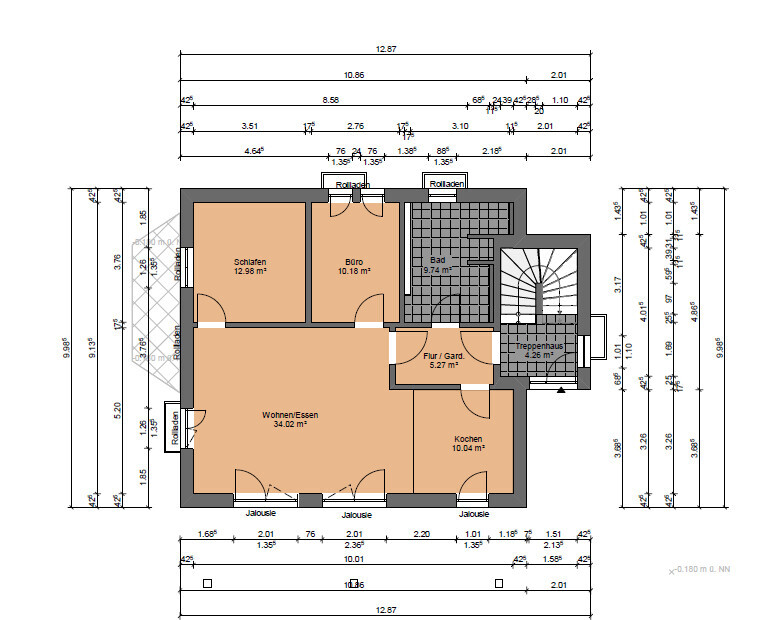
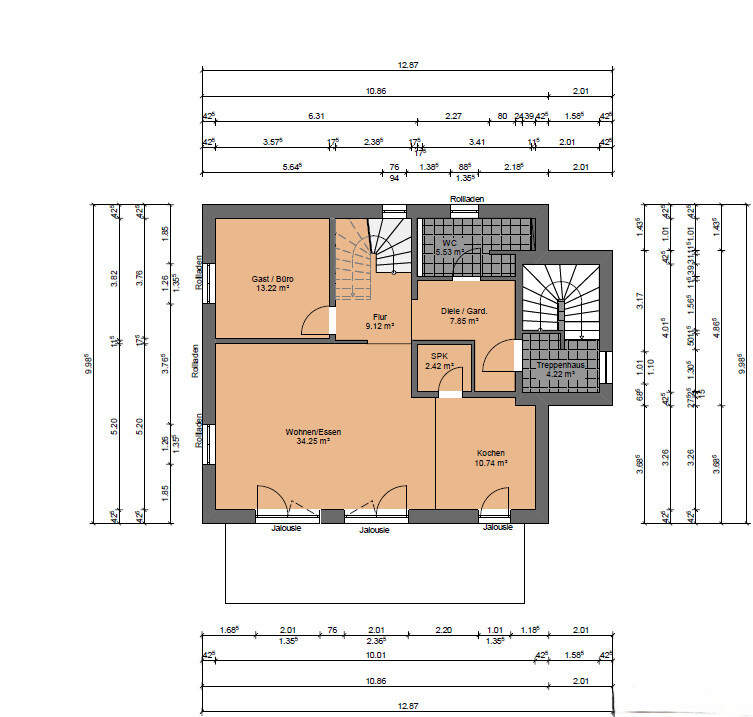
Due to the small size of the plot, the idea is for the parents-in-law to live on the ground floor, and for us (2 adults + 2 small children) to live on the upper floor and attic. We had also considered a semi-detached house with an asymmetric design, but that was too expensive and too large for the plot. Our goal is to still have enough garden space.
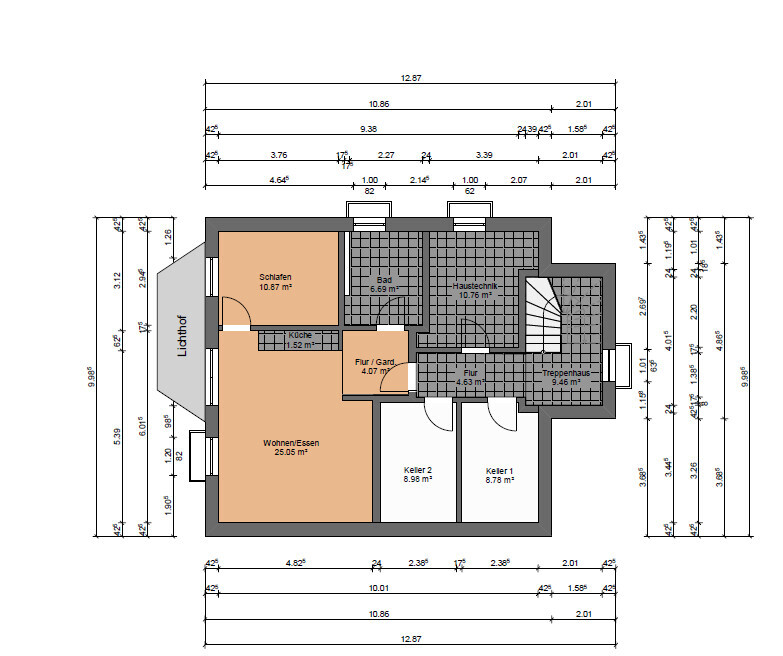
In the basement, provisions are planned for a granny flat or accessory dwelling unit that could be developed later if needed. Initially, this space will be used purely as a utility cellar.
Because of the photovoltaic requirement in Baden-Württemberg and the conditions for related subsidies, the house has been designed as a solid construction meeting KfW40 plus QNG standards. Electrically operated roller shutters or venetian blinds are standard throughout the living room and kitchen.
Development plan/restrictions
Plot size: approx. 475sqm (5113 sq ft)
Slope: no
Site occupancy index: 0.3
Floor area ratio: unknown
Building envelope, building line, boundary: open construction method
Edge development: 1 neighboring house on the left side
Number of parking spaces: 2 per dwelling unit
Number of floors: 2.5 + basement
Roof type: gable roof
Architectural style
Orientation
Maximum heights/limits: main building height 9.50m (31 ft), living area height 6.50m (21 ft)
Additional specifications
Homeowner requirements
Architectural style, roof type, building type
Basement, floors: Basement, ground floor, upper floor, and attic floor
Number of residents, ages: 2 parents-in-law + 2 adults + 2 children (1.5 years, 1 month)
Room requirements on ground floor and upper floor
Office: family use or home office?: One office for home office is planned on both the ground floor and upper floor, which will also serve as guest rooms
Number of guest stays per year: few
Open or closed architecture
Traditional or modern design
Open kitchen, kitchen island: Kitchen in L-shape plus kitchen island
Number of dining spaces: At least 6 on both ground floor and upper floor
Fireplace: no
Music/sound system wall: no
Balcony, roof terrace: Balcony planned on the upper floor
Garage, carport: double garage
Utility garden, greenhouse
Additional wishes/special features/daily routine, including reasons for design choices
House design
Planner: construction company
- Planner from a construction company
- Architect
- Do-it-yourself
What do you particularly like? Why?
What do you not like? Why?
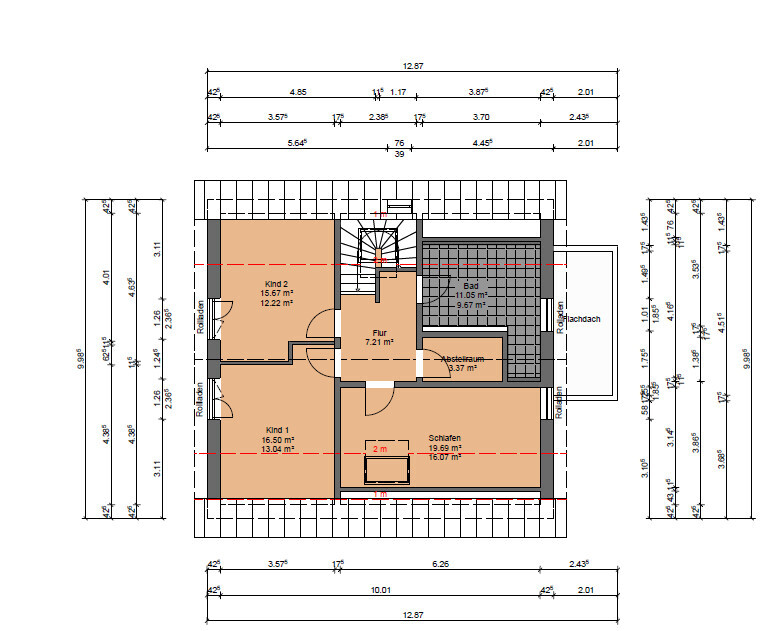
In my opinion, the children’s rooms in the attic are planned too small. This might work now when they’re toddlers, but as bedrooms for teenagers, I find them too small. We considered removing the storage room in the attic and adding it to the master bedroom so the children’s rooms could be larger. Or are we mistaken? As a replacement for the storage room, we possibly considered additional storage space under the staircase.
I have never lived under sloping ceilings, but unfortunately, there is no other way to design this (see above). However, they do significantly reduce the room size.
Price estimate according to architect/planner: The house, excluding incidental building costs and land, should cost around €800,000 (approx. $870,000) turnkey. We will have to do a significant amount of work ourselves to bring the price down.
Personal price limit for the house, including fittings: Our maximum budget for everything is €950,000 (approx. $1,035,000). Whether this is realistic remains to be seen ;-)
Preferred heating system: planned is an air-to-water heat pump plus underfloor heating
If you had to give up something, on which details/upgrades
- could you do without:
- couldn’t do without: basement
Why is the design the way it is now? For example:
The construction company already adapted the designs because previous versions were too expensive. The floor area was reduced from initially 100sqm (1076 sq ft) to 90sqm (970 sq ft). Due to the partly integrated staircase, the effective floor area is now a bit above 80sqm (860 sq ft).
Standard design from the planner?
Which/all wishes were implemented by the architect?
A mix of many examples from various magazines...
What do you think makes it particularly good or bad?
Do you see any potential improvements regarding the floor plans?
this is my first post, so I apologize in advance if I haven’t provided all the necessary information – I put this together to the best of my knowledge and ability :-)
We are currently planning a multi-generational house and have already received some plans from the construction company. This is the current plan. The house is planned to be built on a plot of about 475sqm (5113 sq ft).
Due to the small size of the plot, the idea is for the parents-in-law to live on the ground floor, and for us (2 adults + 2 small children) to live on the upper floor and attic. We had also considered a semi-detached house with an asymmetric design, but that was too expensive and too large for the plot. Our goal is to still have enough garden space.
In the basement, provisions are planned for a granny flat or accessory dwelling unit that could be developed later if needed. Initially, this space will be used purely as a utility cellar.
Because of the photovoltaic requirement in Baden-Württemberg and the conditions for related subsidies, the house has been designed as a solid construction meeting KfW40 plus QNG standards. Electrically operated roller shutters or venetian blinds are standard throughout the living room and kitchen.
Development plan/restrictions
Plot size: approx. 475sqm (5113 sq ft)
Slope: no
Site occupancy index: 0.3
Floor area ratio: unknown
Building envelope, building line, boundary: open construction method
Edge development: 1 neighboring house on the left side
Number of parking spaces: 2 per dwelling unit
Number of floors: 2.5 + basement
Roof type: gable roof
Architectural style
Orientation
Maximum heights/limits: main building height 9.50m (31 ft), living area height 6.50m (21 ft)
Additional specifications
Homeowner requirements
Architectural style, roof type, building type
Basement, floors: Basement, ground floor, upper floor, and attic floor
Number of residents, ages: 2 parents-in-law + 2 adults + 2 children (1.5 years, 1 month)
Room requirements on ground floor and upper floor
Office: family use or home office?: One office for home office is planned on both the ground floor and upper floor, which will also serve as guest rooms
Number of guest stays per year: few
Open or closed architecture
Traditional or modern design
Open kitchen, kitchen island: Kitchen in L-shape plus kitchen island
Number of dining spaces: At least 6 on both ground floor and upper floor
Fireplace: no
Music/sound system wall: no
Balcony, roof terrace: Balcony planned on the upper floor
Garage, carport: double garage
Utility garden, greenhouse
Additional wishes/special features/daily routine, including reasons for design choices
House design
Planner: construction company
- Planner from a construction company
- Architect
- Do-it-yourself
What do you particularly like? Why?
What do you not like? Why?
In my opinion, the children’s rooms in the attic are planned too small. This might work now when they’re toddlers, but as bedrooms for teenagers, I find them too small. We considered removing the storage room in the attic and adding it to the master bedroom so the children’s rooms could be larger. Or are we mistaken? As a replacement for the storage room, we possibly considered additional storage space under the staircase.
I have never lived under sloping ceilings, but unfortunately, there is no other way to design this (see above). However, they do significantly reduce the room size.
Price estimate according to architect/planner: The house, excluding incidental building costs and land, should cost around €800,000 (approx. $870,000) turnkey. We will have to do a significant amount of work ourselves to bring the price down.
Personal price limit for the house, including fittings: Our maximum budget for everything is €950,000 (approx. $1,035,000). Whether this is realistic remains to be seen ;-)
Preferred heating system: planned is an air-to-water heat pump plus underfloor heating
If you had to give up something, on which details/upgrades
- could you do without:
- couldn’t do without: basement
Why is the design the way it is now? For example:
The construction company already adapted the designs because previous versions were too expensive. The floor area was reduced from initially 100sqm (1076 sq ft) to 90sqm (970 sq ft). Due to the partly integrated staircase, the effective floor area is now a bit above 80sqm (860 sq ft).
Standard design from the planner?
Which/all wishes were implemented by the architect?
A mix of many examples from various magazines...
What do you think makes it particularly good or bad?
Do you see any potential improvements regarding the floor plans?
D
Dutchi69520 May 2025 00:19ypg schrieb:
However, I wonder why the basement is planned when everyone only gets their 9sqm (97 sq ft) of storage space plus the utility room. For laundry, you have the bathroom niches. For bicycles, a garden shed will certainly be added, and for the lawn mower, a second one, right?
So, you could actually build a 25 to 30sqm (270 to 320 sq ft) extension at the back on the ground floor for the ancillary rooms, avoid the basement and the placeholder granny flat, and instead spend the saved money on some nice extras: larger windows, an open gable, a better balcony with garden stairs and a canopy.
It would be perfect, of course, to use the future extension structure for that purpose. Then the plans would need to be revised.
Otherwise, it works as it is. The basement is primarily intended to be used as a functional basement, meaning storage space and a hobby or party room.
A small garden shed for the lawn mower and similar equipment is definitely planned. The idea for the bicycles was to store them in the double garage as well, if it is long enough.
Unfortunately, land prices in our area are extremely high. We applied for two plots in the development and unfortunately got the smaller one (the larger was over 500sqm (5,380 sq ft)). But with land prices up to 1000€/sqm (about $93/sq ft), compromises have to be made or one has to move far into the countryside and accept a commute of 45 minutes or more. We "unfortunately" live in a holiday region where land is very expensive and very hard to acquire.
D
Dutchi69520 May 2025 00:32Arauki11 schrieb:
We built in a similar way with my parents back then and lived comfortably for a long time in Baden-Württemberg. Our plot was on a slope and about twice as large, so it’s not directly comparable. My parents wanted a simple basement unit, which was not an option for me, so we built them a large, nice apartment of nearly 100sqm (1076 sq ft) including a roof terrace on the upper floor and attic. Today, I think I may have gone a bit overboard because my parents could have lived just as well in a well-designed 75-80sqm (807-861 sq ft) space, and as they got older, the apartment became a bit too big for my mother.
The fact that their apartment was on the upper floor (plus a long staircase to the main entrance) is something I would do again for the following reason: As long as the parents were fit, they had no problem using the stairs to their home, which also served as their exercise. When my father was no longer able to manage that, he could barely move around on his own anyway, so we used an automatic stair climber or helped him downstairs 2-3 times a week; after all, we lived together in the house. From my own experience, if you can no longer manage stairs, you probably can’t move around independently outdoors either. This also applies to my current 90-year-old mother-in-law. I notice many more unsolvable mental challenges in elderly people. Later, my mother moved in with the grandchildren, where she also lived on an upper floor with a small bathroom. She always said that was better because she could hold onto something everywhere.
What I want to say is:
I would place the parents’ apartment on the upper floor and design a nice layout with a beautiful view and a balcony. I would avoid a basement in flat terrain for cost reasons, but regarding the building coverage ratio of the plot, I have no clue. I would just free myself from the often-heard urge to house the parents on one level at all costs, because their problems and risks are everywhere and cannot be completely prevented. Falls usually don’t happen on the front steps but rather on small rugs, changes in flooring, etc.
Your shown floor plan lacks any furniture, which makes it hard to understand because your individual lifestyle is what really matters. To be honest, I don’t like looking at the floor plan as it is; it’s not attractive and should be redesigned from scratch. Don’t let yourselves be rushed; this takes time and conversation.
The children need direct access to the terrace; the parents (which would also be the case with me) are fine with a nice roof terrace or similar.
Maybe you could share more background details, also about your parents. Thank you very much for the detailed response.
I have already shared some of the background in previous replies. Currently, my in-laws (both just under 60) live on the third floor in 120sqm (1292 sq ft). They no longer want to carry heavy groceries up so many stairs and would prefer to live at ground level. Initially, the plan was to give both parties direct garden access, but this option was clearly over budget. They are willing to reduce their living space but not below 80sqm (861 sq ft).
An asymmetrical semi-detached house was also far beyond our budget, so we have settled on the current plan. According to the builder, building upwards is cheaper than building outwards, which also suits the small plot.
My wife prefers a house with a distinct "character" and does not want everything on one level. That was the reason we decided on upper and attic floors.
I have already noted the advice about including furniture to scale and we will definitely do that.
Please feel free to ask if you have any further questions.
Dutchi695 schrieb:
Actually, we would have four parking spaces -> a double garage plus the two spots in front. I attached the plan further up. The plan in post 9 is a first reference but not sufficient otherwise. There are not even any measurements included. Where will the garage be located? And is it allowed to extend beyond the building boundary / setback line?

Dutchi695 schrieb:
So far, there has been no mention of a secondary apartment—the developer suggested the idea to generate additional rental income. [...] We have currently decided against a secondary apartment; however, it was mistakenly included in the above-mentioned plans. In fact, we are only preparing for a possible secondary apartment / holiday flat so that future expansion would be easier, as the connections would already be in place.
What would a floor plan from an independent architect cost? I read online that it might be around 10-15% of the construction costs.
What optimizations do you see? Hiring an independent architect is usually roughly cost-neutral, as it is a misconception to consider the fee simply as an unnecessary cost increase. You can only "optimize" something that is at least reasonably good to begin with. Even a "pre-installed" secondary apartment immediately incurs construction costs and parking space requirements, even if it doesn't pay off. Would the zoning plan / building permit / planning permission even allow a third residential unit and/or holiday apartment?
If meeting the basic needs is already difficult, exceeding those needs will be even more challenging. This should be logically clear—even to a beginner in their first semester—that the GU’s April Fool’s suggestion is quite the opposite.
Please share the ground elevation details.
https://www.instagram.com/11antgmxde/
https://www.linkedin.com/company/bauen-jetzt/
Dutchi695 schrieb:
Actually, we would have four parking spaces -> a double garage plus the two spaces in front of it. I uploaded the plan further up. However, these count as only two official parking spaces, since usually each space must be accessible independently. How many parking spaces are required per residential unit according to the development plan?
Regarding the planned EWL: How many residential units does your development plan allow for your property?
kbt09 schrieb:
The plan in post 9 serves as an initial guideline but is otherwise insufficient. There aren’t even any meter measurements included. Where is the garage going to be located? And is it allowed to extend beyond the building boundary? You should definitely try drawing everything out yourselves.
There is no shame in having a small plot. However, you need to carefully consider where to fit everything. For example, tandem parking spaces are impractical for two families and likely won’t be approved either.
The zoning plan (building code plan / development plan) plays a major role.
Also, bicycles and such cannot be easily pushed past a house wall or parked cars in a tight space.
You also need your building envelope (building area) for better clarity, as well as the plot width. Draw everything to scale on graph paper.
The rooms themselves work well and none of them are too small.
Similar topics