
Hi,
we are currently in the planning phase for our small wooden house.
Our architect wants to design our staircase according to standard 18065, but this does not match our size preferences.
We want a straight staircase with a length of 250cm (98 inches)... according to the standard, we would have to extend it to at least 290cm (114 inches). The width of 100cm (39 inches) remains unchanged.
Now to our question: Does a staircase in Lower Saxony have to be designed/built according to standard 18065?
In the technical building regulations, I found this paragraph.
Regarding DIN 18065
I could not find a clear answer as to whether I have to comply with the standard.
we are currently in the planning phase for our small wooden house.
Our architect wants to design our staircase according to standard 18065, but this does not match our size preferences.
We want a straight staircase with a length of 250cm (98 inches)... according to the standard, we would have to extend it to at least 290cm (114 inches). The width of 100cm (39 inches) remains unchanged.
Now to our question: Does a staircase in Lower Saxony have to be designed/built according to standard 18065?
In the technical building regulations, I found this paragraph.
Regarding DIN 18065
- 1. The introduction excludes the application to staircases in residential buildings of building classes 1 and 2 and in apartments.
I could not find a clear answer as to whether I have to comply with the standard.
I can’t understand at all how you try to justify having such a steep staircase.
We have a staircase leading to the attic that doesn’t meet the building regulations. Previously, there was a space-saving staircase there that urgently needed to be replaced. The new staircase is a regular one but noticeably steeper. Going up is fine, but coming down is a bit more difficult and definitely not suitable for older people. However, this was deliberately planned because the space upstairs is only used for storage and the office. Otherwise, there would have been very little room left in the hallway. We also never intended to spend our whole lives in this house. So it works for us.
That said, I would never consider installing such a staircase between the ground floor and upper floor.
If you design the house in a way that it’s impossible to install a staircase that complies with the regulations without disproportionate effort, doesn’t that reduce the property’s value? Why would anyone do that in a new build?
We have a staircase leading to the attic that doesn’t meet the building regulations. Previously, there was a space-saving staircase there that urgently needed to be replaced. The new staircase is a regular one but noticeably steeper. Going up is fine, but coming down is a bit more difficult and definitely not suitable for older people. However, this was deliberately planned because the space upstairs is only used for storage and the office. Otherwise, there would have been very little room left in the hallway. We also never intended to spend our whole lives in this house. So it works for us.
That said, I would never consider installing such a staircase between the ground floor and upper floor.
If you design the house in a way that it’s impossible to install a staircase that complies with the regulations without disproportionate effort, doesn’t that reduce the property’s value? Why would anyone do that in a new build?
T
Timotheus19 Nov 2024 19:49How often do I have to say that the staircase meets the standard??? DIN 18065 is fully complied with. I have already mentioned that the standard must be met even if the building authority doesn’t care.
I keep having to read these accusations, which annoys me a lot.
We welcome constructive feedback!
Suggestions are not really useful right now since we don’t have the finalized floor plan yet.
Our house’s exterior dimensions are 6.5m x 12.5m (21 ft 4 in x 41 ft), so it’s relatively narrow. For this reason, after consultations, we decided on a quarter-turn staircase. To avoid being too close to the wall, the winding section has to be kept rather short. The staircase builders and we agreed on about 3m and 1.3m (straight part 3m (10 ft), winding part 1.3m (4 ft 3 in)). This way, we comply with the standard and have a space-saving staircase.
We also tested various staircases and are comfortable with the minimum tread depth. We are not planning to have children, and only the bedroom is planned on the upper floor.
I’m attaching a sketch from us.
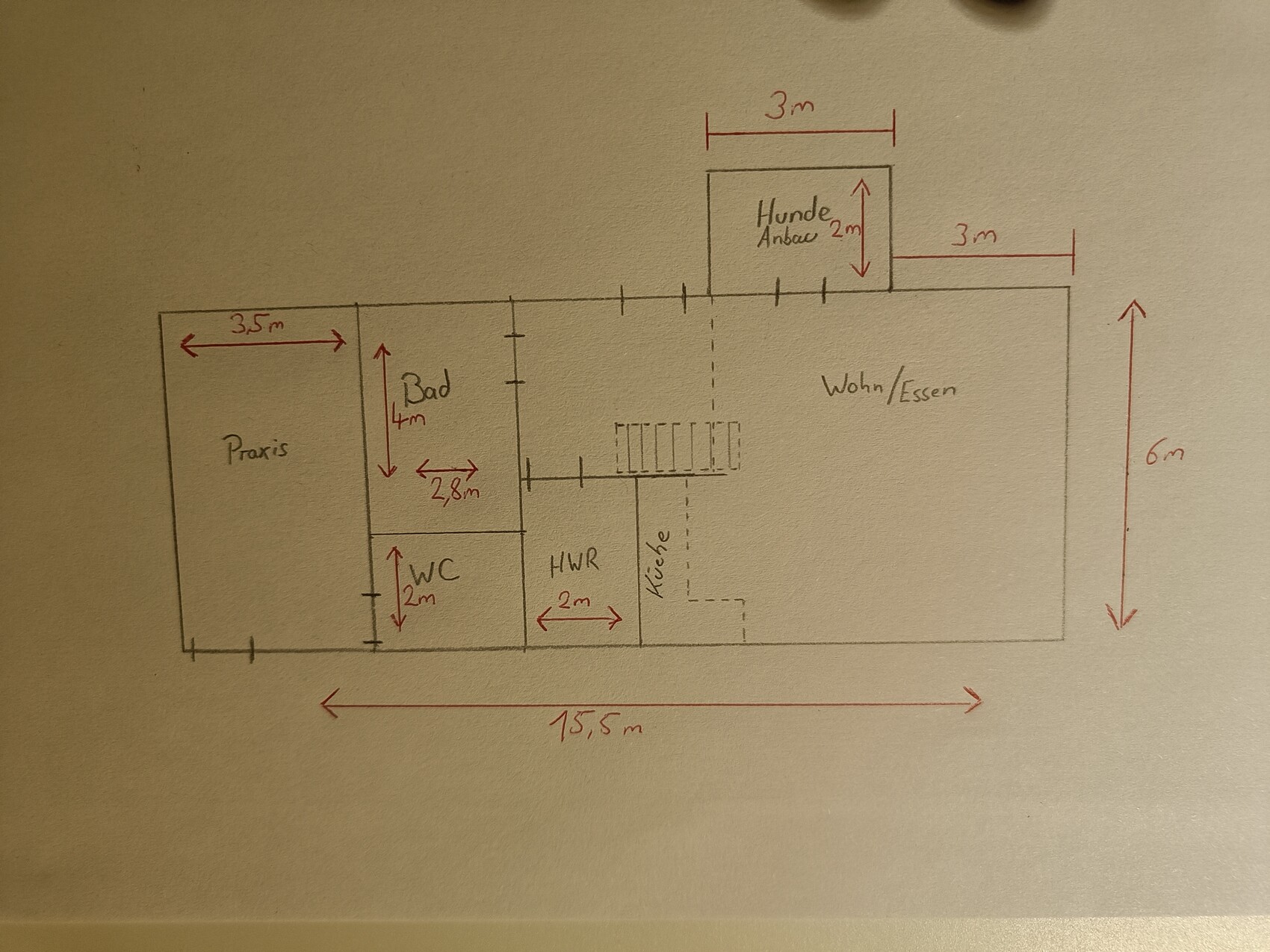
The wall between the kitchen and staircase will be extended to 3m (10 ft). Please ignore the practice area since it does not belong to the main house.
Interior dimensions are 12m x 6m (39 ft 4 in x 20 ft).
Before anyone asks: We have working dogs that need a fixed place.
I keep having to read these accusations, which annoys me a lot.
We welcome constructive feedback!
Suggestions are not really useful right now since we don’t have the finalized floor plan yet.
Our house’s exterior dimensions are 6.5m x 12.5m (21 ft 4 in x 41 ft), so it’s relatively narrow. For this reason, after consultations, we decided on a quarter-turn staircase. To avoid being too close to the wall, the winding section has to be kept rather short. The staircase builders and we agreed on about 3m and 1.3m (straight part 3m (10 ft), winding part 1.3m (4 ft 3 in)). This way, we comply with the standard and have a space-saving staircase.
We also tested various staircases and are comfortable with the minimum tread depth. We are not planning to have children, and only the bedroom is planned on the upper floor.
I’m attaching a sketch from us.
The wall between the kitchen and staircase will be extended to 3m (10 ft). Please ignore the practice area since it does not belong to the main house.
Interior dimensions are 12m x 6m (39 ft 4 in x 20 ft).
Before anyone asks: We have working dogs that need a fixed place.
There is missing information regarding the upper floor — is it a full story or an attic with what knee wall height?
Usually, staircases can be planned more space-efficiently and with better room usage along exterior walls for the building width.
And yes, your last stair landing complied with the standard in terms of measurements, but the 23.2 cm (9.1 inches) tread depth is really not very practical, especially going down, as already mentioned here. Measure your foot length.
Years ago, I made two plans for a narrower house. These examples are only intended as inspiration. On the ground floor, there is only a small area for the connection of external utilities, with the actual technical rooms located on the upper floor. The room layout is also not quite the same as yours but is meant to give you an idea. Both plans assume two full stories. The interior width is only 5 m (16.4 feet). It was designed for a family with three children.
Option 1 could also work with a knee wall
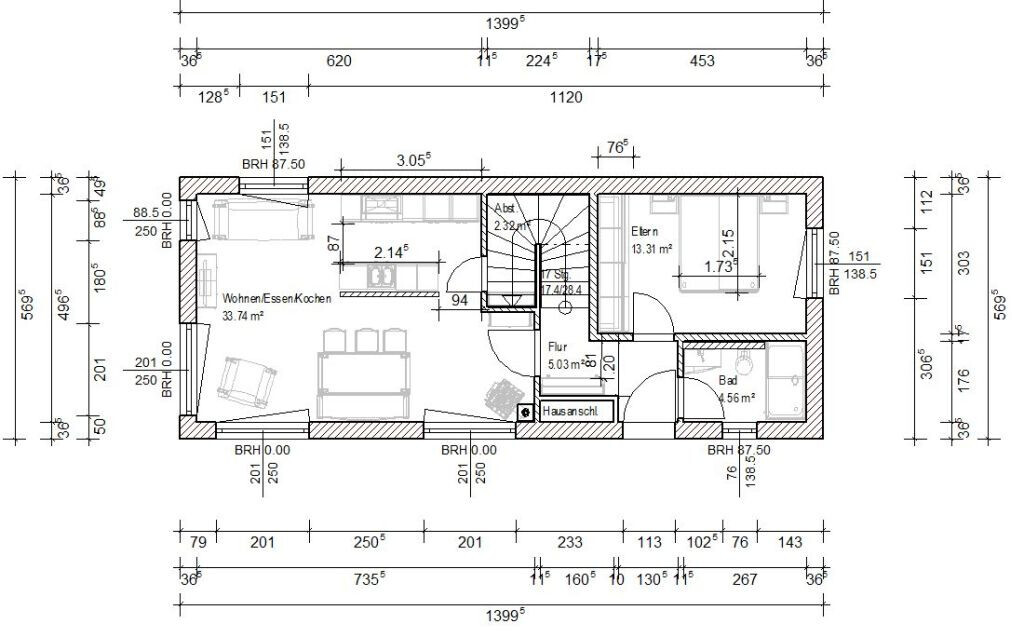
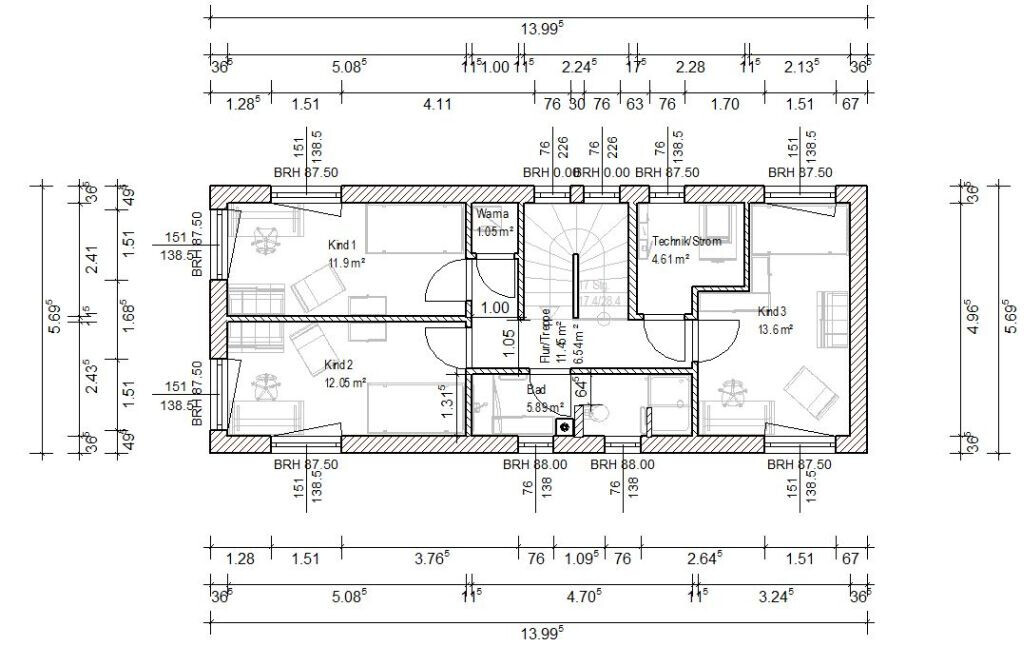
Option 2 requires a full upper floor
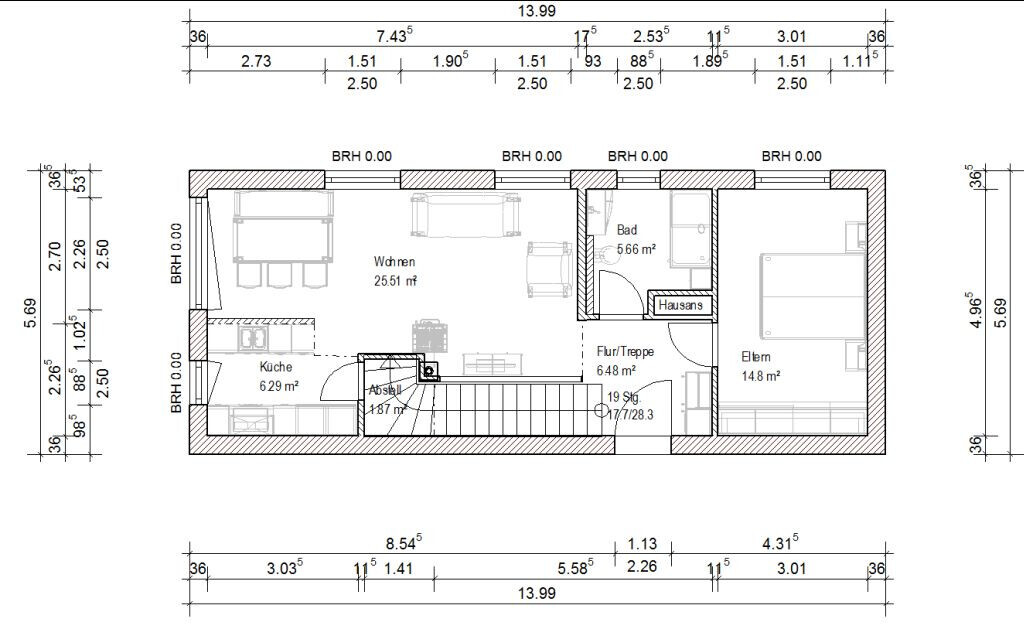
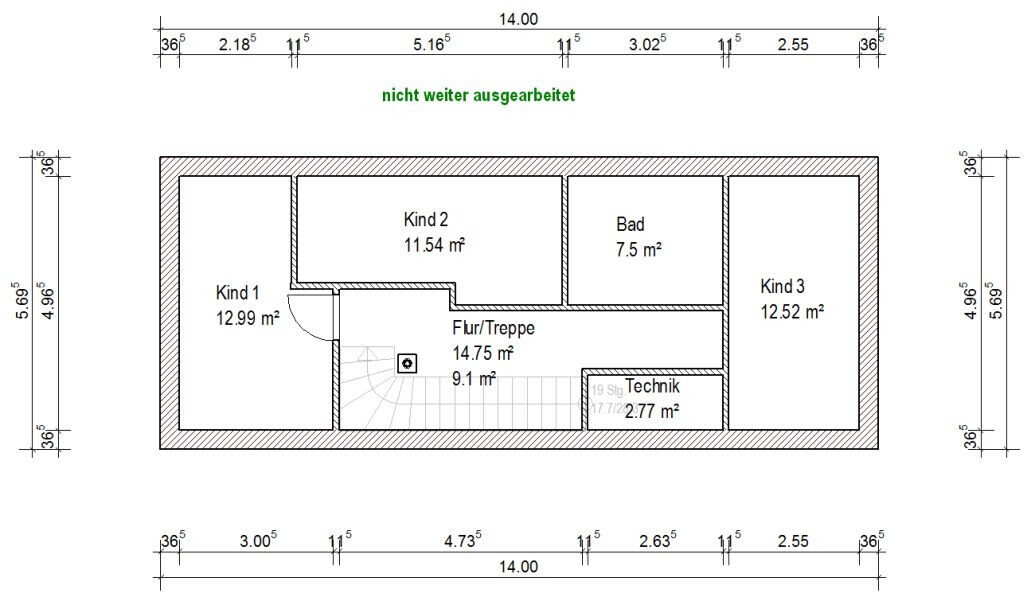
Usually, staircases can be planned more space-efficiently and with better room usage along exterior walls for the building width.
And yes, your last stair landing complied with the standard in terms of measurements, but the 23.2 cm (9.1 inches) tread depth is really not very practical, especially going down, as already mentioned here. Measure your foot length.
Years ago, I made two plans for a narrower house. These examples are only intended as inspiration. On the ground floor, there is only a small area for the connection of external utilities, with the actual technical rooms located on the upper floor. The room layout is also not quite the same as yours but is meant to give you an idea. Both plans assume two full stories. The interior width is only 5 m (16.4 feet). It was designed for a family with three children.
Option 1 could also work with a knee wall
Option 2 requires a full upper floor
Our open staircase to the attic has a tread width of 230 - 260mm (9 - 10 inches), depending on the step. I would never, ever choose such a tread width for the staircase from the ground floor to the upper floor. Two years ago, I had to wear a foot brace for a few weeks. Going up was fine, but going down required a lot of caution. However, this has probably been pointed out to you often enough, apparently also by the architect and stair builder. In the end, you will have to live with it.
Timotheus schrieb:
How many times do I have to say that the staircase meets the standard??? DIN 18065 is followed 100%.
I keep having to read these accusations, which annoys me a lot. Understandably, the repeated mentions bother you, but people respond because you defend this staircase part with many arguments, which in turn has led to criticism. Be glad—the people are actively engaged in your topic!
On the other hand, this might make clear to you how fundamentally important this component is and how significantly disadvantageous it can be to overlook something or perhaps not evaluate things thoroughly enough.
I once worked on a new build of a public building. From the large entrance area, a 4m (13 feet) wide staircase led to the first floor (the standard for public buildings was certainly met). Many employees didn’t use this staircase because it was simply too steep and the tread depth too shallow; there was also an elevator.
In short: the standard is important and regulates basic requirements, but there is also a personal “DNA” to standards that can make life permanently more comfortable—which is why you build a house in the first place. So the standard does not guarantee that your life will be comfortable enough. Therefore, while the standard must be met, it can also be exceeded significantly to achieve the desired result for you.
Keyword: “unwanted, repeated redesign”—small residential units especially require a higher level of planning and skill.
Timotheus schrieb:
We appreciate constructive suggestions!
Suggestions aren’t really useful yet since we don’t have the final floor plan. Exactly—I believe this will be exciting—in a positive way!

Timotheus schrieb:
I’m attaching a sketch from us. [Image]
The wall between the kitchen and stairs will be extended by 3m (10 feet). Please ignore the practice area as it is not part of the main house.
The interior dimensions are 12 x 6m (39 x 20 feet).
In case anyone asks: we have working dogs that need a fixed space. It looks like a 40-foot shipping container scaled up by a factor of 2.5 vertically, or resembles a showman’s caravan with an extendable bay window. Were you workation globetrotters?
https://www.instagram.com/11antgmxde/
https://www.linkedin.com/company/bauen-jetzt/
Similar topics