
Hello everyone,
After reading for a while, I’m finally stepping out of the shadows.
We have reserved a plot of land (BW). Nice size, somewhat expensive, with an old development plan.
This makes things a bit complicated.
Therefore, my (somewhat provocative) question to the experts: In your opinion, is this plot reasonably suitable for building, or would it be better to wait for another plot?
Current situation: Living in a single-family rental house in the same area. Visited model home parks, had informal talks about wishes, collected housing ideas.
For this plot and development plan, a local architect would be our first contact. This has not happened yet, due to doubts about whether this plot is suitable.
No firm decisions yet on construction method, floor plan, etc.; 140m² (1,507 sq ft) would be nice, 5-6 rooms, rest open for now.
Budget: approximately 600,000€ excluding land and additional building costs.
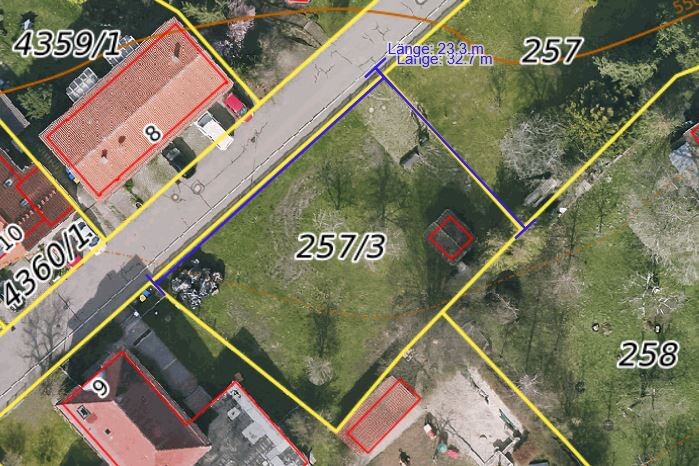
Plot 257/3
* approx. 722m² (7,770 sq ft)
* approx. 3m (10 ft) elevation difference
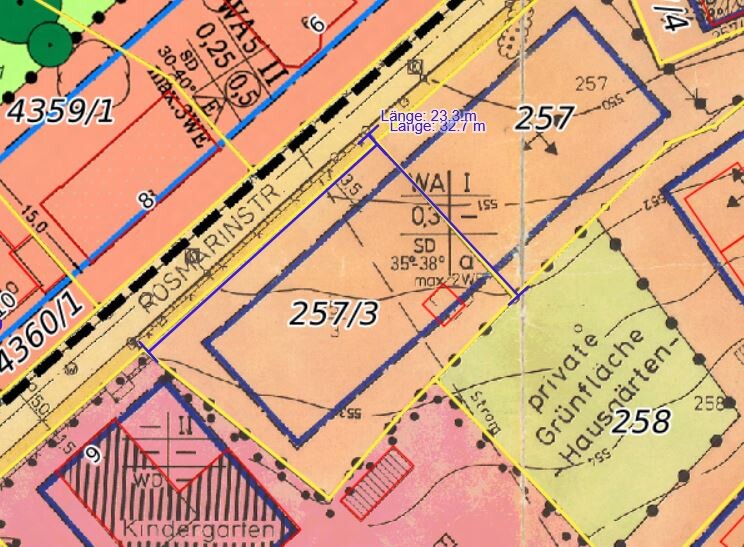
Development plan 11_35 Auf der Ay Gönningen
* Maximum building length 14m (46 ft)
* Maximum building depth 12m (39 ft)
* Single-family house or base unclear
* SD 35-28
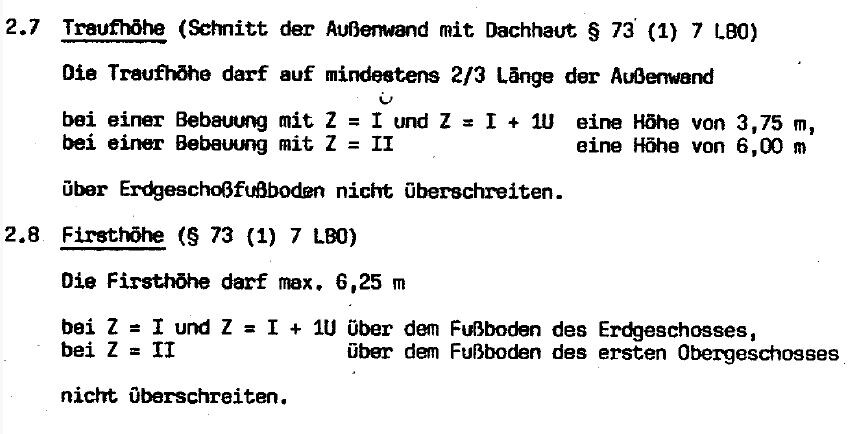
* Maximum eaves height 3.75m (12 ft) above ground floor slab
* Maximum ridge height 6.25m (20.5 ft) above ground floor slab
* See images for further details
Due to the limited ridge height and slope, the only idea I have is an elevated basement + 1.5 stories. However, I am not sure if that is even allowed.
Thank you very much for any input.
After reading for a while, I’m finally stepping out of the shadows.
We have reserved a plot of land (BW). Nice size, somewhat expensive, with an old development plan.
This makes things a bit complicated.
Therefore, my (somewhat provocative) question to the experts: In your opinion, is this plot reasonably suitable for building, or would it be better to wait for another plot?
Current situation: Living in a single-family rental house in the same area. Visited model home parks, had informal talks about wishes, collected housing ideas.
For this plot and development plan, a local architect would be our first contact. This has not happened yet, due to doubts about whether this plot is suitable.
No firm decisions yet on construction method, floor plan, etc.; 140m² (1,507 sq ft) would be nice, 5-6 rooms, rest open for now.
Budget: approximately 600,000€ excluding land and additional building costs.
Plot 257/3
* approx. 722m² (7,770 sq ft)
* approx. 3m (10 ft) elevation difference
Development plan 11_35 Auf der Ay Gönningen
* Maximum building length 14m (46 ft)
* Maximum building depth 12m (39 ft)
* Single-family house or base unclear
* SD 35-28
* Maximum eaves height 3.75m (12 ft) above ground floor slab
* Maximum ridge height 6.25m (20.5 ft) above ground floor slab
* See images for further details
Due to the limited ridge height and slope, the only idea I have is an elevated basement + 1.5 stories. However, I am not sure if that is even allowed.
Thank you very much for any input.
Le_tableau schrieb:
That would depend on how far the basement extends out, right?No. Actually, the definition of a full story is clearly defined in every federal state. This also applies to basements. To assess the neighboring development area and the 0.8 factor, more information about the site would be needed. Surely there was some logic behind it, even if it’s not immediately obvious.
I'm curious to see how it will be handled in your area.
L
Le_tableau19 Feb 2025 22:58hanghaus2023 schrieb:
North-facing slope. What are the dimensions of the building plot? Is it allowed to place the garage on the boundary?A north-facing slope is not the best option initially. The building plot measures approximately 28m x 15m (92ft x 49ft). Garages must not be located more than 6m (20ft) away from the property boundary adjacent to the access road. I couldn’t find any other relevant information in the development plan or the state building regulations.
L
Le_tableau19 Feb 2025 23:08ypg schrieb:
No. The number of full stories is actually clearly defined in every federal state. This also applies to basements.
To evaluate the neighboring development area and the 0.8 ratio, more information about the site would be needed. Surely there was some logic behind it, even if it’s not immediately obvious.
I’m curious to see how it will be handled in your case. Okay, according to the state building code, it says:
(5) Stories above ground are those whose ceiling upper edges extend on average more than 1.4 meters (4.6 feet) above the ground surface; otherwise, they are considered basement levels. Voids between the top floor ceiling and the roof, where occupancy is not possible, do not count as stories.
(6) Full stories are those that extend more than 1.4 meters (4.6 feet) on average above the ground surface and have a minimum height of 2.3 meters (7.5 feet), measured from the top edge of the floor to the top edge of the floor of the story above or, if on the top floor, to the top edge of the roof covering.
This means that if a story extends less than 1.4 meters (4.6 feet) above the average ground surface, it is not considered a full story.
N
NatureSys20 Feb 2025 00:11Le_tableau schrieb:
Ok, according to the state building code, this means:
(5) Stories are considered above-ground if their ceiling edges on average extend more than 1.4 m (4.6 ft) above the ground surface; otherwise, they are basement levels. Cavities between the top ceiling and the roof, where living spaces are not possible, are not counted as stories.
(6) Full stories are levels that extend more than 1.4 m (4.6 ft) above the average measured ground surface and have a height of at least 2.3 m (7.5 ft), measured from the top of the floor to the top of the floor above or to the underside of the roof covering of the level above.
In other words, extending less than 1.4 m (4.6 ft) above the average measured ground surface means it is not a full story. Le_tableau schrieb:
In other words, extending less than 1.4 m (4.6 ft) above the average measured ground surface means it is not a full story. It is also important which ground surface is taken as reference here. In North Rhine-Westphalia (NRW), for example, it is, as far as I know, the original ground level. In our area and most neighboring regions, the basement level was excavated on the sides to allow for more windows. As a result, in finished houses the ceiling is more than 1.4 m (4.6 ft) above the new ground surface. Fun fact: more boundary construction is also allowed underground. We have a 12 m (39 ft) long garage, but only 8 m (26 ft) of it is above the original ground level. This allowed it to be permitted as a boundary garage next to the neighbor’s garage.
In NRW, it is also allowed to build underground beyond the building envelope. At least, that is my understanding of the building code.

Le_tableau schrieb:
I cannot find the "elevation of building structures" or any reference to the baseline for the established ground floor finished floor level in the development plan. This would determine how much of the basement is visible, right? Basically correct. However, disregard my statement
11ant schrieb:
The slope runs roughly diagonally, so whether the house has a square footprint or an axis running lengthwise or widthwise, it doesn’t make much difference. in the way I used the term "slope." Here, however, there is an incline from the street side on Rosmarinstr. toward the garden side facing Auf der Ay. The lot is uphill from the street, and the basement is visible from the street side. Trying to make use of a basement that is not a full floor would therefore be rather unattractive, and you can basically forget about this aspect. By the way, the state building code applies in the version valid at the time the development plan was issued. So I wouldn’t want to build up the basement too much here, but rather just have the cellar protrude to the street side as a plinth only as far as necessary. You should aim for a single-story house.
Le_tableau schrieb:
How is this handled when such a specification is missing? Isn’t it always supposed to be defined? In older development plans, this is often left unregulated to a reasonable extent. It is only due to abusive exploitations that regulations on building setbacks were introduced, and development plans have become increasingly restrictive.
Le_tableau schrieb:
For the neighboring development plan, at least it states: "For new buildings, the ground floor finished floor height may be a maximum of 0.8 m above the average roadway elevation of the access street." Even though this doesn’t really help here. Regulations in more recent development plans are useful insofar as they reveal against what kind of excessive demands the plans have become more robust and the building authorities more meticulous at the same time. This allows you to estimate the likelihood of obtaining exemptions. However, I assume you are referring to the (similarly old or only slightly newer) area along Rosmarinstraße, even-numbered house numbers? You would then need to interpret those rules differently because they relate to the valley-side conditions.
So: from these aspects, I see a clear longitudinal axis (eaves, ridge) running parallel to the street, a shallow building depth, and a moderate knee wall height, most likely around 80 cm (about 31 inches) or less. And no, there’s no need to worry about this.
https://www.instagram.com/11antgmxde/
https://www.linkedin.com/company/bauen-jetzt/
L
Le_tableau21 Feb 2025 22:18NatureSys schrieb:
It is also important which ground level is being referenced here. In North Rhine-Westphalia (NRW), to my knowledge, it is the original ground level. For us and almost all our neighbors, the basement was excavated on the side to allow for more windows. As a result, in the finished houses, the ceiling is more than 1.4 m (4.6 ft) above the new ground level. Fun fact: more boundary development is allowed underground as well. We have a 12 m (39 ft) long garage, of which only 8 m (26 ft) is above the original ground level. This made it possible as a boundary garage next to the neighbor’s garage.
In NRW, building underground outside the building envelope is also permitted. At least, that is my understanding of the building regulations. The building authority says the following, as has practically already been answered here:
For the requested plot, single-family housing is not specifically defined. The single-family house is ultimately determined by the terrain and the permissible number of floors. The basement in this case must not count as a full floor according to calculations. The relevant regulation is the State Building Code of 1983, which states that the upper edge of the basement ceiling may not exceed 1.4 m (4.6 ft) above the average measured ground level. From this, a possible range for the single-family house results.
This means the possibility of a "partially exposed" basement with larger windows facing north/northwest would exist.
I have looked at this in an example. If the building footprint is placed roughly in the center of the building envelope, to accommodate the slope, and the length is about 11 m (36 ft), the following could result:
(Original) Higher levels of the building corners (not sure if this complies with the State Building Code 1983): 551 m (1808 ft), 552 m (1812 ft), 551.5 m (1810 ft), 552.5 m (1814 ft) → approximately 552 m (1811 ft) on average (if the entire parcel is used as the base, a similar value is obtained).
This means the upper edge of the basement ceiling (and thus roughly the single-family house) could be at 552 m + 1.4 m = approximately 553.5 m (1815 ft).
Have I understood this correctly? This means you would practically end up on the highest area of the plot in the south, and the basement would be at about the terrain level in the north at 550.5 m (1806 ft).
Problem: Due to the sloping terrain, this is not really attractive, which is understandable. I will still try to sketch this in a section drawing.
Similar topics