
ᐅ Is it beneficial to prepare for photovoltaic systems during new construction?
Created on: 15 Mar 2021 12:39
P
Pwnage619
Hello
I am about to buy a new build from a developer.
Does it make sense to prepare for a photovoltaic system so that it can be installed later?
What exactly is needed for the preparation? Just an empty conduit?
I am about to buy a new build from a developer.
Does it make sense to prepare for a photovoltaic system so that it can be installed later?
What exactly is needed for the preparation? Just an empty conduit?
I would like to refer back to the earlier post:
The primary standard for antenna safety is IEC / DIN EN 60728-11 (VDE 0855-1), which unfortunately neither recommends routing grounding conductors for antennas preferably on the outside nor requires compliance with separation distances calculated according to IEC / DIN EN 62305-3 (VDE 0185-305-3), although following these would be advisable from a lightning protection perspective.
This also applies to photovoltaic cables, which, like antenna grounding conductors, are often installed as lightning conductors in close proximity to the building structure. An earlier regulation prohibiting the installation of antenna grounding conductors together with coaxial cables has long been removed. Lightning that travels from clouds to the earth over kilometers can be managed with HVI cables but not with a 1 mm (0.04 in) cable sheath.
The currently valid edition of the standard requires that accessible grounding conductors must be installed in PVC conduits with a wall thickness of 3 mm (0.12 in). This requirement has been removed in the upcoming edition of IEC 60728-11.
This standard, which applies to photovoltaic systems, explicitly requires that IF a protective equipotential bonding conductor is installed, it should be routed in immediate proximity to the photovoltaic cables to avoid inductive coupling of lightning currents from nearby strikes.
CONCLUSION: To objectively exclude rare direct lightning strikes, valuable roof installations must be protected with separate air-termination systems in accordance with the state of the art.
WingVII schrieb:
No, that is not allowed. Actually, for a satellite dish, you even need two empty conduits: one for the antenna cables and one for the 16 mm² (0.025 in²) lightning protection conductor. Otherwise, the separation distance required by DIN VDE is not maintained. This is often done incorrectly in practice.
The primary standard for antenna safety is IEC / DIN EN 60728-11 (VDE 0855-1), which unfortunately neither recommends routing grounding conductors for antennas preferably on the outside nor requires compliance with separation distances calculated according to IEC / DIN EN 62305-3 (VDE 0185-305-3), although following these would be advisable from a lightning protection perspective.
This also applies to photovoltaic cables, which, like antenna grounding conductors, are often installed as lightning conductors in close proximity to the building structure. An earlier regulation prohibiting the installation of antenna grounding conductors together with coaxial cables has long been removed. Lightning that travels from clouds to the earth over kilometers can be managed with HVI cables but not with a 1 mm (0.04 in) cable sheath.
The currently valid edition of the standard requires that accessible grounding conductors must be installed in PVC conduits with a wall thickness of 3 mm (0.12 in). This requirement has been removed in the upcoming edition of IEC 60728-11.
DIN VDE 0100-712 schrieb:
712.54 Grounding systems, protective conductors and protective equipotential bonding conductors
If protective equipotential bonding conductors are installed, they must be routed parallel to and in as close contact as possible with the DC and AC cables/wiring and accessories.
This standard, which applies to photovoltaic systems, explicitly requires that IF a protective equipotential bonding conductor is installed, it should be routed in immediate proximity to the photovoltaic cables to avoid inductive coupling of lightning currents from nearby strikes.
CONCLUSION: To objectively exclude rare direct lightning strikes, valuable roof installations must be protected with separate air-termination systems in accordance with the state of the art.
S
Steini202423 Apr 2023 09:06Hello everyone,
we are currently finalizing our selections with our builder and would like to prepare our detached house (gable roof with a 38° pitch) for photovoltaic use (see thread^^).
Our house will be built on a slab foundation (without a basement). The utility room is located on the ground floor, and the technical room with the air-to-water heat pump and hot water tank is on the upper floor. The technical room is connected to the utility room on the ground floor via a shaft.
1) Do the photovoltaic components (inverter, possibly storage, etc.) later have to be routed through the utility room? In other words, do I need to run cables from the upper floor to the ground floor, or can I reasonably combine this with the heating system on the roof? I know this question is somewhat vague. I’m still not exactly sure what we will need. :-/
2) How and where is the “roof penetration” typically made to bring the cables into the house? Is a roof tile removed and replaced with a type of cable sleeve? Are the photovoltaic cables (e.g., on the south side, see photo above) routed over, in, or under the roof to the technical room/cable shaft? Consequently: Do I only need to plan for an empty conduit in the cable shaft, or should an empty conduit also be installed inside the floor to get the cables from the roof penetration to the cable shaft/technical room?
3) FYI: Our builder is charging a hefty €560 for an empty conduit EN40 from the technical room to the utility room. Apparently, they are made of gold....
Best regards and many thanks for your support.
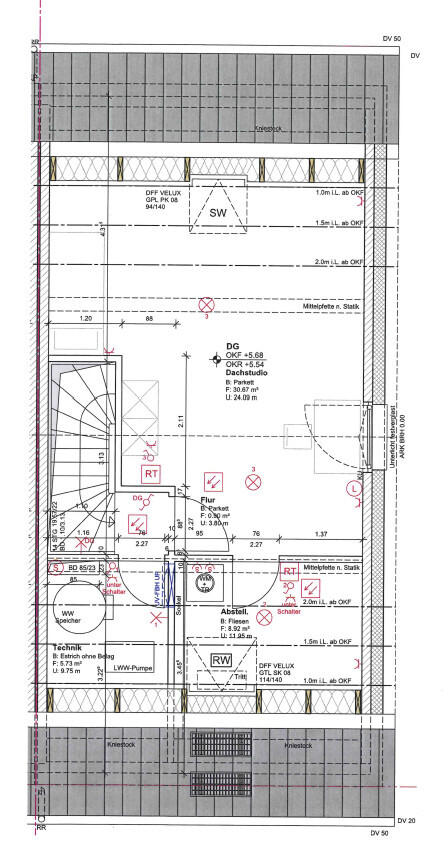
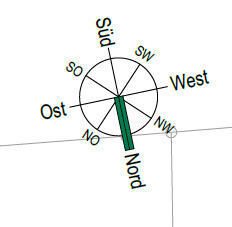
we are currently finalizing our selections with our builder and would like to prepare our detached house (gable roof with a 38° pitch) for photovoltaic use (see thread^^).
Our house will be built on a slab foundation (without a basement). The utility room is located on the ground floor, and the technical room with the air-to-water heat pump and hot water tank is on the upper floor. The technical room is connected to the utility room on the ground floor via a shaft.
1) Do the photovoltaic components (inverter, possibly storage, etc.) later have to be routed through the utility room? In other words, do I need to run cables from the upper floor to the ground floor, or can I reasonably combine this with the heating system on the roof? I know this question is somewhat vague. I’m still not exactly sure what we will need. :-/
2) How and where is the “roof penetration” typically made to bring the cables into the house? Is a roof tile removed and replaced with a type of cable sleeve? Are the photovoltaic cables (e.g., on the south side, see photo above) routed over, in, or under the roof to the technical room/cable shaft? Consequently: Do I only need to plan for an empty conduit in the cable shaft, or should an empty conduit also be installed inside the floor to get the cables from the roof penetration to the cable shaft/technical room?
3) FYI: Our builder is charging a hefty €560 for an empty conduit EN40 from the technical room to the utility room. Apparently, they are made of gold....
Best regards and many thanks for your support.
ad 1 and 2) Even if the inverter (WR) is located near the heating system, you will still need an AC cable running to the main distribution board (HAR) downstairs, meaning an empty conduit from the attic (DG) to the ground floor (EG). If you want backup power (i.e., supply during a blackout), it makes a lot of sense to install the inverter and battery in the main distribution room due to the thick cabling involved. Talk to your electrician about ensuring the main distribution panel has enough space reserved for a photovoltaic system.
There should also be roughly 100x100 cm (39x39 inches) of free space on a wall in the connection room for the inverter, plus about 70x30 cm (28x12 inches) on the floor for the batteries.
Is the electrical connection panel located below the technical room near the shaft, and does the shaft have inspection hatches at both the top and bottom? If so, you might be able to install an empty conduit yourself (the cheapest option). If not, you could consider a core drill hole through the ceiling next to it, which would likely cost about the same. Regarding the roof itself: we had our electrician lay an empty conduit up to just below the roof covering, plus 100 cm (39 inches) of loose length. We then asked the roofer to properly route this through the roof covering later and seal it with a sleeve (the photovoltaic system was installed three years later). This added about 50 euros extra. We have a metal roof, though.
Where the DC cable from the modules passes through the roof covering is secondary, especially if you are covering the entire roof (recommended). The solar installer will wire this appropriately; you can have the cables routed under the modules on the roof. Ideally, the penetration should be right next to the shaft in the attic.
ad 3) Are you working with a developer or a general contractor (GC)? Can you finalize specifics directly with the electrician, or only through the developer/GC?
If you install empty conduit, be sure it includes an internal pull wire. If the conduit has multiple bends, the pull wire is invaluable—otherwise, you can only partially use the inner diameter (31 mm [1.2 inches] inside a 40 mm [1.6 inches] conduit). Do you have a satellite dish on the roof? You can share the required equipotential bonding there. You will likely need two cable runs (2 x 2 x 4 mm²) to cover both sides of the roof.
If you have any doubts, it’s better to install the empty conduit (insist on the pull wire!). The GC will have set the price so that retrofitting is more expensive, meaning the budget for this is probably already tight. Also, talk to the roofer, as they are responsible for warranties. If you try to do it yourself and the roof leaks later, the roofer will likely refuse to honor the warranty.
There should also be roughly 100x100 cm (39x39 inches) of free space on a wall in the connection room for the inverter, plus about 70x30 cm (28x12 inches) on the floor for the batteries.
Is the electrical connection panel located below the technical room near the shaft, and does the shaft have inspection hatches at both the top and bottom? If so, you might be able to install an empty conduit yourself (the cheapest option). If not, you could consider a core drill hole through the ceiling next to it, which would likely cost about the same. Regarding the roof itself: we had our electrician lay an empty conduit up to just below the roof covering, plus 100 cm (39 inches) of loose length. We then asked the roofer to properly route this through the roof covering later and seal it with a sleeve (the photovoltaic system was installed three years later). This added about 50 euros extra. We have a metal roof, though.
Where the DC cable from the modules passes through the roof covering is secondary, especially if you are covering the entire roof (recommended). The solar installer will wire this appropriately; you can have the cables routed under the modules on the roof. Ideally, the penetration should be right next to the shaft in the attic.
ad 3) Are you working with a developer or a general contractor (GC)? Can you finalize specifics directly with the electrician, or only through the developer/GC?
If you install empty conduit, be sure it includes an internal pull wire. If the conduit has multiple bends, the pull wire is invaluable—otherwise, you can only partially use the inner diameter (31 mm [1.2 inches] inside a 40 mm [1.6 inches] conduit). Do you have a satellite dish on the roof? You can share the required equipotential bonding there. You will likely need two cable runs (2 x 2 x 4 mm²) to cover both sides of the roof.
If you have any doubts, it’s better to install the empty conduit (insist on the pull wire!). The GC will have set the price so that retrofitting is more expensive, meaning the budget for this is probably already tight. Also, talk to the roofer, as they are responsible for warranties. If you try to do it yourself and the roof leaks later, the roofer will likely refuse to honor the warranty.
Similar topics