
ᐅ Is it acceptable or poor workmanship to install 2 cm porcelain tiles in this way?
Created on: 12 Mar 2024 22:02
R
rifferingR
riffering12 Mar 2024 22:02Hello,
I was planning to cover my new terrace with 2cm (0.8 inch) porcelain tiles suitable for outdoor use.
The terrace is not covered.
Originally, I wanted to lay the tiles loose on a layer of sharp sand, but the landscaping contractor said NO and instead suggested the following:
Does this approach make sense? What about water drainage? Is there no need for a drainage system or drainage mat?
Thank you in advance!
I was planning to cover my new terrace with 2cm (0.8 inch) porcelain tiles suitable for outdoor use.
The terrace is not covered.
Originally, I wanted to lay the tiles loose on a layer of sharp sand, but the landscaping contractor said NO and instead suggested the following:
- The terrace should be raised, so:
- Remove the old slabs and create and compact a new frost protection layer
- Install a new concrete slab with a slope then set the tiles using flexible mortar with the buttering-floating method.
- Then seal the joints.
Does this approach make sense? What about water drainage? Is there no need for a drainage system or drainage mat?
Thank you in advance!
A
Allthewayup13 Mar 2024 18:07What is the purpose of the concrete slab other than lining the contractor’s pockets?
The structure is as follows:
Unbound base layer (frost protection)
Bound bedding layer (drainage concrete)
Bonding agent (tile adhesive)
Ceramic tile (in your case 2cm (0.8 inches))
Bound joint (drainage capable)
As an alternative to the bound bedding layer with bonding agent, crushed stone can be used, but since the amendment of a standard unknown to me, this is no longer considered “state of the art.”
The structure is as follows:
Unbound base layer (frost protection)
Bound bedding layer (drainage concrete)
Bonding agent (tile adhesive)
Ceramic tile (in your case 2cm (0.8 inches))
Bound joint (drainage capable)
As an alternative to the bound bedding layer with bonding agent, crushed stone can be used, but since the amendment of a standard unknown to me, this is no longer considered “state of the art.”
R
riffering13 Mar 2024 18:20Ok. Thanks. A question regarding this:
From what I could see, they mixed the concrete on site using sand, fine gravel, cement, and water. Could this be drainage concrete, perhaps?
And regarding the joint: why should it be permeable to water? There are also waterproof/sealed joints. Wouldn't that be better? That way, no water would get in at all.
The tiles are frost-resistant!
Thank you very much in advance!
From what I could see, they mixed the concrete on site using sand, fine gravel, cement, and water. Could this be drainage concrete, perhaps?
And regarding the joint: why should it be permeable to water? There are also waterproof/sealed joints. Wouldn't that be better? That way, no water would get in at all.
The tiles are frost-resistant!
Thank you very much in advance!
A
Allthewayup13 Mar 2024 18:51Usually, very few people build their terrace with a true 2% slope away from the house. Therefore, it is better to allow water to seep through the joints and the substructure rather than risk frost damage during winter from water that freezes and expands. If the ceramic tiles are frost-resistant, this only means they do not absorb water that could cause them to crack when freezing. However, if water collects on your waterproof joints and freezes, it expands and causes chipping at the edges of the ceramic tiles. The joints wear down over time from use and eventually no longer align flush with the ceramic but sink by about 1–2mm (0.04–0.08 inches). That is enough, and after a few winters, problems start.
R
riffering13 Mar 2024 18:59Ok, thanks. And regarding the concrete slab:
So, it seems cement, sand, and crushed stone were used and mixed with water. Is it drainage concrete or not?
Here’s how it looks:
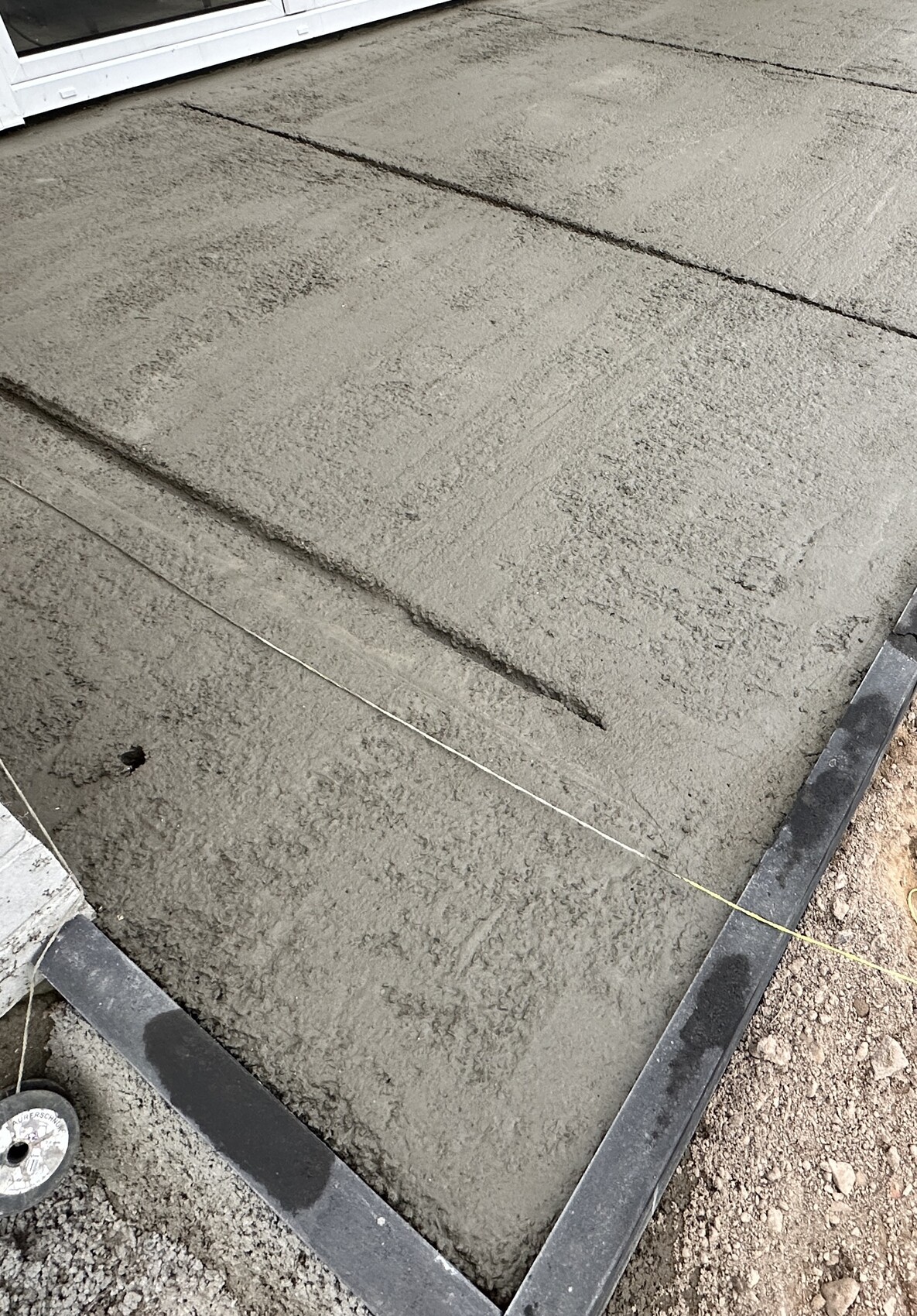
So, it seems cement, sand, and crushed stone were used and mixed with water. Is it drainage concrete or not?
Here’s how it looks:
A
Allthewayup13 Mar 2024 19:19Drainage concrete is available as bagged material or as a single-aggregate mix, as you described. Referring to it as a slab was a bit unusual to me. Common terms for this type of base are “drainage bedding” or “in drainage concrete.” From the picture, it looks like the mix might be too wet, but that could be misleading. I am used to seeing it appear somewhat coarser. However, that doesn’t necessarily mean anything.
Was it a professional company that has been doing this regularly and for a long time? If so, I wouldn’t worry about it.
Was it a professional company that has been doing this regularly and for a long time? If so, I wouldn’t worry about it.
Similar topics