
ᐅ Is It Worth Renovating a Concrete Exterior Staircase from 1910?
Created on: 18 Aug 2025 21:22
S
Sabine23Hello,
we have an outdoor staircase from 1910 (see photo) with 17 steps and a landing after the 10th step. The entire staircase is in poor condition. Three steps are broken, and the stringer on the outside is crumbling. A concrete specialist, after a first inspection, recommends demolition and rebuilding. Repair might be possible but only after thoroughly assessing the condition of the concrete. The builder believes that demolition and rebuilding would be too complex and suggests repairing the staircase, especially since the original appearance, including the Florentine profile, would be difficult to replicate.
We are unsure about the best course of action. Complete demolition and rebuilding seems very involved, also because the steps are connected to the old house and likely rest on a row of bricks. Repairing also appears challenging since the surface would no longer be uniform or visually appealing, and might look like patchwork.
Does anyone have experience or recommendations?
Thank you!
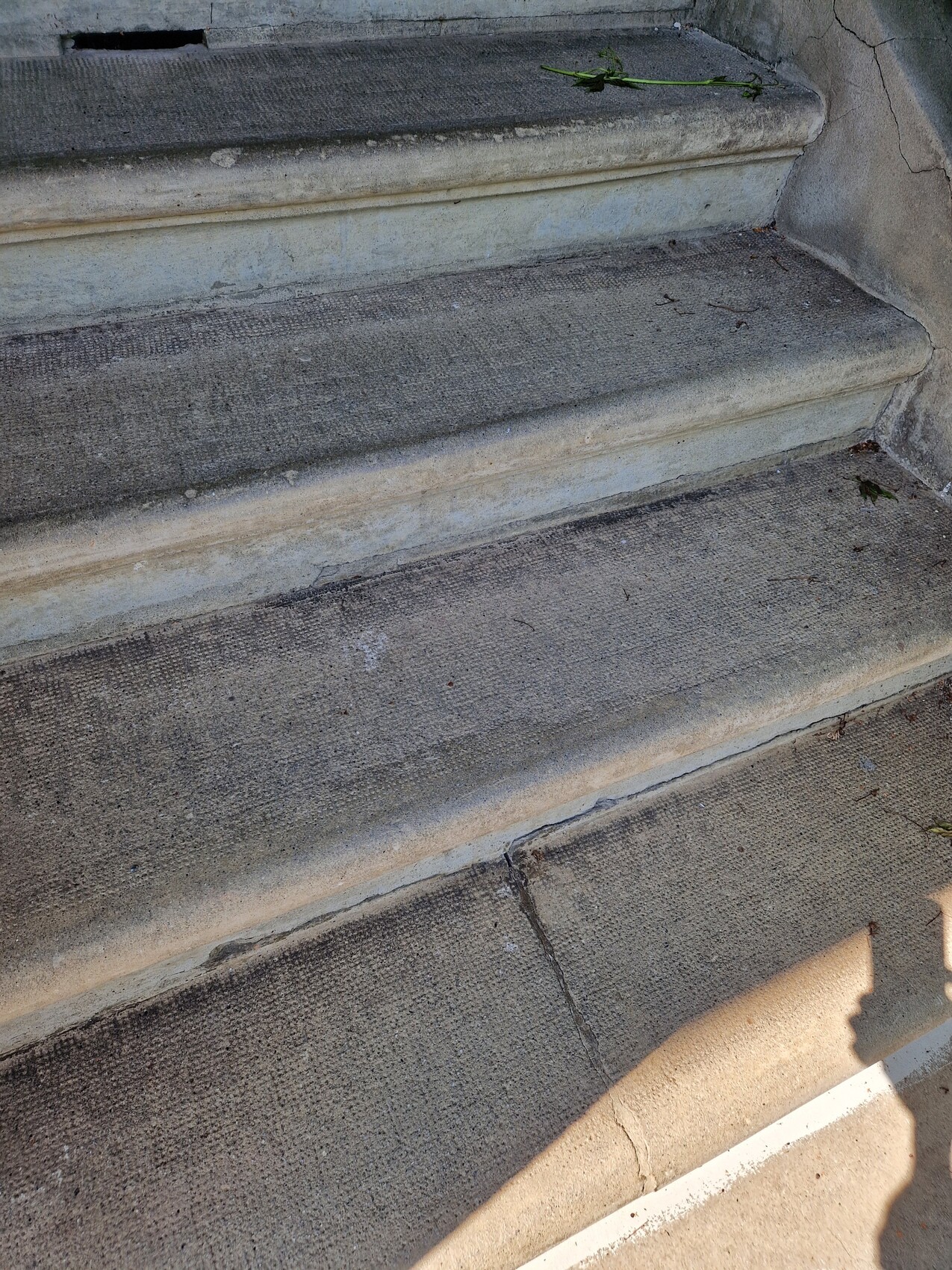
we have an outdoor staircase from 1910 (see photo) with 17 steps and a landing after the 10th step. The entire staircase is in poor condition. Three steps are broken, and the stringer on the outside is crumbling. A concrete specialist, after a first inspection, recommends demolition and rebuilding. Repair might be possible but only after thoroughly assessing the condition of the concrete. The builder believes that demolition and rebuilding would be too complex and suggests repairing the staircase, especially since the original appearance, including the Florentine profile, would be difficult to replicate.
We are unsure about the best course of action. Complete demolition and rebuilding seems very involved, also because the steps are connected to the old house and likely rest on a row of bricks. Repairing also appears challenging since the surface would no longer be uniform or visually appealing, and might look like patchwork.
Does anyone have experience or recommendations?
Thank you!
Hi Sabine,
The situation you described with the old Florentine staircase is indeed not easy to resolve, especially if you want to preserve its appearance. Both options—complete demolition or restoration—are valid, but ultimately the decision depends mainly on the condition of the concrete and the material beneath the surface. The usual saying “demolition is cheaper and faster” rarely applies to architecturally or historically valuable details. Concrete restoration specialists generally offer technical solutions but rarely aesthetic ones. Has either of the two companies conducted a detailed structural analysis of the staircase and the remaining load-bearing material, for example through exposure or ultrasonic testing? Without that, none of them would have a reliable foundation for making a decision.
Regarding restoration, everything hinges on how much of the original profile and shape can still be preserved before a thin overlay smooths out the Florentine patterns permanently. Would you be able to find a specialist craftsman experienced in historic concrete staircases who could provide a quote for partial reconstruction and partial new build? Especially since the stylistic details are so important to you, it could be worth asking—unless, in the end, you prefer a more technical solution with a new design because the old one can hardly be maintained anyway.
By the way: Were the damages caused by de-icing salts or penetrating water? That would be important to know before considering any reuse.
The situation you described with the old Florentine staircase is indeed not easy to resolve, especially if you want to preserve its appearance. Both options—complete demolition or restoration—are valid, but ultimately the decision depends mainly on the condition of the concrete and the material beneath the surface. The usual saying “demolition is cheaper and faster” rarely applies to architecturally or historically valuable details. Concrete restoration specialists generally offer technical solutions but rarely aesthetic ones. Has either of the two companies conducted a detailed structural analysis of the staircase and the remaining load-bearing material, for example through exposure or ultrasonic testing? Without that, none of them would have a reliable foundation for making a decision.
Regarding restoration, everything hinges on how much of the original profile and shape can still be preserved before a thin overlay smooths out the Florentine patterns permanently. Would you be able to find a specialist craftsman experienced in historic concrete staircases who could provide a quote for partial reconstruction and partial new build? Especially since the stylistic details are so important to you, it could be worth asking—unless, in the end, you prefer a more technical solution with a new design because the old one can hardly be maintained anyway.
By the way: Were the damages caused by de-icing salts or penetrating water? That would be important to know before considering any reuse.
Thank you for the detailed response.
We have spoken with a restorer. He said he could "restore" it for a lot of money... However, after seeing a similar restored staircase in an old castle, we don’t want to go that route because it is quite obvious where the steps were broken up and new concrete was poured in. They apparently try to match the concrete texture and color as closely as possible and then patch where needed.
Regarding your questions:
The broken steps are the last two steps before the lawn. I would estimate that some settling occurred there, which caused them to break. The third broken step is under the porch roof. Here, too, I suspect the damage was not caused by water infiltration.
No exposure or ultrasound measurement has been done. However, the underside of the steps is clearly visible and looks visually quite good.
There are ready-made Florentine steps available for individual purchase, but I don’t know if they can be used for a staircase with so many steps or if they are only suitable for a small flight of about three steps, like in a garden staircase. Also, a substructure would have to be built, and the prefabricated steps somehow placed on top. I have no idea if something like this is even feasible.
We have spoken with a restorer. He said he could "restore" it for a lot of money... However, after seeing a similar restored staircase in an old castle, we don’t want to go that route because it is quite obvious where the steps were broken up and new concrete was poured in. They apparently try to match the concrete texture and color as closely as possible and then patch where needed.
Regarding your questions:
The broken steps are the last two steps before the lawn. I would estimate that some settling occurred there, which caused them to break. The third broken step is under the porch roof. Here, too, I suspect the damage was not caused by water infiltration.
No exposure or ultrasound measurement has been done. However, the underside of the steps is clearly visible and looks visually quite good.
There are ready-made Florentine steps available for individual purchase, but I don’t know if they can be used for a staircase with so many steps or if they are only suitable for a small flight of about three steps, like in a garden staircase. Also, a substructure would have to be built, and the prefabricated steps somehow placed on top. I have no idea if something like this is even feasible.
Similar topics