
ᐅ Is it possible to renovate a 1954 suburban house to meet energy efficiency standards? How can this be done?
Created on: 23 Apr 2018 21:12
S
SebastianDr
Hello, my name is Sebastian, I’m 38 years old and I come from Barth in Mecklenburg-Western Pomerania.
We have the opportunity to take over my girlfriend’s grandmother’s house.
It is a 1.5-story terraced house with a pitched roof, built in 1954, located in Zingst on the Darß peninsula.
Key data: built in 1954, exterior dimensions 8 m x 8.5 m (26 ft x 28 ft), gable ends facing north and south.
Personally, we would prefer to renovate the house to meet energy efficiency standards rather than build new, but right now we are unsure how to proceed.
We would like to first assess the feasibility and potential costs and see whether the loan would fit within our budget (you also want to enjoy life).
The house has 38 cm (15 inches) thick walls with about an 8 cm (3 inch) air gap between them.
Windows, roof, and heating system (gas) were renewed in 1993 right after reunification, but are probably no longer up to current standards.
The facade was newly plastered in 1995, but without any insulation.
We envision an extension in timber frame construction to expand the living space by approximately 8 m x 2 m (26 ft x 6.5 ft) on the southern gable end.
-Plans include reroofing with new insulation,
-Adding 2 dormer windows,
-Insulating the facade or injecting insulation into the cavity wall,
-Replacing the gas heating system with a new underfloor heating system and an additional fireplace; complete new pipework and radiators,
-Photovoltaics?
-Completely renewing the electrical system,
-Replacing the wooden floor with a more solid floor covering.
Has anyone here had experience with this kind of project and can offer advice on how they started? Any help would be greatly appreciated.
Best regards,
Basti
We have the opportunity to take over my girlfriend’s grandmother’s house.
It is a 1.5-story terraced house with a pitched roof, built in 1954, located in Zingst on the Darß peninsula.
Key data: built in 1954, exterior dimensions 8 m x 8.5 m (26 ft x 28 ft), gable ends facing north and south.
Personally, we would prefer to renovate the house to meet energy efficiency standards rather than build new, but right now we are unsure how to proceed.
We would like to first assess the feasibility and potential costs and see whether the loan would fit within our budget (you also want to enjoy life).
The house has 38 cm (15 inches) thick walls with about an 8 cm (3 inch) air gap between them.
Windows, roof, and heating system (gas) were renewed in 1993 right after reunification, but are probably no longer up to current standards.
The facade was newly plastered in 1995, but without any insulation.
We envision an extension in timber frame construction to expand the living space by approximately 8 m x 2 m (26 ft x 6.5 ft) on the southern gable end.
-Plans include reroofing with new insulation,
-Adding 2 dormer windows,
-Insulating the facade or injecting insulation into the cavity wall,
-Replacing the gas heating system with a new underfloor heating system and an additional fireplace; complete new pipework and radiators,
-Photovoltaics?
-Completely renewing the electrical system,
-Replacing the wooden floor with a more solid floor covering.
Has anyone here had experience with this kind of project and can offer advice on how they started? Any help would be greatly appreciated.
Best regards,
Basti

SebastianDr schrieb:
Yes, all the documents from 1954 are available. Well, then scan them, so we can work here based on actual images.
SebastianDr schrieb:
As mentioned, it is a double-wall construction with an 8cm (3 inch) air gap. Are both walls solid masonry, or how should one understand that? I can’t reconcile your description with any standard brick format.
SebastianDr schrieb:
We wanted to open up the gable wall and extend the rooms behind it by 2 meters (6.5 feet) with the new extension. I suspected as much – conceptually it’s clear, but it’s tricky. The gable wall is a load-bearing wall, so it would need to be replaced by support beams (which is no small matter) and, in my opinion, would create rather awkward tight spaces if those 2-meter (6.5 feet) narrow strips remain. You can’t just extend a ridge beam that easily and then support the roof structure unevenly on one end with the old building and on the other with the new.
Adding these linear “extensions” to the floor plans seems, in terms of effort, to be well above what you’d expect for an economy-level solution.
Is this concept based on a specific idea for the new floor layouts, or is the “classic” approach too limited for you (such as extending only part of the building’s length along the eaves side, with a knee wall inserted in the attic)?
https://www.instagram.com/11antgmxde/
https://www.linkedin.com/company/bauen-jetzt/
 SebastianDr25 Apr 2018 21:46
I tried scanning the documents, but the quality is just so-so.
SebastianDr25 Apr 2018 22:3411ant schrieb:
With both shells solid, or how should one imagine that? - I can’t match the description with any stone format. Yes, approximately 2cm (1 inch) of exterior plaster, then 11.5cm (4.5 inches) brick, 8–10cm (3–4 inches) cavity, another 11.5cm (4.5 inches) brick, and interior plaster again.
Best regards, Basti
SebastianDr schrieb:
yes, roughly 2cm (1 inch) plaster on the outside, then 11.5cm (4.5 inches) brick, 8-10cm (3-4 inches) cavity, 11.5cm (4.5 inches) brick, and plaster again on the inside. Did you copy that from the linked document? – by the way, external links are not allowed here.
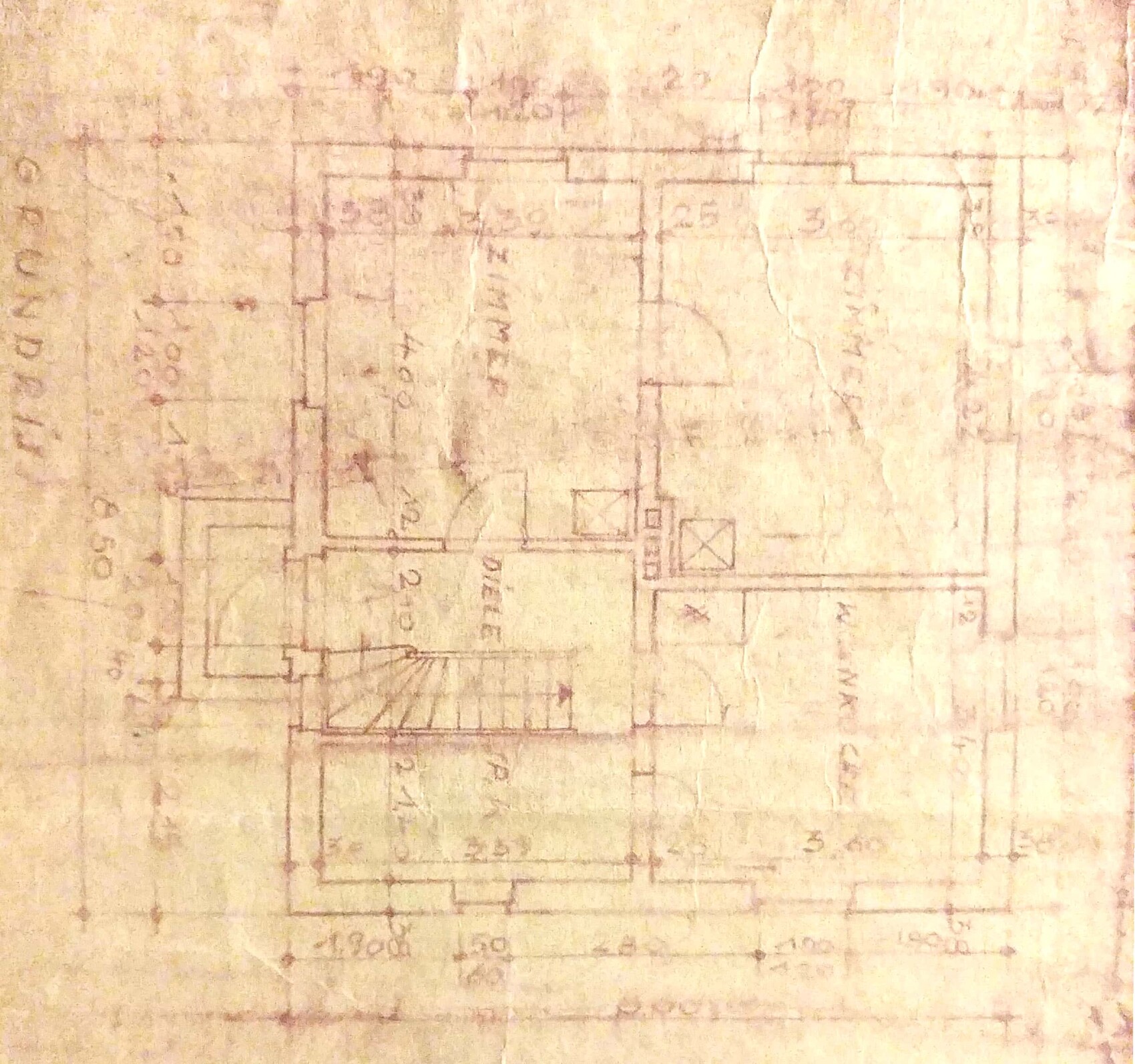
From your drawings, it is actually possible to see something: the brick size is not the newer format but still the pre-war Reichsformat. You can tell this from the wall thicknesses (12/25/38 cm). Accordingly, a solid outer wall could well be present here.
That would even be "better" in the sense that with the described wall structure, the "inner leaf" on its own would be "non-load-bearing," and heavier ceilings than those existing could cause problems.
How certain are you that the described cavity wall construction is present here? Are you basing this only on the similarity to the overall thickness described on the linked website?
A Prussian building regulation might well have been obsolete by 1954 (I’m not exactly sure when it was replaced after the war). I know of a family construction project around 1940 where 25 cm (10 inches) single-leaf external walls were permitted. They used 38 cm (15 inches) only for the basement. In harsher regions, they may have also applied that for above-ground floors.
For 1954, cavity walls would seem unusual: houses built then probably were not planned before World War II, and post-war construction generally favored the simplest approach. On the other hand, this could also explain why cavity walls were chosen here to save bricks.
Based on the plans, I assume the 38 cm (15 inches) refers to the shell measurement – with 12 cm (5 inches) bricks, that would mean a 14 cm (6 inch) cavity.
https://www.instagram.com/11antgmxde/
https://www.linkedin.com/company/bauen-jetzt/
SebastianDr schrieb:
Quality is just so-so. However, an experienced eye still notices quite a bit, beyond the fact that it is an obviously charming little house even to laymen (it looks just like the little house our grandma supposedly had, the one mentioned in that carnival song where it gets drunk):
Image 1)
Wall thicknesses of 12, 25, and 38 cm (5, 10, and 15 inches) indicate old Reich format standards. The window reveal edges show stops, which, in this form, speak against the assumed cavity wall construction. Two stoves were probably connected to the chimney flues on the left side of the plan (front parlor) and the middle chimney, while the stove would have been connected to the right chimney flue (which runs through the rear parlor in an arc). The partition wall to the pantry might have fixings for the stair stringer; otherwise, a rabbit mesh (wire lath) wall might have sufficed there. The straight partition wall is load-bearing, and ceiling joists probably run parallel to the staircase. There is no visible toilet—was it under the stairs, or possibly in an outbuilding?
Image 2)
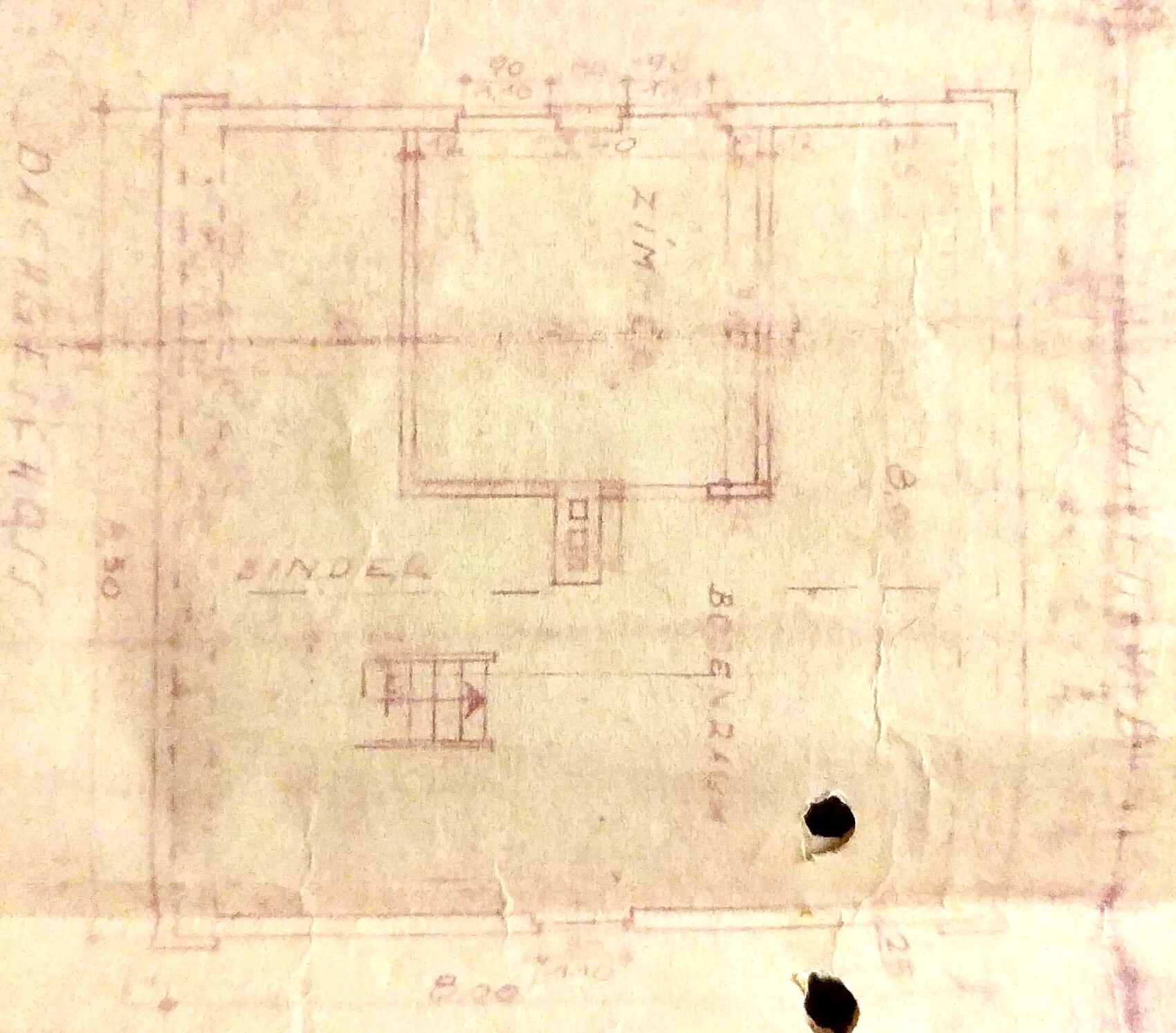
A mansard chamber also has 12 cm (5 inches) wall thickness. However, these walls are not arranged in a way that suggests they are masonry. They are more likely stud walls, with the chamber positioned within a field of the roof structure.
Image 3)
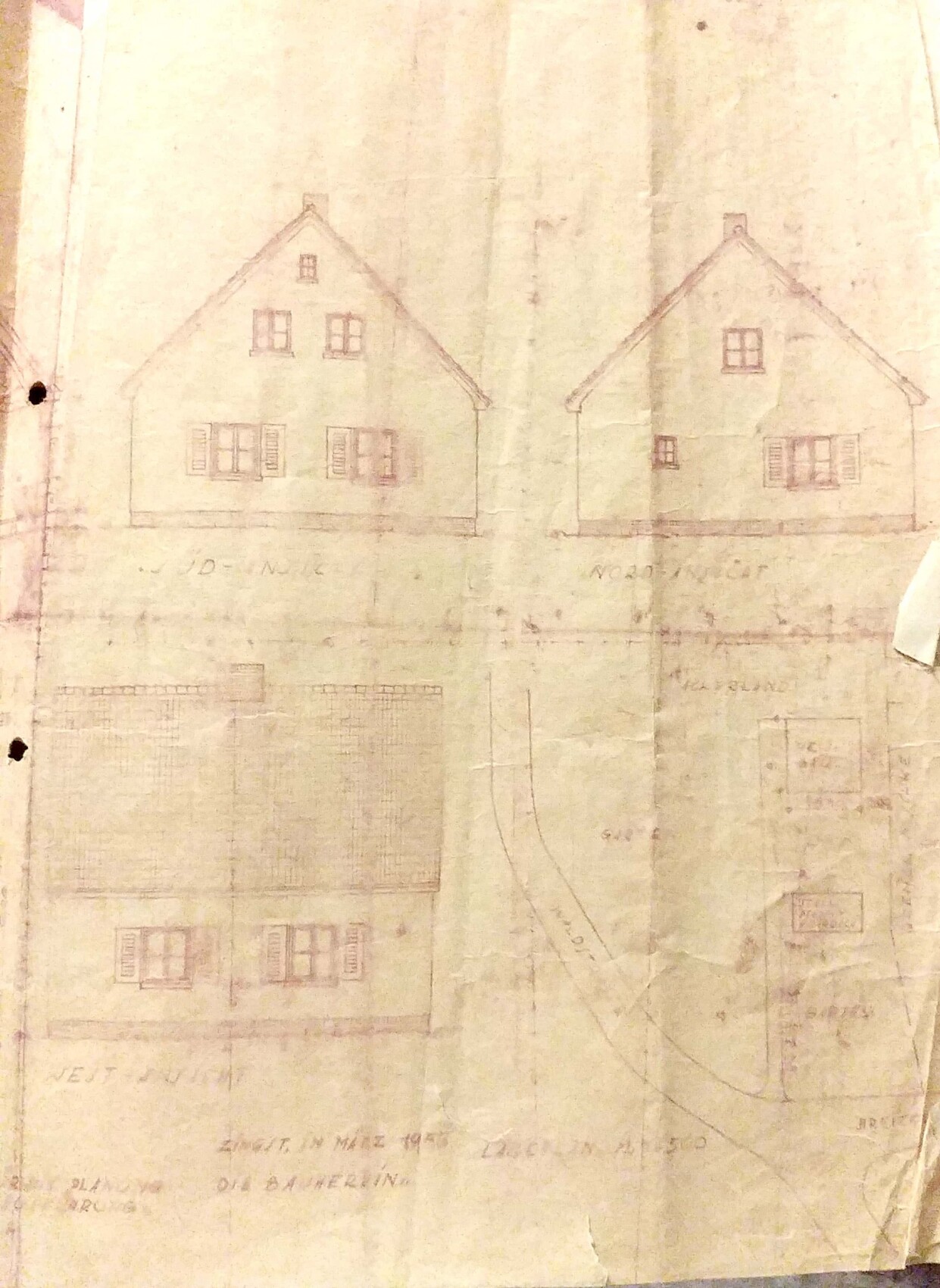
The chimney penetrates the ridge; there is no modern type ridge purlin as is common today.
Image 4)
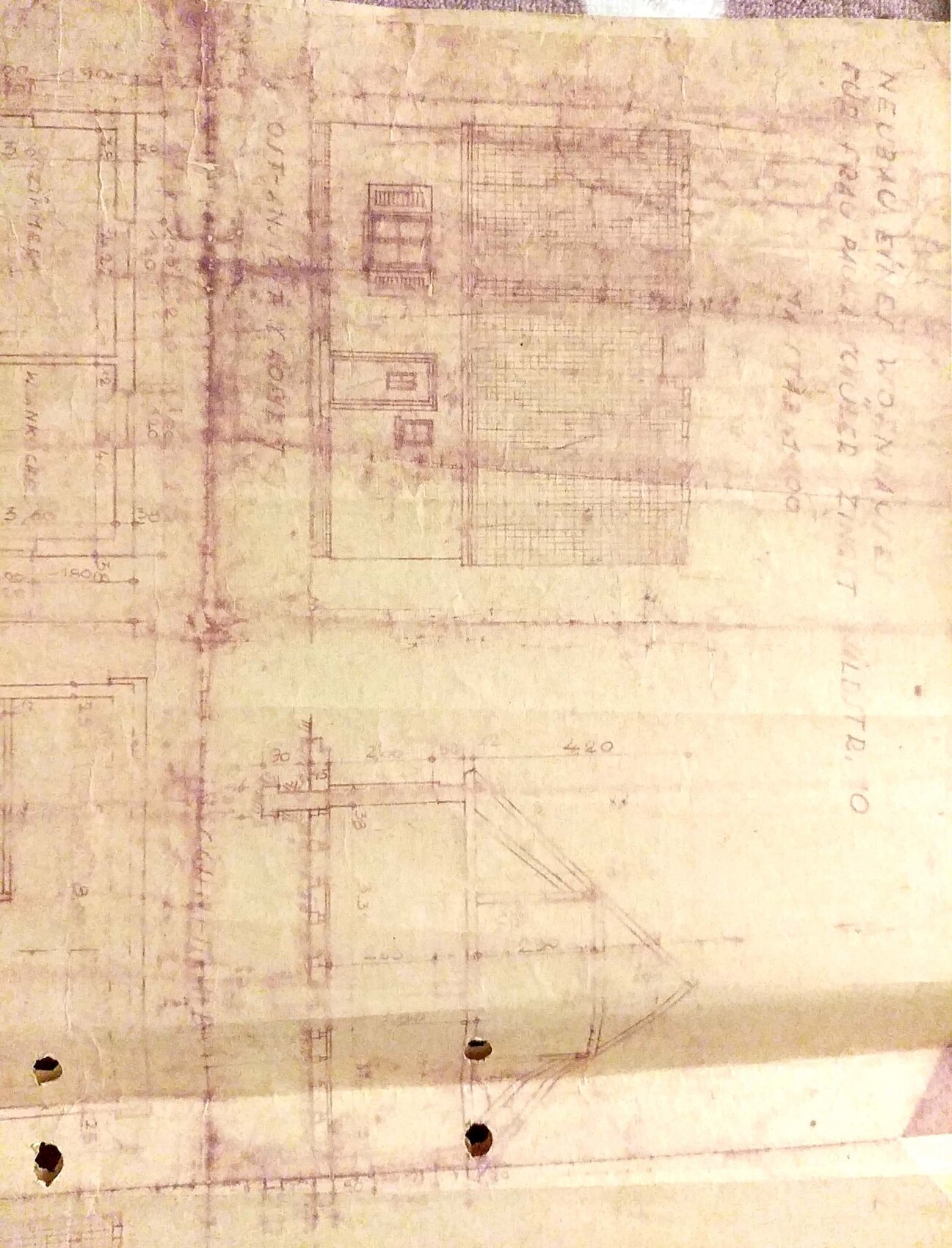
Here you can see a roof structure with double purlins. Besides the wind braces, the mansard chamber likely also contributes to the bracing of the roof structure. The floorboards beneath the ground floor planks probably rest on their own strip foundations.
Post an updated site plan here, and we can more closely examine what is possible. This is a gem and can become one again, but it will require considerable work to adapt it to ‘today’s’ standards. Worthwhile, but not easy.
https://www.instagram.com/11antgmxde/
https://www.linkedin.com/company/bauen-jetzt/
SebastianDr26 Apr 2018 05:35@11ant I wasn’t aware of the link, sorry.
I know about the masonry because my father-in-law created an opening there in the early 1980s, where the window is shown on the kitchen drawing, for an extension that houses the toilet (now the bathroom). Thanks for your very detailed description of the construction. We will see what the architect says. We want to modernize the house a bit but, as I said, we are still in the idea phase.
Best regards, Basti
I know about the masonry because my father-in-law created an opening there in the early 1980s, where the window is shown on the kitchen drawing, for an extension that houses the toilet (now the bathroom). Thanks for your very detailed description of the construction. We will see what the architect says. We want to modernize the house a bit but, as I said, we are still in the idea phase.
Best regards, Basti
Similar topics