
ᐅ Is it permissible to exceed the eaves height of a semi-detached house?
Created on: 5 Nov 2018 18:32
F
Freistoß
Hello everyone,
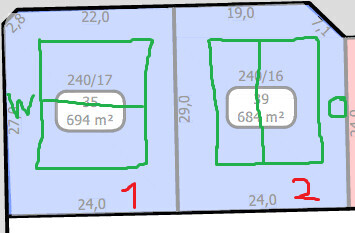
I am currently planning a semi-detached house. The eaves height is fixed at 4 meters (13 feet). The building may be a maximum of 8.5 meters (28 feet) tall. The ridge direction is set (east/west). In our new development area, I saw a house that significantly exceeds the eaves height. In the attached file, this is house 1. House 2 has the usual orientation, with the main entrance doors facing the street to the north. However, house 2 has its doors on the west side. Can someone explain what this is about? Each house has its own individual roof. That is probably the reason. The other houses have a continuous roof. The knee wall of house 2 is about 60 cm (24 inches), while house 1’s is about 1.6 meters (5 feet 3 inches). Does anyone with architectural knowledge know the answer to this? I would appreciate your help.
I am currently planning a semi-detached house. The eaves height is fixed at 4 meters (13 feet). The building may be a maximum of 8.5 meters (28 feet) tall. The ridge direction is set (east/west). In our new development area, I saw a house that significantly exceeds the eaves height. In the attached file, this is house 1. House 2 has the usual orientation, with the main entrance doors facing the street to the north. However, house 2 has its doors on the west side. Can someone explain what this is about? Each house has its own individual roof. That is probably the reason. The other houses have a continuous roof. The knee wall of house 2 is about 60 cm (24 inches), while house 1’s is about 1.6 meters (5 feet 3 inches). Does anyone with architectural knowledge know the answer to this? I would appreciate your help.

In post #1, drawing 2, I see something completely different from what you describe in the text: two adjacent plots of land, each with a detached single-family house, and definitely not uniform ridge directions; and above all, there are no heights shown. I can’t follow you at all.
https://www.instagram.com/11antgmxde/
https://www.linkedin.com/company/bauen-jetzt/
ypg schrieb:Far from any magic. The eaves height is the height where the exterior wall breaks through the roof covering. So, instead of attaching the namesake gutter to the actual edge of the roof surface, you imagine the roof overhang removed and the roof hypothetically ending exactly at the outside face of the exterior wall.
The eaves height is not simply measured but calculated by a professional. Whether the roof pitch or ridge height plays a role in this—I don’t know how the calculations work.
https://www.instagram.com/11antgmxde/
https://www.linkedin.com/company/bauen-jetzt/
11ant schrieb:
In post #1, drawing 2, I see something completely different from what you describe in the text: two adjacent plots, each with a detached single-family houseNo. The drawing shows two semi-detached houses. The roof ridge directions are not clear from the drawings, only from the post. On the left, each half has its own roof, which then meet at the eaves. On the right, a conventional semi-detached house. As already stated.
ypg schrieb:
Two semi-detached houses are shown. Aha (?) – but each on separate single-family house plots (35 / 240/17 and 39 / 240/16). Therefore, they are probably more like two-family houses, where the side-by-side or back-to-back units do not have their own individual plots.
https://www.instagram.com/11antgmxde/
https://www.linkedin.com/company/bauen-jetzt/
Freistoß schrieb:
I think it has something to do with the roof shape. I believe it has something to do with the local development plan. This plan should define what is meant by eave height (usually what @11ant describes in #7) and where the reference point is located. There are significant differences here. Some development plans refer to the natural ground level at the exterior wall, while others refer to the planned elevation of the access road.
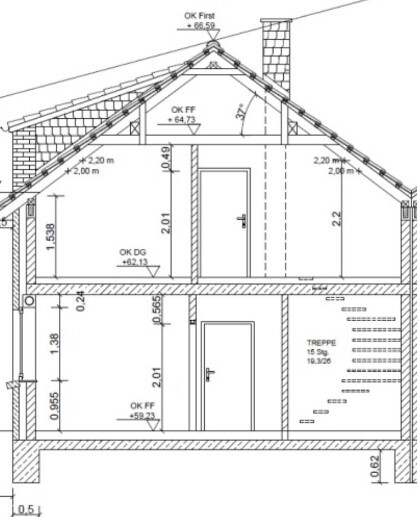
In the section drawing from your first post, the eave height according to definition #7 is 4.438 meters (14 feet 7 inches) above the planned ground level. In the section from post #3, it is 4.00 meters (13 feet 1 inch), where the planned ground level appears to refer to the road elevation.
So either the development plan should be made available to us, or you should check how the eaves and the reference point are defined in the development plan. If the conditions for both plots are actually the same, an exemption might also be possible for an exceedance of 43.8 centimeters (17 inches). In that case, the only option is to inquire at the permitting authority.
The planned development road elevation is correct.
Both conditions are exactly the same. The same regulations apply to both plots.
So it has nothing to do with the fact that higher construction is possible due to the roof shape? This is also the case with houses featuring a mansard roof.
Both conditions are exactly the same. The same regulations apply to both plots.
So it has nothing to do with the fact that higher construction is possible due to the roof shape? This is also the case with houses featuring a mansard roof.
Freistoß schrieb:
So, it has nothing to do with the fact that the building can be higher because of the roof shape? I still haven’t understood what you are getting at. In your examples, the roof types are the same – both are gable roofs with the eaves on the sides.
Freistoß schrieb:
With houses that have a stepped roof, isn’t that also the case? What do you mean by a stepped roof? A stepped story with a flat roof? In that case, the eaves height equals the parapet.
Freistoß schrieb:
Both conditions are exactly the same. So, street level and plot level are exactly the same?
Similar topics