
ᐅ Is it permissible to exceed the eaves height of a semi-detached house?
Created on: 5 Nov 2018 18:32
F
FreistoßHello everyone,
I am currently planning a semi-detached house. The eaves height is fixed at 4 meters (13 feet). The building may be a maximum of 8.5 meters (28 feet) tall. The ridge direction is set (east/west). In our new development area, I saw a house that significantly exceeds the eaves height. In the attached file, this is house 1. House 2 has the usual orientation, with the main entrance doors facing the street to the north. However, house 2 has its doors on the west side. Can someone explain what this is about? Each house has its own individual roof. That is probably the reason. The other houses have a continuous roof. The knee wall of house 2 is about 60 cm (24 inches), while house 1’s is about 1.6 meters (5 feet 3 inches). Does anyone with architectural knowledge know the answer to this? I would appreciate your help.
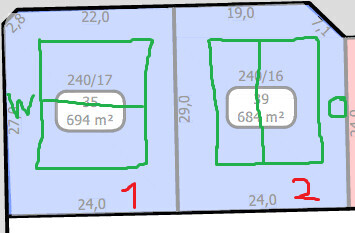
I am currently planning a semi-detached house. The eaves height is fixed at 4 meters (13 feet). The building may be a maximum of 8.5 meters (28 feet) tall. The ridge direction is set (east/west). In our new development area, I saw a house that significantly exceeds the eaves height. In the attached file, this is house 1. House 2 has the usual orientation, with the main entrance doors facing the street to the north. However, house 2 has its doors on the west side. Can someone explain what this is about? Each house has its own individual roof. That is probably the reason. The other houses have a continuous roof. The knee wall of house 2 is about 60 cm (24 inches), while house 1’s is about 1.6 meters (5 feet 3 inches). Does anyone with architectural knowledge know the answer to this? I would appreciate your help.
Freistoß schrieb:
In our new development, I saw a house that clearly exceeds the eaves height. In the attached file, this is house 1.Freistoß schrieb:
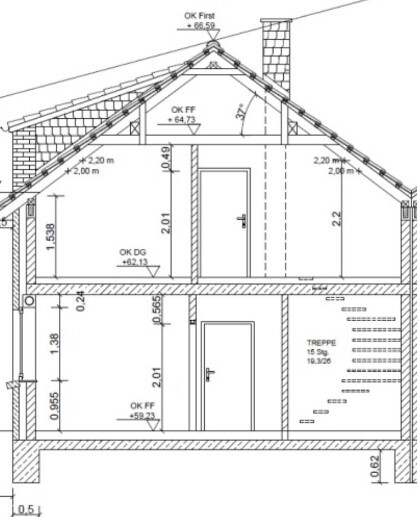
at house 1 at 1.6m (5 feet 3 inches).Knee wall height is not the same as eaves height. The eaves height is the height where the roof meets the façade. Here it could be around 1.20m (4 feet). That would then match the approximately 4 meters (13 feet) measured from the ground level.
Both houses, as you describe, have their ridges oriented east/west.
The house on the left is a semi-detached house with separate roofs, the house on the right is a conventional semi-detached house.
The location of the entrances is not determined by the description you provided here.
Thank you for your response. I am aware that the knee wall height and the eave height are different. I just wanted to point out that the knee wall height can vary even if the eave height remains the same. How is that possible? Here is an example. The eave height is 4 meters (13 feet), and the knee wall height is about 65 cm (25.5 inches). I believe it has something to do with the roof shape.
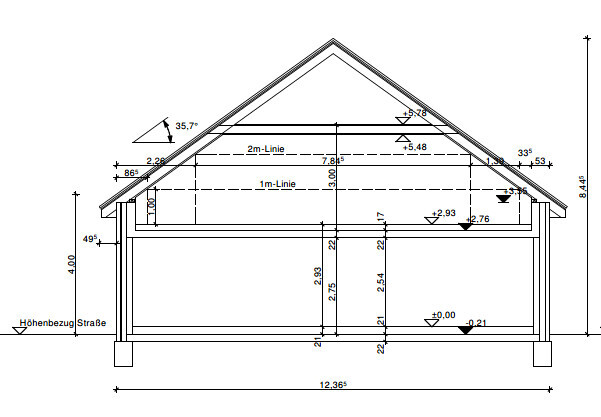
Sorry, I think I expressed myself poorly.
The eave height is not simply measured but calculated by a professional. Whether the roof pitch or ridge height plays a role in this, I don’t know how the calculations work.
Why do you think the eave height is higher on one house? On the second house, it is shown. Unfortunately, the side of the drawing is cut off on the first one. I assume the building was constructed according to the development plan.
As a layperson, I can’t help you further with this.
The eave height is not simply measured but calculated by a professional. Whether the roof pitch or ridge height plays a role in this, I don’t know how the calculations work.
Why do you think the eave height is higher on one house? On the second house, it is shown. Unfortunately, the side of the drawing is cut off on the first one. I assume the building was constructed according to the development plan.
As a layperson, I can’t help you further with this.
Similar topics