
I have a single-family house built with the following masonry construction:
- 11.5 cm (4.5 inches) dense solid brick 1.8/250 + 2.0 cm (0.8 inches) expanded polystyrene insulation + 17.5 cm (6.9 inches) aerated concrete 1.4/150
What do you think? With this setup, is adding more insulation absolutely necessary or would it bring significant benefits? A heat pump is planned, but for that, the house needs to be “well” insulated. Unfortunately, it is never clearly defined what “well” insulated actually means. Is the construction described above considered “well” insulated or rather insufficient?
Also, what do the numbers 1.8/250 and 1.4/150 after the dense brick and aerated concrete indicate?
- 11.5 cm (4.5 inches) dense solid brick 1.8/250 + 2.0 cm (0.8 inches) expanded polystyrene insulation + 17.5 cm (6.9 inches) aerated concrete 1.4/150
What do you think? With this setup, is adding more insulation absolutely necessary or would it bring significant benefits? A heat pump is planned, but for that, the house needs to be “well” insulated. Unfortunately, it is never clearly defined what “well” insulated actually means. Is the construction described above considered “well” insulated or rather insufficient?
Also, what do the numbers 1.8/250 and 1.4/150 after the dense brick and aerated concrete indicate?
B
Benutzer2008 Mar 2022 16:52The 1.8 or 1.4 values refer to density classes.
From an energy perspective, the wall is a disaster—practically uninsulated. Are the windows as old as the masonry? And is there insulation on the basement ceiling or roof?

This is the U-value calculated for your wall.
For comparison, here is a rough overview from poorly insulated (top) to very well insulated (new build) at the bottom:
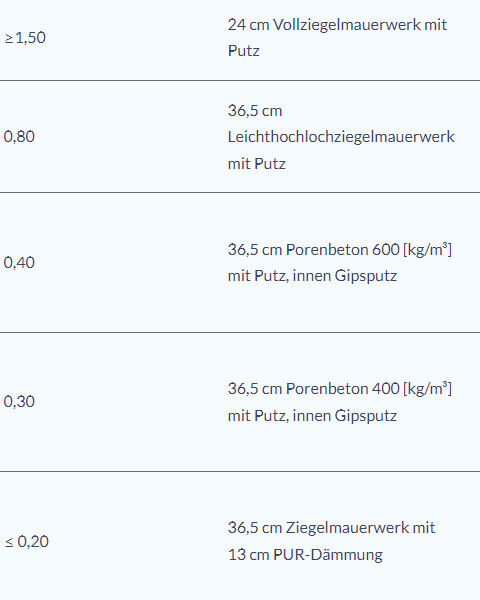
From an energy perspective, the wall is a disaster—practically uninsulated. Are the windows as old as the masonry? And is there insulation on the basement ceiling or roof?
This is the U-value calculated for your wall.
For comparison, here is a rough overview from poorly insulated (top) to very well insulated (new build) at the bottom:
bestens schrieb:
What do you think? In this setup, is additional insulation absolutely necessary, or would it really make much difference? A heat pump is possibly planned, but for that, the house needs to be "well" insulated. Unfortunately, it is never clearly explained what exactly "well" insulated means. Would you say that the insulation defined above qualifies as "well" insulated, or rather poor?
And what do the numbers 1.8/20 and 1.4/150 behind KSV and KSL actually mean? This is far from being "well insulated" and corresponds roughly to standards from around the 1970s.
The 1.8 and 1.4 indicate the bulk density classes, and the number following represents the strength class (in the old classification).
Thank you for the responses.
But altogether it’s 31 cm (12 inches) including the polystyrene insulation in between. Why is the insulation value practically zero? What would you recommend here? Adding extra insulation to the exterior walls again? Is it possible to simply add more insulation here, or what would generally be advisable?
With the existing insulation, a heat pump wouldn’t really make sense, right? Gas would be more practical here, wouldn’t it?
The basement ceiling is not insulated, which could be done easily, and the roof is already insulated from the inside. The floors are all made of reinforced concrete and additionally insulated with 10 cm (4 inches) of mineral wool.
But altogether it’s 31 cm (12 inches) including the polystyrene insulation in between. Why is the insulation value practically zero? What would you recommend here? Adding extra insulation to the exterior walls again? Is it possible to simply add more insulation here, or what would generally be advisable?
With the existing insulation, a heat pump wouldn’t really make sense, right? Gas would be more practical here, wouldn’t it?
The basement ceiling is not insulated, which could be done easily, and the roof is already insulated from the inside. The floors are all made of reinforced concrete and additionally insulated with 10 cm (4 inches) of mineral wool.
B
Benutzer2008 Mar 2022 17:53bestens schrieb:
But altogether it’s 31 cm (12 inches) including some polystyrene in between. Why does that basically result in almost no insulation? You can see that from the numbers. The insulating effect of stone is almost negligible. That’s why good winter jackets use down or synthetic materials that insulate well (they trap a lot of air).
bestens schrieb:
With the existing insulation, a heat pump wouldn’t really make sense, right? Gas would be more reasonable here, wouldn’t it? Without external thermal insulation composite system (ETICS) in your case, I don’t see a heat pump working well. Gas or possibly wood pellets would be more suitable.
Similar topics