
Hello everyone,
I hope I’m posting this question in the right forum. For some time now, I have suspected that photovoltaic (PV) systems are more of a way to preserve money relatively safely rather than being as profitable as often claimed. Since I am currently considering installing such a system myself, I’ve run some calculations. Maybe there are errors that you can point out. Because if this is really how it looks, I don’t quite understand the photovoltaic craze...
I based my calculation on an investment of 30,000 euros. That’s a significant amount, but it can be replaced by any other sum.
As an average price including installation, I found values of about 3,500 euros per module with an annual output of 1,000 kWh in Germany. I assumed that 20% of the electricity is self-consumed and 80% is fed into the grid. For the self-consumed electricity, I initially calculated a savings of 25 cents per kWh, increasing annually by 1.5% (as electricity prices rise, the savings increase). For the electricity fed into the grid, I also initially assumed 25 cents per kWh, with an annual increase of 1.5%. Is that actually realistic? If not, the outlook looks quite bleak! Furthermore, I assumed repair costs of about 5,000 euros every 15 years, for example, for a new inverter.
I compared this to a) financing costs of 2.5% and b) an alternative investment with an average interest rate of 1.5% over the next 30 years. The result looks like this (displayed small, just click to enlarge):
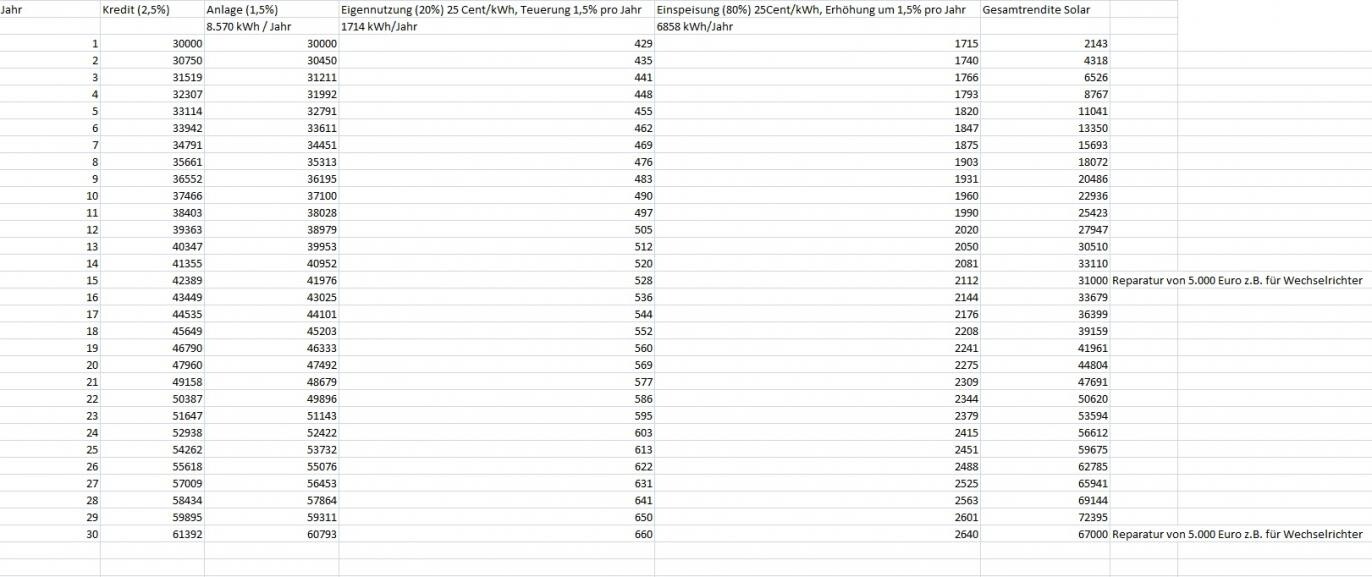
Conclusion: After 30 years, the photovoltaic system results in a profit of 6,000 to 7,000 euros, assuming everything goes normally. However, this only holds if the annual compensation (feed-in tariff / payment for fed electricity) increases by 1.5% every year and the average interest rate for alternative investments remains at only 1.5% (!) over the next 30 years. Therefore, I interpret this as meaning that this investment is quite questionable for me...
Where are the errors in my financial planning???
I hope I’m posting this question in the right forum. For some time now, I have suspected that photovoltaic (PV) systems are more of a way to preserve money relatively safely rather than being as profitable as often claimed. Since I am currently considering installing such a system myself, I’ve run some calculations. Maybe there are errors that you can point out. Because if this is really how it looks, I don’t quite understand the photovoltaic craze...
I based my calculation on an investment of 30,000 euros. That’s a significant amount, but it can be replaced by any other sum.
As an average price including installation, I found values of about 3,500 euros per module with an annual output of 1,000 kWh in Germany. I assumed that 20% of the electricity is self-consumed and 80% is fed into the grid. For the self-consumed electricity, I initially calculated a savings of 25 cents per kWh, increasing annually by 1.5% (as electricity prices rise, the savings increase). For the electricity fed into the grid, I also initially assumed 25 cents per kWh, with an annual increase of 1.5%. Is that actually realistic? If not, the outlook looks quite bleak! Furthermore, I assumed repair costs of about 5,000 euros every 15 years, for example, for a new inverter.
I compared this to a) financing costs of 2.5% and b) an alternative investment with an average interest rate of 1.5% over the next 30 years. The result looks like this (displayed small, just click to enlarge):
Conclusion: After 30 years, the photovoltaic system results in a profit of 6,000 to 7,000 euros, assuming everything goes normally. However, this only holds if the annual compensation (feed-in tariff / payment for fed electricity) increases by 1.5% every year and the average interest rate for alternative investments remains at only 1.5% (!) over the next 30 years. Therefore, I interpret this as meaning that this investment is quite questionable for me...
Where are the errors in my financial planning???

I am not an expert in photovoltaic systems, but I will share what I understood when I looked into the topic last year. However, my understanding could be wrong or may now be outdated.
With electricity generated from a photovoltaic system, there is no self-consumption, at least not if you store it somewhere inside the house. The electricity you generate with your photovoltaic system usually goes 100% into the public grid. There is also a separate electricity meter for this.
The electricity you consume is drawn 100% from the grid. This is measured by another meter.
I am not familiar with how these two are settled. Is it calculated by subtracting the generated electricity from consumption, and the difference is paid to the energy provider per kWh? Or do you receive a fixed amount per kWh for the electricity you generate, and then pay the energy provider the amount due plus any remaining balance?
If the latter is the case, you can only lose out. While your income per kWh is fixed, the costs for the electricity you consume tend to rise over time.
Besides repair costs—which over 30 years are also subject to inflation—you have to consider maintenance and the fact that the system produces less electricity year after year, even if the number of sunlight hours stays the same. The modules fade, get dirty, and sometimes one may even break.
In the end—and I think we almost agree on this—you are basically paying just to be a little “greener” and to satisfy your “eco ego.”
Other than helping your energy provider have some extra kilowatt-hours of supposedly green electricity in the grid, for which they didn’t have to do anything, only to then squeeze you again through the “renewable energy” transition charges, I don’t think you really gain anything.
I’d rather spend that money on buying a car. The depreciation is probably about the same.
But that is just my humble opinion.
With electricity generated from a photovoltaic system, there is no self-consumption, at least not if you store it somewhere inside the house. The electricity you generate with your photovoltaic system usually goes 100% into the public grid. There is also a separate electricity meter for this.
The electricity you consume is drawn 100% from the grid. This is measured by another meter.
I am not familiar with how these two are settled. Is it calculated by subtracting the generated electricity from consumption, and the difference is paid to the energy provider per kWh? Or do you receive a fixed amount per kWh for the electricity you generate, and then pay the energy provider the amount due plus any remaining balance?
If the latter is the case, you can only lose out. While your income per kWh is fixed, the costs for the electricity you consume tend to rise over time.
Besides repair costs—which over 30 years are also subject to inflation—you have to consider maintenance and the fact that the system produces less electricity year after year, even if the number of sunlight hours stays the same. The modules fade, get dirty, and sometimes one may even break.
In the end—and I think we almost agree on this—you are basically paying just to be a little “greener” and to satisfy your “eco ego.”
Other than helping your energy provider have some extra kilowatt-hours of supposedly green electricity in the grid, for which they didn’t have to do anything, only to then squeeze you again through the “renewable energy” transition charges, I don’t think you really gain anything.
I’d rather spend that money on buying a car. The depreciation is probably about the same.
But that is just my humble opinion.
Similar topics