
Hello,
are you sure you told your architect that you and your partner want a usable basement?
Regards, Bauexperte
are you sure you told your architect that you and your partner want a usable basement?
MrArmageddon schrieb:So basically a future junk room with the excuse of technical equipment 😀
... to be used as a storage space for rarely used items, for food storage, and to house all the building services (heating, electrical, network, etc.).
Regards, Bauexperte
D
daniels873 Nov 2016 16:22If you consider a home gym as a good New Year's resolution, then yes. If you have been exercising regularly for a while, you will appreciate having the space.
B
Bauexperte3 Nov 2016 16:30Hello,
I’m not sure how I ended up starting this thread as the original poster; however, the different perspectives shared by users here are definitely interesting!
From my professional experience, there are only three reasons why homeowners choose to build a basement:
What tends to be overlooked in this discussion, in my opinion, is that a basement—whether it is a utility or a finished living basement—also involves significant costs due to earthworks. If a sufficiently load-bearing, natural soil layer with a bearing capacity of at least 200 kN/m2 of uniform soil stratum is found, the costs are still manageable; if the actual ground conditions deviate from this, it *can* become quite expensive. Therefore, it is too simplistic to reduce the cost of a basement solely to the needed labor and materials.
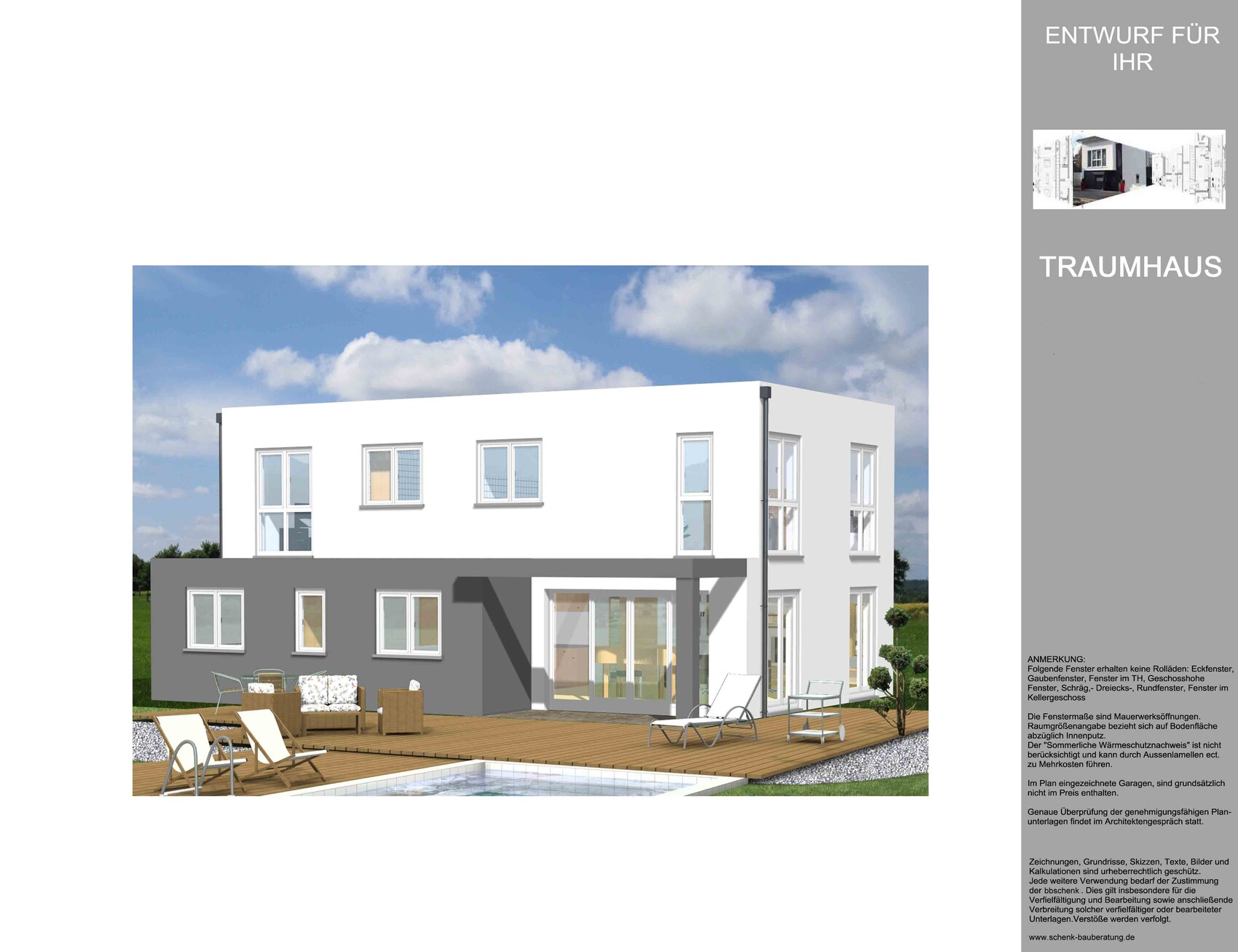
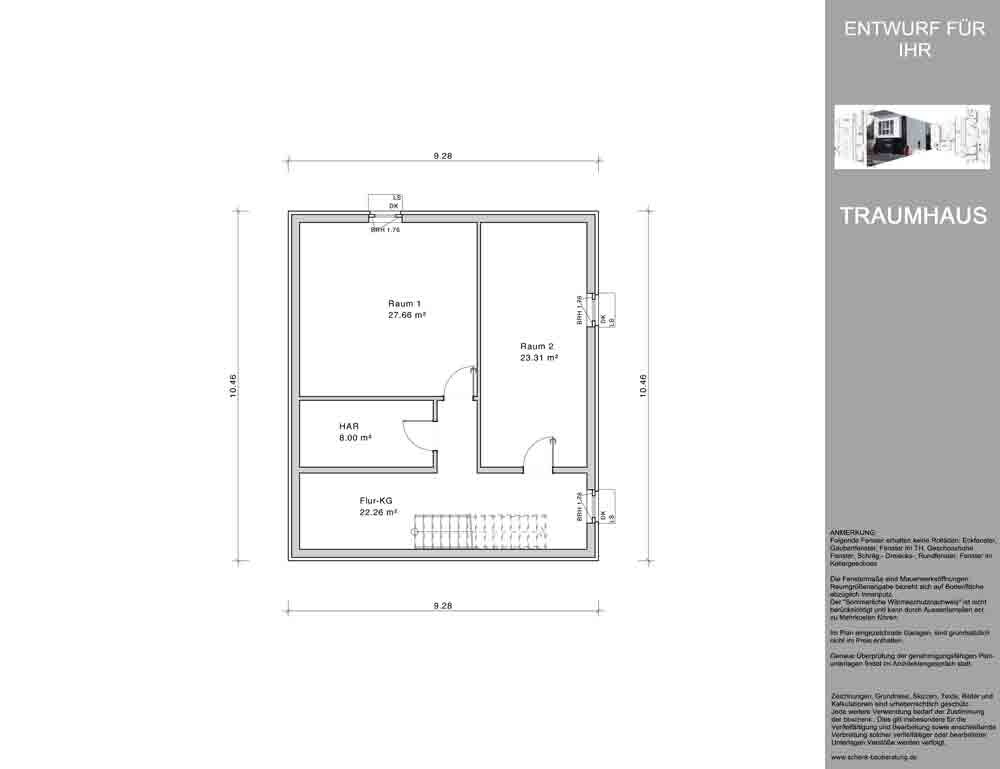
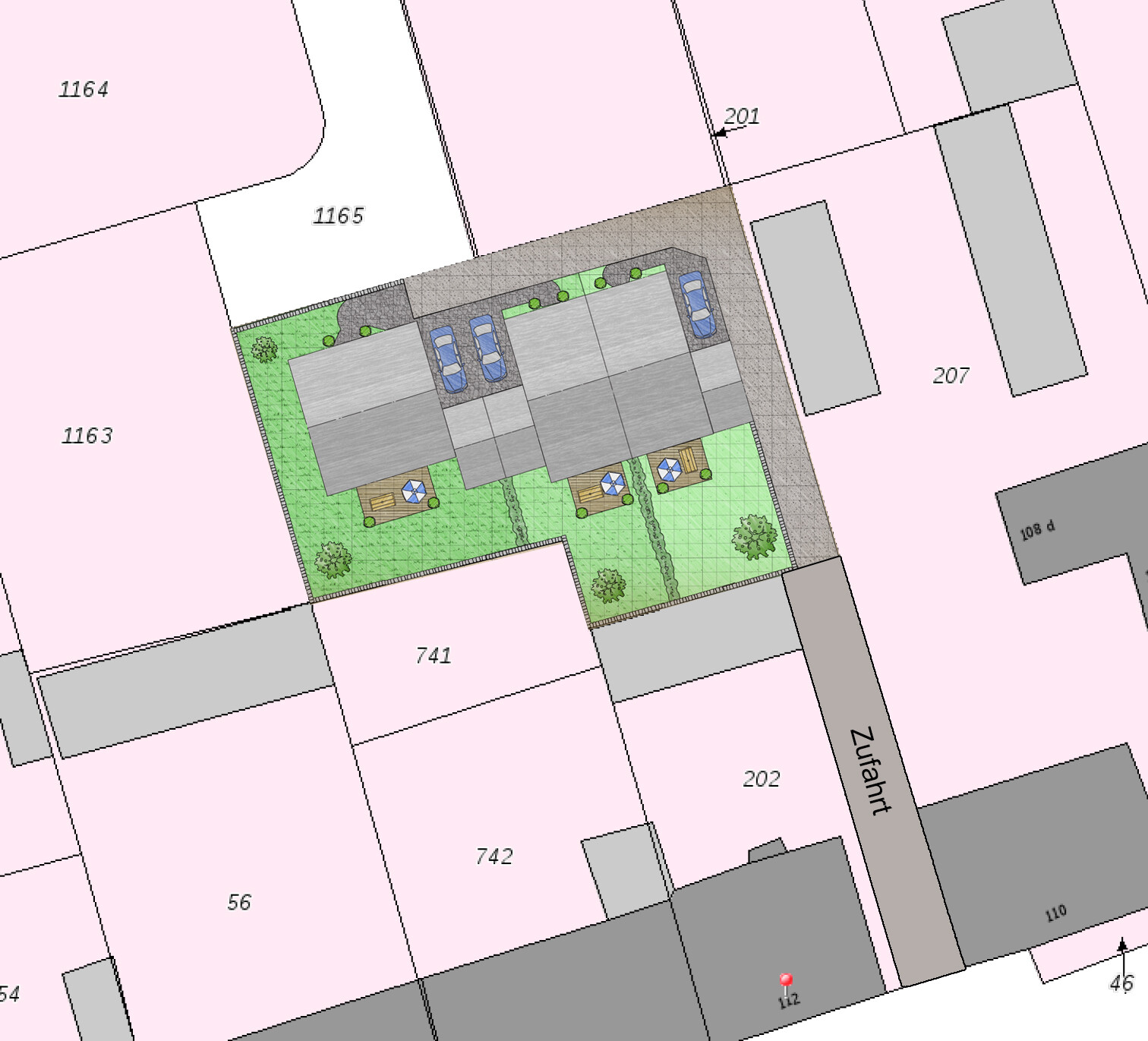
Below, I describe a construction project with a partial basement; I have included images that are harmless to share with our client. The basis is our bill of quantities, which I would rate as balanced.
Single-family house with 280 sqm (3,014 sq ft) of living/usable space, turnkey as a complete house with covered outdoor seating, complying with the 2014 Energy Saving Ordinance (EnEV)
Patio, plastered finish, 14.48 x 14.46 m (48 x 47.5 ft), with partial basement 9.28 x 10.46 m (30.4 x 34.3 ft)
Clear ground floor height 2.75 m (9 ft)
Waterproofed basement
Partially colored plaster
Colored windows (single-sided film)
Concrete staircase
Controlled mechanical ventilation with heat recovery
Electric roller shutters
Photovoltaic preparation
Laundry chute system
Stainless steel chimney liner
Painting and floor coverings
Flat roof
Fixed price €429,000.00
(The cost for the basement including excavation and lateral storage was €65,000.00)
Cost per sqm turnkey single-family house: €2,166.00; cost per sqm utility basement (so far): €793.00
Additional ancillary building costs (Baunebenkosten)
Ancillary building costs Package 1
Surveyor including site plan, set-out and final measurement
Ancillary building costs Package 2
Construction power, construction water supply
Ancillary building costs Package 3
Removal of complete topsoil, clean soil assumed
Removal of full excavation, clean soil assumed
Import of fill gravel
Import and spreading of unsieved topsoil
Site clearing, disposal of natural overburden
One tree root cutting and removal
Creation of storage area
Covering up to 50 sqm (540 sq ft) of street surface in front of the property
Ancillary building costs Package 4
Wastewater drainage pipes from the house to the northern property boundary including inspection chamber DN 1000 down to 2.00 m (6.6 ft) depth
Wastewater drainage pipes from the house to the northern property boundary
Ancillary building costs Package 5
Paving work for terrace area, parking space and driveway, max. 50 sqm (540 sq ft)
Paving sub-base preparation, supply and installation of anthracite edging stones
Installation and sweeping of paving material, material cost up to €25/sqm (approx. $27/sq ft), e.g. “La Tierra” type
Platform up to 1.00 sqm (11 sq ft) with palisade edging from the above material
Complete packages 1 to 5: €37,400.00
This clearly shows that the costs for a basement are far from limited to the original construction expenses; the additional earthwork costs were significant because the excavation could not be stored on the property. Added difficulty came from the plot being accessed from the rear boundary; I have excluded those costs here as they are not typical.
In contrast, a current project of a classic single-family house:
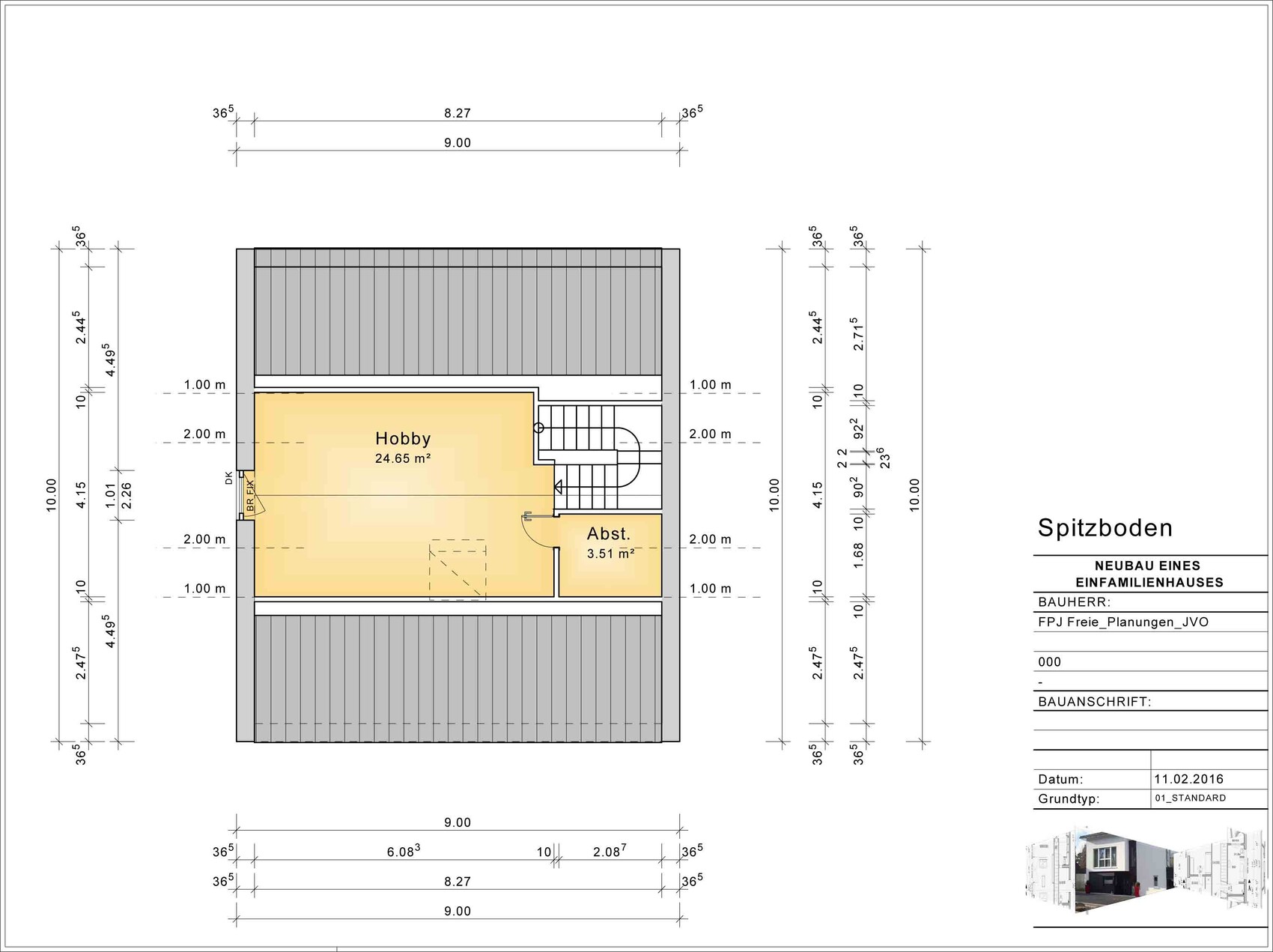
Single-family house, 160 sqm (1,722 sq ft) living/usable space, turnkey, complete house, plastered finish,
9.00 x 10.00 m (29.5 x 32.8 ft) on reinforced concrete slab, 2014 Energy Saving Ordinance
Internal pitched roof
Colored windows (single-sided film)
Steel-wood staircase
Decentralized ventilation system
Electric roller shutters
Photovoltaic preparation
Painting and floor coverings
Fixed price €302,000.00
Ancillary building cost packages 1 to 5 for slab-on-grade €33,000.00 (due to surrounding development)
The cost for a utility basement including excavation and lateral storage would be €41,000.00. Since the soil survey has just been commissioned, I cannot yet report on soil conditions or possible additional earthwork costs.
Cost per sqm turnkey single-family house: €1,887.50; current cost utility basement sqm: €594.00
In the first example, the basement is used exclusively as a utility cellar; in the second example, the finished attic with 28.16 sqm (303 sq ft) is available as living and utility space.
In these examples, only utility basements are discussed; if the underground space is to be finished for living purposes, the heating system must be adapted to the required output, basement windows must comply with habitable space requirements and provide a second escape route, and the basement equipment must correspond to the above-ground areas. Overall, a finished basement costs no less than the above-ground living area.
For comparison: a prefabricated garage measuring 2.96 x 8.96 x 2.45 m (9.7 x 29.4 x 8 ft) with door and window facing the garden, sectional overhead door, and necessary strip foundations currently costs €10,500; this equals about €396 per sqm (approx. $37 per sq ft). The car stays dry and about 9.00 sqm (97 sq ft) of additional usable space is available.
Fundamentally, I find that a basement is missed only when it is not professionally required or dictated by site topography, but when the above-ground space has been designed without considering actual needs. There are online examples claiming €300 per sqm for a basement, which I hope I have helped to clarify somewhat; also another common online myth (pro-basement lobby) is that a basement *only* costs 10% of the construction budget. I see no evidence that single-family houses without basements can only be sold at a loss. In the coming years, it will likely become more common to build without basements due to the risks associated with soil conditions and the ongoing rise in building costs.
Therefore, from my point of view, it is important to develop a design plan based on the actual need; for example, planning a utility room where laundry is mostly done. For some homeowners, that may be on the ground floor, for families often the upper floor or attic. Do I need a basement, and if so, what for? If a home office is desired—often the case for teachers, but increasingly for remote workers—the attic should be considered; the small access doors under the slopes are a good storage solution. Space for technical equipment can be quickly separated and created at low additional cost.
I also often read about planning for the future—living on a single floor in old age—what actually happens to the basement if there is one? Aside from the fact that I rarely see designs where this doesn’t fragment the ground floor plan (interestingly, an important point such as guest WC with shower is often neglected in this consideration), everyone should ask themselves whether they really want to limit themselves to the worst-case scenario. What if, as I wish to everyone, it never occurs and life circumstances change? Experience in recent years shows that existing properties are often sold in later life stages and replaced by smaller units (condominiums) or new builds with children (granny flats). I have often seen parents inherit their property to children and then rent themselves back in. Not the worst decision in my opinion, especially if there is a large garden area to maintain.
Best regards,
Bauexperte
I’m not sure how I ended up starting this thread as the original poster; however, the different perspectives shared by users here are definitely interesting!
From my professional experience, there are only three reasons why homeowners choose to build a basement:
- "A house without a basement is not a house"
- a professional necessity
- the topography of the site
What tends to be overlooked in this discussion, in my opinion, is that a basement—whether it is a utility or a finished living basement—also involves significant costs due to earthworks. If a sufficiently load-bearing, natural soil layer with a bearing capacity of at least 200 kN/m2 of uniform soil stratum is found, the costs are still manageable; if the actual ground conditions deviate from this, it *can* become quite expensive. Therefore, it is too simplistic to reduce the cost of a basement solely to the needed labor and materials.
Below, I describe a construction project with a partial basement; I have included images that are harmless to share with our client. The basis is our bill of quantities, which I would rate as balanced.
Single-family house with 280 sqm (3,014 sq ft) of living/usable space, turnkey as a complete house with covered outdoor seating, complying with the 2014 Energy Saving Ordinance (EnEV)
Patio, plastered finish, 14.48 x 14.46 m (48 x 47.5 ft), with partial basement 9.28 x 10.46 m (30.4 x 34.3 ft)
Clear ground floor height 2.75 m (9 ft)
Waterproofed basement
Partially colored plaster
Colored windows (single-sided film)
Concrete staircase
Controlled mechanical ventilation with heat recovery
Electric roller shutters
Photovoltaic preparation
Laundry chute system
Stainless steel chimney liner
Painting and floor coverings
Flat roof
Fixed price €429,000.00
(The cost for the basement including excavation and lateral storage was €65,000.00)
Cost per sqm turnkey single-family house: €2,166.00; cost per sqm utility basement (so far): €793.00
Additional ancillary building costs (Baunebenkosten)
Ancillary building costs Package 1
Surveyor including site plan, set-out and final measurement
Ancillary building costs Package 2
Construction power, construction water supply
Ancillary building costs Package 3
Removal of complete topsoil, clean soil assumed
Removal of full excavation, clean soil assumed
Import of fill gravel
Import and spreading of unsieved topsoil
Site clearing, disposal of natural overburden
One tree root cutting and removal
Creation of storage area
Covering up to 50 sqm (540 sq ft) of street surface in front of the property
Ancillary building costs Package 4
Wastewater drainage pipes from the house to the northern property boundary including inspection chamber DN 1000 down to 2.00 m (6.6 ft) depth
Wastewater drainage pipes from the house to the northern property boundary
Ancillary building costs Package 5
Paving work for terrace area, parking space and driveway, max. 50 sqm (540 sq ft)
Paving sub-base preparation, supply and installation of anthracite edging stones
Installation and sweeping of paving material, material cost up to €25/sqm (approx. $27/sq ft), e.g. “La Tierra” type
Platform up to 1.00 sqm (11 sq ft) with palisade edging from the above material
Complete packages 1 to 5: €37,400.00
This clearly shows that the costs for a basement are far from limited to the original construction expenses; the additional earthwork costs were significant because the excavation could not be stored on the property. Added difficulty came from the plot being accessed from the rear boundary; I have excluded those costs here as they are not typical.
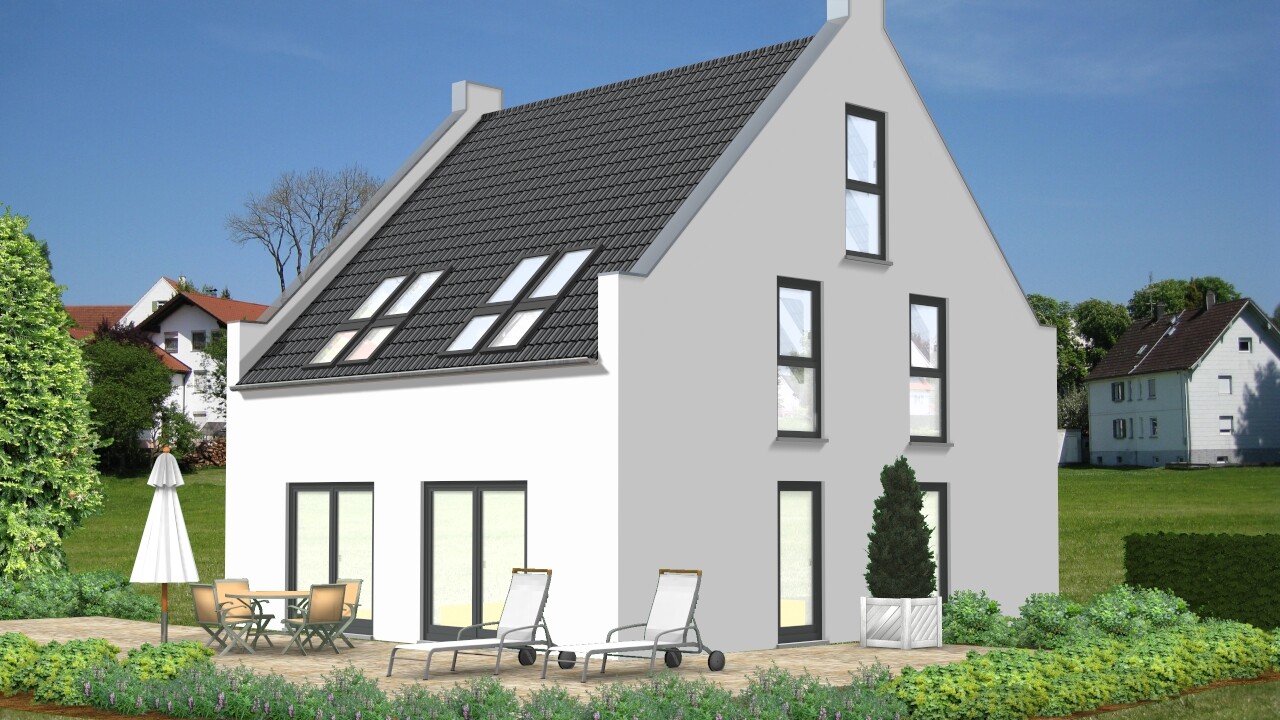
In contrast, a current project of a classic single-family house:
Single-family house, 160 sqm (1,722 sq ft) living/usable space, turnkey, complete house, plastered finish,
9.00 x 10.00 m (29.5 x 32.8 ft) on reinforced concrete slab, 2014 Energy Saving Ordinance
Internal pitched roof
Colored windows (single-sided film)
Steel-wood staircase
Decentralized ventilation system
Electric roller shutters
Photovoltaic preparation
Painting and floor coverings
Fixed price €302,000.00
Ancillary building cost packages 1 to 5 for slab-on-grade €33,000.00 (due to surrounding development)
The cost for a utility basement including excavation and lateral storage would be €41,000.00. Since the soil survey has just been commissioned, I cannot yet report on soil conditions or possible additional earthwork costs.
Cost per sqm turnkey single-family house: €1,887.50; current cost utility basement sqm: €594.00
In the first example, the basement is used exclusively as a utility cellar; in the second example, the finished attic with 28.16 sqm (303 sq ft) is available as living and utility space.
In these examples, only utility basements are discussed; if the underground space is to be finished for living purposes, the heating system must be adapted to the required output, basement windows must comply with habitable space requirements and provide a second escape route, and the basement equipment must correspond to the above-ground areas. Overall, a finished basement costs no less than the above-ground living area.
For comparison: a prefabricated garage measuring 2.96 x 8.96 x 2.45 m (9.7 x 29.4 x 8 ft) with door and window facing the garden, sectional overhead door, and necessary strip foundations currently costs €10,500; this equals about €396 per sqm (approx. $37 per sq ft). The car stays dry and about 9.00 sqm (97 sq ft) of additional usable space is available.
Fundamentally, I find that a basement is missed only when it is not professionally required or dictated by site topography, but when the above-ground space has been designed without considering actual needs. There are online examples claiming €300 per sqm for a basement, which I hope I have helped to clarify somewhat; also another common online myth (pro-basement lobby) is that a basement *only* costs 10% of the construction budget. I see no evidence that single-family houses without basements can only be sold at a loss. In the coming years, it will likely become more common to build without basements due to the risks associated with soil conditions and the ongoing rise in building costs.
Therefore, from my point of view, it is important to develop a design plan based on the actual need; for example, planning a utility room where laundry is mostly done. For some homeowners, that may be on the ground floor, for families often the upper floor or attic. Do I need a basement, and if so, what for? If a home office is desired—often the case for teachers, but increasingly for remote workers—the attic should be considered; the small access doors under the slopes are a good storage solution. Space for technical equipment can be quickly separated and created at low additional cost.
I also often read about planning for the future—living on a single floor in old age—what actually happens to the basement if there is one? Aside from the fact that I rarely see designs where this doesn’t fragment the ground floor plan (interestingly, an important point such as guest WC with shower is often neglected in this consideration), everyone should ask themselves whether they really want to limit themselves to the worst-case scenario. What if, as I wish to everyone, it never occurs and life circumstances change? Experience in recent years shows that existing properties are often sold in later life stages and replaced by smaller units (condominiums) or new builds with children (granny flats). I have often seen parents inherit their property to children and then rent themselves back in. Not the worst decision in my opinion, especially if there is a large garden area to maintain.
Best regards,
Bauexperte
J
j.bautsch4 Nov 2016 08:13Even though I can't contribute anything important to this, great post, thank you very much.

Everything is nice and understandable. But if you cannot extend the building horizontally and the height is restricted by regulations, then going downward is the only option to gain sufficient storage space.
In an age of increasing densification, the basement, despite all the costs, often is not really "out" after all.
In an age of increasing densification, the basement, despite all the costs, often is not really "out" after all.
Similar topics