
K
krider0074 May 2025 14:18Hello,
I am currently planning the bathroom for a small new-build apartment that I want to rent out. The architect has drawn the shower situation very optimistically. In reality, the glass panel would only be 100 cm long (40 inches) and the entrance 53 cm (21 inches).
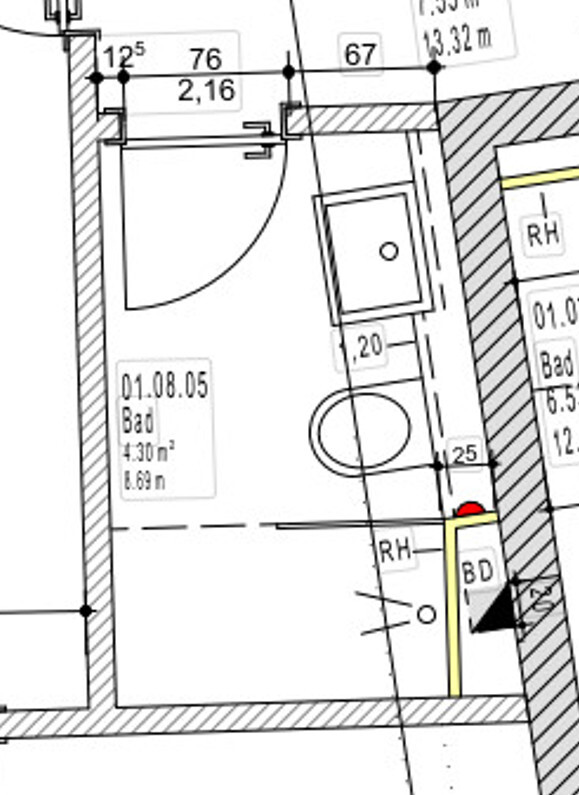
[IMG width="556px"]https://www.hausbau-forum.de/attachments/2025-05-04_125152-jpg.91270/?hash=42944183376d3ee44c1005a4ca4ad2b0[/IMG]
The bathroom planner instead suggests a pivot door.
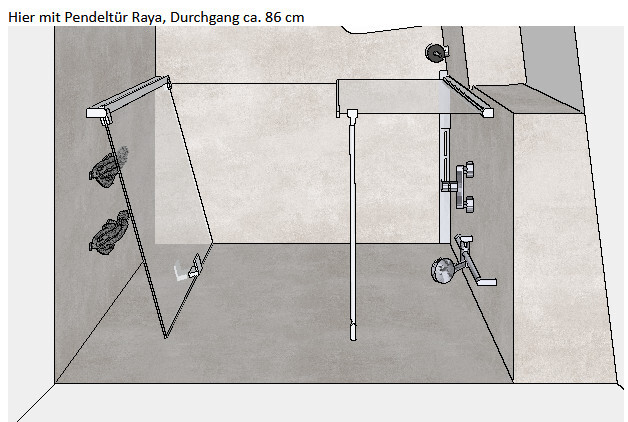
I want the apartment to look very modern and be very low-maintenance for tenants. Therefore, I would actually prefer the walk-in shower solution over something with hinges and potentially moldy seals, etc. Granted, the opening is a bit narrow, but you can get through as long as you are not very overweight. I also simulated water splashing outside with a 100 cm (40 inches) panel at home, and with a towel or bath mat laid down, it is not really a problem.
Which solution would you recommend?
Best regards,
Oliver
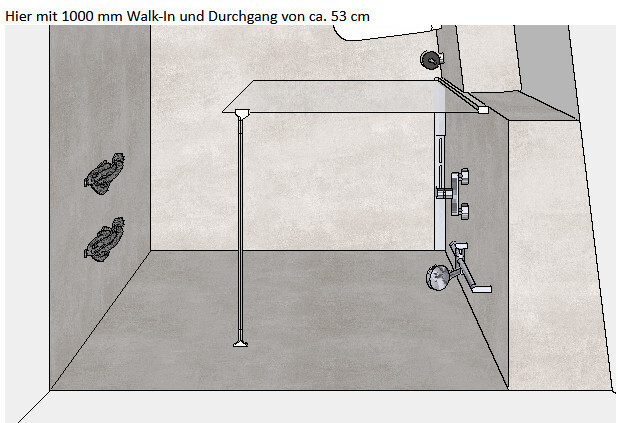
I am currently planning the bathroom for a small new-build apartment that I want to rent out. The architect has drawn the shower situation very optimistically. In reality, the glass panel would only be 100 cm long (40 inches) and the entrance 53 cm (21 inches).
[IMG width="556px"]https://www.hausbau-forum.de/attachments/2025-05-04_125152-jpg.91270/?hash=42944183376d3ee44c1005a4ca4ad2b0[/IMG]
The bathroom planner instead suggests a pivot door.
I want the apartment to look very modern and be very low-maintenance for tenants. Therefore, I would actually prefer the walk-in shower solution over something with hinges and potentially moldy seals, etc. Granted, the opening is a bit narrow, but you can get through as long as you are not very overweight. I also simulated water splashing outside with a 100 cm (40 inches) panel at home, and with a towel or bath mat laid down, it is not really a problem.
Which solution would you recommend?
Best regards,
Oliver
krider007 schrieb:
and very low maintenance for tenants. That’s why I actually prefer the walk-in solution over something with hinges and potentially moldy seals, etc.That would also be a high priority for me. It’s also more cost-effective.krider007 schrieb:
In reality, the glass panel would only be 100cm long and the entrance 53cm.53cm (21 inches) seems very narrow to me. Are those actual measurements, or will you subtract anything for wall tiles? A 90cm (35 inches) wall can also work with a rain shower.Does the enclosure need to be that large? Or can you gain an extra 10cm (4 inches) there?
Personally, I find the door more comfortable but would go for a passage width of around 75 cm (30 inches). In any case, the door should be able to open fully inward into the shower.
If there is still space in the boxed section on the right side of the plan, I would plan a small recess at about 100 to 120 cm (39 to 47 inches) height to place shower gel or shampoo.
Alternatively, you could include two triangular holders in the grout lines in the lower right corner of the plan for storage.
If there is still space in the boxed section on the right side of the plan, I would plan a small recess at about 100 to 120 cm (39 to 47 inches) height to place shower gel or shampoo.
Alternatively, you could include two triangular holders in the grout lines in the lower right corner of the plan for storage.
I installed this in a small bathroom with a 60cm (24 inch) passage, which I find sufficient.
Personally, I wouldn’t choose a full glass panel but rather a half-height wall topped with a glass sheet or even build the wall up to the ceiling. Glass, especially near the floor, tends to get dirty quickly and requires special maintenance. I also don’t like floor-to-ceiling glass because you have to bend down to use a squeegee after showering.
I have tried the various options myself and ultimately prefer the half-height wall or the fully built-up version (around 180–200cm (71–79 inches)) as the most practical, while still maintaining a stylish look. Setting the glass on the outer edge creates a convenient shelf inside for shampoo and other items during the shower.
Personally, I wouldn’t choose a full glass panel but rather a half-height wall topped with a glass sheet or even build the wall up to the ceiling. Glass, especially near the floor, tends to get dirty quickly and requires special maintenance. I also don’t like floor-to-ceiling glass because you have to bend down to use a squeegee after showering.
I have tried the various options myself and ultimately prefer the half-height wall or the fully built-up version (around 180–200cm (71–79 inches)) as the most practical, while still maintaining a stylish look. Setting the glass on the outer edge creates a convenient shelf inside for shampoo and other items during the shower.
What kind of adjoining room is that on the left side of the floor plan? Or possibly on the right side? To explore options, you should consider the bathroom or the entire apartment as a whole, rather than focusing only on a walk-in shower occupying 4.3 m² (46 sq ft). Personally, even if it’s a studio apartment, I wouldn’t be very keen on this bathroom, walk-in shower or not. I find it lacking in functionality.
W
wiltshire5 May 2025 10:31krider007 schrieb:
Which solution would you recommend to me? As a landlord: The solution without a door.
As an owner-occupier: For me, the solution without a door; however, many would prefer having a door.
As a tenant: Whether there is a door or just an open passageway would not be a deciding factor for me as a tenant.
The clear opening width of 53 cm (21 inches) is narrow and clearly below standard. According to my passport, I am 1.83 m (6 ft) tall, classified as “obese” by BMI, and in my mid-50s, so not very flexible anymore. A 53 cm (21 inch) width would be just enough, but I would suggest increasing it to 60 cm (24 inches), even if that causes a bit more water splashing.
I would change this layout. The bathroom gains character from the angled installation wall. I would follow through on that idea consistently and align the glass partition perpendicular to it instead of parallel to the back wall. You already have a built-out installation wall for the toilet’s concealed cistern. Extend this up to the end wall, and you’ll gain space inside the shower cubicle that you would otherwise lose by boxing it in. If this extension does not reach the ceiling, you also create the advantageous storage space described by @Arauki11. As a side effect, even with a larger entry, the solution without a door reduces water splashing. The tenant would only have to clean a slightly sharper angle, which is not problematic.
Similar topics