
Hello everyone,
We moved into our new house last summer (oh God, that already sounds so long ago). Since then, there has been a lot to do—and there still is. Now, however, the remaining work is increasingly shifting outdoors.
The well has already been drilled. At that spot, I installed a small pit, and the garden shed will be placed on top of it. Now I’ve been thinking about the irrigation system again and realized that it will be difficult to access the pit underground once the garden shed is in place, as I would then be undermining the base slab.
So, I’ve been giving it some thought and reading a lot, but not everything is clear to me yet.
Firstly: before I pour the base slab, I need to run the necessary pipes out of the pit. That means drilling a hole through the pit ring and laying 1 to x PVC pipes (KG pipes) extending 1 to 2 meters (3 to 6.5 feet) beyond the edge of the base slab, so that I can later feed the water line through them when the time comes.
By the way, the garden shed will also house the sub-distribution for the outdoor electrical system. So, I also need to run a cable from the pit through the base slab to the distribution board in the garden shed for the pump. Additionally, I need 2 to 3 PVC pipes from inside where the distribution board is mounted, under the base slab to the outside, for all the electrical wiring on the driveway—such as the gate, lighting, and control cables for the irrigation valves, etc.
Now to the main topic: the automatic irrigation system
In this forum, it seems @rick2018 has good knowledge about this subject. Maybe you could give me some tips as well.
Below is a plan of our property:
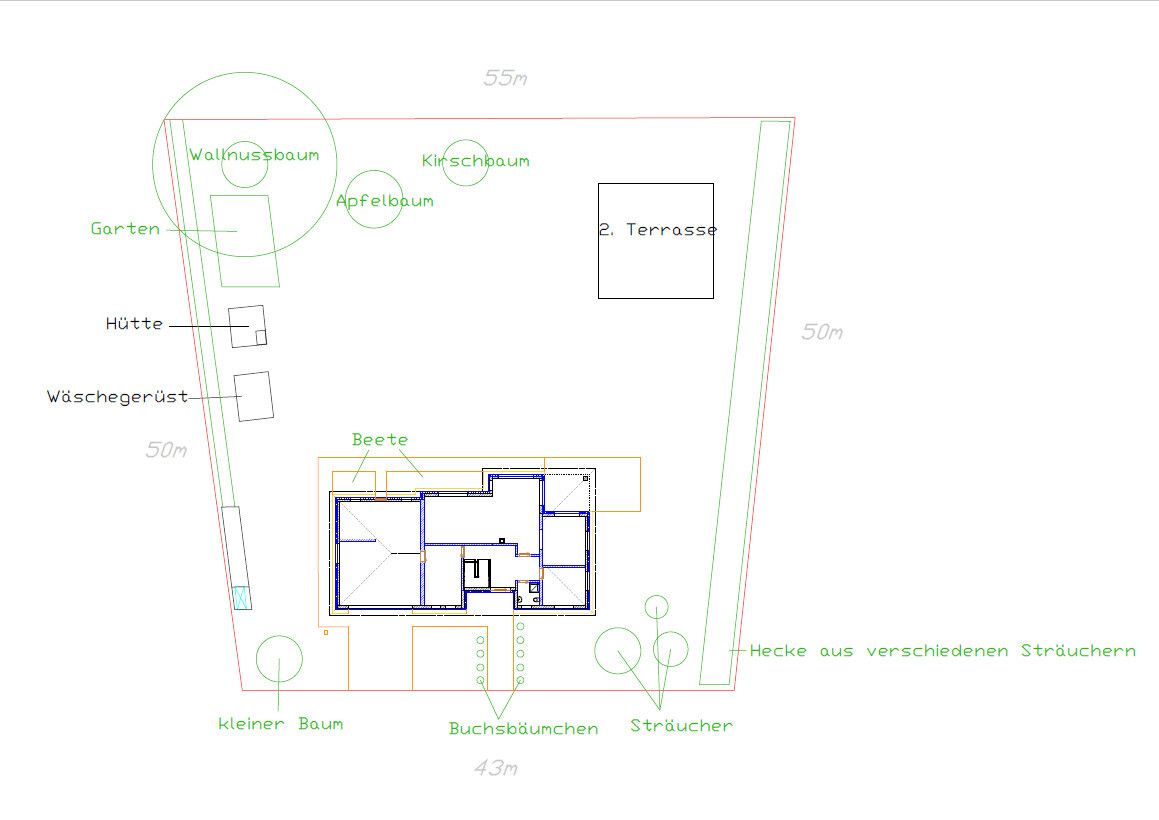
Except for the house, none of this has actually been implemented yet. The plants are just planned and may still change. The second terrace on the drawing is currently 10 x 10 meters (33 x 33 feet). It won’t actually be that large; that’s just a placeholder for the approximate future location. However, it definitely won’t be built in the next five years. That brings me to my first point:
1. How do you take that into account now? For example, regarding the second terrace, I would mostly plan the sprinklers as if the terrace will never be built, since it’s still uncertain whether and where exactly it will be placed. What about the trees? If I install the sprinklers now and then plant a tree 1 or 2 meters (3 to 6.5 feet) away next year, there will be shade along the axis behind the tree. In the first few years, this is probably negligible due to the small trunk diameter, but what happens when the trunk gets thicker?
2. What exactly should be irrigated? Lawn, flower beds, and vegetable garden are clear. I’ve read differing opinions about hedges, especially regarding adaptation to watering. What about trees? They should be able to cope on their own, right? Is it really overkill to install irrigation just for the first and maybe the second year?
3. For my large lawn areas, I’m considering Hunter gear-driven rotors. However, these are said to be rather sensitive to wind. Here, it’s usually windy because we’re on a small hill. But once everything around is planted, there shouldn’t be much wind close to the ground, right? @rick2018, why do you prefer rotators like the MP3000 over gear-driven rotors like the I20, for example?
4. My father-in-law took care of the well. I believe a Grundfos SQ2-55 pump is installed “in the hole.” The borehole depth was about 20 meters (66 feet) and the pump hangs at roughly 15 meters (49 feet) depth. The property slopes upwards by almost one meter (3 feet) to the right, so the pump has to push water up about 16 meters (52 feet). The pump is capable of 54 meters (177 feet) total head. So that leaves about 38 meters (125 feet), which corresponds to roughly 3.8 bar (55 psi) and, unfortunately, only about 2 cubic meters per hour (around 880 gallons per hour).
If I understand correctly, I can only operate two gear-driven I20 rotors with the 4.0 nozzle on one zone, since each requires 0.81 m³/h (about 360 gallons/hr) at 2.5 bar (36 psi) with a 11.9-meter (39 feet) radius (planning uses 10.5 meters). That will mean a lot of zones. Alternatively, I could try to return the pump to the well driller (as it wasn’t used before) and get one with 4 m³/h (about 1760 gallons/hr) or more. The question is whether that would make my well wear out faster (clogging?).
5. Let’s say I keep the existing pump and end up with 30 zones. How would that work in practice? Would each lawn irrigation zone run for 30 minutes? And every 3 days? That would cause problems with my planned robotic mower that will almost always be running over the large area. In the end, I won’t have time to enjoy the yard because either the mower is running or the sprinklers are on.
6. It is recommended to start the design in a corner of the property. So, for example, I start at the top right and place the first sprinkler in front of the hedge. The thing is: the hedge is currently very narrow, but will become 1 to 2 meters (3 to 6.5 feet) wide over time.
7. The sprinklers extend during operation and retract afterwards. How durable are these if someone steps on them? It looks like I will eventually have a “carpet” of pop-up sprinklers. The children should, of course, still be able to play freely.
That’s enough for now. Have a nice rest of the Sunday!
We moved into our new house last summer (oh God, that already sounds so long ago). Since then, there has been a lot to do—and there still is. Now, however, the remaining work is increasingly shifting outdoors.
The well has already been drilled. At that spot, I installed a small pit, and the garden shed will be placed on top of it. Now I’ve been thinking about the irrigation system again and realized that it will be difficult to access the pit underground once the garden shed is in place, as I would then be undermining the base slab.
So, I’ve been giving it some thought and reading a lot, but not everything is clear to me yet.
Firstly: before I pour the base slab, I need to run the necessary pipes out of the pit. That means drilling a hole through the pit ring and laying 1 to x PVC pipes (KG pipes) extending 1 to 2 meters (3 to 6.5 feet) beyond the edge of the base slab, so that I can later feed the water line through them when the time comes.
By the way, the garden shed will also house the sub-distribution for the outdoor electrical system. So, I also need to run a cable from the pit through the base slab to the distribution board in the garden shed for the pump. Additionally, I need 2 to 3 PVC pipes from inside where the distribution board is mounted, under the base slab to the outside, for all the electrical wiring on the driveway—such as the gate, lighting, and control cables for the irrigation valves, etc.
Now to the main topic: the automatic irrigation system
In this forum, it seems @rick2018 has good knowledge about this subject. Maybe you could give me some tips as well.
Below is a plan of our property:
Except for the house, none of this has actually been implemented yet. The plants are just planned and may still change. The second terrace on the drawing is currently 10 x 10 meters (33 x 33 feet). It won’t actually be that large; that’s just a placeholder for the approximate future location. However, it definitely won’t be built in the next five years. That brings me to my first point:
1. How do you take that into account now? For example, regarding the second terrace, I would mostly plan the sprinklers as if the terrace will never be built, since it’s still uncertain whether and where exactly it will be placed. What about the trees? If I install the sprinklers now and then plant a tree 1 or 2 meters (3 to 6.5 feet) away next year, there will be shade along the axis behind the tree. In the first few years, this is probably negligible due to the small trunk diameter, but what happens when the trunk gets thicker?
2. What exactly should be irrigated? Lawn, flower beds, and vegetable garden are clear. I’ve read differing opinions about hedges, especially regarding adaptation to watering. What about trees? They should be able to cope on their own, right? Is it really overkill to install irrigation just for the first and maybe the second year?
3. For my large lawn areas, I’m considering Hunter gear-driven rotors. However, these are said to be rather sensitive to wind. Here, it’s usually windy because we’re on a small hill. But once everything around is planted, there shouldn’t be much wind close to the ground, right? @rick2018, why do you prefer rotators like the MP3000 over gear-driven rotors like the I20, for example?
4. My father-in-law took care of the well. I believe a Grundfos SQ2-55 pump is installed “in the hole.” The borehole depth was about 20 meters (66 feet) and the pump hangs at roughly 15 meters (49 feet) depth. The property slopes upwards by almost one meter (3 feet) to the right, so the pump has to push water up about 16 meters (52 feet). The pump is capable of 54 meters (177 feet) total head. So that leaves about 38 meters (125 feet), which corresponds to roughly 3.8 bar (55 psi) and, unfortunately, only about 2 cubic meters per hour (around 880 gallons per hour).
If I understand correctly, I can only operate two gear-driven I20 rotors with the 4.0 nozzle on one zone, since each requires 0.81 m³/h (about 360 gallons/hr) at 2.5 bar (36 psi) with a 11.9-meter (39 feet) radius (planning uses 10.5 meters). That will mean a lot of zones. Alternatively, I could try to return the pump to the well driller (as it wasn’t used before) and get one with 4 m³/h (about 1760 gallons/hr) or more. The question is whether that would make my well wear out faster (clogging?).
5. Let’s say I keep the existing pump and end up with 30 zones. How would that work in practice? Would each lawn irrigation zone run for 30 minutes? And every 3 days? That would cause problems with my planned robotic mower that will almost always be running over the large area. In the end, I won’t have time to enjoy the yard because either the mower is running or the sprinklers are on.
6. It is recommended to start the design in a corner of the property. So, for example, I start at the top right and place the first sprinkler in front of the hedge. The thing is: the hedge is currently very narrow, but will become 1 to 2 meters (3 to 6.5 feet) wide over time.
7. The sprinklers extend during operation and retract afterwards. How durable are these if someone steps on them? It looks like I will eventually have a “carpet” of pop-up sprinklers. The children should, of course, still be able to play freely.
That’s enough for now. Have a nice rest of the Sunday!
So. I have now marked a few sprinklers.
For now, only for lawn irrigation.
As shown at the top right of the image, the different colors represent MP1000 (6x), MP2000 (9x), and MP3000 (19x) rotors.

Is the overall layout understandable as it is?
I have now added a few letters where I have questions:
A: I saw something about rectangular sprinklers somewhere. I think those might be more suitable here, right? Or should they be avoided?
B: Here, there is a large overlap of sprinklers with the shrubs. As I understand it, you can adjust the sprinklers to exclude certain areas. Does that work very well or is it rather approximate? Especially for the one MP3000 in this case — it is quite limited. It’s actually a very long, narrow strip.
C: Similar to A. Would it be better to use a rectangular sprinkler here?
D: Could the 90° MP3000 in the corner be omitted or is it better to keep it?
E: Here the MP1000 covers a very small area. Is there a more efficient way to solve this?
In general: If I set a sprinkler for a 90° coverage area so that it sprays the first 45° up to 8m (26 feet), the next 30° only 6m (20 feet), and the last 15° again 7m (23 feet),
can the MP rotor do that? And if yes, is the precipitation rate per irrigated square meter the same across the entire 90°? For example, an MP1000 set for 90° only uses 0.8 l/min (0.21 gallons per minute) when set to full throw over the entire 90°. If I reduce the throw distance in parts of the area, does it then use less accordingly? What do the square and triangle symbols mean in the last two columns of precipitation mm/hour?
For now, only for lawn irrigation.
As shown at the top right of the image, the different colors represent MP1000 (6x), MP2000 (9x), and MP3000 (19x) rotors.
Is the overall layout understandable as it is?
I have now added a few letters where I have questions:
A: I saw something about rectangular sprinklers somewhere. I think those might be more suitable here, right? Or should they be avoided?
B: Here, there is a large overlap of sprinklers with the shrubs. As I understand it, you can adjust the sprinklers to exclude certain areas. Does that work very well or is it rather approximate? Especially for the one MP3000 in this case — it is quite limited. It’s actually a very long, narrow strip.
C: Similar to A. Would it be better to use a rectangular sprinkler here?
D: Could the 90° MP3000 in the corner be omitted or is it better to keep it?
E: Here the MP1000 covers a very small area. Is there a more efficient way to solve this?
In general: If I set a sprinkler for a 90° coverage area so that it sprays the first 45° up to 8m (26 feet), the next 30° only 6m (20 feet), and the last 15° again 7m (23 feet),
can the MP rotor do that? And if yes, is the precipitation rate per irrigated square meter the same across the entire 90°? For example, an MP1000 set for 90° only uses 0.8 l/min (0.21 gallons per minute) when set to full throw over the entire 90°. If I reduce the throw distance in parts of the area, does it then use less accordingly? What do the square and triangle symbols mean in the last two columns of precipitation mm/hour?

Hello Denz,
already a good start.
A: Whether you can use the Hunter rectangular rotors effectively depends on the distances and areas. Open the datasheet. They are a good solution for narrow areas, paths, or walkways. Place them on both sides of the path. The great thing about the rotor system is that you can mix and match sprinklers freely. You can safely use the rectangular rotors if it makes sense for the situation. This would be a case where I would use them.
B: No, you cannot exclude areas in the middle. You can only adjust the angle and starting point. The general rule is to “start from the corners,” so near the boxwood and the hedge. In this particular case, I would use rectangular rotors at the bottom and omit the MP3000. You already have overlapping coverage from above, so the overlap between the rectangular rotors themselves would be sufficient.
C: No suitable application for rectangular rotors here. Swap MP1000 for MP2000 so they can cover each other.
D: This could be omitted since you reach the area from two other sides with different rotors.
E: The sprinkler should be positioned at the outer edge, further to the left. In general, this zone is not well designed, and you have a dry spot above (is this intentional?). Also, the sprinklers do not overlap. I understand you want to save on required flow and sprinklers. I would add one more sprinkler at the bottom right. The advantage is that the tree is fairly centered, so the water will hit close to the ground near the tree, which should not harm it. Depending on the tree, extra tree watering might not be necessary.
Regarding the functions of the rotor heads again:
- MP1000, 2000, and 3000 have different throw distances that can be adjusted by up to 25%.
- The heads come in various arcs: 90°–210°, 210°–270°, 360°, corner 45°, strip 180°, strip 90° right and left. You can adjust the arc on the first three. The throw distance and arc stay fixed throughout the irrigation cycle.
If you reduce the throw distance, water consumption also decreases. The same applies if you use a 45° corner instead of a 90° head. Water use then goes down to 0.4 liters per minute (about 0.1 gallons per minute) instead of 0.8 liters per minute (about 0.2 gallons per minute). The big advantage here: the precipitation rate per square meter stays almost the same. So you can combine all kinds of heads. With different sprinkler systems, you would otherwise have to calculate precipitation rates and possibly form separate zones for different sprinklers.
What you described is a multi-surface sprinkler, for example from Gardena. Experiences so far have been poor: not durable, uneven precipitation, wind sensitive, expensive, and it is not pop-up. There is a reason why such equipment isn’t used professionally (Hunter, Rain Bird, Perrot).
The square and triangle describe the sprinkler layout and their associated precipitation rates — square layout and equilateral triangle. You don’t need to worry about that further. The precipitation amount only needs to be uniform. You regulate the absolute water volume through the irrigation runtime.
What’s important for you is the required volume per hour in cubic meters per hour (m³/h) to define the zones.
already a good start.
A: Whether you can use the Hunter rectangular rotors effectively depends on the distances and areas. Open the datasheet. They are a good solution for narrow areas, paths, or walkways. Place them on both sides of the path. The great thing about the rotor system is that you can mix and match sprinklers freely. You can safely use the rectangular rotors if it makes sense for the situation. This would be a case where I would use them.
B: No, you cannot exclude areas in the middle. You can only adjust the angle and starting point. The general rule is to “start from the corners,” so near the boxwood and the hedge. In this particular case, I would use rectangular rotors at the bottom and omit the MP3000. You already have overlapping coverage from above, so the overlap between the rectangular rotors themselves would be sufficient.
C: No suitable application for rectangular rotors here. Swap MP1000 for MP2000 so they can cover each other.
D: This could be omitted since you reach the area from two other sides with different rotors.
E: The sprinkler should be positioned at the outer edge, further to the left. In general, this zone is not well designed, and you have a dry spot above (is this intentional?). Also, the sprinklers do not overlap. I understand you want to save on required flow and sprinklers. I would add one more sprinkler at the bottom right. The advantage is that the tree is fairly centered, so the water will hit close to the ground near the tree, which should not harm it. Depending on the tree, extra tree watering might not be necessary.
Regarding the functions of the rotor heads again:
- MP1000, 2000, and 3000 have different throw distances that can be adjusted by up to 25%.
- The heads come in various arcs: 90°–210°, 210°–270°, 360°, corner 45°, strip 180°, strip 90° right and left. You can adjust the arc on the first three. The throw distance and arc stay fixed throughout the irrigation cycle.
If you reduce the throw distance, water consumption also decreases. The same applies if you use a 45° corner instead of a 90° head. Water use then goes down to 0.4 liters per minute (about 0.1 gallons per minute) instead of 0.8 liters per minute (about 0.2 gallons per minute). The big advantage here: the precipitation rate per square meter stays almost the same. So you can combine all kinds of heads. With different sprinkler systems, you would otherwise have to calculate precipitation rates and possibly form separate zones for different sprinklers.
What you described is a multi-surface sprinkler, for example from Gardena. Experiences so far have been poor: not durable, uneven precipitation, wind sensitive, expensive, and it is not pop-up. There is a reason why such equipment isn’t used professionally (Hunter, Rain Bird, Perrot).
The square and triangle describe the sprinkler layout and their associated precipitation rates — square layout and equilateral triangle. You don’t need to worry about that further. The precipitation amount only needs to be uniform. You regulate the absolute water volume through the irrigation runtime.
What’s important for you is the required volume per hour in cubic meters per hour (m³/h) to define the zones.
Hello Rick,
Okay, thanks. It’s starting to become clearer now. So, for a sprinkler, for example, I set a 140° arc and a throw radius of 7.5m (25 feet), and it is fixed like that over the entire area it waters.
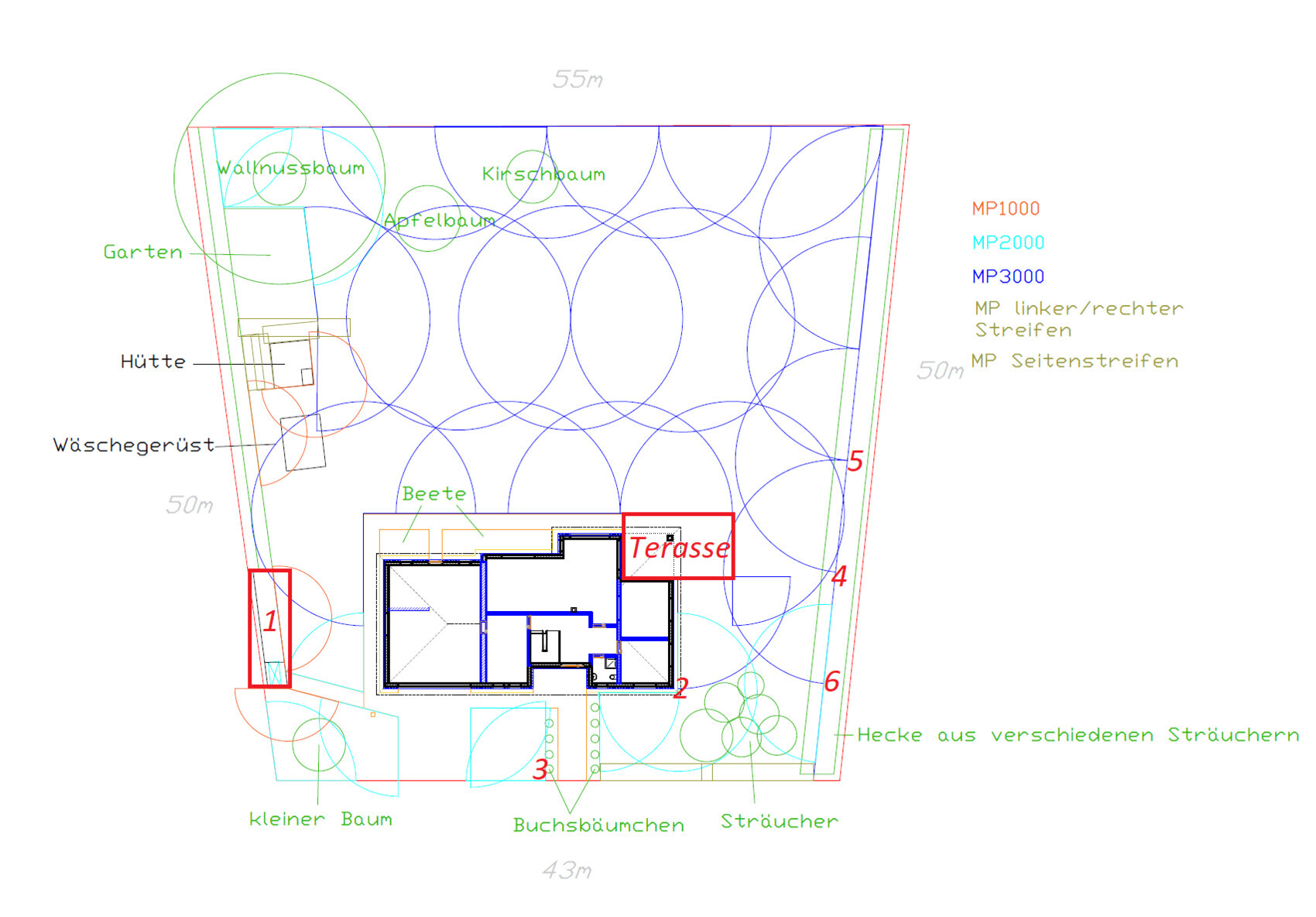
So, I set sprinkler 4, which slightly overlaps the terrace from the right, so that it doesn’t water the terrace—setting it to a radius of 7.8m (26 feet). But then it doesn’t reach sprinklers 5 and 6 anymore. That means I have to shift everything a little upwards in the plan, and then the rectangular sprinkler at the bottom won’t fully cover its area.
What about sprinklers 2 and 6—would you leave them set like that and just water the shrubs along with them?
I don’t quite understand why sprinkler 3 should be changed from MP1000 to MP2000. It still won’t reach the others that way. Now I also have to adjust those two so that they don’t water the path. Then they’ll overlap even less. In theory, I should probably use 4 sprinklers—one in each corner—but isn’t that overkill?
At position 1, there will be a wooden shelter with space for trash bins. The path leading to it runs diagonally, so I didn’t position the sprinkler there near the hedge but rather at the intersection between the shelter and the start of the paving, so I can set the angle accordingly on the sprinkler.
So just to make sure I understand: all MP Rotator series sprinklers have approximately the same precipitation rate per square meter? That means I only divide the zones now based on two criteria: different water requirements. For the entire lawn, it’s basically the same (or do I need to create separate zones for shaded areas?) and the flower beds and hedges each get their own separate groups/circuits.
Okay, thanks. It’s starting to become clearer now. So, for a sprinkler, for example, I set a 140° arc and a throw radius of 7.5m (25 feet), and it is fixed like that over the entire area it waters.
So, I set sprinkler 4, which slightly overlaps the terrace from the right, so that it doesn’t water the terrace—setting it to a radius of 7.8m (26 feet). But then it doesn’t reach sprinklers 5 and 6 anymore. That means I have to shift everything a little upwards in the plan, and then the rectangular sprinkler at the bottom won’t fully cover its area.
What about sprinklers 2 and 6—would you leave them set like that and just water the shrubs along with them?
I don’t quite understand why sprinkler 3 should be changed from MP1000 to MP2000. It still won’t reach the others that way. Now I also have to adjust those two so that they don’t water the path. Then they’ll overlap even less. In theory, I should probably use 4 sprinklers—one in each corner—but isn’t that overkill?
At position 1, there will be a wooden shelter with space for trash bins. The path leading to it runs diagonally, so I didn’t position the sprinkler there near the hedge but rather at the intersection between the shelter and the start of the paving, so I can set the angle accordingly on the sprinkler.
So just to make sure I understand: all MP Rotator series sprinklers have approximately the same precipitation rate per square meter? That means I only divide the zones now based on two criteria: different water requirements. For the entire lawn, it’s basically the same (or do I need to create separate zones for shaded areas?) and the flower beds and hedges each get their own separate groups/circuits.
I wanted to start preparing the Excel sheet to calculate the ranges later.
While doing this, I noticed that different pressure settings result in different throwing distances. That’s understandable. However, I had assumed that the recommended pressure of 2.8 bar (41 psi) would already provide the maximum throwing distance.
This is true for the MP3000, but unfortunately not for the others.
Additionally, the information on the website is inconsistent. Under the Models tab, the MP2000’s range is listed as 4.0–6.7 m (13–22 ft), but under the Operating Data tab, the maximum is only 6.4 m (21 ft). Which one is correct?
(I also assumed only 90–93% of the specified throwing distance for my planning.)
While doing this, I noticed that different pressure settings result in different throwing distances. That’s understandable. However, I had assumed that the recommended pressure of 2.8 bar (41 psi) would already provide the maximum throwing distance.
This is true for the MP3000, but unfortunately not for the others.
Additionally, the information on the website is inconsistent. Under the Models tab, the MP2000’s range is listed as 4.0–6.7 m (13–22 ft), but under the Operating Data tab, the maximum is only 6.4 m (21 ft). Which one is correct?
(I also assumed only 90–93% of the specified throwing distance for my planning.)
Hello Denz,
Unfortunately, I don’t have much time right now, so just a brief reply on a few points:
- For sprinkler 3, either adjust it so that the spray zones overlap (and thus also cover the lane) or use multiple sprinklers. Multiple sprinklers cost more and require a higher flow rate (volume per hour), but this results in a shorter watering time. The precipitation rate is still low enough to avoid overwatering the lawn.
- Yes, the rotator heads have (almost) the same precipitation rate per square meter. When creating the circles, you only need to consider the maximum flow rate/water consumption, shaded and sunny areas, and the plants’ water requirements if they differ.
- Regarding pressure and throw distances: Download the datasheet for the Hunter rotators. I recommend using pressure-regulating bodies (PRS-40). This ensures the pressure at each sprinkler head is the same, regardless of its position within the zone. Additionally, this provides greater freedom in positioning within the watering zones. The pressure will be constant at 2.8 bar (40.6 psi). You supply the system’s mainline with nearly the maximum permissible pressure for the regulators (6 bar / 87 psi). The 2.8 bar is the optimal operating range. This way, you get consistent throw distances that you can reliably plan with.
Unfortunately, I don’t have much time right now, so just a brief reply on a few points:
- For sprinkler 3, either adjust it so that the spray zones overlap (and thus also cover the lane) or use multiple sprinklers. Multiple sprinklers cost more and require a higher flow rate (volume per hour), but this results in a shorter watering time. The precipitation rate is still low enough to avoid overwatering the lawn.
- Yes, the rotator heads have (almost) the same precipitation rate per square meter. When creating the circles, you only need to consider the maximum flow rate/water consumption, shaded and sunny areas, and the plants’ water requirements if they differ.
- Regarding pressure and throw distances: Download the datasheet for the Hunter rotators. I recommend using pressure-regulating bodies (PRS-40). This ensures the pressure at each sprinkler head is the same, regardless of its position within the zone. Additionally, this provides greater freedom in positioning within the watering zones. The pressure will be constant at 2.8 bar (40.6 psi). You supply the system’s mainline with nearly the maximum permissible pressure for the regulators (6 bar / 87 psi). The 2.8 bar is the optimal operating range. This way, you get consistent throw distances that you can reliably plan with.
No problem. There's no rush yet.
I roughly calculated the numbers and I think I must have made a mistake somewhere:
I currently have 4x MP1000, 10x MP2000, 16x MP3000, 3x MP left/right strips, and 3x MP side strips. Using the flow rates from the datasheet for the individual angles, etc., I come to a total of 179.88 liters per minute (l/min).
I read that lawns need about 10-15 liters per square meter (l/m²) twice a week. The sprinklers all have a precipitation rate of 10-12 millimeters (mm). Let’s simplify by assuming 10mm and 10 liters twice a week. (10mm corresponds to 10 liters per hour.)
So, for approximately 2100 square meters (m²) (the rest is built-up area), I need 21,000 liters (21 cubic meters, m³), twice a week. Assuming 10mm precipitation from the sprinklers, they would run (assuming the pump delivers 2m³ per hour and the lawn requires the same amount of water everywhere, and ignoring fractional values) 21m³ / 2m³/h * 2 times per week = 21m³ per week * 4 weeks/month = 84m³ per month just for the lawn.
The average water consumption per person per year is about 3.5m³ per month. So, for 2 people, that’s also exactly 84m³ per year—but only for the lawn, and per month versus per year. That’s quite a lot!
The sprinklers would run a total of 10.5 hours per week.
Is there a mistake in my thinking? I find the amount of water used just for the lawn quite high.
I haven’t accounted for any natural rainfall yet.
I roughly calculated the numbers and I think I must have made a mistake somewhere:
I currently have 4x MP1000, 10x MP2000, 16x MP3000, 3x MP left/right strips, and 3x MP side strips. Using the flow rates from the datasheet for the individual angles, etc., I come to a total of 179.88 liters per minute (l/min).
I read that lawns need about 10-15 liters per square meter (l/m²) twice a week. The sprinklers all have a precipitation rate of 10-12 millimeters (mm). Let’s simplify by assuming 10mm and 10 liters twice a week. (10mm corresponds to 10 liters per hour.)
So, for approximately 2100 square meters (m²) (the rest is built-up area), I need 21,000 liters (21 cubic meters, m³), twice a week. Assuming 10mm precipitation from the sprinklers, they would run (assuming the pump delivers 2m³ per hour and the lawn requires the same amount of water everywhere, and ignoring fractional values) 21m³ / 2m³/h * 2 times per week = 21m³ per week * 4 weeks/month = 84m³ per month just for the lawn.
The average water consumption per person per year is about 3.5m³ per month. So, for 2 people, that’s also exactly 84m³ per year—but only for the lawn, and per month versus per year. That’s quite a lot!
The sprinklers would run a total of 10.5 hours per week.
Is there a mistake in my thinking? I find the amount of water used just for the lawn quite high.
I haven’t accounted for any natural rainfall yet.
Similar topics