
Hello dear community,
I hope I am posting in the right subforum for my question.
We have conducted a soil survey and are currently requesting quotes for the upcoming earthworks.
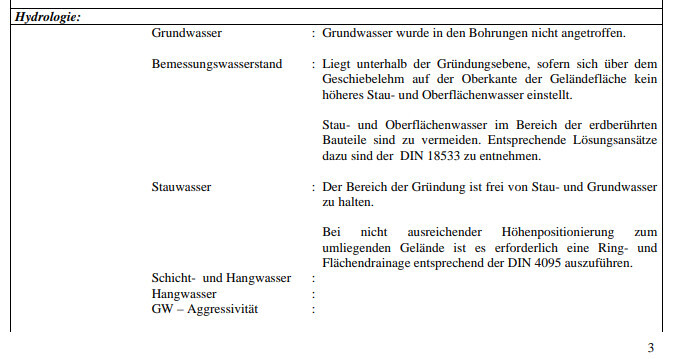
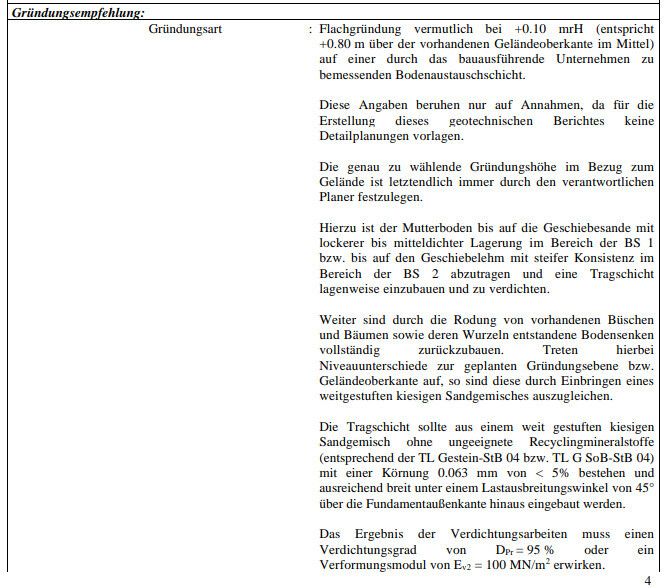
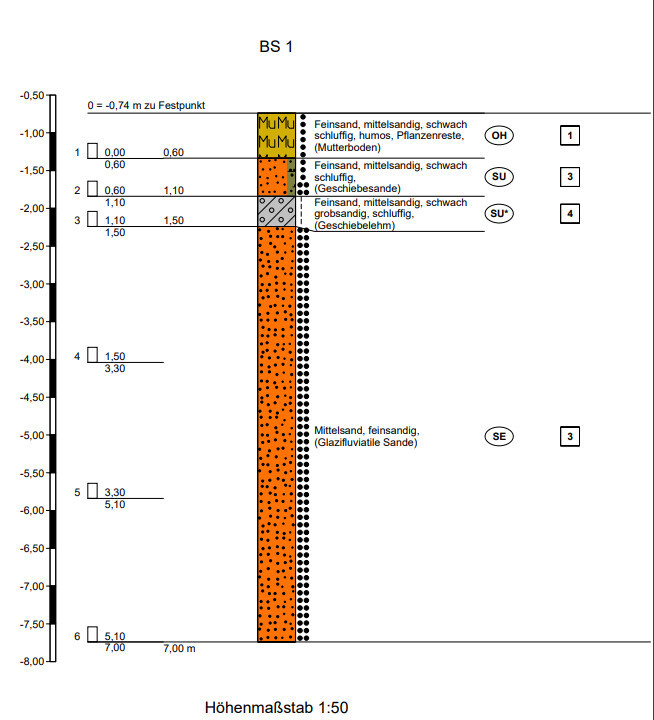
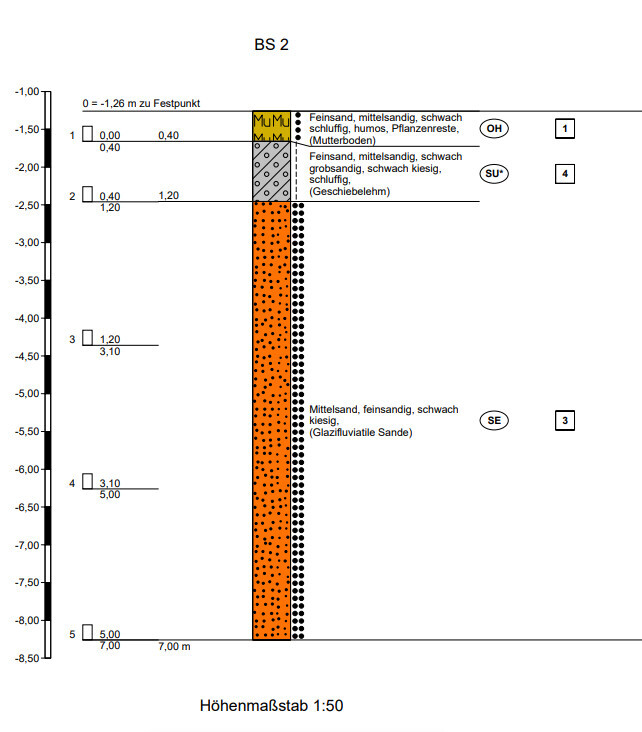
I am quite uncertain about the required removal of topsoil and the possible need for drainage work. I would be very grateful for your interpretation or explanation. I am posting the relevant excerpts from the soil report here.
The first quote from a civil engineer states:
"Sand slab for a single-family house without a basement, 11x11m (36x36 feet), 120 m2 (1,292 sq ft) excavate soil to a depth of 1 m (3 ft) Remove approximately 150 m3 (196 yd³) of soil and dispose of it Deliver, install, and compact approximately 150 m3 (196 yd³) F1 sand in layers Fine grading ± 2 cm (1 inch) and plate load test Excavate for foundations" = 10,000€
Is this appropriate, or is something missing (drainage?), or is there anything excessive?

I hope I am posting in the right subforum for my question.
We have conducted a soil survey and are currently requesting quotes for the upcoming earthworks.
I am quite uncertain about the required removal of topsoil and the possible need for drainage work. I would be very grateful for your interpretation or explanation. I am posting the relevant excerpts from the soil report here.
The first quote from a civil engineer states:
"Sand slab for a single-family house without a basement, 11x11m (36x36 feet), 120 m2 (1,292 sq ft) excavate soil to a depth of 1 m (3 ft) Remove approximately 150 m3 (196 yd³) of soil and dispose of it Deliver, install, and compact approximately 150 m3 (196 yd³) F1 sand in layers Fine grading ± 2 cm (1 inch) and plate load test Excavate for foundations" = 10,000€
Is this appropriate, or is something missing (drainage?), or is there anything excessive?

Schnubbihh schrieb:
The general contractor (GC) will offer the service if needed, but has already indicated that they cannot provide the most competitive offer and that we should consider a separate earthworks contractor. Ouch, I’m unfortunately reading more than just a subtle hint here that you approached the GC contrary to my top rule without tendering :-(https://www.instagram.com/11antgmxde/
https://www.linkedin.com/company/bauen-jetzt/
S
Schnubbihh14 Jan 2024 20:45First concrete offer received:
(1) Excavate 60cm (24 inches), with frost protection and drainage
- Excavation and soil disposal: €2,600
- Backfilling with F1 material and compaction: €2,300
- Drainage around the house including soakaway chamber: €4,400
- Frost protection strip footing excavation: €600
Total: approx. €10,000
(2) Excavate 150cm (59 inches), without frost protection or drainage
- Excavation and soil disposal: €6,500
- Backfilling with F1 material and compaction: €6,300
Total: approx. €12,800
My questions:
(1) From your experience, is there a qualitative difference between these two options, or should the decision be based solely on price?
(2) How deep are strip footings typically installed, and are they usually continuous around the building? In other words, does option 2 actually omit the frost protection, or are strip footings generally considered equivalent to frost protection?
(3) Can the soakaway chamber for the drainage around the house also be used directly as an overflow protection for the planned cistern in the garden?
(1) Excavate 60cm (24 inches), with frost protection and drainage
- Excavation and soil disposal: €2,600
- Backfilling with F1 material and compaction: €2,300
- Drainage around the house including soakaway chamber: €4,400
- Frost protection strip footing excavation: €600
Total: approx. €10,000
(2) Excavate 150cm (59 inches), without frost protection or drainage
- Excavation and soil disposal: €6,500
- Backfilling with F1 material and compaction: €6,300
Total: approx. €12,800
My questions:
(1) From your experience, is there a qualitative difference between these two options, or should the decision be based solely on price?
(2) How deep are strip footings typically installed, and are they usually continuous around the building? In other words, does option 2 actually omit the frost protection, or are strip footings generally considered equivalent to frost protection?
(3) Can the soakaway chamber for the drainage around the house also be used directly as an overflow protection for the planned cistern in the garden?
Schnubbihh schrieb:
First concrete offer is in: ... between which there is such a huge gap that either the bidders have carelessly read the tender documents, or at least one of them is trying to take advantage of you, or you have skimped on hiring a competent tendering professional.
Even my late grandmother without glasses can see that this doesn’t add up.
It looks like a bidding bot took snippets from your request and just attached prices. The gamble here is to hope you’ll accept the offer because
- A: they have the lowest unit prices on the line items, or
- B: they have the lowest total price, or
- C: they have at least one single line item that a competitor didn’t even include.
Do you want an expensive learning experience or to actually build a house?
If it’s the latter, then you should take the tendering process more seriously.
https://www.instagram.com/11antgmxde/
https://www.linkedin.com/company/bauen-jetzt/
S
Schnubbihh15 Jan 2024 08:1111ant schrieb:
... between which there are so many differences that
either the bidders did not read the tender carefully, or at least one of them is trying to take advantage of you,
or you skimped on hiring a competent tender planner.
Even my late grandmother could see without glasses that this does not add up.
A bidding bot has copied snippets from your request and attached prices to them. The gambling strategy here is to count on you accepting the offer because
- A: the bidder has the lower unit price on the items, or
- B: the bidder has the lower overall price, or
- C: the bidder has at least one individual item that a competitor did not list at all.
Do you want to make an expensive learning experience or build a house?
If the latter, then you should take the tendering process more seriously. Are you aware that these are two different alternative positions from one bidder?
Also, I roughly summarized the positions from the offer here for better readability.
So I don’t quite understand how you come to your respective conclusions...
W
WilderSueden15 Jan 2024 08:52Schnubbihh schrieb:
(3) Is it possible to use the soakaway pit of the perimeter drainage directly as an overflow protection for the planned rainwater cistern in the garden? Definitely not. Overflows should be connected to the stormwater drainage system for both the cistern and the perimeter drainage. Otherwise, there is a risk that during prolonged rainfall, water will accumulate in your soakaway pit and back up into the drainage system. This is exactly the situation where drainage is needed.
Schnubbihh schrieb:
(1) From your perspective, is there a qualitative difference between the two options, or should the decision be based solely on price?
(2) How deep are strip foundations typically, and are they always continuous all around? In other words, does option 2 really eliminate the need for a frost protection layer, or are strip foundations always equivalent to a frost protection layer? As a non-professional, I wonder which option actually includes the frost protection layer. In option 2, you can directly pour the slab, whereas in option 1 there are just trenches for the frost protection, so something still needs to be added.
By the way, a frost protection layer does not have a structural function, unlike the strip foundation. What you need and how deep it should be will be determined by your architect or structural engineer.
S
Schnubbihh15 Jan 2024 09:48WilderSueden schrieb:
Absolutely not. Overflows should be connected to the stormwater drain, both for the cistern and the drainage system. Otherwise, you risk water standing in your soakaway during continuous rain and backing up into the drainage. But this is exactly the situation where you need the drainage. We don’t have a stormwater drain here; we have to let the water infiltrate on the property.
WilderSueden schrieb:
As a non-expert, I wonder where exactly to pour the frost protection strip. In option 2, you can pour the slab directly, while in option 1 there are only trenches for the frost protection strip. So something will be added there.
By the way, a frost protection strip has no structural function, unlike a strip footing. Your architect or structural engineer will tell you what you need and how deep it should go. Yes, you’re right. I’ve noticed that too. However, I had assumed that a strip footing (if deep enough) automatically counts as a frost protection strip. But like you, I’m also just a layperson here.
Similar topics