
Hello dear community,
I hope I am posting in the right subforum for my question.
We have conducted a soil survey and are currently requesting quotes for the upcoming earthworks.
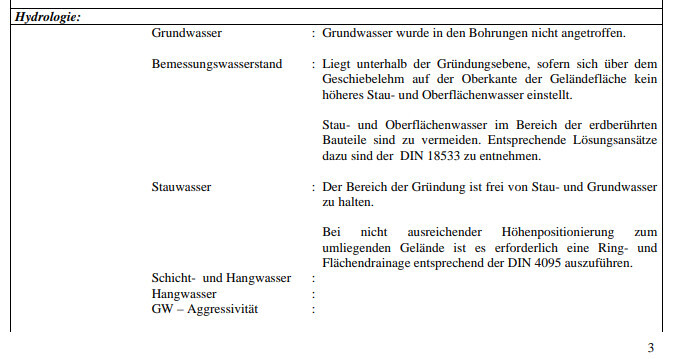
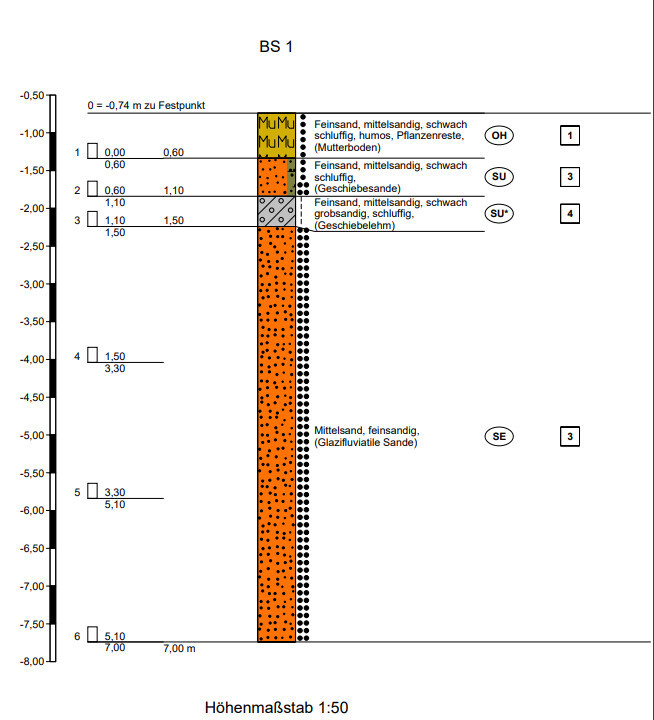
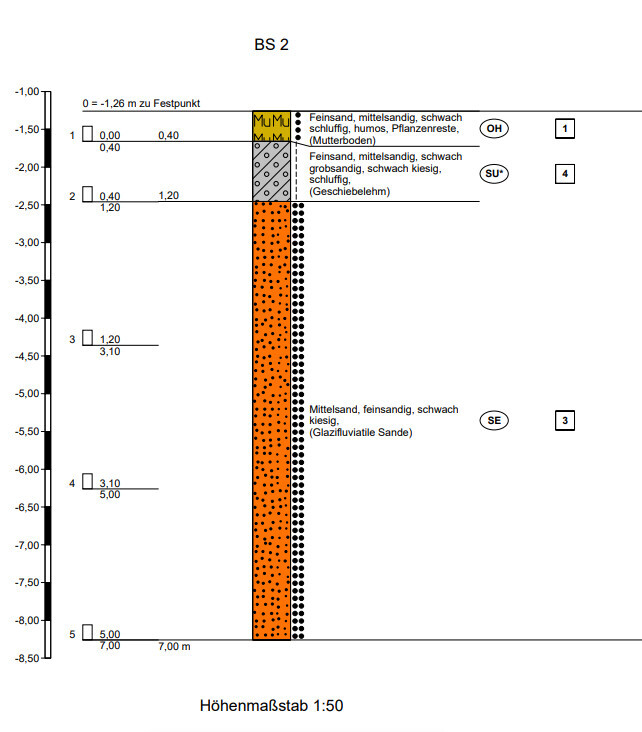
I am quite uncertain about the required removal of topsoil and the possible need for drainage work. I would be very grateful for your interpretation or explanation. I am posting the relevant excerpts from the soil report here.
The first quote from a civil engineer states:
"Sand slab for a single-family house without a basement, 11x11m (36x36 feet), 120 m2 (1,292 sq ft) excavate soil to a depth of 1 m (3 ft) Remove approximately 150 m3 (196 yd³) of soil and dispose of it Deliver, install, and compact approximately 150 m3 (196 yd³) F1 sand in layers Fine grading ± 2 cm (1 inch) and plate load test Excavate for foundations" = 10,000€
Is this appropriate, or is something missing (drainage?), or is there anything excessive?


I hope I am posting in the right subforum for my question.
We have conducted a soil survey and are currently requesting quotes for the upcoming earthworks.
I am quite uncertain about the required removal of topsoil and the possible need for drainage work. I would be very grateful for your interpretation or explanation. I am posting the relevant excerpts from the soil report here.
The first quote from a civil engineer states:
"Sand slab for a single-family house without a basement, 11x11m (36x36 feet), 120 m2 (1,292 sq ft) excavate soil to a depth of 1 m (3 ft) Remove approximately 150 m3 (196 yd³) of soil and dispose of it Deliver, install, and compact approximately 150 m3 (196 yd³) F1 sand in layers Fine grading ± 2 cm (1 inch) and plate load test Excavate for foundations" = 10,000€
Is this appropriate, or is something missing (drainage?), or is there anything excessive?
S
Schnubbihh2 Jan 2024 22:20Osnabruecker schrieb:
I read it the exact opposite way. The clay is meant to remain. Therefore, only about 0.5 m (1.5 feet) of excavation. And on top of that, approximately 1.5 m (5 feet) of build-up. Yes, I also received the following feedback from the geotechnical expert:
"Of course, you can remove the clay layer and then construct a frost-resistant and water-permeable sand-gravel mix beneath the foundation, resting on the glaciofluvial sand. But that will cost money and significantly increase the earthwork expenses."
Schnubbihh schrieb:
and are currently obtaining quotes for the upcoming earthworks.Why isn’t the general contractor handling this? Earthworks are usually included in the construction scope description, for example at a depth of 30cm (12 inches). It doesn’t make sense to have two separate earthwork contractors involved. The general contractor is also the point of contact for reviewing the report.S
Schnubbihh2 Jan 2024 22:44ypg schrieb:
Why doesn’t the general contractor (GC) handle this? Excavation is usually included up to about 30cm (12 inches) depth in the scope of work (at least that’s common). It doesn’t make sense to have two separate excavators working. The GC is also the contact person for interpreting the report. The GC will offer the service if needed but has already informed us that they cannot provide the most competitive quote and recommended that we approach a separate excavation contractor.
I have an on-site appointment with a civil engineer specialized in deep excavation on Thursday and want to ensure I am prepared and asking the right questions. Your input is therefore very helpful to me.
I understand the overall situation as follows: due to the significantly deeper position of the foundation slab (compared to the assumption in the soil report), it might make sense to remove the entire layer of glacial loam to potentially avoid installing a drainage system. I’m curious to see if the excavation contractor on Thursday shares this view.
So, the soil does not initially look too problematic. Have any dynamic probing tests been carried out?
From the documents, I understand that strip foundations are planned?
Here is a brief assessment and what I would have written...
Since there are silt fractions in the sandy soil down to 1.5 m (5 feet) below the finished ground level (FGL), this soil is not frost-resistant. The geotechnical engineer should have specified the frost action zone and the frost-resistant foundation depth in their report.
Frost protection can be ensured by:
1. A frost-resistant construction. This means excavation and filling with F1 material down to 1.0 m (3 feet) below FGL (1 m is assumed here; FGL is the new planned ground level).
2. Frost skirts down to 1.0 m (3 feet) below FGL (allowing the use of non-frost-resistant but well-compacted material).
3. Strip foundations down to 1.0 m (3 feet) below FGL.
Building waterproofing:
Either a perimeter drainage system with damp proofing against ground moisture or a waterproof slab against hydrostatic pressure is recommended. Since I do not know the site conditions, I will rely on the statement given. I would generally tend towards drainage, as it is usually more cost-effective to implement if permitted.
Theoretically, infiltration of rainwater into the sandy soil should also be possible... but that is another topic.
Foundation:
The topsoil must be removed, that is clear. Nothing else has been requested by the geotechnical engineer.
1. If you want to found without foundations (frost skirts or strips), you must ensure a frost-resistant construction down to your planned foundation level—however you manage that (more filling, deeper excavation, changing the foundation level, etc.).
2. Frost skirts serve only to protect against frost and are not designed to carry loads. After removing the topsoil, well-compacting fill material can theoretically be used here.
3. Loads are transferred to the ground via strip foundations (the report should include specifications). The structural engineer calculates the quantity, position, and dimensions of the foundations. The topsoil must be removed, and the “void” down to the slab (and insulation) must be refilled. I would use compactable material here as well (it does not have to be F1), even though the slab itself does not carry loads.
Soil analysis:
I would wait on analysis for now. This concerns topsoil that should be characterized according to the Federal Soil Protection Ordinance (BBodSchV). But it depends on what the earthworks contractor plans to do with it. Once disposal is arranged, ask the earthworks contractor what analysis they require and then proceed accordingly.
Best regards
From the documents, I understand that strip foundations are planned?
Here is a brief assessment and what I would have written...
Since there are silt fractions in the sandy soil down to 1.5 m (5 feet) below the finished ground level (FGL), this soil is not frost-resistant. The geotechnical engineer should have specified the frost action zone and the frost-resistant foundation depth in their report.
Frost protection can be ensured by:
1. A frost-resistant construction. This means excavation and filling with F1 material down to 1.0 m (3 feet) below FGL (1 m is assumed here; FGL is the new planned ground level).
2. Frost skirts down to 1.0 m (3 feet) below FGL (allowing the use of non-frost-resistant but well-compacted material).
3. Strip foundations down to 1.0 m (3 feet) below FGL.
Building waterproofing:
Either a perimeter drainage system with damp proofing against ground moisture or a waterproof slab against hydrostatic pressure is recommended. Since I do not know the site conditions, I will rely on the statement given. I would generally tend towards drainage, as it is usually more cost-effective to implement if permitted.
Theoretically, infiltration of rainwater into the sandy soil should also be possible... but that is another topic.
Foundation:
The topsoil must be removed, that is clear. Nothing else has been requested by the geotechnical engineer.
1. If you want to found without foundations (frost skirts or strips), you must ensure a frost-resistant construction down to your planned foundation level—however you manage that (more filling, deeper excavation, changing the foundation level, etc.).
2. Frost skirts serve only to protect against frost and are not designed to carry loads. After removing the topsoil, well-compacting fill material can theoretically be used here.
3. Loads are transferred to the ground via strip foundations (the report should include specifications). The structural engineer calculates the quantity, position, and dimensions of the foundations. The topsoil must be removed, and the “void” down to the slab (and insulation) must be refilled. I would use compactable material here as well (it does not have to be F1), even though the slab itself does not carry loads.
Soil analysis:
I would wait on analysis for now. This concerns topsoil that should be characterized according to the Federal Soil Protection Ordinance (BBodSchV). But it depends on what the earthworks contractor plans to do with it. Once disposal is arranged, ask the earthworks contractor what analysis they require and then proceed accordingly.
Best regards
S
Schnubbihh3 Jan 2024 10:27Wow, thanks a lot for the detailed response!
The soil report states:
"This is Frost Action Zone I, so the embedment depth of the frost skirts must be > 0.80 m (2.6 ft) deep."
Frost protection:
As I understand it, you can either excavate the entire area to a depth of >0.8 m (2.6 ft) and refill with frost-protective material F1, or only remove the topsoil down to about 0.5 m (1.6 ft) and instead use a frost skirt or strip foundation with an embedment depth of >0.8 m (2.6 ft). In the end, this will likely come down to a cost decision.
Lateral water pressure (water bearing soil):
Here, I understand the situation similarly: either excavate the entire area down to the medium sand layer (>1.5 m (4.9 ft)) or use a perimeter drainage system. Again, this will probably just be a question of cost in the end.
Thanks again!
The soil report states:
"This is Frost Action Zone I, so the embedment depth of the frost skirts must be > 0.80 m (2.6 ft) deep."
Frost protection:
As I understand it, you can either excavate the entire area to a depth of >0.8 m (2.6 ft) and refill with frost-protective material F1, or only remove the topsoil down to about 0.5 m (1.6 ft) and instead use a frost skirt or strip foundation with an embedment depth of >0.8 m (2.6 ft). In the end, this will likely come down to a cost decision.
Lateral water pressure (water bearing soil):
Here, I understand the situation similarly: either excavate the entire area down to the medium sand layer (>1.5 m (4.9 ft)) or use a perimeter drainage system. Again, this will probably just be a question of cost in the end.
Thanks again!

Schnubbihh schrieb:
If I understand the drawing correctly, it is calculated at about +0.4m (1.3 ft) above ground level. I attached the picture. Am I interpreting this correctly? The drawing is difficult to understand. What is the purpose of building up the ground so that rainwater then flows toward the terrace? Also, consider the recommended relocation of the house due to the turning area.
https://www.instagram.com/11antgmxde/
https://www.linkedin.com/company/bauen-jetzt/
Similar topics