
Hello everyone,
We have a geotechnical report for a potential building plot. Since I am not a geologist, I find it somewhat difficult to interpret the information. Are there experienced people here who can draw conclusions for construction from such a report? As a layperson, who would you usually discuss such a report with before purchasing a plot?
In particular, the report contains information about foundations and infiltration that reads quite negative to me as a non-expert.
a) Infiltration: Due to poor soil permeability, it is recommended to provide overflow installations for heavy rain events.

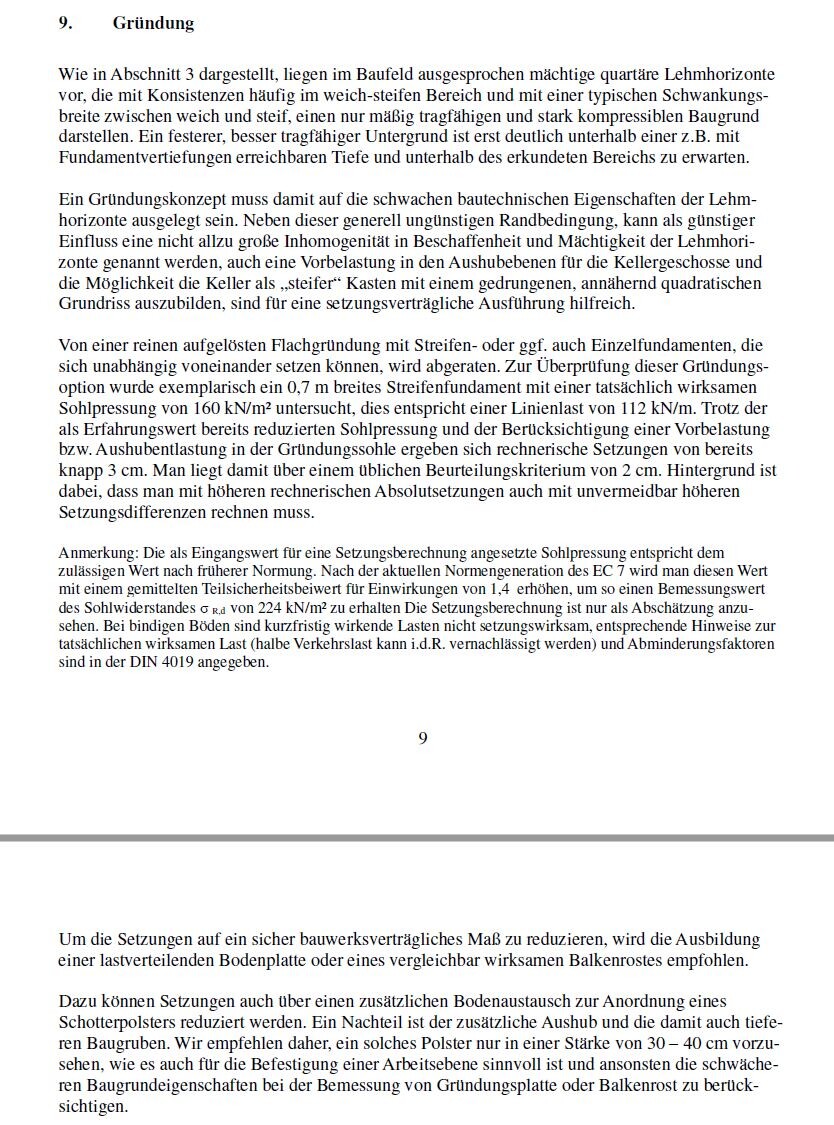
b) Foundations: Clay layers with weak geotechnical properties:

Thanks and regards
We have a geotechnical report for a potential building plot. Since I am not a geologist, I find it somewhat difficult to interpret the information. Are there experienced people here who can draw conclusions for construction from such a report? As a layperson, who would you usually discuss such a report with before purchasing a plot?
In particular, the report contains information about foundations and infiltration that reads quite negative to me as a non-expert.
a) Infiltration: Due to poor soil permeability, it is recommended to provide overflow installations for heavy rain events.
b) Foundations: Clay layers with weak geotechnical properties:
Thanks and regards
11ant is right. The plot is sold without a house and can be built on freely. Since the plot is priced quite low compared to similar plots, we are cautious and want to make sure we’re not buying a pig in a poke.
Thanks in advance for your assessment. What I take away from it: this is not an unusual soil for southern Germany and can be built on with certain special measures.
How should I imagine the overflow device for heavy rain mentioned in the report?
Thanks. Can you estimate what additional costs arise compared to a standard foundation slab? Usually, costs of 300€ per sqm (32 USD per sq ft) are calculated.
What exactly do you mean by draining the roof surfaces? Isn’t it always necessary to drain into a sewer?
Thanks in advance for your assessment. What I take away from it: this is not an unusual soil for southern Germany and can be built on with certain special measures.
How should I imagine the overflow device for heavy rain mentioned in the report?
Cronos86 schrieb:
So, foundation slab... let’s keep it simple. The fill material up to 1 m (3.3 ft) should be removed. Install geogrid and backfill with frost protection material 00/32 or 00/45. At least 50 cm (20 inches) overhang, then slope it off at a 45-degree angle. Given the NHN elevation, this should be sufficient for frost protection. This should also be stated in the report.
Seal the foundation slab against ground moisture according to DIN 18533 W1.1-E.
Drain the roof surfaces into the sewer system; you won’t be able to avoid that.
You can assume a bearing capacity of about 15 MN/m³ (meganewtons per cubic meter) for the bedding module.
Now I have to put the kids to bed, I’ll think about what else is important. But that would be my recommendation.
Thanks. Can you estimate what additional costs arise compared to a standard foundation slab? Usually, costs of 300€ per sqm (32 USD per sq ft) are calculated.
What exactly do you mean by draining the roof surfaces? Isn’t it always necessary to drain into a sewer?
Usually, this is regulated by the zoning plan, but there is often no legal obligation to connect.
This is what the section about infiltration is about. The goal is to keep rainwater on the property and allow it to infiltrate into the ground, if the soil conditions permit.
This is regulated by the DWA A 138 guideline. In most cases, your soil does not allow this, or extremely large infiltration systems are required, along with additional safeguards for heavy rainfall events. Therefore, you have to bite the bullet and pay indefinitely for managing the rainwater and discharge it into the sewer.
I can’t tell you how expensive the slab will be, as it depends on many factors (material costs, steel prices, etc.), but as long as they don’t try to sell you a waterproof slab, it should be manageable.
Regards
This is what the section about infiltration is about. The goal is to keep rainwater on the property and allow it to infiltrate into the ground, if the soil conditions permit.
This is regulated by the DWA A 138 guideline. In most cases, your soil does not allow this, or extremely large infiltration systems are required, along with additional safeguards for heavy rainfall events. Therefore, you have to bite the bullet and pay indefinitely for managing the rainwater and discharge it into the sewer.
I can’t tell you how expensive the slab will be, as it depends on many factors (material costs, steel prices, etc.), but as long as they don’t try to sell you a waterproof slab, it should be manageable.
Regards
W
WilderSueden2 Dec 2023 13:09moccanna schrieb:
What I take from this is: for southern Germany, not an unusual soil that can be built on with certain special measures. Exactly. And as I said... There are many ways to solve the problem, each with its own advantages and disadvantages.
moccanna schrieb:
How should I imagine the mentioned overflow device for heavy rain that is referenced in the report? Some development plans require that rainwater infiltrate on the property. This infiltration system then needs to have an overflow connected to the sewer, because during heavy or prolonged rainfall the soakaway can fill up quickly. In areas with a lot of clay, however, this is generally not required, as it is completely pointless and can even be potentially dangerous if you start liquefying large amounts of clay on the property.
Infiltration through the paving is usually required (although also not very practical), which simply means being more generous with the gravel layer.

moccanna schrieb:
Since the plot is priced quite low compared to similar plots, we are suspicious and want to be sure we’re not buying a pig in a poke. The markets for building plots and developer projects behave like interconnected vessels, so disturbances (such as the current uncertainty) always affect both sides. Plots like this one (intended for just two single-family houses or a semi-detached house, with construction not yet started) are naturally the first to be pushed aside. Locked-in liquidity without expected returns has to be resolved as "time before money." You won't sell below your purchase price, but you don’t have to go above it either — the main thing is that the asset can be quickly turned back into liquid funds. "Next door" ...
MaBa_786 schrieb:
And it just got worse: Traumhaus has filed for insolvency. ... here you can read a snapshot of the current sentiment. A building plot always remains a pig in a poke; after all, only three lottery numbers... uh, drill cores were taken here. At least all of them come from the plot in question itself, not just from the larger building area in cumolo.
https://www.instagram.com/11antgmxde/
https://www.linkedin.com/company/bauen-jetzt/
moccanna schrieb:
How should I imagine the mentioned overflow device for heavy rain, as stated in the report?Basically, it works like a buffer tank that temporarily holds rainwater on the property. For the sewer system, the advantage is reducing peak flow; and for the soil on the property, it prevents the rainwater from mixing directly with it. Water essentially follows two strong impulses: moving downhill due to gravity or reacting to obstacles. It always takes the path of least resistance. The less permeable the soil is, the more likely it is that runoff will occur. The topsoil, which belongs to this natural water cycle, effectively becomes detached from its soil family—resulting in soil softening (and on a slope: potential landslides).https://www.instagram.com/11antgmxde/
https://www.linkedin.com/company/bauen-jetzt/