
ᐅ Design of iDM heat pump with respect to COP (Coefficient of Performance)
Created on: 26 Aug 2022 11:21
A
Araknis
Hello.
Let’s assume a well-insulated new building with approximately 200 m² (2,150 sq ft) and a heating load of around 7 kW. So far, I have assumed that the heat pump should be appropriately sized and that oversizing it would be disadvantageous. Now, I’m looking at the datasheet of my preferred iDM heat pump, the iPump A, and I found the following:
Based on my previous understanding, the suitable model would be the iDM iPump A 2-7, which can modulate between 2.06 and 7.55 kW. The next larger model, the A 3-11, operates between 2.80 and 10.20 kW and, according to opinions I’ve heard so far, would actually be too big.
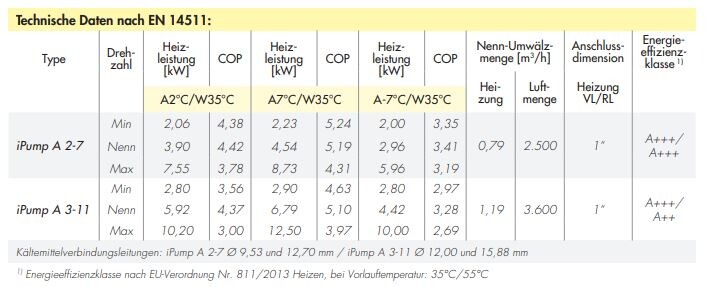
However, when I look at this table, the COP for the larger heat pump at lower loads is noticeably better than running the smaller one at full capacity. So, the larger version would be better for my situation, right?
Or am I missing something?
Let’s assume a well-insulated new building with approximately 200 m² (2,150 sq ft) and a heating load of around 7 kW. So far, I have assumed that the heat pump should be appropriately sized and that oversizing it would be disadvantageous. Now, I’m looking at the datasheet of my preferred iDM heat pump, the iPump A, and I found the following:
Based on my previous understanding, the suitable model would be the iDM iPump A 2-7, which can modulate between 2.06 and 7.55 kW. The next larger model, the A 3-11, operates between 2.80 and 10.20 kW and, according to opinions I’ve heard so far, would actually be too big.
However, when I look at this table, the COP for the larger heat pump at lower loads is noticeably better than running the smaller one at full capacity. So, the larger version would be better for my situation, right?
Or am I missing something?
G
Gecko19277 Sep 2022 08:14SaniererNRW123 schrieb:
Since a heat pump usually operates mostly at part load (even the slightly smaller one than the calculated heat pump), this "problem" only occurs on a few days per year when it is extremely cold. However, this is not the case for domestic hot water production, which the iPump handles with its integrated 180-liter (47-gallon) mini-storage tank, often cycling 2-3 times per day.
What you describe is certainly true if the heating system is designed for continuous operation. Most thermostats cause a heat pump to cycle frequently due to its ERR (energy-related regulation). Additionally, there may be lockout periods or setback phases due to photovoltaic power availability. Although this is usually discouraged for efficiency reasons, if electricity is essentially free during the day and costs about 40 cents at night, efficiency becomes less relevant.
S
SaniererNRW1237 Sep 2022 08:23Gecko1927 schrieb:
However, not for domestic hot water, and the iPump often does this 2-3 times a day thanks to its integrated 180-liter (48-gallon) mini storage tank. Then you shouldn’t be showering 2-3 times a day 😉 .
Gecko1927 schrieb:
Most installers configure a heat pump in a way that causes a lot of short cycling due to the ERR.
There may also be block-out periods or setback times related to photovoltaic electricity. Although this is usually discouraged for efficiency reasons, if the electricity during the day is more or less free and costs 40 cents per kilowatt-hour at night, efficiency becomes almost irrelevant. That’s exactly why I always recommend here in the forum to have the heating system professionally designed and to get an exemption from the ERR if possible. Then it’s no problem at all. But of course, for the installer it’s easier to say “we’ve always done it this way, a bit more capacity plus a buffer tank will do.”
A
Alessandro7 Sep 2022 11:28Many heating system users often choose the larger model because they also include the hot water preparation in the calculation. A small heat pump naturally takes longer (or even much longer!), which is not necessarily beneficial for the heating operation if you produce hot water twice (or even more) times a day.
S
SaniererNRW1237 Sep 2022 11:39Alessandro schrieb:
A small heat pump simply takes correspondingly longer (or even a very long time!), which is not necessarily beneficial for the heating operation if you use hot water 2 times (or even more) per day. That then is not due to the heat pump itself (modern heat pumps now deliver 55-60 degrees Celsius (131-140 degrees Fahrenheit) supply temperature with a proper flow rate), but rather depends on the size of the storage tank and user behavior. Using hot water 2 times or more per day means that with a small tank of around 160 liters (42 gallons), you consume 350 liters (92 gallons) or more of hot water daily. How is that possible unless a family of four takes four full baths a day?
A
Alessandro7 Sep 2022 12:17The question is simply about how long a heat pump takes to heat up the hot water tank. The smaller the heat pump, the longer it takes. I have seen systems where heating the domestic hot water with a hysteresis of about 5K (9°F) takes around 2 hours. If you heat twice, you end up "wasting" a total of 4 hours on hot water!
Also, don't forget the heat loss of a tank when it is idle, without hot water circulation or withdrawal. This can easily be 3–5K (5–9°F) within 24 hours!
Also, don't forget the heat loss of a tank when it is idle, without hot water circulation or withdrawal. This can easily be 3–5K (5–9°F) within 24 hours!
S
SaniererNRW1237 Sep 2022 12:24Alessandro schrieb:
I have already seen systems where hot water production with a hysteresis of about 5°C (9°F) takes around 2 hours.Wow, how poorly are those systems designed.Even the smallest Pana Monoblock requires only about 45 minutes for a 10°C (18°F) hysteresis with a 300-liter (79-gallon) tank.
In my case, with a 5°C (9°F) hysteresis, it takes about 20 minutes for 300 liters (79 gallons). But: properly planned and with sufficient flow rate (that can also be around 20 liters/min (5.3 gallons/min)).
Similar topics