
Hello everyone,
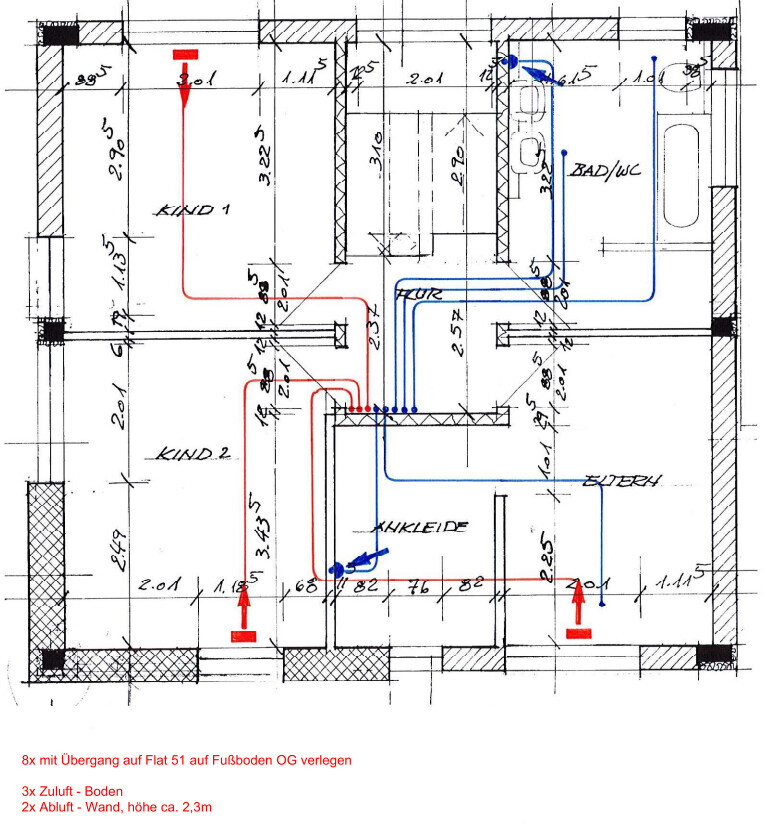
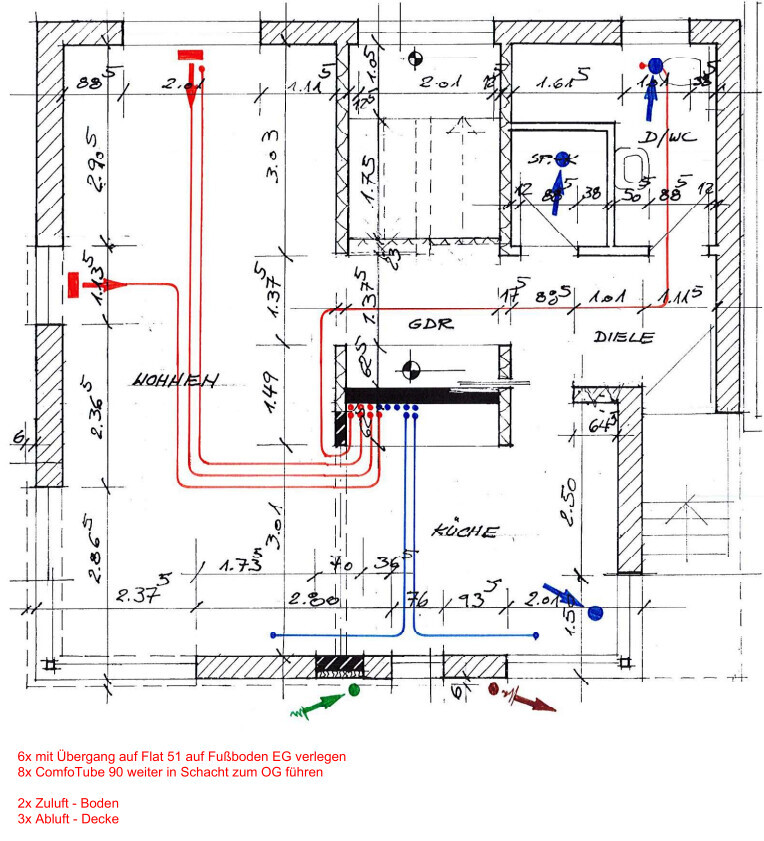
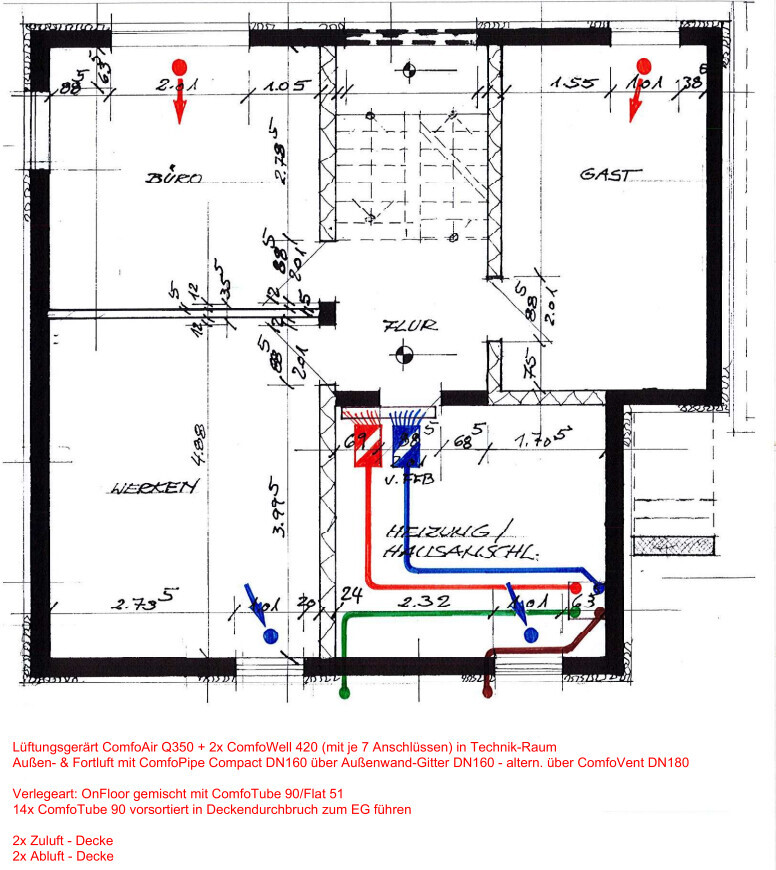
for our new construction project aiming for KfW55 standard, we are planning to install a central ventilation system with heat recovery (yes, we discussed this extensively and decided on it). I have now received the initial plan from Zehnder, see attachment.
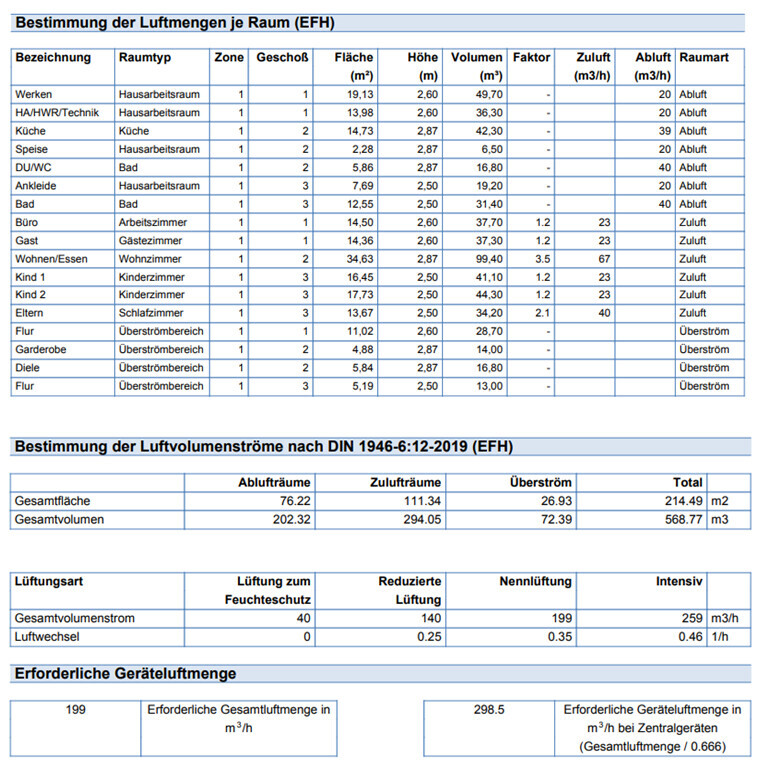
Some points have not been recorded correctly, for example the ceiling height on the upper floor, as we are planning an "open ceiling" here. The calculation is based on a ceiling height of 2.50m (8.2 feet), which is clearly too low. The other height references are also inconsistent; once the finished floor level of the ground floor is used, another time the top edge of the floor slab in the basement. I have already pointed this out.
Aside from that, I often read that these systems tend to be somewhat oversized to allow for reserves and partial load operation. Zehnder suggested the Q350TR model to us.
What also strikes me is the low number of supply air vents – or am I mistaken? For example, there are no vents in the hallway/wardrobe area. I would also have expected two vents per bedroom and children’s room (?).
It is important to us that no noises or drafts are noticeable, and that we do not regret a wrong decision afterwards that initially seemed like a cost-saving measure. We are not committed to a single manufacturer; Zehnder was chosen because I have only read good things so far.
Thanks for taking a look!
Best regards,
Jentopa
for our new construction project aiming for KfW55 standard, we are planning to install a central ventilation system with heat recovery (yes, we discussed this extensively and decided on it). I have now received the initial plan from Zehnder, see attachment.
Some points have not been recorded correctly, for example the ceiling height on the upper floor, as we are planning an "open ceiling" here. The calculation is based on a ceiling height of 2.50m (8.2 feet), which is clearly too low. The other height references are also inconsistent; once the finished floor level of the ground floor is used, another time the top edge of the floor slab in the basement. I have already pointed this out.
Aside from that, I often read that these systems tend to be somewhat oversized to allow for reserves and partial load operation. Zehnder suggested the Q350TR model to us.
What also strikes me is the low number of supply air vents – or am I mistaken? For example, there are no vents in the hallway/wardrobe area. I would also have expected two vents per bedroom and children’s room (?).
It is important to us that no noises or drafts are noticeable, and that we do not regret a wrong decision afterwards that initially seemed like a cost-saving measure. We are not committed to a single manufacturer; Zehnder was chosen because I have only read good things so far.
Thanks for taking a look!
Best regards,
Jentopa
Stephan— schrieb:
Intermediate ceiling – I think the hesitation is due to laziness, but since you are the client, he should provide solid facts...Yeah, material cost is one thing. According to him, the structural engineer has to pull out the slide rule again, and that costs me quite a bit. Structural engineering in general was quite expensive, even though we don’t have any "special features," see floor plan. I will keep the on-floor option now.
What I still don’t understand is the volume issue on the upper floor. Why is the room volume, specifically the ceiling height, irrelevant for the design? According to Zehnder, there are different calculation methods or approaches for this. However, that is not a valid or (to me) understandable answer.
Tolentino schrieb:
My general contractor initially wanted to make the intermediate ceiling (ZwiDe) thicker. That would have cost an extra 3,000, but at the time it seemed cheaper to solve it with more insulation on the intermediate ceiling instead. The story height increase itself only cost 1,900.
I couldn’t have predicted that insulation prices would skyrocket nine months later...
In the end, doing the installation myself wasn’t worth it... I also considered doing some of the work myself. However, that means one hour of travel time per workday and having to work whenever possible, which probably won’t fit my schedule, to avoid delaying subsequent trades. Plus, with two small children, it’s less than ideal.

The issue with the room volume was the same for me. I had a design planned by an MEP engineering office specifically. They also said it was irrelevant. In my case, it was only about 15cm (6 inches) more, so I could somewhat understand that it didn’t make a significant difference, probably because the calculations are generally done with a margin of safety. If it had been 3m (10 feet), I might have asked more questions.
What ceiling height do you have?
What ceiling height do you have?
TGA engineer could still be an option, thanks for the tip! Although I don’t want to use a sledgehammer to crack a nut.
The ceiling height on the upper floor (except for the hallway = 250cm (98 inches)) is about 4m (13 feet) at the highest point. I need to find the floor plan or ask the architect about the room volume.
I also plan to get a second quote from another manufacturer (Wolf, Maico, Hellios…?) anyway. I’m curious to hear what they say about the situation on the upper floor.
The ceiling height on the upper floor (except for the hallway = 250cm (98 inches)) is about 4m (13 feet) at the highest point. I need to find the floor plan or ask the architect about the room volume.
I also plan to get a second quote from another manufacturer (Wolf, Maico, Hellios…?) anyway. I’m curious to hear what they say about the situation on the upper floor.

Jentopa schrieb:
Just briefly regarding our special requirements, in case that’s what you mean: as quiet as possible, especially in the bedrooms.We don’t have Zehnder but use a combined unit from Tecalor, though I can reassure you here as well. At night, our system lowers the ventilation to the lowest setting, making it barely noticeable in the bedroom. I consider myself rather sensitive to noise and still can’t hear it at night.As @Stephan— already mentioned: the more you dive into the subject, the more uncertain you become. Flat ducts are difficult to clean, have higher pressure losses, the air velocity should not exceed 1.5m/s (5ft/s), no bends...
I think I'll follow the advice of @Tolentino and hire an HVAC planner after all.
I think I'll follow the advice of @Tolentino and hire an HVAC planner after all.
Similar topics