
Hello everyone,
for our new construction project aiming for KfW55 standard, we are planning to install a central ventilation system with heat recovery (yes, we discussed this extensively and decided on it). I have now received the initial plan from Zehnder, see attachment.
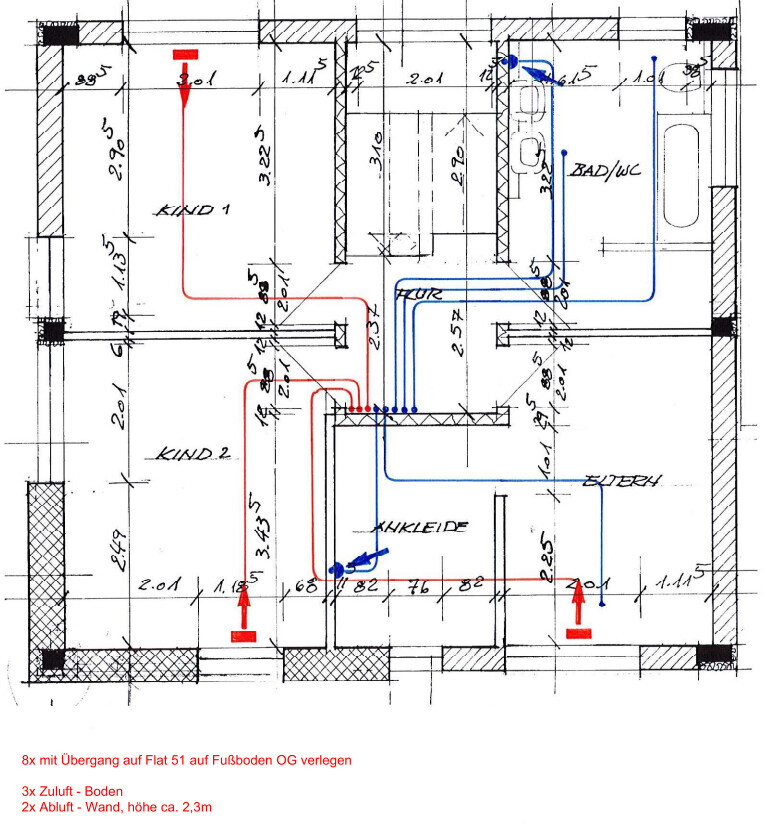
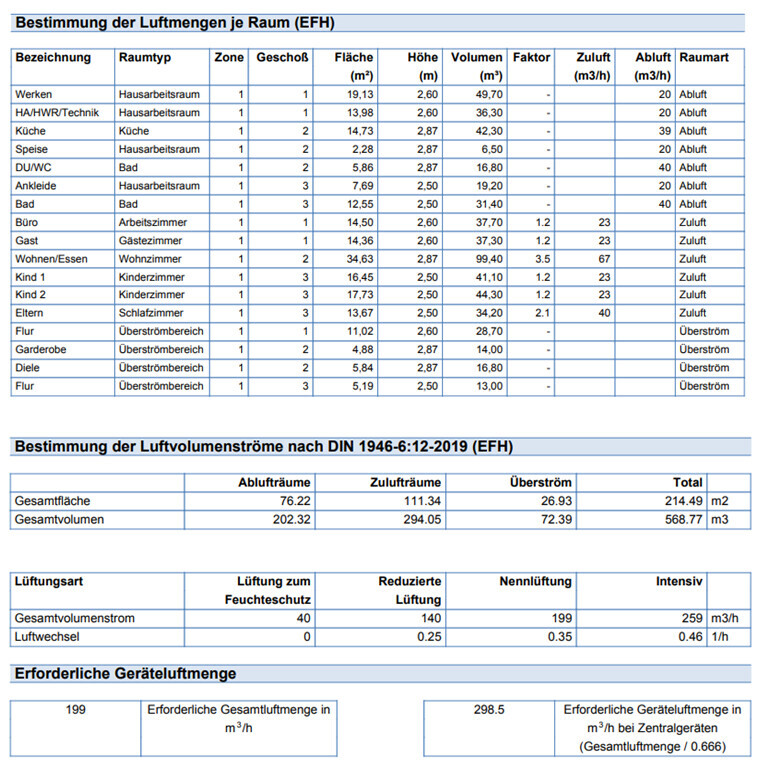
Some points have not been recorded correctly, for example the ceiling height on the upper floor, as we are planning an "open ceiling" here. The calculation is based on a ceiling height of 2.50m (8.2 feet), which is clearly too low. The other height references are also inconsistent; once the finished floor level of the ground floor is used, another time the top edge of the floor slab in the basement. I have already pointed this out.
Aside from that, I often read that these systems tend to be somewhat oversized to allow for reserves and partial load operation. Zehnder suggested the Q350TR model to us.
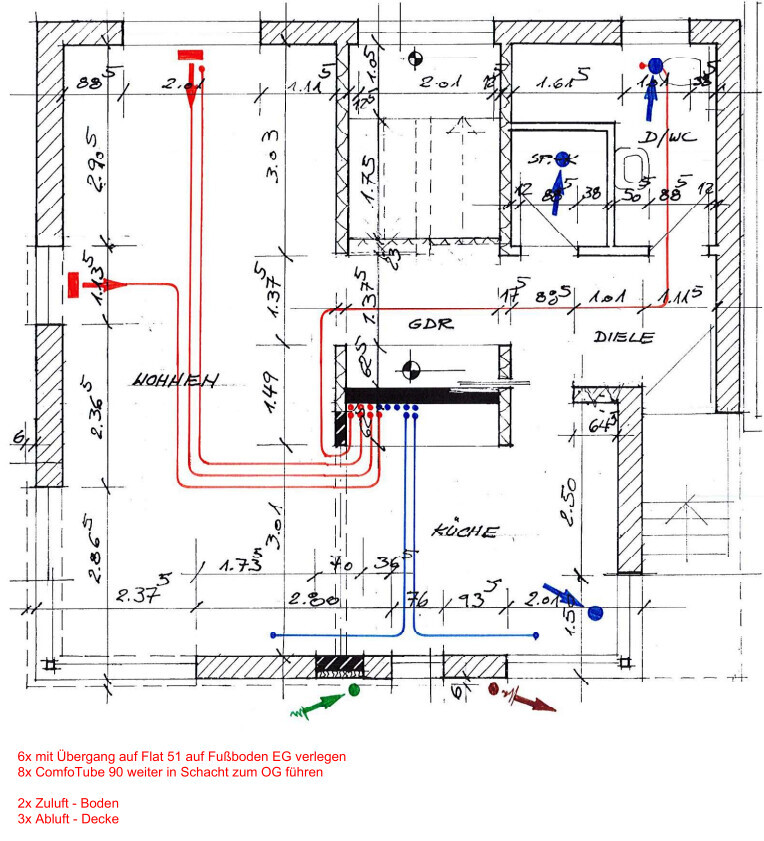
What also strikes me is the low number of supply air vents – or am I mistaken? For example, there are no vents in the hallway/wardrobe area. I would also have expected two vents per bedroom and children’s room (?).
It is important to us that no noises or drafts are noticeable, and that we do not regret a wrong decision afterwards that initially seemed like a cost-saving measure. We are not committed to a single manufacturer; Zehnder was chosen because I have only read good things so far.
Thanks for taking a look!
Best regards,
Jentopa
for our new construction project aiming for KfW55 standard, we are planning to install a central ventilation system with heat recovery (yes, we discussed this extensively and decided on it). I have now received the initial plan from Zehnder, see attachment.
Some points have not been recorded correctly, for example the ceiling height on the upper floor, as we are planning an "open ceiling" here. The calculation is based on a ceiling height of 2.50m (8.2 feet), which is clearly too low. The other height references are also inconsistent; once the finished floor level of the ground floor is used, another time the top edge of the floor slab in the basement. I have already pointed this out.
Aside from that, I often read that these systems tend to be somewhat oversized to allow for reserves and partial load operation. Zehnder suggested the Q350TR model to us.
What also strikes me is the low number of supply air vents – or am I mistaken? For example, there are no vents in the hallway/wardrobe area. I would also have expected two vents per bedroom and children’s room (?).
It is important to us that no noises or drafts are noticeable, and that we do not regret a wrong decision afterwards that initially seemed like a cost-saving measure. We are not committed to a single manufacturer; Zehnder was chosen because I have only read good things so far.
Thanks for taking a look!
Best regards,
Jentopa
Just had another discussion with Zehnder. Here’s a summary; it might be useful for others as well:
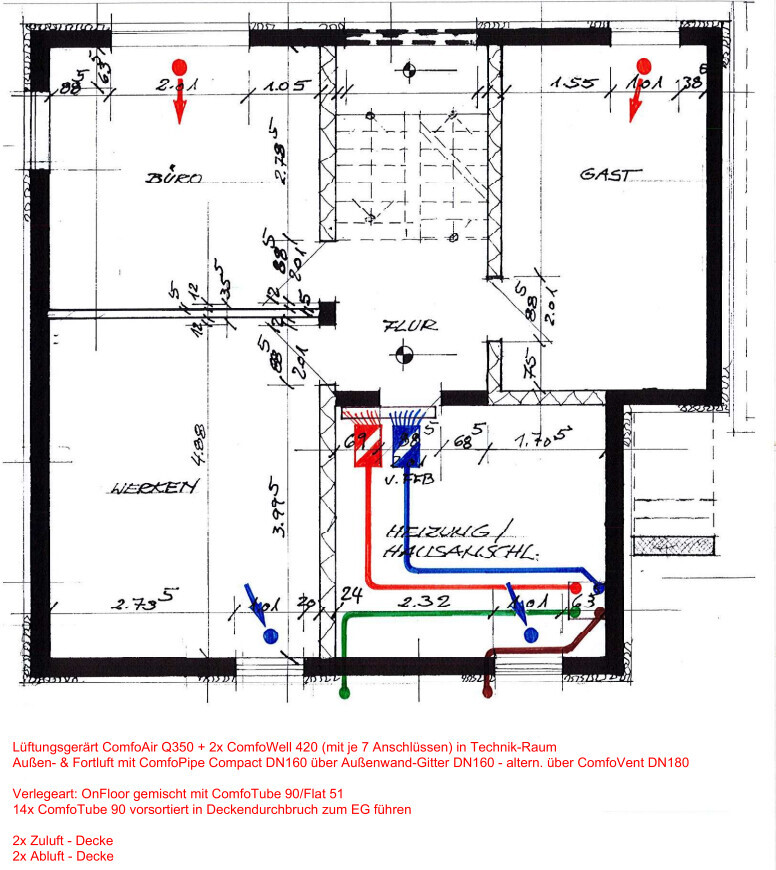
The next step is to consult the structural engineer again to get approval for the ceiling penetration (in the cloakroom). Possibly there will be two penetrations if the opening is too large.
- Pre-heating coil – “definitely” (direct quote). “You don’t want the system or heat exchanger to freeze when it gets very cold in winter...” We live in the Rhine-Main area.
- At a maximum of 40 m³/h (24 cfm) per valve and used silencer (one, otherwise pressure loss occurs), you should only notice airflow if you put your ear directly on the valve. Alternatively: two supply air valves in the bedroom and reduced volume (one connection still free on the unit).
- A larger unit costs approximately €1,000, would then operate with less load and have more capacity. However, this is not necessary.
- Calculations are based on an air exchange rate of 0.35 – this is sufficient for four people.
- Relocating outlets by 1.5–2 meters (5–6.5 feet) is no problem. Minimum and maximum duct lengths should still be considered.
- Sofa in front of a supply air valve: if there is 15–20 cm (6–8 inches) of clearance, it won’t affect the airflow.
- Outdoor openings for supply and exhaust air are placed on the south side: not ideal during summer, but not problematic. The distance between them should be at least 2 m (6.5 feet).
- Preferred setup is supply air at floor level and exhaust air at ceiling level. Reason: supply air can be preheated by the underfloor heating when it rises. Exhaust air is usually extracted from above, as with a cooker hood. However, there is no strict right or wrong here; both options are possible.
- Speaking of cooker hoods: recirculating models are better than exhaust types. But both are possible (e.g., requiring a special wall duct).
- Heating, ventilation, and sanitary trades are best handled by a single contractor.
The next step is to consult the structural engineer again to get approval for the ceiling penetration (in the cloakroom). Possibly there will be two penetrations if the opening is too large.
Hello Jentopa,
like you, I gave this a lot of thought. Here is my conclusion:
- Try to bend round ducts (75mm (3 inches)) into the concrete ceiling (consult a structural engineer, consider the build-up height, and also the height of the lattice girders in case of precast ceiling panels). Round ducts cost one-third as much as flat ducts and allow for cleaning balls to be vacuumed through (which is not possible with flat ducts).
Better to have one more duct to the outlet to reduce airflow velocity (and thus noise).
Note: I revised my design based on the nominal ventilation rate (as provided by every manufacturer) and deliberately oversized the ductwork (Excel sheet with some formulas). I plan to implement my system with a ventilation unit (so far only ducts have been installed in the cavity ceiling), so I cannot provide a final conclusion yet. You might want to read the following thread.
We planned an exhaust hood for the kitchen (providing a duct in the ground slab instead of making a wall penetration later).
For us, the airflow setup is:
Supply air on the ground floor comes from above
Exhaust air on the ground floor goes out from above
Supply air on the upper floor comes from below
Exhaust air on the upper floor exits through the wall
This is based on the ductwork installed in the cavity ceiling.
like you, I gave this a lot of thought. Here is my conclusion:
- Try to bend round ducts (75mm (3 inches)) into the concrete ceiling (consult a structural engineer, consider the build-up height, and also the height of the lattice girders in case of precast ceiling panels). Round ducts cost one-third as much as flat ducts and allow for cleaning balls to be vacuumed through (which is not possible with flat ducts).
Better to have one more duct to the outlet to reduce airflow velocity (and thus noise).
Note: I revised my design based on the nominal ventilation rate (as provided by every manufacturer) and deliberately oversized the ductwork (Excel sheet with some formulas). I plan to implement my system with a ventilation unit (so far only ducts have been installed in the cavity ceiling), so I cannot provide a final conclusion yet. You might want to read the following thread.
We planned an exhaust hood for the kitchen (providing a duct in the ground slab instead of making a wall penetration later).
For us, the airflow setup is:
Supply air on the ground floor comes from above
Exhaust air on the ground floor goes out from above
Supply air on the upper floor comes from below
Exhaust air on the upper floor exits through the wall
This is based on the ductwork installed in the cavity ceiling.
As you can see in the following image, we have planned significantly more ductwork for the 170sqm (1,830 sq ft) house.
Green – supply air
Blue – exhaust air (except for one green, because the duct is too small) 🙂
https://www.hausbau-forum.de/threads/kwl-wrg-luftbrunnen-dunstabzug-abluft-und-unabhaengiger-kamin.38086/post-545490
Green – supply air
Blue – exhaust air (except for one green, because the duct is too small) 🙂
https://www.hausbau-forum.de/threads/kwl-wrg-luftbrunnen-dunstabzug-abluft-und-unabhaengiger-kamin.38086/post-545490
Thank you @Stephan—
Unfortunately, the structural engineer dismissed the idea right when the slab was being poured and even threatened significant additional costs due to recalculations and materials. Among other things, the concrete slab would need to be at least 2 cm (about 0.8 inches) thicker, making a total of 22 cm (about 8.7 inches). I think he just doesn’t feel like dealing with it...
In my plan, I will include an additional valve (and piping) for the bedroom to make it quieter exactly there. Noise and drafts are my biggest concerns.
What still doesn’t make sense to me is why the (room) volume doesn’t seem to matter for designing the system. At least a minimum air exchange rate of 0.3 should be reached, and to calculate that, I need the volume, right? However, the volume wasn’t based on the floor plans or cross-sections but was assumed as 2.5 m (about 8.2 feet) room height on the upper floor. When I asked about this, I was told "that’s irrelevant" (?)
Which system did you end up choosing?
Unfortunately, the structural engineer dismissed the idea right when the slab was being poured and even threatened significant additional costs due to recalculations and materials. Among other things, the concrete slab would need to be at least 2 cm (about 0.8 inches) thicker, making a total of 22 cm (about 8.7 inches). I think he just doesn’t feel like dealing with it...
In my plan, I will include an additional valve (and piping) for the bedroom to make it quieter exactly there. Noise and drafts are my biggest concerns.
What still doesn’t make sense to me is why the (room) volume doesn’t seem to matter for designing the system. At least a minimum air exchange rate of 0.3 should be reached, and to calculate that, I need the volume, right? However, the volume wasn’t based on the floor plans or cross-sections but was assumed as 2.5 m (about 8.2 feet) room height on the upper floor. When I asked about this, I was told "that’s irrelevant" (?)
Which system did you end up choosing?
Intermediate ceiling – It might seem like laziness, but as a customer, you should demand solid facts. 2cm (0.8 inches) thickness over 100m² (1,076 ft²) equals 2m³ (70.6 ft³) of concrete, which could cost around 300€, possibly more if additional reinforcement steel is needed (he should be able to estimate that). Try mentioning the “dead zone,” the central area of the slab.
I would also assume that the height must be taken into account. Check other manufacturers’ websites, where you can often create your own calculation by entering the room dimensions (results should be somewhat comparable).
We are just starting the interior construction and have not installed a system yet, but I will probably choose Zehnder as well. (Remember to plan for a pipe for the floor drain trap in the slab during your planning.)
I would also assume that the height must be taken into account. Check other manufacturers’ websites, where you can often create your own calculation by entering the room dimensions (results should be somewhat comparable).
We are just starting the interior construction and have not installed a system yet, but I will probably choose Zehnder as well. (Remember to plan for a pipe for the floor drain trap in the slab during your planning.)

My general contractor initially wanted to make the intermediate floor thicker. That would have cost 3,000 more, but at the time it seemed cheaper to solve it with more insulation on the intermediate floor. The story height increase only cost 1,900.
I couldn't have known that insulation prices would explode nine months later...
In the end, doing the installation myself wasn't worth it...
I couldn't have known that insulation prices would explode nine months later...
In the end, doing the installation myself wasn't worth it...
Similar topics