
A friendly hello to all helpful forum members...
Unfortunately, I have a somewhat unusual problem (hence the somewhat lengthy text), for which I have not yet found a well-founded or confidently feasible solution. I would greatly appreciate advice from experienced builders or renovators!
Background: Old building from the 1960s, no basement, concrete slab foundation (with 30cm (12 inches) of construction debris underneath), exterior walls made of brick, building-standard horizontal damp-proof course starting from the first row of bricks, fully renovated and converted, slight slope (the north-facing room is just above ground level, the south side about 1.50m (5 feet) higher), occupied by us for 2 years, no other issues.
Problem: Earthy smell and moisture since summer 2018 in the north-facing room (with mold on furniture and clothing, NOT on the walls) and bathroom, especially noticeable when opening the door thresholds.
Cause: Incorrect sealing compound recommended by a professional friend (PCI Lastogum; intended for splash water in shower areas, not for ground moisture penetration), used throughout the ground floor ("I've always done it this way; it has always worked").
Result: Compound detached and softened into a rubbery texture on the wall below the horizontal damp-proof course; floor structure (Fermacell dry screed; also poorly advised, as we now know, since it is partly organic) damp and bacterial contaminated.
However:
Lastogum on the slab remains tight/hard and well bonded to the concrete.
Problems occur only in the north-facing room and bathroom.
Plan: Remove the floor in the north-facing room and bathroom; apply proper waterproofing extending above the horizontal damp-proof course and rebuild the floor using inorganic materials; leave the rest of the ground floor floor intact as long as no manifest problems arise.
Current information: Several experts contradict each other in almost every aspect (procedure, affected rooms, materials, floor construction, exact cause, internal or external waterproofing, health risks...). At present, air quality is good again and moisture levels are low (due to winter season/correct ventilation as usual/dehumidifier).
Now my questions, hoping for your help:
- Can the intact Lastogum on the slab remain and the new waterproofing be installed on top, or if not, why must it be milled off?
- What is the best way to connect the waterproofing at the wall junction?
- Waterproof slurry or bitumen membrane?
- Where should a vapor barrier or vapor retarder be installed, and where not?
- Water-repellent dry screed or is flowing screed required?
Furthermore, I received a rather alarming statement from one of the professionals:
"There will always be water accumulating under the insulation layer, rotting there like a swimming pool" (due to condensation moisture/low dew point at the very cold floor—this topic is now very familiar to us). However, "this doesn’t matter; you wouldn’t notice anything."
...If it's just about not noticing it, then you could seal everything airtight and let it continue rotting underneath. That can’t be right, can it?
...If the insulation layer is well bonded, then water cannot accumulate there, but rather somewhere else in the floor construction, where it can evaporate again, right?
Looking forward to your advice; thank you very much!
Pajero
PS: We understand that not questioning the suitability of the sealing compound was a mistake, but at that time we had no reason to doubt the recommendation of the professional who otherwise provided excellent advice for the rest of the house.
PS: External waterproofing is planned in the medium term, but cannot be carried out before 2025 for several reasons. There are no subjective impairments on the walls or in other rooms; living comfort is good and the building structure is (still) not affected.
Unfortunately, I have a somewhat unusual problem (hence the somewhat lengthy text), for which I have not yet found a well-founded or confidently feasible solution. I would greatly appreciate advice from experienced builders or renovators!
Background: Old building from the 1960s, no basement, concrete slab foundation (with 30cm (12 inches) of construction debris underneath), exterior walls made of brick, building-standard horizontal damp-proof course starting from the first row of bricks, fully renovated and converted, slight slope (the north-facing room is just above ground level, the south side about 1.50m (5 feet) higher), occupied by us for 2 years, no other issues.
Problem: Earthy smell and moisture since summer 2018 in the north-facing room (with mold on furniture and clothing, NOT on the walls) and bathroom, especially noticeable when opening the door thresholds.
Cause: Incorrect sealing compound recommended by a professional friend (PCI Lastogum; intended for splash water in shower areas, not for ground moisture penetration), used throughout the ground floor ("I've always done it this way; it has always worked").
Result: Compound detached and softened into a rubbery texture on the wall below the horizontal damp-proof course; floor structure (Fermacell dry screed; also poorly advised, as we now know, since it is partly organic) damp and bacterial contaminated.
However:
Lastogum on the slab remains tight/hard and well bonded to the concrete.
Problems occur only in the north-facing room and bathroom.
Plan: Remove the floor in the north-facing room and bathroom; apply proper waterproofing extending above the horizontal damp-proof course and rebuild the floor using inorganic materials; leave the rest of the ground floor floor intact as long as no manifest problems arise.
Current information: Several experts contradict each other in almost every aspect (procedure, affected rooms, materials, floor construction, exact cause, internal or external waterproofing, health risks...). At present, air quality is good again and moisture levels are low (due to winter season/correct ventilation as usual/dehumidifier).
Now my questions, hoping for your help:
- Can the intact Lastogum on the slab remain and the new waterproofing be installed on top, or if not, why must it be milled off?
- What is the best way to connect the waterproofing at the wall junction?
- Waterproof slurry or bitumen membrane?
- Where should a vapor barrier or vapor retarder be installed, and where not?
- Water-repellent dry screed or is flowing screed required?
Furthermore, I received a rather alarming statement from one of the professionals:
"There will always be water accumulating under the insulation layer, rotting there like a swimming pool" (due to condensation moisture/low dew point at the very cold floor—this topic is now very familiar to us). However, "this doesn’t matter; you wouldn’t notice anything."
...If it's just about not noticing it, then you could seal everything airtight and let it continue rotting underneath. That can’t be right, can it?
...If the insulation layer is well bonded, then water cannot accumulate there, but rather somewhere else in the floor construction, where it can evaporate again, right?
Looking forward to your advice; thank you very much!
Pajero
PS: We understand that not questioning the suitability of the sealing compound was a mistake, but at that time we had no reason to doubt the recommendation of the professional who otherwise provided excellent advice for the rest of the house.
PS: External waterproofing is planned in the medium term, but cannot be carried out before 2025 for several reasons. There are no subjective impairments on the walls or in other rooms; living comfort is good and the building structure is (still) not affected.
I can’t quite visualize the exact construction setup, but I believe that without exterior waterproofing, any interior measures are pointless. Damp walls will eventually crumble. You also cannot apply a proper waterproofing layer on saturated masonry. I don’t necessarily see the wrong sealing compound as the main issue, since it didn’t cause the fundamental problem (moisture coming from outside). You can only fully address the interior once the exterior problem has been resolved. If that can’t be done for another five years (?), then the interior work will have to wait until then. Otherwise, you’ll just end up having to open it up again. In the meantime, I would remove the Lastogum and leave the area exposed so that the moisture can dry out.
M
Mottenhausen30 Dec 2018 16:38Would the ceiling height allow for installing floor insulation to 1. solve the condensation issue and 2. raise the new floor closer to the level of the old moisture barrier between the 1st and 2nd brick course? … and thus simplify the connection issue. Otherwise, as Elina suggests: excavate and renovate, and check whether the old horizontal barrier is still intact.
Hello and many thanks for your advice!
The house dates back to 1962, and the exterior walls have never been waterproofed. There were no problems before because the floor construction consisted of inorganic screed on bitumen felt; therefore, the bottom row of bricks has been damp for 57 years, but according to the expert report, the structural fabric is still in excellent condition since water could not diffuse inward, preventing salts from being leached out of the masonry. Also, there was no mold previously in this room (and for us, only on furniture/rugs etc., but fortunately not yet on any building components – here the issue is moisture and odor caused by resulting microbial growth).
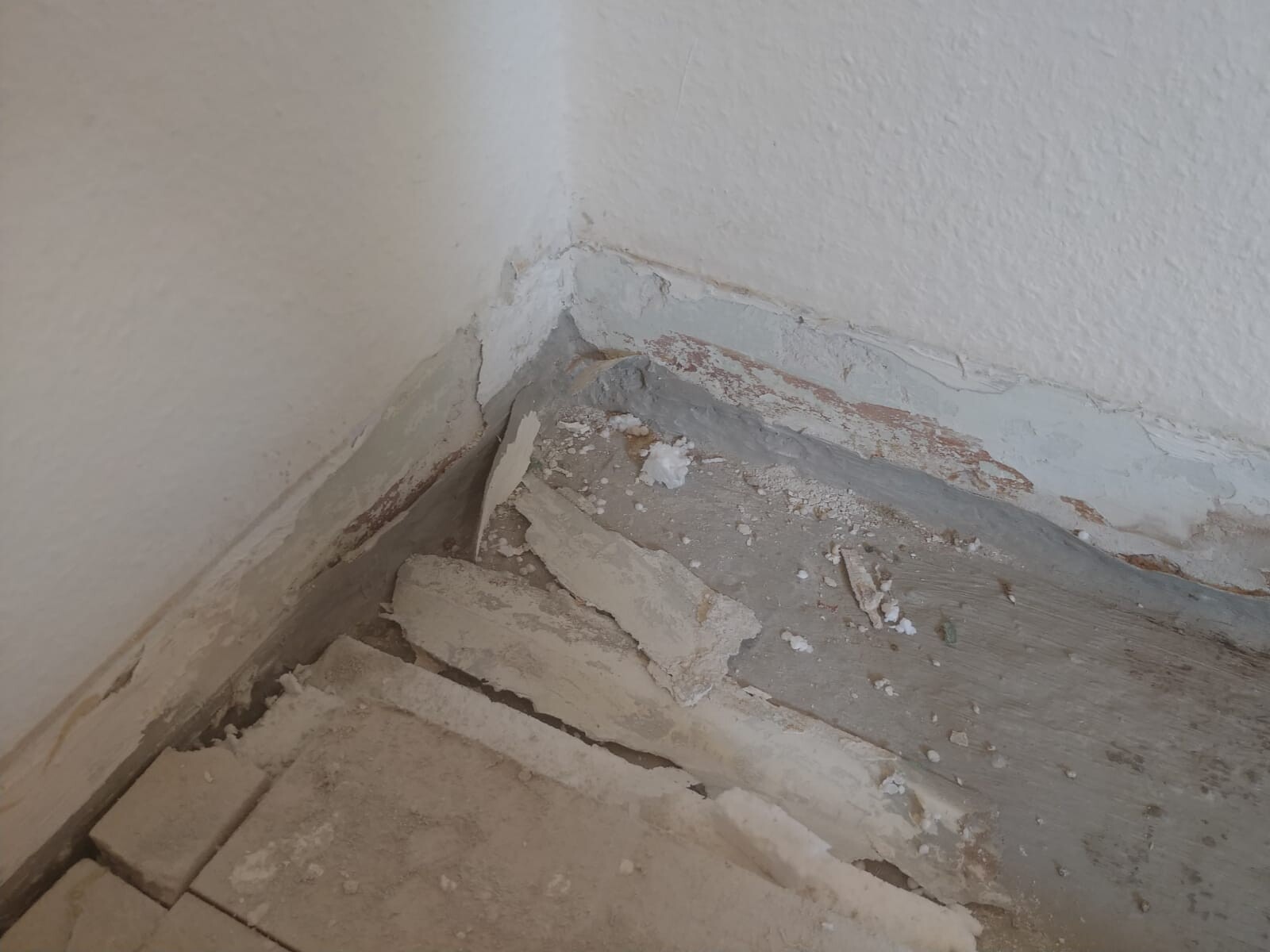
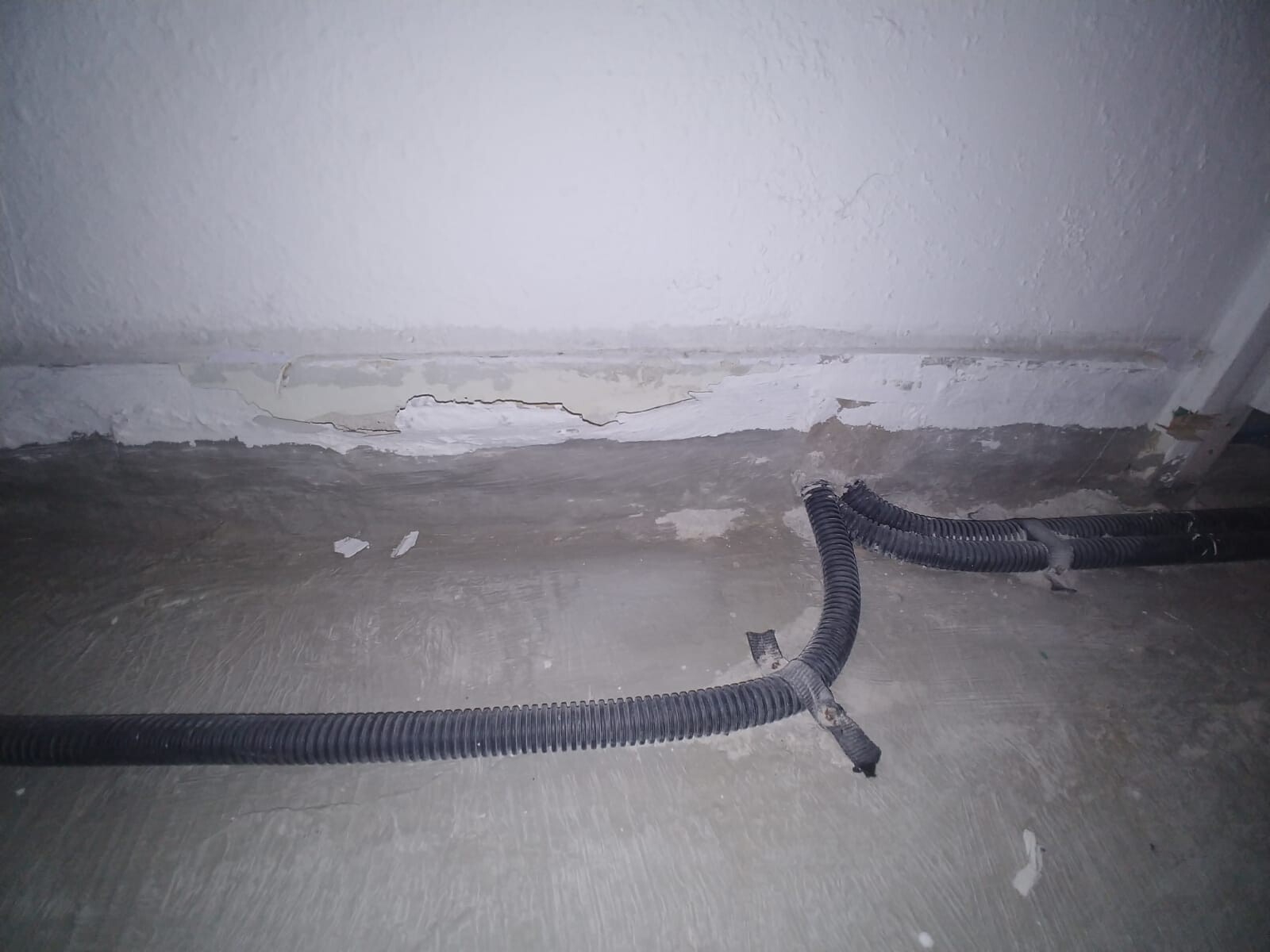
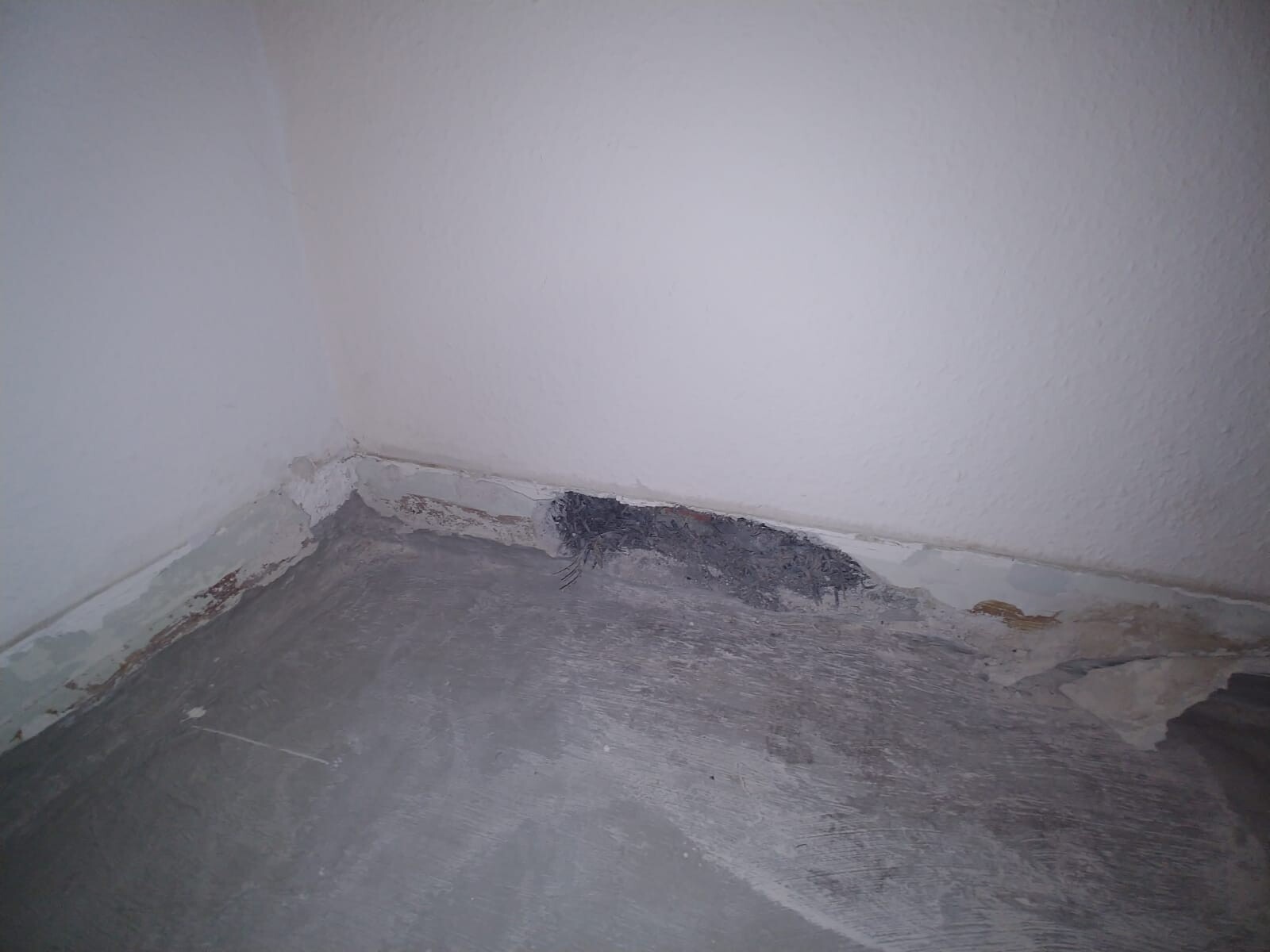
Unfortunately, we now have a partly organic floor construction with Fermacell dry screed, which could absorb moisture and did so within the framework. This led to the apparent problem with mold on furniture and water diffusing into the floor construction (see photos 1, 2, and 3: detached Lastogum and crumbling plaster behind it).
Regarding the floor height: The expanded polystyrene insulation, dry screed, and parquet together were already higher than the old construction (carpet on screed on bitumen felt), so we had to shorten the doors.
About “leaving it open”: This does not refer to one spot but to the entire floor slab and the lowest brick course. The floor slab has been sealed with bitumen felt since 1962; although it was no longer intact recently, the slab has never been able to dry out because the house has no basement.
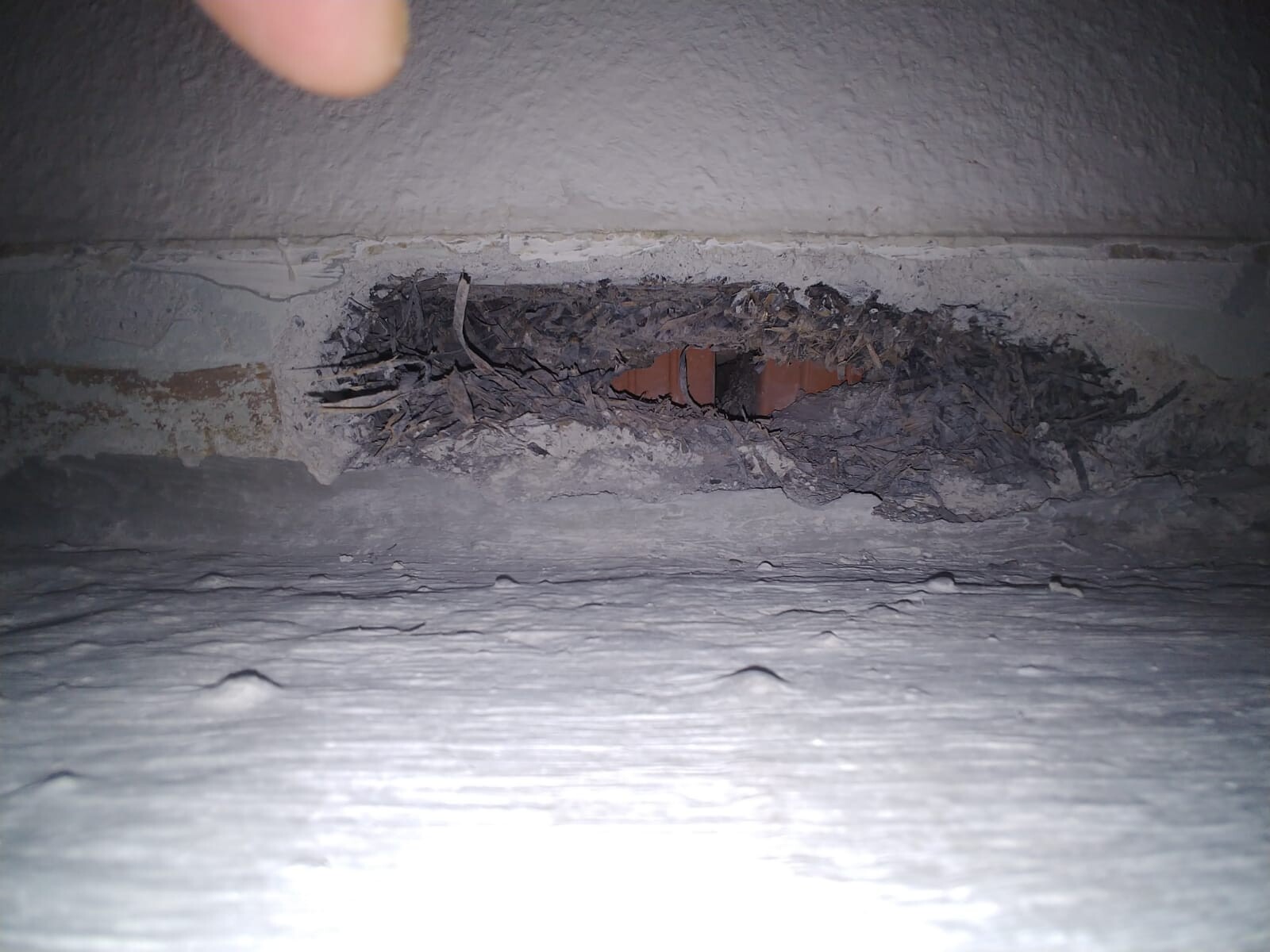
Today we have largely removed the floor construction and will soon remove the wall covering of the lowest brick course (plaster on Heraklith) in front of the exterior brick wall as well (see photo 3 showing the first breakthrough through the wall layers). This area can then dry out; the bricks look like new (see photo 4) – so obviously no damage has occurred from the moisture.
An exterior waterproofing, unfortunately, is not an option for the foreseeable future – which is why we are less worried, as the situation has apparently left no traces on the building fabric for 57 years.
Regarding the damp-proof course: It is clearly intact throughout (measured with a Gann moisture meter above and below the first brick course: 25 to 30 digits above, 60 or more below).
Maybe you can advise us whether removing the Heraklith by chipping could damage the damp-proof course? It should only be within the brick wall, so presumably no risk?
Since the Lastogum on the floor slab appears intact: what do you think about a new floor construction with a self-adhesive cold-applied vapor and radon barrier ON top of the Lastogum (since it does not adhere well to concrete anyway), followed by vacuum insulation, inorganic screed, and the existing parquet on top?
(Possibly a bitumen coating with insulation and screed on top would be better, since that seemed to work well for a very long time before?)
As for the inner base waterproofing, we are still uncertain... on the exposed bricks, applying sealing slurry and a vapor barrier membrane extended up from the floor? We are not sure whether a coving fillet is needed or if a renovation plaster would be required, and how to proceed after installing the extended vapor barrier.
In any case, many thanks for your interest and patience – we really appreciate your advice!
Best regards,
Pajero
The house dates back to 1962, and the exterior walls have never been waterproofed. There were no problems before because the floor construction consisted of inorganic screed on bitumen felt; therefore, the bottom row of bricks has been damp for 57 years, but according to the expert report, the structural fabric is still in excellent condition since water could not diffuse inward, preventing salts from being leached out of the masonry. Also, there was no mold previously in this room (and for us, only on furniture/rugs etc., but fortunately not yet on any building components – here the issue is moisture and odor caused by resulting microbial growth).
Unfortunately, we now have a partly organic floor construction with Fermacell dry screed, which could absorb moisture and did so within the framework. This led to the apparent problem with mold on furniture and water diffusing into the floor construction (see photos 1, 2, and 3: detached Lastogum and crumbling plaster behind it).
Regarding the floor height: The expanded polystyrene insulation, dry screed, and parquet together were already higher than the old construction (carpet on screed on bitumen felt), so we had to shorten the doors.
About “leaving it open”: This does not refer to one spot but to the entire floor slab and the lowest brick course. The floor slab has been sealed with bitumen felt since 1962; although it was no longer intact recently, the slab has never been able to dry out because the house has no basement.
Today we have largely removed the floor construction and will soon remove the wall covering of the lowest brick course (plaster on Heraklith) in front of the exterior brick wall as well (see photo 3 showing the first breakthrough through the wall layers). This area can then dry out; the bricks look like new (see photo 4) – so obviously no damage has occurred from the moisture.
An exterior waterproofing, unfortunately, is not an option for the foreseeable future – which is why we are less worried, as the situation has apparently left no traces on the building fabric for 57 years.
Regarding the damp-proof course: It is clearly intact throughout (measured with a Gann moisture meter above and below the first brick course: 25 to 30 digits above, 60 or more below).
Maybe you can advise us whether removing the Heraklith by chipping could damage the damp-proof course? It should only be within the brick wall, so presumably no risk?
Since the Lastogum on the floor slab appears intact: what do you think about a new floor construction with a self-adhesive cold-applied vapor and radon barrier ON top of the Lastogum (since it does not adhere well to concrete anyway), followed by vacuum insulation, inorganic screed, and the existing parquet on top?
(Possibly a bitumen coating with insulation and screed on top would be better, since that seemed to work well for a very long time before?)
As for the inner base waterproofing, we are still uncertain... on the exposed bricks, applying sealing slurry and a vapor barrier membrane extended up from the floor? We are not sure whether a coving fillet is needed or if a renovation plaster would be required, and how to proceed after installing the extended vapor barrier.
In any case, many thanks for your interest and patience – we really appreciate your advice!
Best regards,
Pajero
Similar topics