
Hello,
I am receiving conflicting advice from various people regarding my problem. Therefore, I am trying here. Perhaps someone has experienced something similar and knows the best way to solve this issue.
I have a steel beam located exactly within the insulation layer (200mm height [8 inches]). The attic above is uninsulated. The house was built in 1983 using Poroton bricks (outer wall 360mm [14 inches]). The joists of the collar beam ceiling are attached to the steel beam with angle irons. None of the wood has rotted yet, but there is probably some moisture ingress. When the building was constructed, the insulation (glass wool) was installed up to the beam. Naturally, this caused condensation. The insulation at the end face is about 10cm (4 inches) blackened, and the steel beam has surface rust. This issue is of course worsened by the fact that the adjoining rooms are the kitchen and bathroom.
Two options have been suggested to me:
a) Leave it open above (remove the floorboards) to allow for drying.
This option already exists and led to the mentioned condensation, which is likely also promoted by secondary diffusion.
b) Cover it with wood fiber boards and spray with foam insulation. Reasoning: no air = no circulation and thus no condensation.
Is it really advisable to use highly "absorbent" wood fiber boards, and is the above theory about condensation correct? Should the steel beam within the insulation layer be ideally “sealed off” and “wrapped,” or is it better to ventilate behind it?
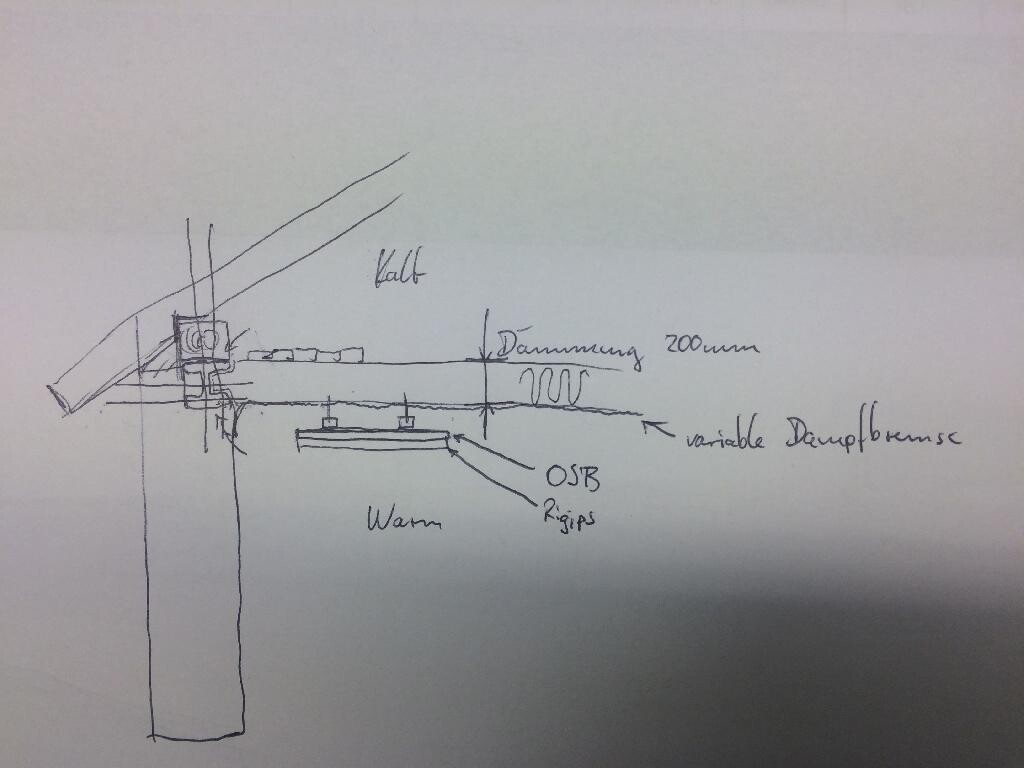
This is how the roof structure should look (the lower battens are, of course, installed perpendicular):
Thank you very much for your support.
Best regards
I am receiving conflicting advice from various people regarding my problem. Therefore, I am trying here. Perhaps someone has experienced something similar and knows the best way to solve this issue.
I have a steel beam located exactly within the insulation layer (200mm height [8 inches]). The attic above is uninsulated. The house was built in 1983 using Poroton bricks (outer wall 360mm [14 inches]). The joists of the collar beam ceiling are attached to the steel beam with angle irons. None of the wood has rotted yet, but there is probably some moisture ingress. When the building was constructed, the insulation (glass wool) was installed up to the beam. Naturally, this caused condensation. The insulation at the end face is about 10cm (4 inches) blackened, and the steel beam has surface rust. This issue is of course worsened by the fact that the adjoining rooms are the kitchen and bathroom.
Two options have been suggested to me:
a) Leave it open above (remove the floorboards) to allow for drying.
This option already exists and led to the mentioned condensation, which is likely also promoted by secondary diffusion.
b) Cover it with wood fiber boards and spray with foam insulation. Reasoning: no air = no circulation and thus no condensation.
Is it really advisable to use highly "absorbent" wood fiber boards, and is the above theory about condensation correct? Should the steel beam within the insulation layer be ideally “sealed off” and “wrapped,” or is it better to ventilate behind it?
This is how the roof structure should look (the lower battens are, of course, installed perpendicular):
Thank you very much for your support.
Best regards

The detail is clearly not ideally resolved: the steel profile here also seems to take on the role of the ring beam, which is normally cast on top of the masonry as the uppermost finish. The ring beam absorbs the shear forces from the roof and holds the exterior walls together. I hope the steel profile, in conjunction with the ceiling joist layer, functions as a rigid diaphragm to handle this purpose, with the ceiling joists being stressed in tension. The attachment of the ceiling joists to the profile must be capable of withstanding tensile forces (angle iron?). More interesting, however, is the question of how the steel profile is structurally fixed to the Poroton masonry. I hope no movement or cracking has occurred so far. Fundamentally, this detail should be examined by a structural engineer.
It is correct that there is a significant thermal bridge here. Convection of warm, moist indoor air into the structure must definitely be prevented. Choosing a vapor-retarder with variable permeability is appropriate. However, it must be carefully installed (sealed joints) and above all carefully adhered to the masonry (using cartridge adhesive) and finally plastered over. Only then is airtightness achieved. The materials specified by the vapor barrier manufacturer should be used as a system; no mixing of materials or custom compositions.
The thermal bridge itself remains; fundamentally, mold growth can occur on the room side. This can only be avoided by interior insulation (insulation wedge), for example with a calcium silicate board that raises the surface temperature of the wall above the dew point, preventing condensation. OSB board and spray foam are unnecessary.
The insulated ceiling joist layer must not be sealed airtight on the upper side with vapor-tight coverings, as condensation will otherwise form on the underside of the cold surface. Either the insulation package in the ceiling is closed at the top with a wind-tight but vapor-permeable wood fiber board (not walkable, or walkable starting at a minimum thickness of 35mm (1.4 inches), depending on joist spacing), or additionally made walkable with a raised, ventilated boarding above the wood fiber board (or alternatively: a wind-tight, vapor-permeable membrane with an sd-value less than 0.5). Similar to a ventilated facade, but horizontally.
On the interior room side of the ceiling, below the membrane, a maximum of 20% of the insulation should generally be located above the membrane here: 40mm (1.6 inches).
It is correct that there is a significant thermal bridge here. Convection of warm, moist indoor air into the structure must definitely be prevented. Choosing a vapor-retarder with variable permeability is appropriate. However, it must be carefully installed (sealed joints) and above all carefully adhered to the masonry (using cartridge adhesive) and finally plastered over. Only then is airtightness achieved. The materials specified by the vapor barrier manufacturer should be used as a system; no mixing of materials or custom compositions.
The thermal bridge itself remains; fundamentally, mold growth can occur on the room side. This can only be avoided by interior insulation (insulation wedge), for example with a calcium silicate board that raises the surface temperature of the wall above the dew point, preventing condensation. OSB board and spray foam are unnecessary.
The insulated ceiling joist layer must not be sealed airtight on the upper side with vapor-tight coverings, as condensation will otherwise form on the underside of the cold surface. Either the insulation package in the ceiling is closed at the top with a wind-tight but vapor-permeable wood fiber board (not walkable, or walkable starting at a minimum thickness of 35mm (1.4 inches), depending on joist spacing), or additionally made walkable with a raised, ventilated boarding above the wood fiber board (or alternatively: a wind-tight, vapor-permeable membrane with an sd-value less than 0.5). Similar to a ventilated facade, but horizontally.
On the interior room side of the ceiling, below the membrane, a maximum of 20% of the insulation should generally be located above the membrane here: 40mm (1.6 inches).
The detail is obviously not optimally resolved: The steel profile also appears to serve as a ring beam here, which is normally cast in concrete as the top finishing element on the masonry, absorbing shear forces from the roof and "tying" the exterior walls together. I hope the steel profile, together with the ceiling joist layer, acts as a rigid diaphragm and that the ceiling joists are loaded in tension to fulfill this role. The attachment of the ceiling joists to the profile must be tension-resistant (angle iron?). More interesting, however, is the question of how the steel profile is securely fixed to the Poroton masonry in terms of structural analysis. I hope there have been no movements causing cracks so far. Essentially, this detail should be examined by a structural engineer.A continuous ring beam is cast on top of the masonry. Only on the north side was a steel I-beam installed and connected to the ring beam. Since I do not see any cracks in the walls, it seems to be working. In my opinion, the angle irons are not the right solution either. They are welded onto the beam, and the welds look very good. My structural engineer has expressed no concerns about this.
It is true that there is a significant thermal bridge here. Convection of warm, moist indoor air into the construction must definitely be prevented. Choosing a moisture-variable vapor retarder is correct. However, it must be carefully installed (sealed joints) and, above all, carefully adhered to the masonry (with cartridge adhesive) and finally plastered. Only then is airtightness achieved. The materials supplied by the membrane manufacturer must be used as a system, with no mixing of different materials or custom compositions.I would exclusively use system components to ensure optimal compatibility. What about the OSB layer? It is installed beneath the variable vapor retarder. Could this cause issues with inward vapor regulation? The joints are not supposed to be sealed since the OSB is only meant as a support layer. Or does this lead to building physics problems?
W. Pickartz schrieb:
The thermal bridge persists; fundamentally, mold can develop on the room side here. This can only be avoided by installing internal insulation (insulation wedge), for example with a calcium silicate board, which raises the wall surface temperature above the dew point and prevents condensation. OSB boards and spray foam are unnecessary.Interesting option. Where exactly does the insulation wedge begin with the thick side (25mm (1 inch)?)? I assume it is adhered directly under the vapor retarder and tapers down to the interior plaster. Is a width of 500mm (20 inches) sufficient, or does it need to extend significantly deeper?
W. Pickartz schrieb:
The insulated ceiling joist layer must not be tightly enclosed on top by vapor barrier-type coverings, as this would cause condensation on the underside of the cold covering. Either the insulation package in the ceiling is closed at the top with a windproof, vapor-open wood fiberboard (non-walkable or walkable from a minimum thickness of 35mm (1.4 inches), depending on joist spacing), or additionally walkable with raised, ventilated battens over the wood fiberboard (or alternatively windproof, vapor-open membrane with sd-value < 0.5). Similar to a ventilated facade, but horizontal.Tongue-and-groove boards are already installed on top (butted at the ends) and therefore presumably not vapor-retarding? In the edge area near the steel beam, I would lay wood fiberboards in the still-open space today to prevent mice from entering the system. This area does not need to be walkable.
W. Pickartz schrieb:
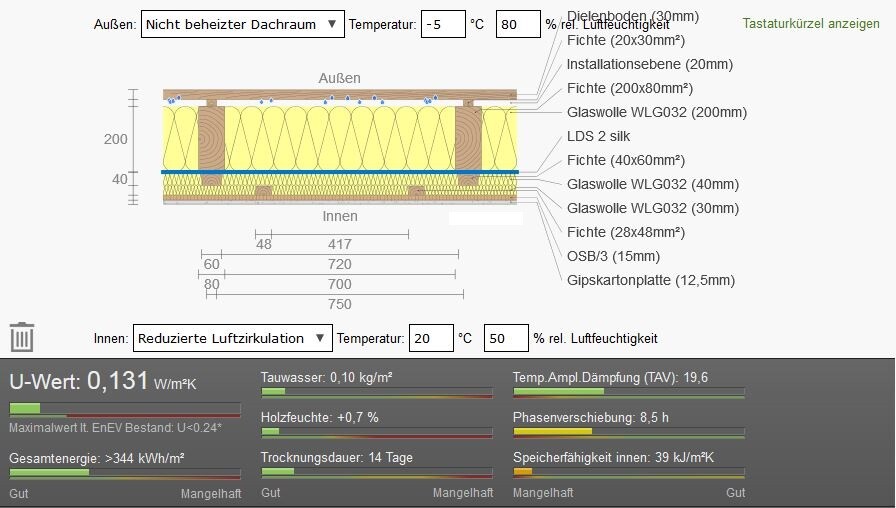
On the interior side of the ceiling, below the membrane, no more than 20% of the insulation should be located above the membrane here: 40mm (1.6 inches)Thank you. I have removed the lower layer. Does the ceiling build-up seem appropriate to you now? Recessed ceiling lights are planned, so I intended to use cross battens (which are shown rotated incorrectly by 90° in the picture) as the installation layer, or is that unnecessary when using installation frames (80mm (3 inches) deep)? Then I could use the 40/60 battens directly as cross battens, save some ceiling height, and avoid creating an air gap. Just a thought...
One more follow-up question. Would you slide the insulation wool back into the joist, or attach a calcium silicate board in front of the joist and then position the insulation wool against it? I want to avoid the insulation wool getting wet at the end grain and losing its effectiveness.
The OSB board is unnecessary. The insulation between the joists must be properly finished from a building physics perspective with a vapor-permeable but windproof underlay membrane/roofing underlay with a maximum sd-value of 0.03, sealed airtight at the top to prevent airflow. When installing recessed ceiling lights, you need to consider heat generation—typically, a minimum distance of up to 100mm (4 inches) from combustible materials is required, and heat build-up should be avoided—or use LED downlights if necessary. I am not familiar with the current installation guidelines.
For the steel beam, I would fill or cover it with precisely cut XPS foam and an appropriate solvent-free construction adhesive without voids, and butt the ceiling insulation against it. XPS absorbs very little moisture.
For the steel beam, I would fill or cover it with precisely cut XPS foam and an appropriate solvent-free construction adhesive without voids, and butt the ceiling insulation against it. XPS absorbs very little moisture.
So, is the goal to isolate the beam from the air? Are today’s materials physically capable of reliably maintaining this over time in terms of vibration and thermal expansion behavior?
Would it also be an option to build an approximately 10cm (4 inches) thick box around the steel beam, run the vapor retarder underneath it and connect it to the wall? Inside the box, use EPS insulation board to keep the dew point away from the glass wool? Then let the box extend upward into the roof and cover it above with a vapor-permeable wood fiberboard (to protect against pests).
Would it also be an option to build an approximately 10cm (4 inches) thick box around the steel beam, run the vapor retarder underneath it and connect it to the wall? Inside the box, use EPS insulation board to keep the dew point away from the glass wool? Then let the box extend upward into the roof and cover it above with a vapor-permeable wood fiberboard (to protect against pests).
Similar topics