
ᐅ Integrating Fresh Air Supply for Bora Exhaust System into Kitchen Island
Created on: 18 Feb 2025 14:00
S
Schul8er
Hello everyone,
we are currently planning our new build and are now considering the supply and exhaust air system for our Bora system. It’s not yet 100% decided that it will be the Bora system. The InductionAir Plus system from Siemens is also said to be very good – especially attractive in terms of price.
The concept will be the same:
An open-plan kitchen with an island that has an integrated exhaust system for the cooktop. In the living room area, there is a wood-burning stove – possibly with its own fresh air supply. In winter, the exhaust system naturally has the disadvantage that warm indoor air is extracted and cold outside air enters when windows are open.
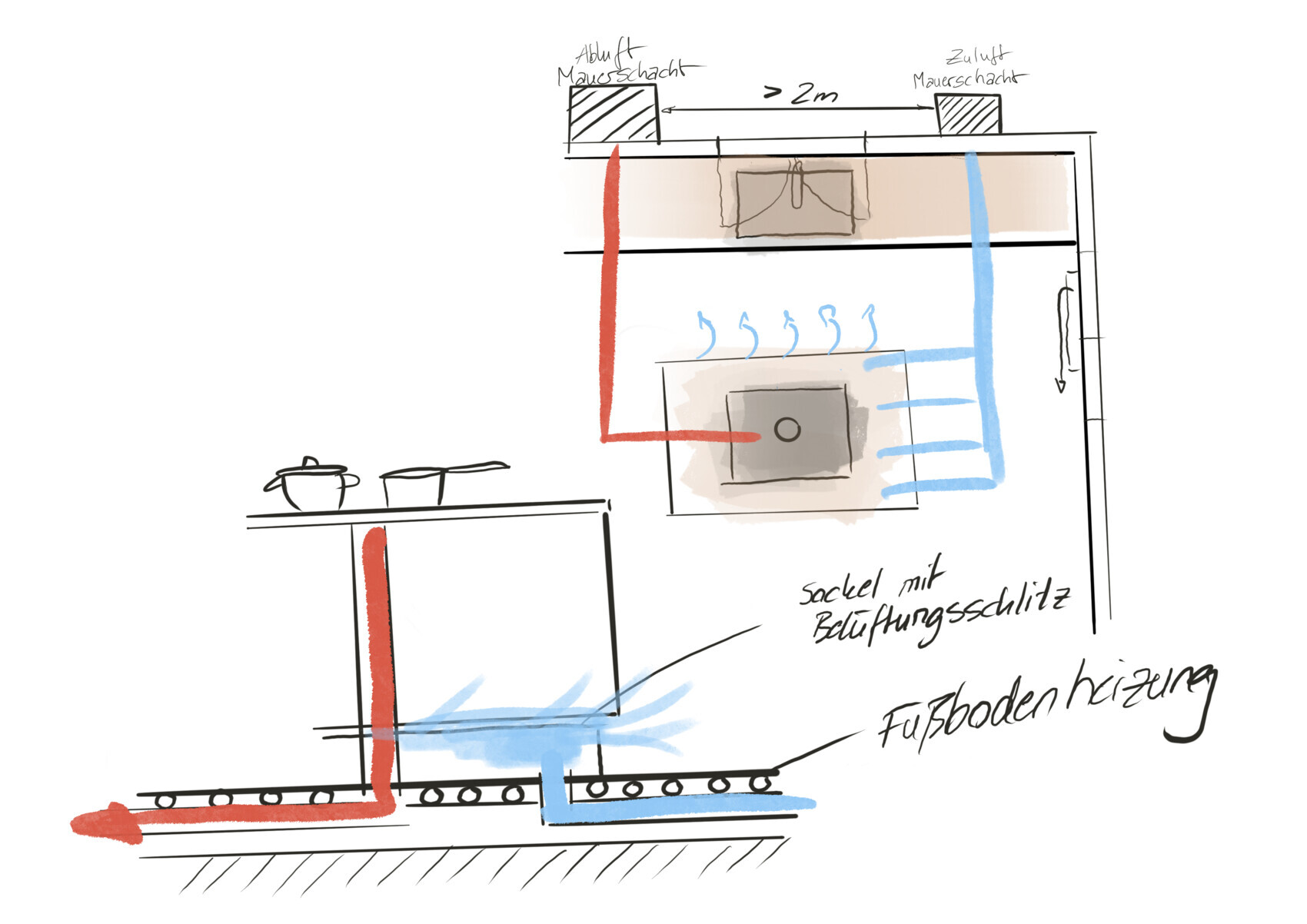
I’ve read that it can be useful to channel the supply air for the exhaust system into the plinth area of the kitchen cabinets. The surrounding air can be slightly preheated by the underfloor heating, and the cold air is already at floor level. In the worst case, you just have cold feet. I have sketched the concept once. I would lead the supply air into the plinth of the island and create a gap to the cabinet carcass so that fresh air can flow into the room at this point. Supply and exhaust air vents are spatially separated on the exterior wall and situated at floor level (possibly through a wall box or light well) to avoid condensation forming on rising ducts. Check valves would probably need to be installed.
Does anyone have experience with this kind of solution? What distance should supply and exhaust vents have, both in the kitchen and on the exterior wall? What else should be considered? Does the exhaust system still need a “fresh air contact” or pressure sensor if there is a wood stove with its own fresh air supply?
I appreciate all experiences and advice.
Regards
we are currently planning our new build and are now considering the supply and exhaust air system for our Bora system. It’s not yet 100% decided that it will be the Bora system. The InductionAir Plus system from Siemens is also said to be very good – especially attractive in terms of price.
The concept will be the same:
An open-plan kitchen with an island that has an integrated exhaust system for the cooktop. In the living room area, there is a wood-burning stove – possibly with its own fresh air supply. In winter, the exhaust system naturally has the disadvantage that warm indoor air is extracted and cold outside air enters when windows are open.
I’ve read that it can be useful to channel the supply air for the exhaust system into the plinth area of the kitchen cabinets. The surrounding air can be slightly preheated by the underfloor heating, and the cold air is already at floor level. In the worst case, you just have cold feet. I have sketched the concept once. I would lead the supply air into the plinth of the island and create a gap to the cabinet carcass so that fresh air can flow into the room at this point. Supply and exhaust air vents are spatially separated on the exterior wall and situated at floor level (possibly through a wall box or light well) to avoid condensation forming on rising ducts. Check valves would probably need to be installed.
Does anyone have experience with this kind of solution? What distance should supply and exhaust vents have, both in the kitchen and on the exterior wall? What else should be considered? Does the exhaust system still need a “fresh air contact” or pressure sensor if there is a wood stove with its own fresh air supply?
I appreciate all experiences and advice.
Regards
J
Jesse Custer19 Feb 2025 07:22kbt09 schrieb:
@Jesse Custer .. so you are a supply air user. You then ventilate moisture through the window after cooking, while cooking, or more slowly through the controlled mechanical ventilation system. In contrast, there are exhaust air users who want to get rid of humid air immediately to the outside.Apart from the fact that, with the currently very dry air, we are grateful for any increase in humidity however small: we also have an open-plan floor — we have never needed to ventilate because of cooking. Okay, I did once slightly overcook a schnitzel in December, but that doesn’t really count.
I still consider such complex solutions to be completely excessive.
Jesse Custer schrieb:
I still consider such a complex solution completely exaggerated. The solution isn’t that complicated if it’s planned during the construction phase. You also save on carbon filters in the future, which are only needed with recirculated air.
@Schul8er ... one thing to be clear about is that odors don’t only occur while cooking but also spread when the food is served, and so on.
Regarding the distribution of fresh air, if your duct runs in the floor up to the island, the air won’t get warmer either.
One supply air point is enough, where air can then be distributed to the right and left with a Y-connector, for example. Or it can be placed at one end of the window row, with a right angle so the air flows under the kitchen cabinets. Your kitchen consultant should be able to advise you on this as well.
For the shadow gap with the baseboard ... if necessary, simply make the baseboard half a centimeter (0.2 inches) shorter. Alternatively, you could use ventilation grilles, for example opposite the island where they’re not visible from a distance. Again, I recommend asking your kitchen studio or searching for more answers online.
Is a mechanical ventilation system with heat recovery also planned?
Then your chimney inspector will tell you what else you need.
We have a fireplace ourselves (not yet in use, possibly never), an exhaust hood (vented through the basement floor slab with an external backdraft damper), and a mechanical ventilation system with heat recovery.
According to the chimney inspector, with this combination of three systems (fireplace/mechanical ventilation/exhaust hood), a differential pressure sensor is required.
Then your chimney inspector will tell you what else you need.
We have a fireplace ourselves (not yet in use, possibly never), an exhaust hood (vented through the basement floor slab with an external backdraft damper), and a mechanical ventilation system with heat recovery.
According to the chimney inspector, with this combination of three systems (fireplace/mechanical ventilation/exhaust hood), a differential pressure sensor is required.
Similar topics