
ᐅ Insulation of the Top Floor Ceiling in a Cold Roof Construction
Created on: 30 Oct 2018 22:17
S
Sebastian B.S
Sebastian B.30 Oct 2018 22:17Dear members,
I plan to insulate the upper floor ceiling (22cm (8.7 inches) reinforced concrete slab) with 2 layers of 14cm (5.5 inches) EPS rigid foam boards.
The wall plates of the pitched roof (ventilated roof) rest directly on the floor slab on a wall protection membrane. There is ventilation of about 2–3cm (1–1.2 inches) along the entire length at the eaves.
Although it is sometimes mentioned in the forum that a vapor barrier is not necessary for a reinforced concrete slab, I still intend to install one and extend it up the gable wall and wall plates (so that it looks like a basin). I will then lay the EPS rigid foam boards staggered within this.
I have the following questions, maybe someone can help me (see sketch).
- Should I glue the vapor barrier (sheet) directly to the wall plates, or can I also glue it to the reinforced concrete slab in the bend area at the upstand? Which adhesive would you recommend (e.g., [AluJet])?
- Does it make sense to tape the EPS rigid foam boards at the joints? Or would this cause problems?
- There is an intermediate gap between the upstanding vapor barrier sheet and the wall plate where I still need to add insulation. This insulation would lie directly on the wall plate without a vapor barrier or vapor retarder, so I assume it must be vapor permeable. What type of insulation would be suitable here (mineral wool, wood fiber, stone wool, etc.)?
Perhaps someone has a photo of a similar construction situation so I could see how the sheet and insulation are installed.
Thank you very much.
Best regards, Sebi
I plan to insulate the upper floor ceiling (22cm (8.7 inches) reinforced concrete slab) with 2 layers of 14cm (5.5 inches) EPS rigid foam boards.
The wall plates of the pitched roof (ventilated roof) rest directly on the floor slab on a wall protection membrane. There is ventilation of about 2–3cm (1–1.2 inches) along the entire length at the eaves.
Although it is sometimes mentioned in the forum that a vapor barrier is not necessary for a reinforced concrete slab, I still intend to install one and extend it up the gable wall and wall plates (so that it looks like a basin). I will then lay the EPS rigid foam boards staggered within this.
I have the following questions, maybe someone can help me (see sketch).
- Should I glue the vapor barrier (sheet) directly to the wall plates, or can I also glue it to the reinforced concrete slab in the bend area at the upstand? Which adhesive would you recommend (e.g., [AluJet])?
- Does it make sense to tape the EPS rigid foam boards at the joints? Or would this cause problems?
- There is an intermediate gap between the upstanding vapor barrier sheet and the wall plate where I still need to add insulation. This insulation would lie directly on the wall plate without a vapor barrier or vapor retarder, so I assume it must be vapor permeable. What type of insulation would be suitable here (mineral wool, wood fiber, stone wool, etc.)?
Perhaps someone has a photo of a similar construction situation so I could see how the sheet and insulation are installed.
Thank you very much.
Best regards, Sebi
S
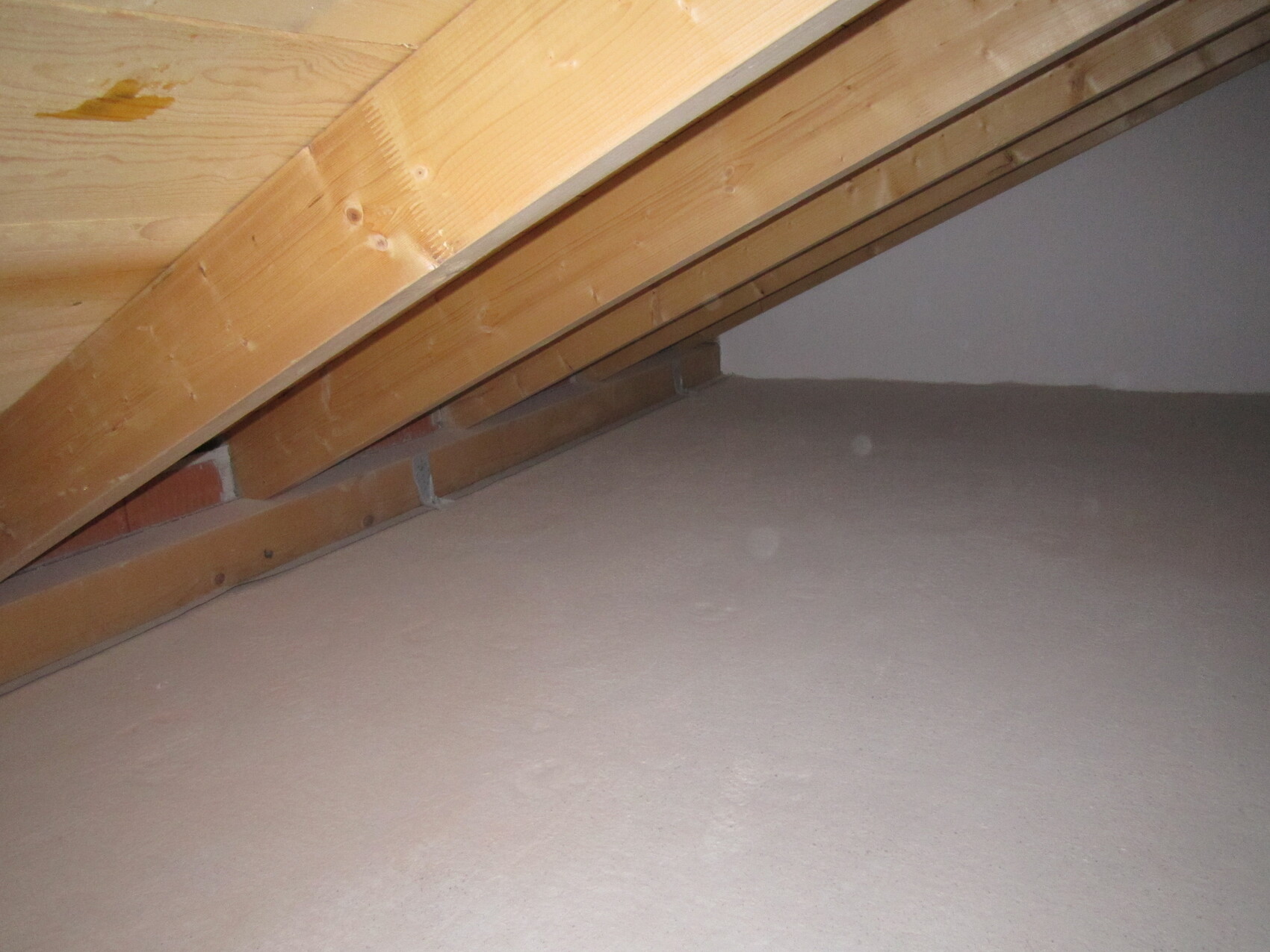
Sebastian B.1 Nov 2018 23:15Picture of the roof frame and upper floor ceiling
If you omit the vapor retarder and lay the boards loosely, you minimize the risk of building damage and save yourself the work. The vapor retarder is unnecessary.
To insulate cavities on the cold side of a building component, any insulation material can be used, the more vapor-permeable the better.
On the outside (i.e., on the EPS insulation), no vapor-tight layer should be installed (such as OSB and similar).
To insulate cavities on the cold side of a building component, any insulation material can be used, the more vapor-permeable the better.
On the outside (i.e., on the EPS insulation), no vapor-tight layer should be installed (such as OSB and similar).
S
Sebastian B.6 Nov 2018 22:08Hello Jumi1, thanks for the message.
I also think that I can lay the EPS rigid foam boards directly on the raw concrete ceiling without a vapor barrier. At least without a foil, it is ensured that moisture (wherever it might come from) can escape through the underlay membrane or the ventilation openings at the eaves.
Is it possible to place an EPS rigid foam board directly on the sole plate, or should a different, more vapor-permeable material be used here?
Best regards and thanks again for your response.
I also think that I can lay the EPS rigid foam boards directly on the raw concrete ceiling without a vapor barrier. At least without a foil, it is ensured that moisture (wherever it might come from) can escape through the underlay membrane or the ventilation openings at the eaves.
Is it possible to place an EPS rigid foam board directly on the sole plate, or should a different, more vapor-permeable material be used here?
Best regards and thanks again for your response.
Sebastian B. schrieb:
Is it possible to lay an EPS rigid foam board directly on the purlin, or should a different material be used here that is more vapor permeable?Regarding vapor permeability, I wouldn’t worry too much in this case, but EPS boards are too rigid for the purlin and its unevenness, as well as for the installation situation between the rafters. It’s better to use a layer of flexible insulation mats here. Whether you choose glass wool, rock wool, jute, or wood fiber depends on your preference; otherwise, they all work about the same.
Does the insulation on the ceiling need to be walkable? EPS boards are not. If so, you would have to add a load distribution layer on top, for example, chipboard panels. Unbonded EPS boards tend to be slippery and gaps easily form. If you use EPS, it’s best to choose ones with tongue and groove edges.
If it doesn’t need to be walkable, I would lay mineral wool mats (or natural materials as mentioned above) in two layers instead of EPS. For areas that are occasionally walked on or used for storage, wood fiber boards with a compressed surface are suitable, as you don’t need an additional load distribution layer and they don’t slip as easily as EPS.
Similar topics