
ᐅ Attic insulation due to controlled mechanical ventilation. Is there enough air exchange?
Created on: 27 Jul 2019 18:49
P
Platzhirsch85P
Platzhirsch8527 Jul 2019 18:49Hello everyone,
We are currently building a single-family house with a general contractor. The drywall installer has just finished the attic ceiling and insulating the loft (a controlled residential ventilation system will be installed in the loft; gable roof; each gable side has a small window in the loft area; exterior walls made of Poroton clay blocks, insulation plus brick veneer).
Execution details:
- Attic: Ceilings and sloped walls will be covered with gypsum boards. Between the roof covering and the interior cladding, a 220mm (8.7 inches) thick insulation layer (thermal conductivity rating WLG 032) with an additional vapor retarder is installed. The loft floor is covered with tongue-and-groove boards.
- Roof: a vapor-permeable breathable underlay membrane, counter battens, and battens. The underlay membrane features an adhesive edge strip and is sealed accordingly. A UV-resistant drip edge strip is installed at the junction with the gutter. The eaves sides are fitted with an eaves ventilation comb. The gable entrance roof covering is mounted on a weatherproof substructure.
- Loft: insulation with mineral wool (thickness 35mm (1.4 inches)), battens with an additional vapor retarder.
Now my concerns:
The entire loft has the same vapor retarder installed below the insulation as used in the upper floor ceiling. The situation: cold winter. The membrane temperature is lower than the dew point of the warm air in the upper floor. I open the hatch to the loft. The warm, moist air from the upper floor flows into the loft and condenses on the membrane. According to the drywall installer, is the air exchange between the loft and the outside air sufficient to dry out the loft? The membrane was not sealed, and the Poroton exterior wall is not plastered on the inside. According to the drywall installer, this allows enough air flow. Should the loft windows also be kept tilted open in winter for ventilation?
What is your opinion? Is this a common construction method?
I look forward to your answers!
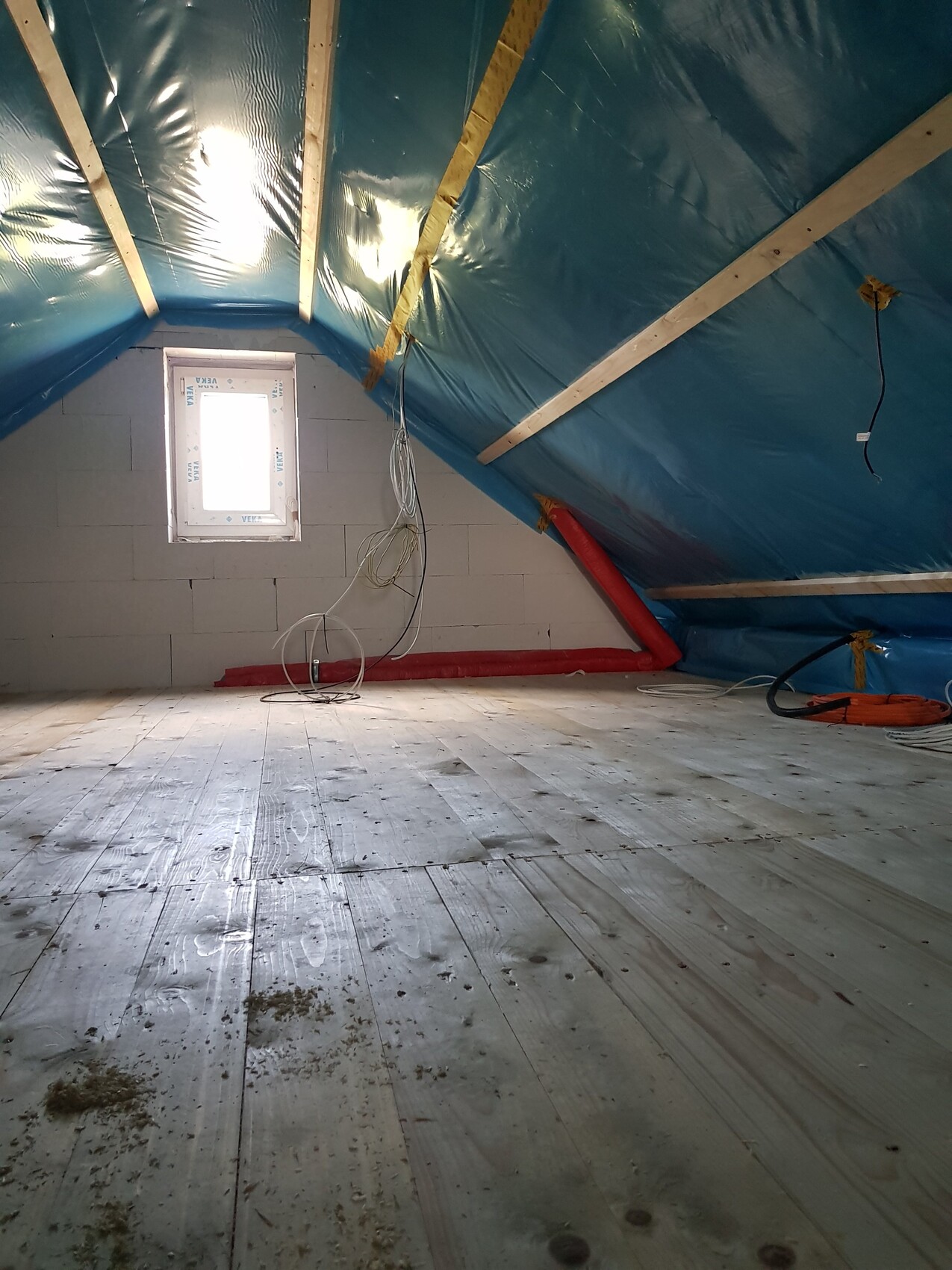
We are currently building a single-family house with a general contractor. The drywall installer has just finished the attic ceiling and insulating the loft (a controlled residential ventilation system will be installed in the loft; gable roof; each gable side has a small window in the loft area; exterior walls made of Poroton clay blocks, insulation plus brick veneer).
Execution details:
- Attic: Ceilings and sloped walls will be covered with gypsum boards. Between the roof covering and the interior cladding, a 220mm (8.7 inches) thick insulation layer (thermal conductivity rating WLG 032) with an additional vapor retarder is installed. The loft floor is covered with tongue-and-groove boards.
- Roof: a vapor-permeable breathable underlay membrane, counter battens, and battens. The underlay membrane features an adhesive edge strip and is sealed accordingly. A UV-resistant drip edge strip is installed at the junction with the gutter. The eaves sides are fitted with an eaves ventilation comb. The gable entrance roof covering is mounted on a weatherproof substructure.
- Loft: insulation with mineral wool (thickness 35mm (1.4 inches)), battens with an additional vapor retarder.
Now my concerns:
The entire loft has the same vapor retarder installed below the insulation as used in the upper floor ceiling. The situation: cold winter. The membrane temperature is lower than the dew point of the warm air in the upper floor. I open the hatch to the loft. The warm, moist air from the upper floor flows into the loft and condenses on the membrane. According to the drywall installer, is the air exchange between the loft and the outside air sufficient to dry out the loft? The membrane was not sealed, and the Poroton exterior wall is not plastered on the inside. According to the drywall installer, this allows enough air flow. Should the loft windows also be kept tilted open in winter for ventilation?
What is your opinion? Is this a common construction method?
I look forward to your answers!
Who came up with this? It couldn’t be more wrong...
Concentrating gaps like this can only lead to building damage.
Seal the vapor barrier and plaster the walls.
It shouldn’t get too cold up there; if necessary, ventilate occasionally or install a controlled mechanical ventilation system right away.
Concentrating gaps like this can only lead to building damage.
Seal the vapor barrier and plaster the walls.
It shouldn’t get too cold up there; if necessary, ventilate occasionally or install a controlled mechanical ventilation system right away.
P
Platzhirsch8527 Jul 2019 19:301) So, are my concerns as described correct?
2) If the vapor barrier is glued and the exterior wall is plastered, the air exchange with the outside air will be significantly reduced. How will the moisture that enters through a brief window opening in the upper floor then be transported out?
3) Could partial removal of the vapor barrier be a useful solution?
2) If the vapor barrier is glued and the exterior wall is plastered, the air exchange with the outside air will be significantly reduced. How will the moisture that enters through a brief window opening in the upper floor then be transported out?
3) Could partial removal of the vapor barrier be a useful solution?
No liters will accumulate here...
If everything is done properly, any moisture will be evenly released to the outside. Let's assume the membrane acts as a vapor retarder and not a vapor barrier.
Moisture does not originate here.
Set up moisture meters and ventilate occasionally.
If everything is done properly, any moisture will be evenly released to the outside. Let's assume the membrane acts as a vapor retarder and not a vapor barrier.
Moisture does not originate here.
Set up moisture meters and ventilate occasionally.
Similar topics