
Happy New Year!
My concern: I want to convert a workshop into a residential building. The roof is made of free-spanning steel trusses and is currently covered with asbestos corrugated sheets from the former East Germany and insulated underneath the trusses with unhealthy slag wool.
I would like to discuss my ideas with you:
I personally like the trusses themselves (14 trusses span 14 x 8 meters (46 x 26 feet) free-spanning) and would like to make them visible.
So a conversion to a warm roof.
I do not want to use plastics or mineral wool products to keep conscience, ecology, and indoor air quality good.
The construction should still be as simple, inexpensive, and sensible as possible, and I intend to do as much of the work myself as possible.
The roof has an eave height of 3.5 meters (11.5 feet) and a 15-degree slope, so it is not very dangerous to work on.
I imagine the following roof build-up:
OSB 3/4 directly on the steel trusses as bracing and vapor retarder.
Rigid wood fiber insulation board 10 to 16 cm (4 to 6 inches) (Steico Therm?)
Waterproof membrane or underlay board.
Counter battens
Standing seam metal roofing.
Do you agree with these considerations?
Are there simpler or cheaper alternatives?
Thanks for your feedback,
Wolfgang
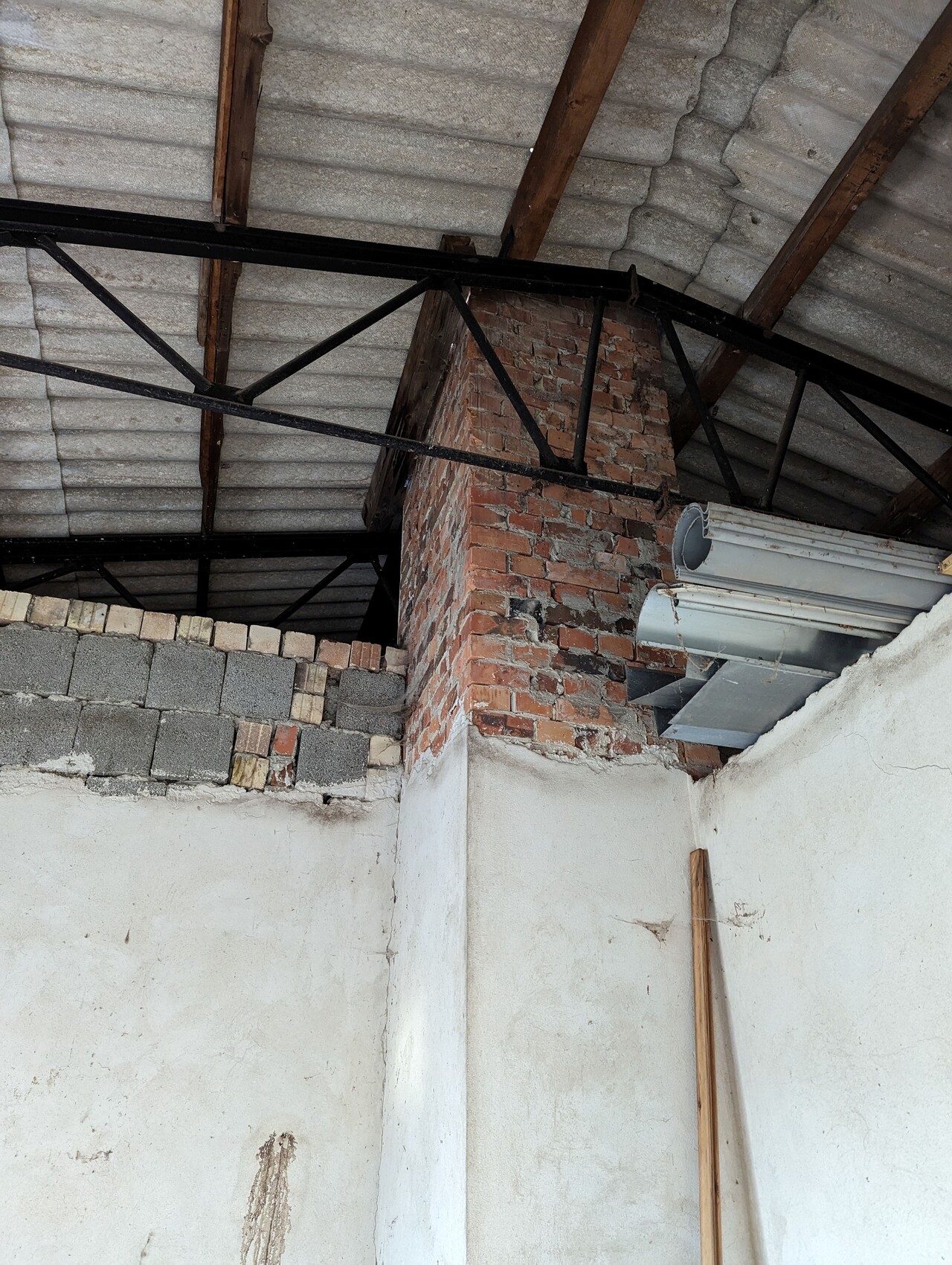
My concern: I want to convert a workshop into a residential building. The roof is made of free-spanning steel trusses and is currently covered with asbestos corrugated sheets from the former East Germany and insulated underneath the trusses with unhealthy slag wool.
I would like to discuss my ideas with you:
I personally like the trusses themselves (14 trusses span 14 x 8 meters (46 x 26 feet) free-spanning) and would like to make them visible.
So a conversion to a warm roof.
I do not want to use plastics or mineral wool products to keep conscience, ecology, and indoor air quality good.
The construction should still be as simple, inexpensive, and sensible as possible, and I intend to do as much of the work myself as possible.
The roof has an eave height of 3.5 meters (11.5 feet) and a 15-degree slope, so it is not very dangerous to work on.
I imagine the following roof build-up:
OSB 3/4 directly on the steel trusses as bracing and vapor retarder.
Rigid wood fiber insulation board 10 to 16 cm (4 to 6 inches) (Steico Therm?)
Waterproof membrane or underlay board.
Counter battens
Standing seam metal roofing.
Do you agree with these considerations?
Are there simpler or cheaper alternatives?
Thanks for your feedback,
Wolfgang
Addendum:
I had forgotten that a conversion from workshop to residential use is planned.
Therefore, the requirements for residential buildings apply instead of the limit values for non-residential buildings (NRB) – but in principle, this does not change anything.
The crucial factor is whether the workshop was heated before or not.
I had forgotten that a conversion from workshop to residential use is planned.
Therefore, the requirements for residential buildings apply instead of the limit values for non-residential buildings (NRB) – but in principle, this does not change anything.
The crucial factor is whether the workshop was heated before or not.
M
Messerjoe16 Jan 2024 23:32dertill schrieb:
The crucial factor is whether the workshop was heated beforehand or not. First of all, thanks for the helpful advice.
Yes, it is a metal workshop with an oil heater and an office room.
It is even insulated, unfortunately with this unhealthy slag wool, which I will remove.
I have now come to terms with a proper complete renovation.
I will add 16cm (6 inches) of wood fiber insulation to the roof and 12–16cm (5–6 inches) to the walls, each ventilated behind, with a metal roof and a wooden facade on top.
This should allow me to achieve a U-value of ≤0.24 for the existing building.
I have contacted a structural engineer to verify the load-bearing capacity of the roof trusses (or not, *shivers*).
Below, I have drawn the detail of the roof construction for both the existing state and the renovation:
Best regards,
Wolfgang
PS:
dertill schrieb:
The expert will also tell you what you ARE ALLOWED to do before you decide what you want. How is the expert supposed to know what to advise against if I haven’t thought it through beforehand?
Messerjoe schrieb:
How is the expert supposed to know what to advise me against if I haven’t thought it through beforehand?Either they or someone else will tell you that converting commercial spaces into residential ones generally requires a building permit (planning permission). Along with that, if you are renovating, you will need to comply with U-values (thermal insulation standards). So it’s best to first check with the local building authority to find out what they require, and then someone will need to provide proof of thermal compliance.Similar topics