
ᐅ Insulation Between Rafters in Older Buildings: Material Selection, Vapor Retarder, and Ventilation
Created on: 29 Dec 2025 13:35
B
BertlarHello,
I want to insulate part of the roof with cavity insulation between the rafters and have a few questions regarding the choice of materials and execution, as well as whether this approach would be feasible.
The house is almost 100 years old. However, the roof was already insulated with cavity insulation between the rafters about 40 years ago (I’m not exactly sure). The insulation used is fiberglass with an aluminum foil facing. The insulation is about 10 cm (4 inches) thick. On top of the boarding, there is a sanded bitumen membrane, so it is "sealed."
The roof covers a living area with a sloping ceiling on the lower part and an unheated, unoccupied attic space above, which is also insulated and internally covered with tongue-and-groove boards.
The ceiling of the upper floor is insulated as well, but I do not know the exact type of insulation used there. Presumably, it is also fiberglass since you can see it through a small opening.
In one part of the attic (about one fifth of one roof side, 4 rafter bays), the insulation had to be removed a few years ago, and I now want to reinstall insulation there.
In my opinion, the roof is not properly ventilated. Ventilation holes were retrofitted along the ridge, but there are no ventilation openings at the eaves.
I want to insulate the 4 rafter bays again now with cavity insulation as well as possible under the circumstances. I also need to consider insulating the entire roof in a few years, but for now, I’m not planning to do that.
Previously, I planned to use ISOVER Integra ZKF 1-034 for insulation and possibly use a vapor retarder like ISOVER Vario XtraSafe.
In another forum, where I have already asked for advice (I believe posting links is not allowed here, otherwise I would share it), I was advised against using fiberglass insulation. I’m now leaning towards wood fiber boards being a more sensible option.
I was also advised in my case to possibly do without a vapor retarder.
Another issue is that insulation remains in place in the lower part of the rafters. This means there would be different insulation materials in the attic compared to the lower area. However, since the lower area is finished living space, it would be difficult to access the insulation from the outside.
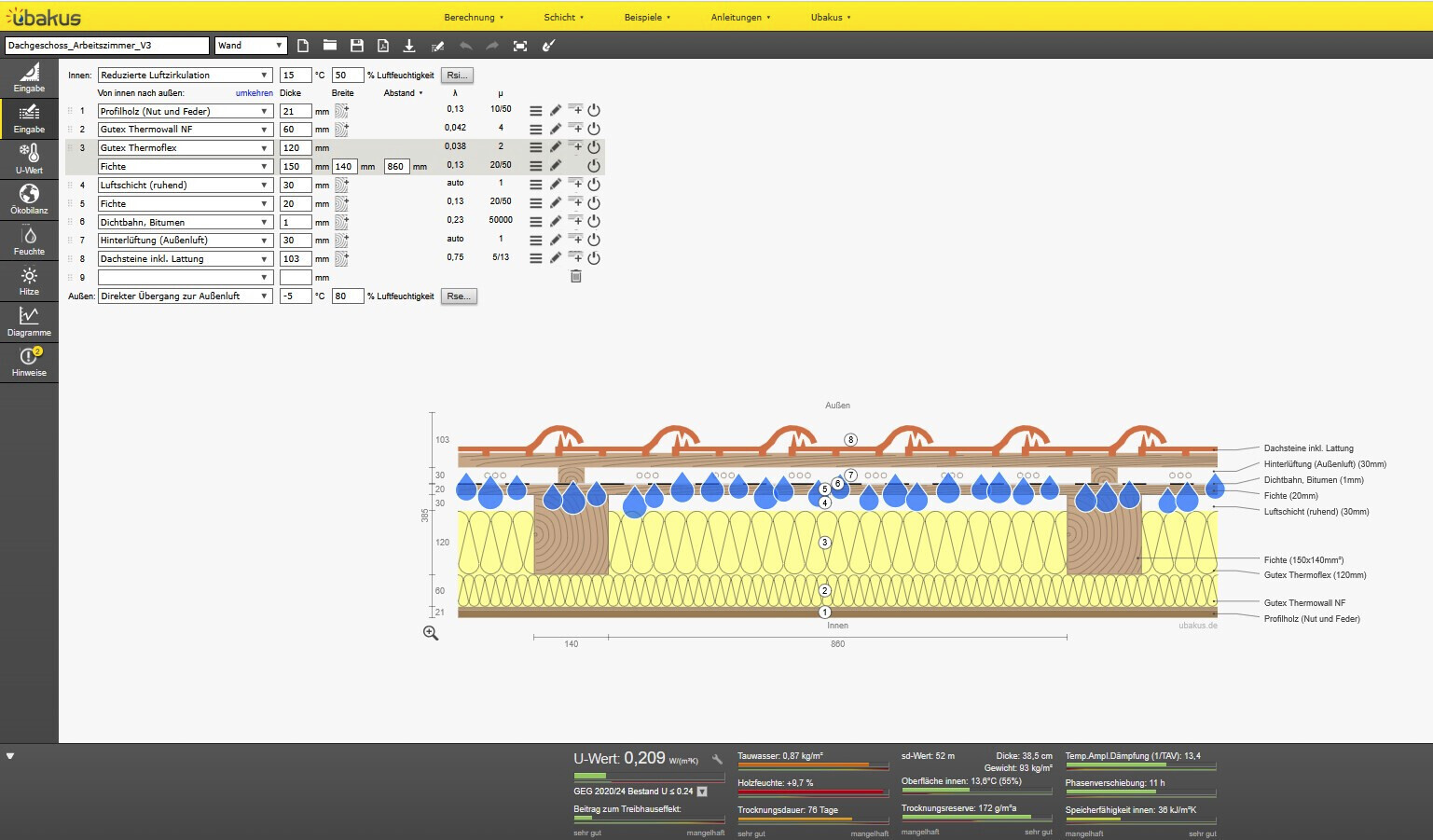
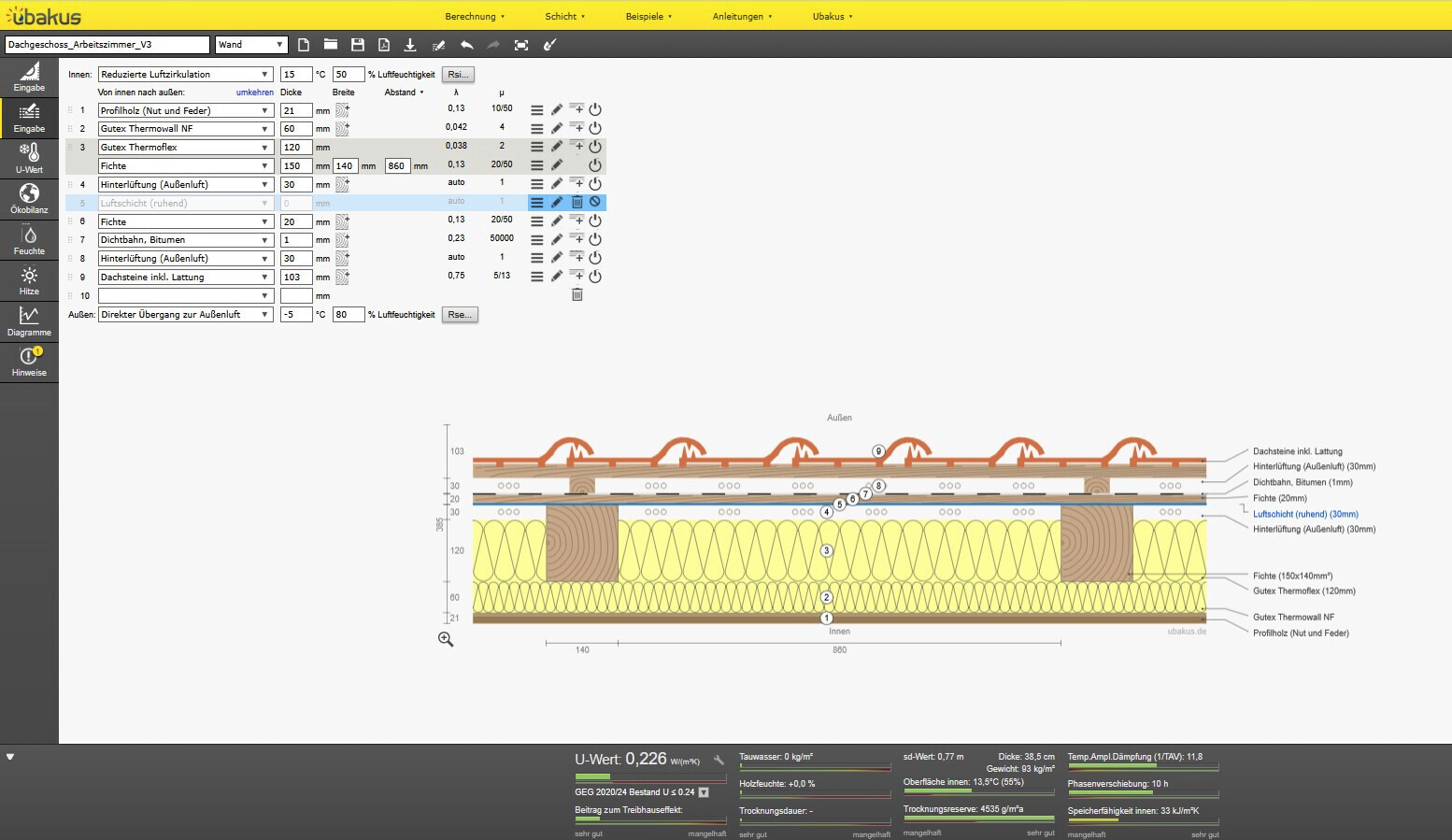
Here is a calculation using Ubakus and how the roof structure is currently planned, once without and once with ventilation:
Without ventilation:
With ventilation:
Could I proceed this way?
Would it work without ventilation? From the image, it seems not.
I would try to achieve ventilation and would consult a carpenter about this.
Thank you very much and best regards,
Bertlar
I want to insulate part of the roof with cavity insulation between the rafters and have a few questions regarding the choice of materials and execution, as well as whether this approach would be feasible.
The house is almost 100 years old. However, the roof was already insulated with cavity insulation between the rafters about 40 years ago (I’m not exactly sure). The insulation used is fiberglass with an aluminum foil facing. The insulation is about 10 cm (4 inches) thick. On top of the boarding, there is a sanded bitumen membrane, so it is "sealed."
The roof covers a living area with a sloping ceiling on the lower part and an unheated, unoccupied attic space above, which is also insulated and internally covered with tongue-and-groove boards.
The ceiling of the upper floor is insulated as well, but I do not know the exact type of insulation used there. Presumably, it is also fiberglass since you can see it through a small opening.
In one part of the attic (about one fifth of one roof side, 4 rafter bays), the insulation had to be removed a few years ago, and I now want to reinstall insulation there.
In my opinion, the roof is not properly ventilated. Ventilation holes were retrofitted along the ridge, but there are no ventilation openings at the eaves.
I want to insulate the 4 rafter bays again now with cavity insulation as well as possible under the circumstances. I also need to consider insulating the entire roof in a few years, but for now, I’m not planning to do that.
Previously, I planned to use ISOVER Integra ZKF 1-034 for insulation and possibly use a vapor retarder like ISOVER Vario XtraSafe.
In another forum, where I have already asked for advice (I believe posting links is not allowed here, otherwise I would share it), I was advised against using fiberglass insulation. I’m now leaning towards wood fiber boards being a more sensible option.
I was also advised in my case to possibly do without a vapor retarder.
Another issue is that insulation remains in place in the lower part of the rafters. This means there would be different insulation materials in the attic compared to the lower area. However, since the lower area is finished living space, it would be difficult to access the insulation from the outside.
Here is a calculation using Ubakus and how the roof structure is currently planned, once without and once with ventilation:
Without ventilation:
With ventilation:
Could I proceed this way?
Would it work without ventilation? From the image, it seems not.
I would try to achieve ventilation and would consult a carpenter about this.
Thank you very much and best regards,
Bertlar
Similar topics