
ᐅ Insulating Older Homes: External or Internal Insulation? Solutions for High Energy Consumption
Created on: 21 Nov 2025 21:02
M
mralladinM
mralladin21 Nov 2025 21:02Hi,
We bought this house at the beginning of the year without any heating data and have now realized that it currently uses a lot of heating energy. Early next year, underfloor heating with insulation is planned, as the floor on the ground level is extremely cold and the heat pump we had installed is currently consuming a lot of energy. However, the house also has a very worn-out facade, and I have been considering adding external wall insulation here. At first, I wanted to do interior insulation everywhere, but that would mean removing the new drywall again, which seems pointless, especially since the exterior facade needs to be renovated anyway.
On the left side of the house, there is a vacant building that is not heated. How could I insulate there? Inside, it only has four drywall walls that I would need to redo. Would it be better to use drywall again with aluminum vapor barrier foil and a vapor retarder, or just add mineral porous blocks in front of the existing old wall?
On the right side of the house, there is a barn that I basically need to tear down first due to the old roof. An energy consultant mentioned that I could theoretically use the KfW85 loan for the demolition as well, if I present the facade renovation as the main reason (which I will do anyway).
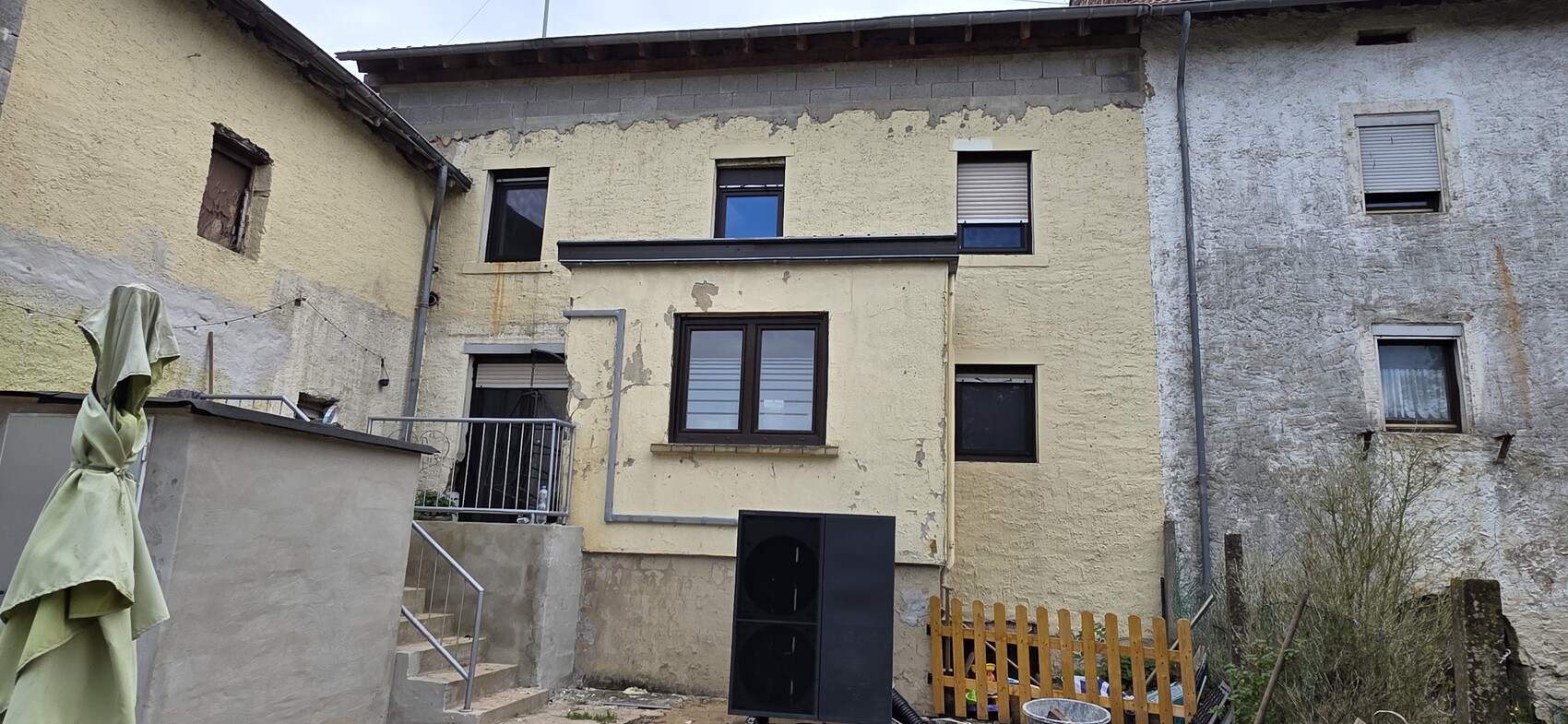
We bought this house at the beginning of the year without any heating data and have now realized that it currently uses a lot of heating energy. Early next year, underfloor heating with insulation is planned, as the floor on the ground level is extremely cold and the heat pump we had installed is currently consuming a lot of energy. However, the house also has a very worn-out facade, and I have been considering adding external wall insulation here. At first, I wanted to do interior insulation everywhere, but that would mean removing the new drywall again, which seems pointless, especially since the exterior facade needs to be renovated anyway.
On the left side of the house, there is a vacant building that is not heated. How could I insulate there? Inside, it only has four drywall walls that I would need to redo. Would it be better to use drywall again with aluminum vapor barrier foil and a vapor retarder, or just add mineral porous blocks in front of the existing old wall?
On the right side of the house, there is a barn that I basically need to tear down first due to the old roof. An energy consultant mentioned that I could theoretically use the KfW85 loan for the demolition as well, if I present the facade renovation as the main reason (which I will do anyway).
Hi alladin,
Sorry for the late reply to your question. Honestly, given the condition of the facade, I’m not surprised that the heat pump is currently working so hard. So before you consider any complex interior insulation solutions, insulating from the outside is essential. Everything else is only a second-best option in an older building like this, as otherwise you risk creating thermal bridges and moisture problems.
The wall adjacent to the unheated neighboring building is not unusual in terms of building physics. You should treat it like any other exterior wall: apply an external insulation system, preferably 14 to 16 cm EPS (5.5 to 6.3 inches) or mineral wool, depending on your budget and preference for resistance to algae growth. Just because you are installing new drywall (gypsum board) on the inside doesn’t mean you necessarily need a vapor barrier. Why install a vapor retarder if the wall is going to be renovated with a vapor-open system on the outside? That would actually be counterproductive.
Regarding KfW85, yes, demolition costs can be partially included if they are essential for the energy efficiency measure...
Sorry for the late reply to your question. Honestly, given the condition of the facade, I’m not surprised that the heat pump is currently working so hard. So before you consider any complex interior insulation solutions, insulating from the outside is essential. Everything else is only a second-best option in an older building like this, as otherwise you risk creating thermal bridges and moisture problems.
The wall adjacent to the unheated neighboring building is not unusual in terms of building physics. You should treat it like any other exterior wall: apply an external insulation system, preferably 14 to 16 cm EPS (5.5 to 6.3 inches) or mineral wool, depending on your budget and preference for resistance to algae growth. Just because you are installing new drywall (gypsum board) on the inside doesn’t mean you necessarily need a vapor barrier. Why install a vapor retarder if the wall is going to be renovated with a vapor-open system on the outside? That would actually be counterproductive.
Regarding KfW85, yes, demolition costs can be partially included if they are essential for the energy efficiency measure...
Demolition just because of the roof? Or is it going to be replaced anyway?
If you have the budget and it concerns the facade: yes, external insulation.
The floor insulation should also be appropriate when installing underfloor heating to minimize heat loss downward.
For the side of the house that is unheated, you can consider internal insulation combined with wall heating during the same renovation.
Don’t forget the top floor ceiling and the roof. Also, remember thermal bridges around windows, shutters, etc.
If you have the budget and it concerns the facade: yes, external insulation.
The floor insulation should also be appropriate when installing underfloor heating to minimize heat loss downward.
For the side of the house that is unheated, you can consider internal insulation combined with wall heating during the same renovation.
Don’t forget the top floor ceiling and the roof. Also, remember thermal bridges around windows, shutters, etc.
M
mralladin24 Nov 2025 07:08Joedreck schrieb:
A demolition just because of the roof? Or is it going to be removed anyway?
If you have the money and for the facade: yes, insulation on the outside.
The floor insulation should also be appropriate if you install underfloor heating, to minimize heat loss downwards.
For the side of the house that is unheated, you can consider internal insulation combined with wall heating.
Don’t forget the top floor ceiling and the roof. Also remember thermal bridges around windows/shutters, etc. The roof has to be removed anyway because it’s too old and unstable. Money – well, I’ll have to finance it additionally, which is why I’m asking about KfW.
Similar topics