
ᐅ Insulating a Suspended Ceiling? Heat from Ceiling Spotlights?
Created on: 29 Sep 2025 17:24
O
Obereiche
Hello everyone,
the topic of insulation in our timber frame construction is still driving me crazy. After reading everywhere that even at the installation level it is important to avoid any gaps in the insulation, since air could circulate freely there, I made a special effort to prevent this (which was already quite challenging with all the pipes, cables, and ventilation ducts).
Now the electrician has instructed me, for the suspended ceilings, not to fill the full depth of the joists with acoustic insulation (mineral wool boards), but to leave some space so that the heat from the recessed ceiling lights can be dissipated. But wouldn’t this create exactly that kind of gap again? Or does it not matter because the ceiling above is not an exterior wall?
And how about the ridge beam under the attic roof? According to the insulation manufacturers, it is best to install a horizontal insulation layer below the ridge beam (since the ridge is a particularly critical spot), but then I wouldn’t be able to install recessed lights there either.
the topic of insulation in our timber frame construction is still driving me crazy. After reading everywhere that even at the installation level it is important to avoid any gaps in the insulation, since air could circulate freely there, I made a special effort to prevent this (which was already quite challenging with all the pipes, cables, and ventilation ducts).
Now the electrician has instructed me, for the suspended ceilings, not to fill the full depth of the joists with acoustic insulation (mineral wool boards), but to leave some space so that the heat from the recessed ceiling lights can be dissipated. But wouldn’t this create exactly that kind of gap again? Or does it not matter because the ceiling above is not an exterior wall?
And how about the ridge beam under the attic roof? According to the insulation manufacturers, it is best to install a horizontal insulation layer below the ridge beam (since the ridge is a particularly critical spot), but then I wouldn’t be able to install recessed lights there either.

O
Obereiche7 Oct 2025 22:09Same topic, different location:
In the bathroom on the ground floor, a corner toilet with a corresponding pre-wall installation is fitted.
In the angled corner, the wastewater pipe runs to the bathroom on the floor above.
Downwards, the wastewater pipe penetrates the concrete ceiling (of course airtight) into the unheated basement.
I insulated the basement ceiling around the cistern and the drain pipe with a 16cm (6 inch) thick layer of glass wool. All adjacent walls are interior walls.
Online, I keep reading everywhere: "You absolutely must fill the entire space behind the wall from the basement ceiling to the room ceiling with insulation. Otherwise, a cold spot would form there with temperature differences to the warm bathroom, resulting in condensation, etc."
But isn’t this exactly the same issue as with suspended ceilings?
In the bathroom on the ground floor, a corner toilet with a corresponding pre-wall installation is fitted.
In the angled corner, the wastewater pipe runs to the bathroom on the floor above.
Downwards, the wastewater pipe penetrates the concrete ceiling (of course airtight) into the unheated basement.
I insulated the basement ceiling around the cistern and the drain pipe with a 16cm (6 inch) thick layer of glass wool. All adjacent walls are interior walls.
Online, I keep reading everywhere: "You absolutely must fill the entire space behind the wall from the basement ceiling to the room ceiling with insulation. Otherwise, a cold spot would form there with temperature differences to the warm bathroom, resulting in condensation, etc."
But isn’t this exactly the same issue as with suspended ceilings?
N
nordanney7 Oct 2025 23:23Obereiche schrieb:
But isn’t that exactly the same issue as with the suspended ceiling?No. An uninsulated pipe can behave like a bottle of beer you take out of the fridge in summer. Moisture from the air can condense on it. How likely is that? Very low. This problem mostly occurs with rainwater pipes located inside the building. In autumn, those can get very cold when it rains and may become wet.
For such cases, you can choose an insulated pipe for a small additional cost—both to reduce noise and to prevent possible condensation (various manufacturers offer these). Alternatively, you can simply wrap the pipe with insulation (many options available).
O
Obereiche8 Oct 2025 09:20The pipe itself is already insulated. The installer did that directly.
It concerns the cavity in the recessed corner, so to speak, the interior wall in front of the interior wall (which, however, has an exterior side facing the basement).
It concerns the cavity in the recessed corner, so to speak, the interior wall in front of the interior wall (which, however, has an exterior side facing the basement).
N
nordanney8 Oct 2025 10:22Obereiche schrieb:
The pipe itself is already insulated. The installer did that right away.
It’s about the cavity in the recessed corner, so to speak, the interior wall in front of the interior wall (which in the direction of the basement effectively has an exterior side). If you’re worried, then fill it up. Please fill all cavities – including in the living room, kitchen, etc. Otherwise, you will have problems with mold everywhere. •Irony off•
O
Obereiche4 Nov 2025 19:00I have done some more research, and the most sensible approach seems to be removing the insulation again and leaving the basement ceiling exposed behind the stud wall. This increases the likelihood that the basement ceiling will be slightly warmed by the warm room air, preventing condensation from forming in the first place. And if condensation does occur, the moisture will only build up on the basement ceiling, where it won’t cause any damage initially and can eventually diffuse back into the room.
However, the OSB boards in front of the flush-mounted toilet tank are problematic, as they are vapor-tight (although only moderately, since they are not sealed or taped). I need them to attach the drywall to, because the distance from one corner of the wall to the other is too wide for screwing the drywall directly, and I can’t fasten anything to the flush tank itself.
Do you have any other ideas on how I can cover the tank with a vapor-permeable material? And does this even make sense, considering it will be tiled later on (tiles themselves are vapor-tight, but the grout joints are not)?
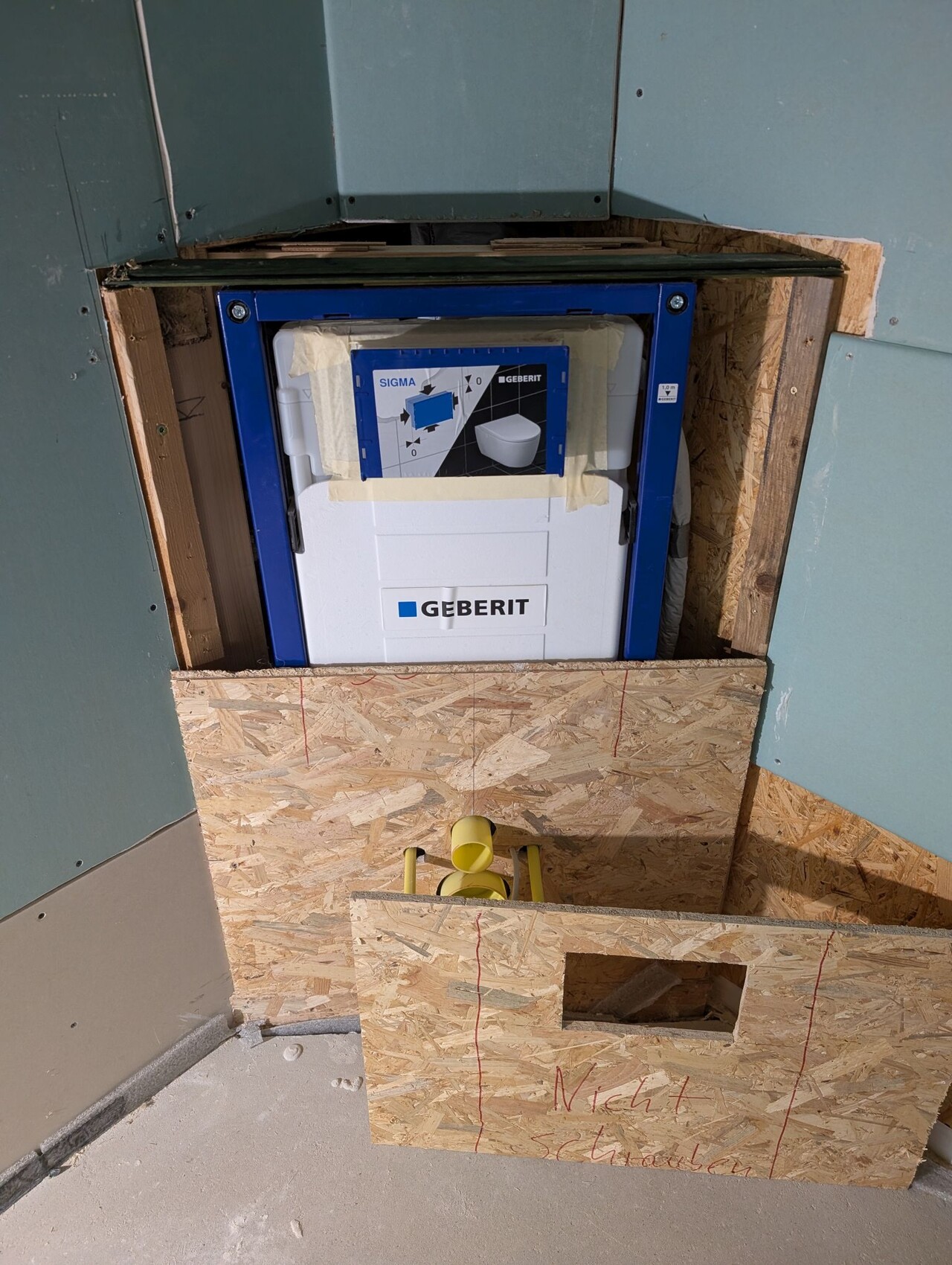
However, the OSB boards in front of the flush-mounted toilet tank are problematic, as they are vapor-tight (although only moderately, since they are not sealed or taped). I need them to attach the drywall to, because the distance from one corner of the wall to the other is too wide for screwing the drywall directly, and I can’t fasten anything to the flush tank itself.
Do you have any other ideas on how I can cover the tank with a vapor-permeable material? And does this even make sense, considering it will be tiled later on (tiles themselves are vapor-tight, but the grout joints are not)?
Similar topics